Page 61 of 219
Using the automatic locking
mode
The automatic locking mode must
be used when installing a child
safety seat in any outboard
passenger seat.
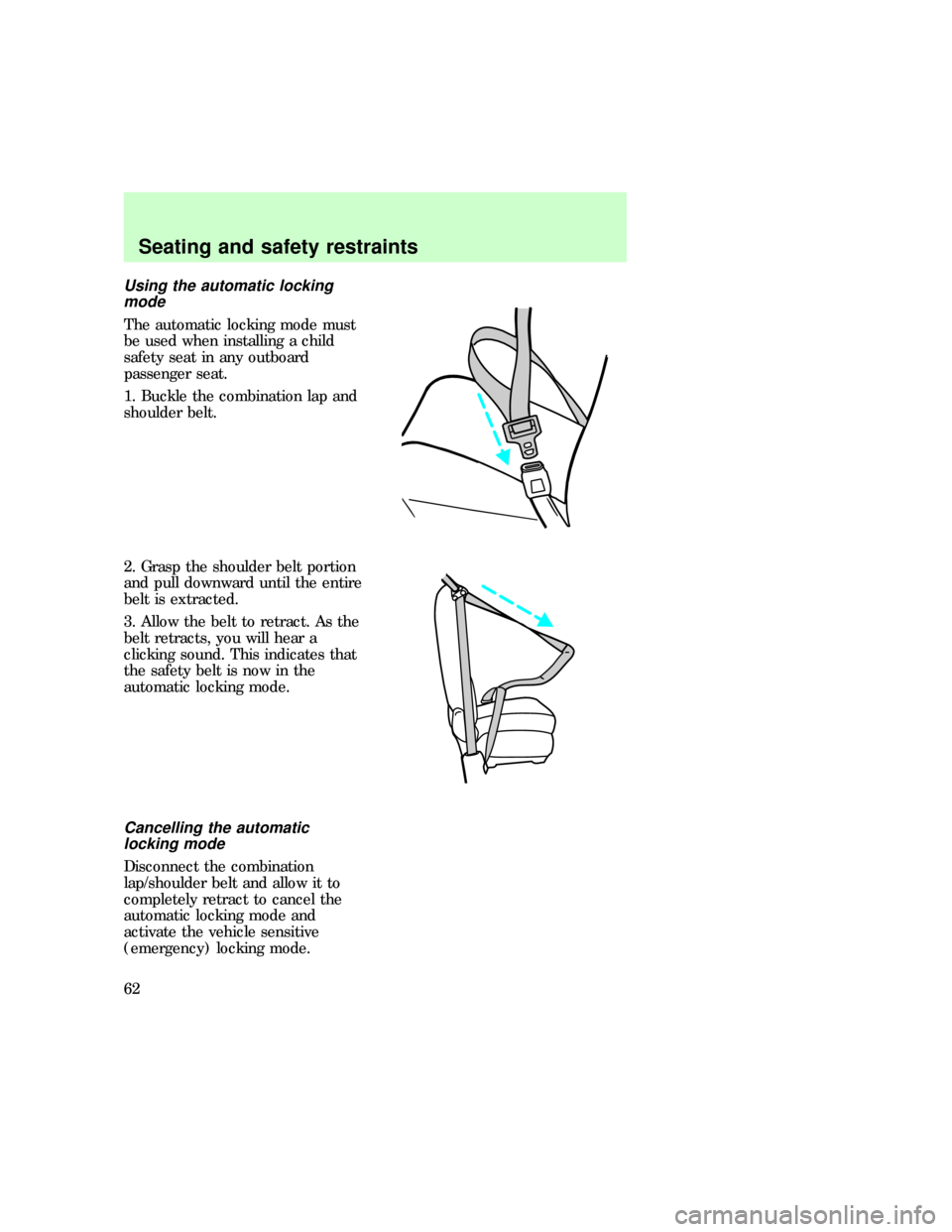
1. Buckle the combination lap and
shoulder belt.
2. Grasp the shoulder belt portion
and pull downward until the entire
belt is extracted.
3. Allow the belt to retract. As the
belt retracts, you will hear a
clicking sound. This indicates that
the safety belt is now in the
automatic locking mode.
Cancelling the automatic
locking mode
Disconnect the combination
lap/shoulder belt and allow it to
completely retract to cancel the
automatic locking mode and
activate the vehicle sensitive
(emergency) locking mode.
f12_cancel_alr
f12_front_sbelt_height_adjust
Seating and safety restraints
62
Page 62 of 219
Front seat safety belt height
adjustment
Your vehicle has safety belt height
adjustments for the driver and
passenger seating positions.
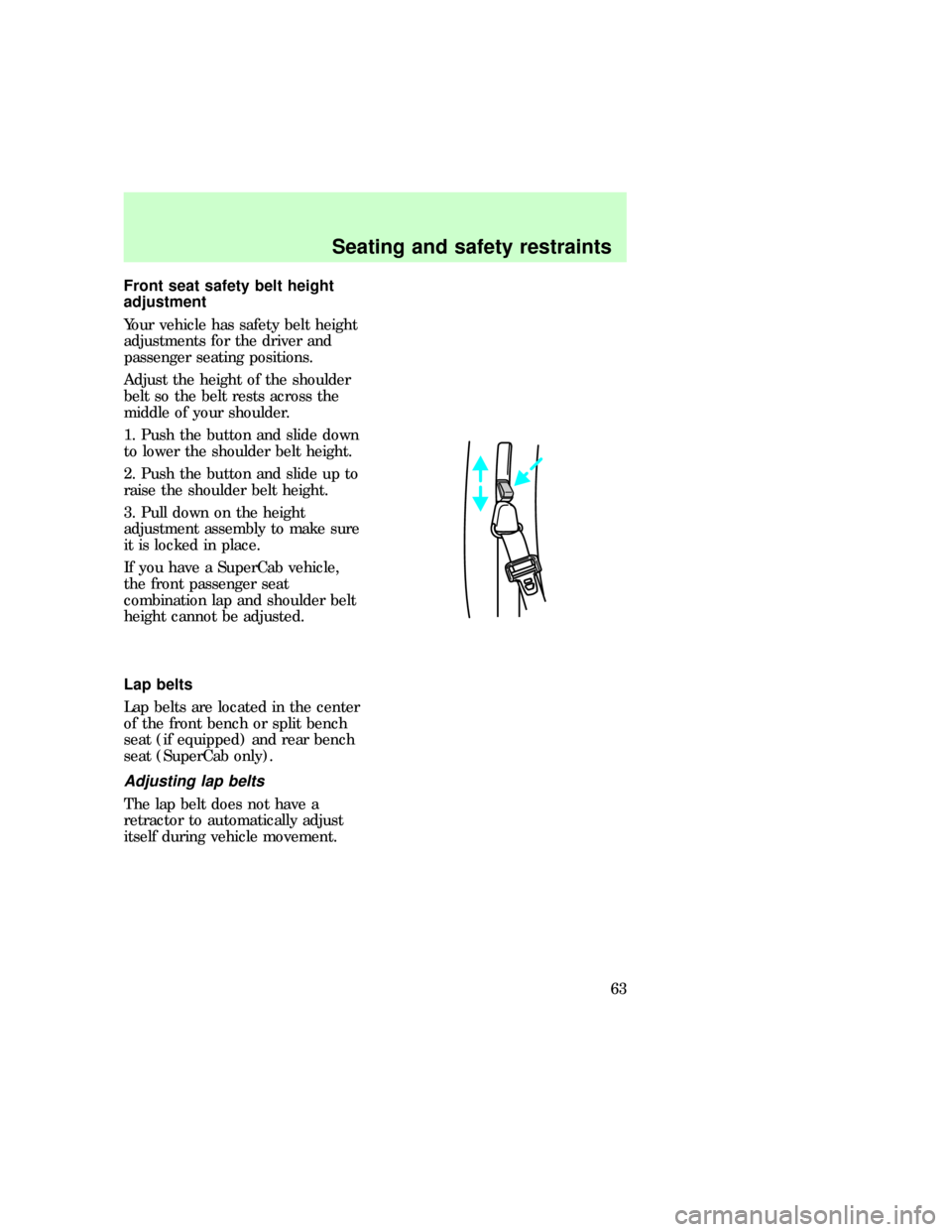
Adjust the height of the shoulder
belt so the belt rests across the
middle of your shoulder.
1. Push the button and slide down
to lower the shoulder belt height.
2. Push the button and slide up to
raise the shoulder belt height.
3. Pull down on the height
adjustment assembly to make sure
it is locked in place.
If you have a SuperCab vehicle,
the front passenger seat
combination lap and shoulder belt
height cannot be adjusted.
Lap belts
Lap belts are located in the center
of the front bench or split bench
seat (if equipped) and rear bench
seat (SuperCab only).
Adjusting lap belts
The lap belt does not have a
retractor to automatically adjust
itself during vehicle movement.
f12_lap_belts
f12_adjusting_lap_belts
Seating and safety restraints
63
Page 76 of 219

Child and infant or child safety
seats
Carefully follow all of the
manufacturer's instructions
included with the safety seat you
put in your vehicle. If you do not
install and use the safety seat
properly, the child may be
injured in a sudden stop or
collision.
Ford recommends the use of a
child safety seat having a top
tether strap. Install the child safety
seat in a seating position which is
capable of providing a tether
anchorage. For more information
on top tether straps seeAttaching
safety seats with tether strapsin
this chapter.
When installing a child safety seat:
²Use the correct safety belt
buckle for that seating position.
²Make sure the tongue is
securely fastened in the buckle.
²Keep the buckle release button
pointing up and away from the
safety seat, with the tongue
between the child seat and the
release button, to prevent
accidental unbuckling.
²Place seatbacks in the upright
position.
²Put the safety belt in the
automatic locking mode. Refer
toUsing the automatic locking
modein this chapter.
f12_installing_seats
Seating and safety restraints
77
Page 79 of 219
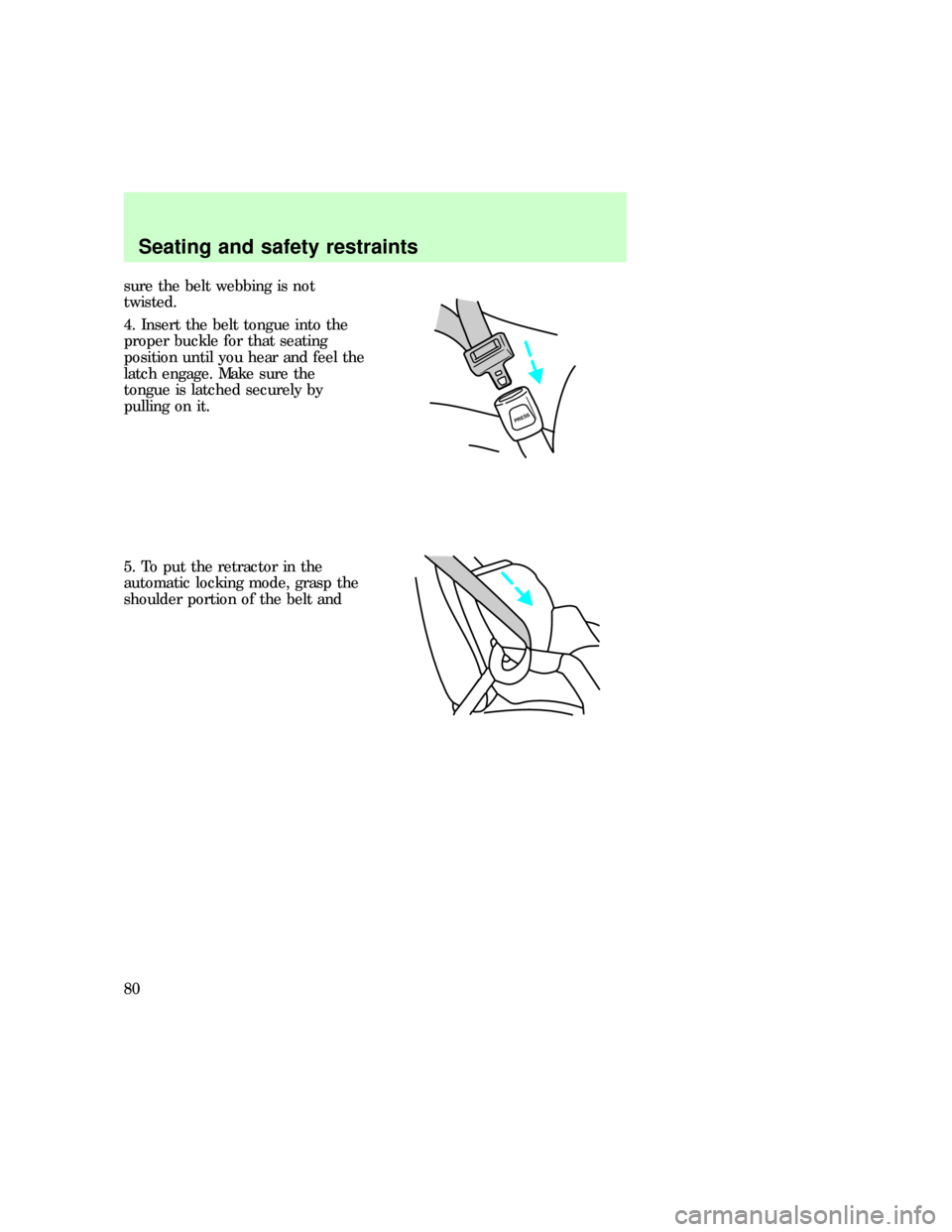
sure the belt webbing is not
twisted.
4. Insert the belt tongue into the
proper buckle for that seating
position until you hear and feel the
latch engage. Make sure the
tongue is latched securely by
pulling on it.
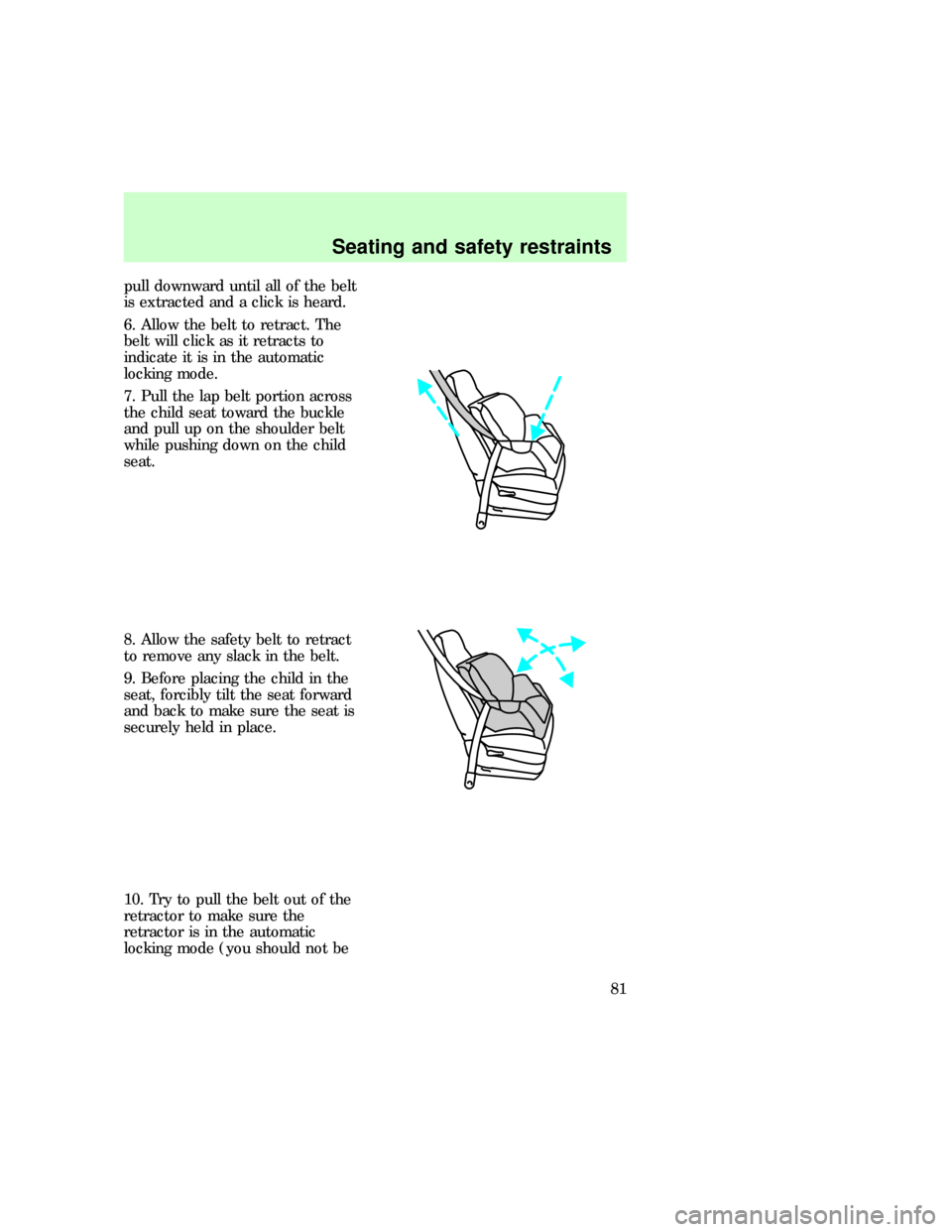
5. To put the retractor in the
automatic locking mode, grasp the
shoulder portion of the belt and
PRESS
Seating and safety restraints
80
Page 80 of 219
pull downward until all of the belt
is extracted and a click is heard.
6. Allow the belt to retract. The
belt will click as it retracts to
indicate it is in the automatic
locking mode.
7. Pull the lap belt portion across
the child seat toward the buckle
and pull up on the shoulder belt
while pushing down on the child
seat.
8. Allow the safety belt to retract
to remove any slack in the belt.
9. Before placing the child in the
seat, forcibly tilt the seat forward
and back to make sure the seat is
securely held in place.
10. Try to pull the belt out of the
retractor to make sure the
retractor is in the automatic
locking mode (you should not be
Seating and safety restraints
81
Page 81 of 219
able to pull more belt out). If the
retractor is not locked, unbuckle
the belt and repeat steps two
through nine.
Check to make sure the child seat is
properly secured before each use.
Using a tether strap
Ford recommends using child
safety seats with a top tether
strap. Contact the manufacturer of
your safety seat for information
about ordering a tether strap if one
is not provided to you. Contact
your Ford dealer for a free tether
strap if one is not provided to you.
Contact your Ford dealer for a free
tether anchor kit (613D74) so you
can attach a tether anchor bracket
to the back of the seat cushion. If
you have a SuperCab, attach the
bracket to the inside of the back
panel of your vehicle. Carefully
follow the instructions provided
with the kit.
If you have a SuperCab, Ford
recommends you attach tether
safety seats in a rear seating
position (if possible) with the
tether strap attached to the tether
anchor bracket as shown in the
instructions provided with the
tether anchor kit.
If the tethered seat is installed in
the front seat, put the tether strap
over the seatback and attach it to
the anchor bracket installed on the
rear edge of the seat cushion as
explained in the tether strap
instructions.
f12_tether_straps
Seating and safety restraints
82
Page 87 of 219
STARTING PROCEDURE
Starting the engine
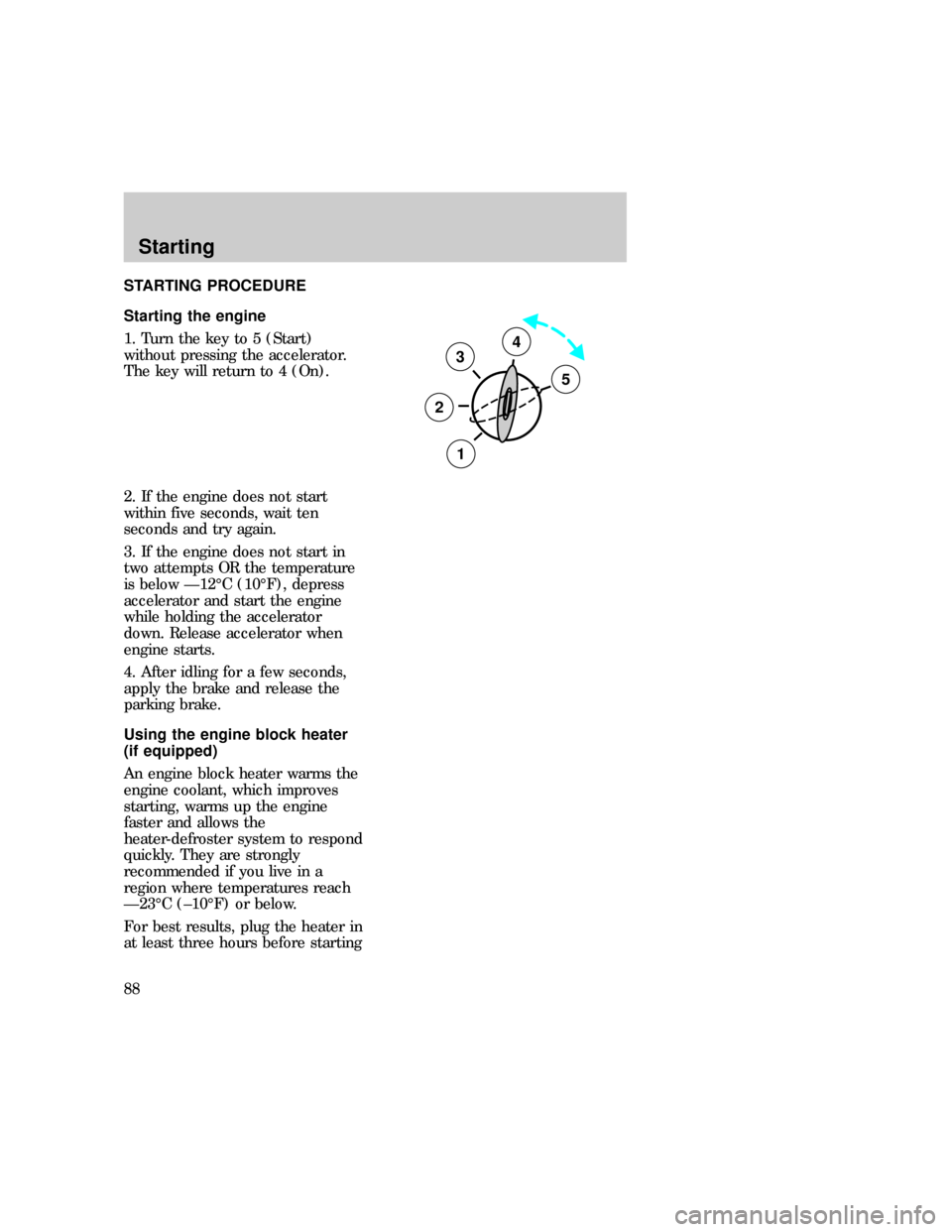
1. Turn the key to 5 (Start)
without pressing the accelerator.
The key will return to 4 (On).
2. If the engine does not start
within five seconds, wait ten
seconds and try again.
3. If the engine does not start in
two attempts OR the temperature
is below Ð12ÉC (10ÉF), depress
accelerator and start the engine
while holding the accelerator
down. Release accelerator when
engine starts.
4. After idling for a few seconds,
apply the brake and release the
parking brake.
Using the engine block heater
(if equipped)
An engine block heater warms the
engine coolant, which improves
starting, warms up the engine
faster and allows the
heater-defroster system to respond
quickly. They are strongly
recommended if you live in a
region where temperatures reach
Ð23ÉC (±10ÉF) or below.
For best results, plug the heater in
at least three hours before starting
3
2
1
5
4
com_starting_vehicle.01
com_engine_heater.01
Starting
88
Page 90 of 219

BRAKES
Rear anti-lock brake system
(ABS) (if equipped)
This system prevents one or both
rear wheels from locking up when
the brakes are applied during a
sudden stop.
Even with rear ABS, the front
brakes may lock up on any surface.
Be careful when braking, especially
on loose snow or gravel.
Anti-lock brake system (ABS) (if
equipped)
The ABS operates by detecting the
onset of wheel lock up during
brake applications and
compensating for this tendency.
The front wheels are prevented
from locking even when the brakes
are firmly applied. The
accompanying illustration depicts
the advantage of an ABS equipped
vehicle (on bottom) to a non-ABS
equipped vehicle (on top) during
hard braking.
Using ABS
²In an emergency, apply full force
on the brake. The ABS will be
activated immediately, thus
allowing you to retain full
steering control of your vehicle
and, providing there is sufficient
space, will enable you to avoid
obstacles and bring the vehicle
to a quiet stop.
²We recommend that you
familiarize yourself with this
f12_rear_abs
com_abs.01
com_using_abs.01
Driving
91