Page 97 of 219
Each time the vehicle is started,
the transmission will automatically
return to normal overdrive mode.
2 (Second)± Use 2 (Second) to
start-up on slippery roads or to
provide additional engine braking
on downgrades. Transmission
operates in first and second gears.
1 (Low)± Use 1 (Low) to provide
maximum engine braking on steep
downgrades. Upshifts can be made
by shifting to 2 (Second) or to
D(Overdrive). Selecting 1 (Low)
at higher speeds causes a shift to 2
(Second), and will shift to 1 (Low)
after vehicle decelerates to the
proper speed.
Brake-shift interlock
The brake-shift interlock feature
prevents you from shifting from P
(Park) unless the brake pedal is
depressed (with the ignition in the
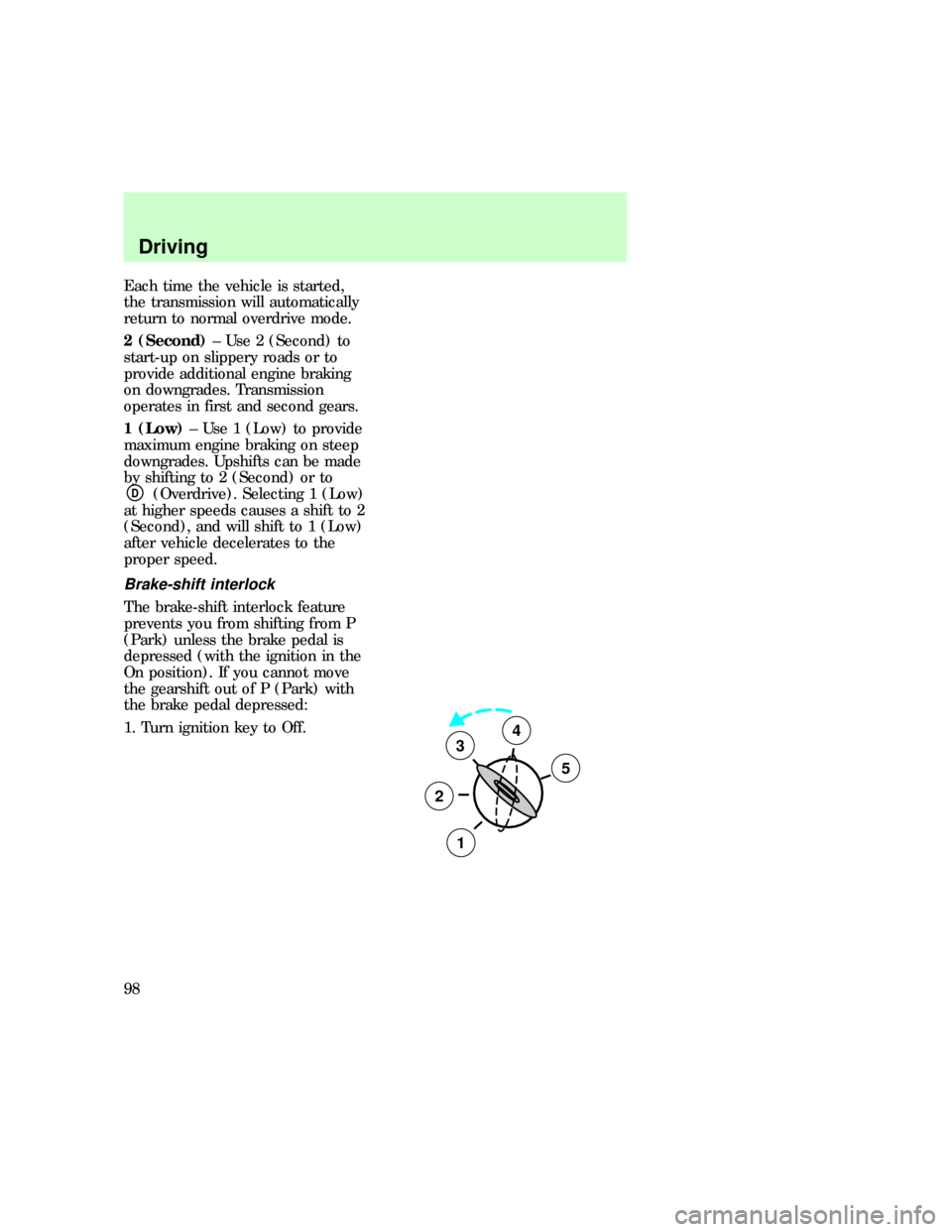
On position). If you cannot move
the gearshift out of P (Park) with
the brake pedal depressed:
1. Turn ignition key to Off.
3
2
1
5
4
f12_brake_shift_interlock
Driving
98
Page 98 of 219
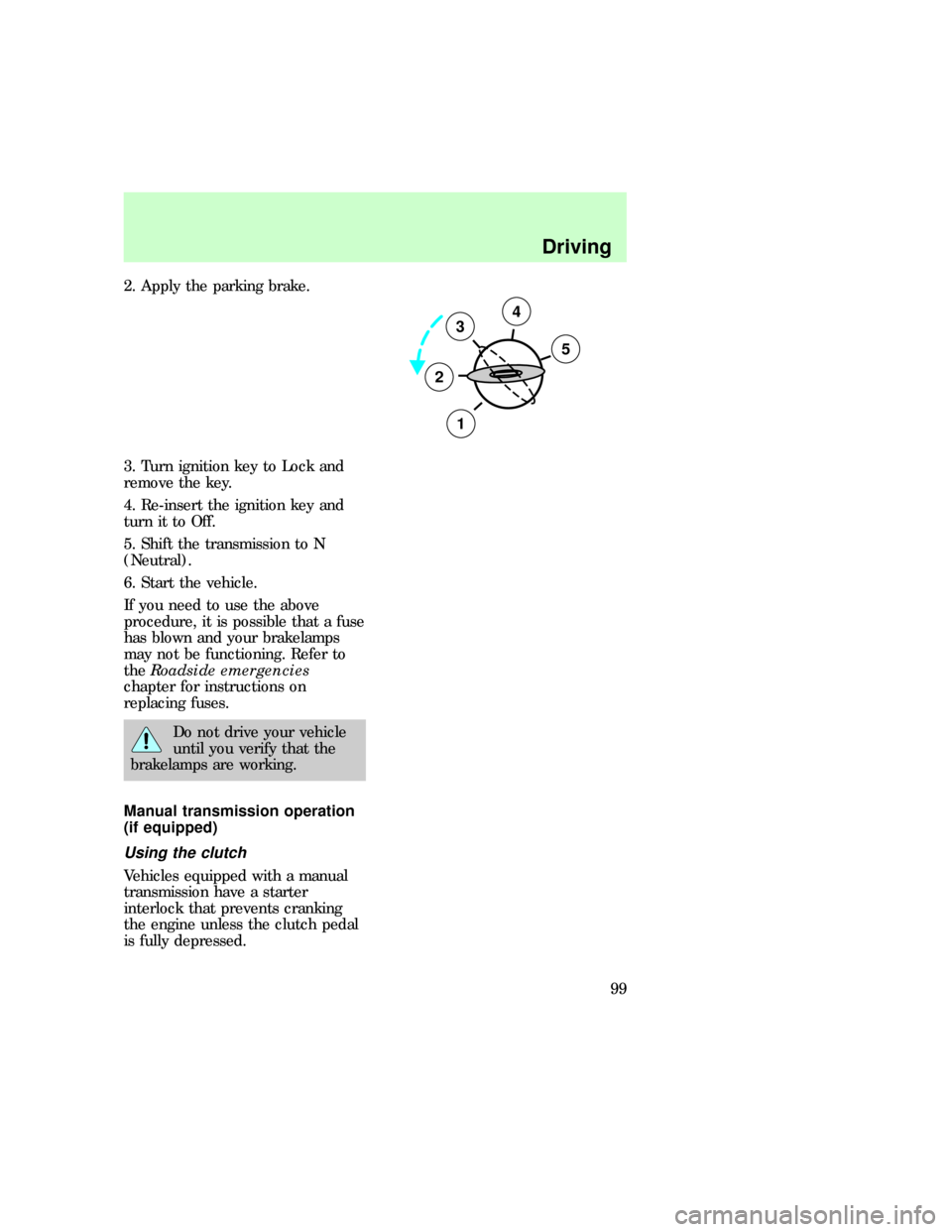
2. Apply the parking brake.
3. Turn ignition key to Lock and
remove the key.
4. Re-insert the ignition key and
turn it to Off.
5. Shift the transmission to N
(Neutral).
6. Start the vehicle.
If you need to use the above
procedure, it is possible that a fuse
has blown and your brakelamps
may not be functioning. Refer to
theRoadside emergencies
chapter for instructions on
replacing fuses.
Do not drive your vehicle
until you verify that the
brakelamps are working.
Manual transmission operation
(if equipped)
Using the clutch
Vehicles equipped with a manual
transmission have a starter
interlock that prevents cranking
the engine unless the clutch pedal
is fully depressed.
3
2
1
5
4
f12_manual
f12_using_clutch
Driving
99
Page 103 of 219
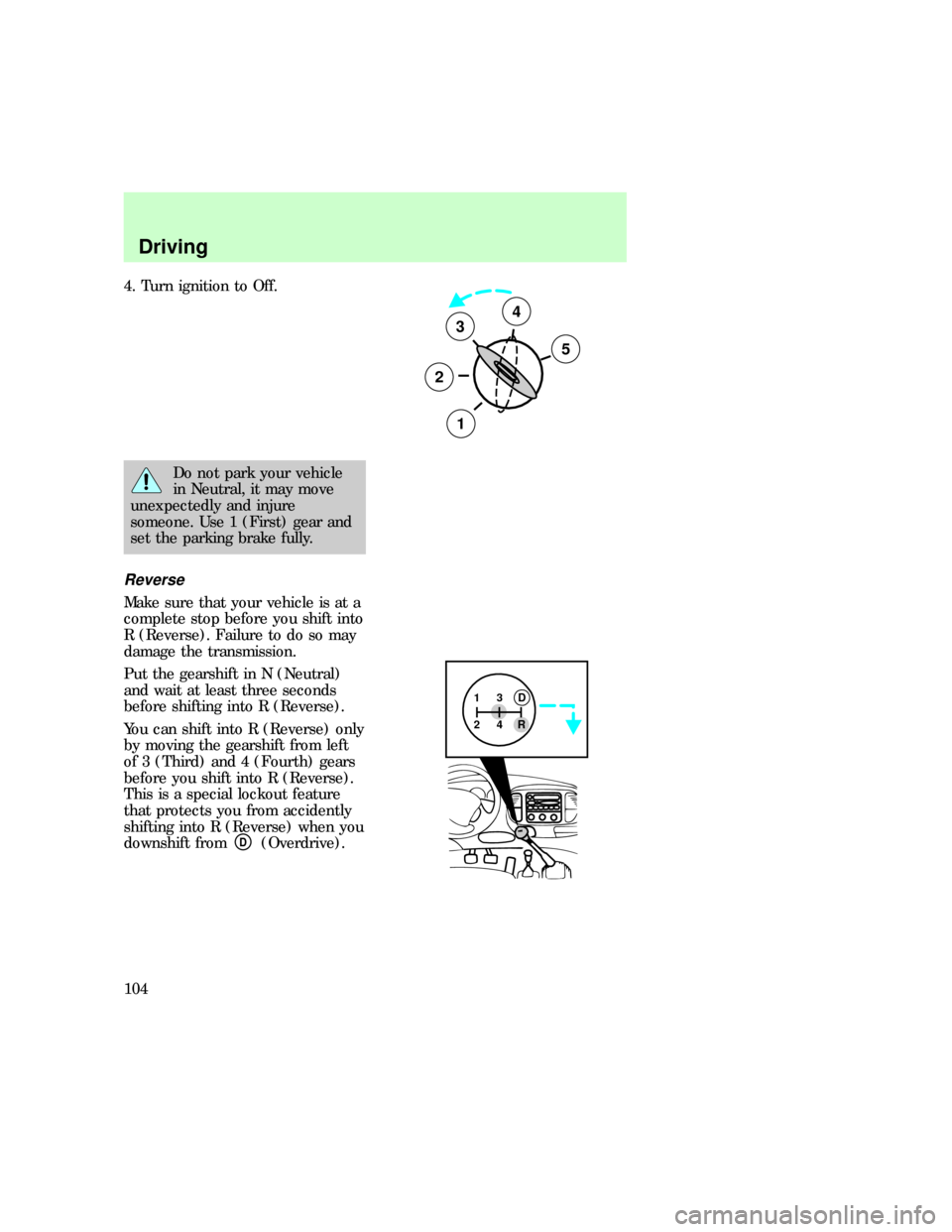
4. Turn ignition to Off.
Do not park your vehicle
in Neutral, it may move
unexpectedly and injure
someone. Use 1 (First) gear and
set the parking brake fully.
Reverse
Make sure that your vehicle is at a
complete stop before you shift into
R (Reverse). Failure to do so may
damage the transmission.
Put the gearshift in N (Neutral)
and wait at least three seconds
before shifting into R (Reverse).
You can shift into R (Reverse) only
by moving the gearshift from left
of 3 (Third) and 4 (Fourth) gears
before you shift into R (Reverse).
This is a special lockout feature
that protects you from accidently
shifting into R (Reverse) when you
downshift from
D(Overdrive).
3
2
1
5
4
13
24RD
f12_reverse
Driving
104
Page 104 of 219
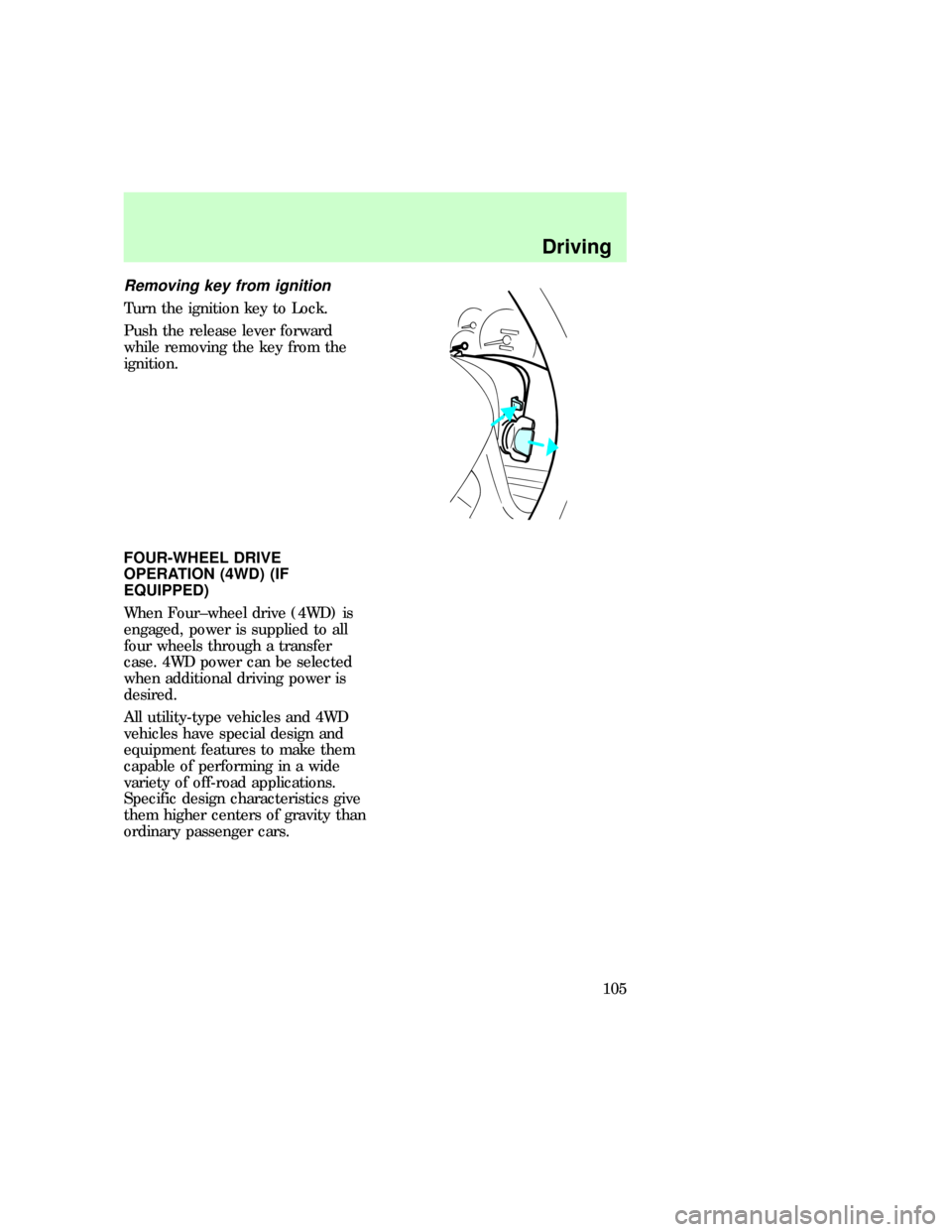
Removing key from ignition
Turn the ignition key to Lock.
Push the release lever forward
while removing the key from the
ignition.
FOUR-WHEEL DRIVE
OPERATION (4WD) (IF
EQUIPPED)
When Four±wheel drive (4WD) is
engaged, power is supplied to all
four wheels through a transfer
case. 4WD power can be selected
when additional driving power is
desired.
All utility-type vehicles and 4WD
vehicles have special design and
equipment features to make them
capable of performing in a wide
variety of off-road applications.
Specific design characteristics give
them higher centers of gravity than
ordinary passenger cars.
f12_four_wd
Driving
105
Page 114 of 219

When descending a steep hill,
avoid sudden braking. Rapid
pumping of the brake pedal will
help slow the vehicle and still
maintain steering control.
When speed control is on and you
are driving uphill, your vehicle
speed may drop considerably,
especially if you are carrying a
heavy load.
If vehicle speed drops more than
15±25 km/h (8±14 mph), the speed
control will cancel automatically.
Resume speed with accelerator
pedal.
If speed control cancels after
climbing the hill, reset speed by
pressing and holding the SET
ACCEL button (to resume speeds
over 50 km/h (30 mph).
Automatic transmission may shift
frequently while driving up steep
grades. Eliminate frequent shifting
by shifting out of
D(Overdrive)
into D (Drive).
Driving on snow and ice
A 4WD vehicle has advantages
over 2WD vehicles in snow and ice
but can skid like any other vehicle.
Avoid sudden applications of
power and quick changes of
direction on snow and ice. Apply
the accelerator slowly and steadily
when starting from a full stop.
When braking, apply the brakes as
you normally would. In order to
allow the anti-lock brake system
(ABS) to operate properly, keep
f12_driving_snow_ice
Driving
115
Page 136 of 219
Instrument panel fuses
Always replace a fuse with
one that has the specified
amperage rating. Using a fuse
with a higher amperage rating
can cause severe wire damage
and could start a fire.
Position Amps Description
1 15 Stop/turn lamps and turn indicators
2 5 Instrument cluster
3 25 Cigarette lighter
4 5 Power mirrors, autolamp, remote
anti-theft/keyless entry, headlamp relay and
parking lamp relay
5 15 Speed control, daytime running lamps, climate
control blend door, backup lamps, A/C clutch
coil
6 5 Brake-shift interlock, generic electronic module
(GEM)/central timer module (CTM) and air
suspension module
7 - Not used
8 5 Radio, remote anti-theft/keyless entry, GEM
module/CTM module
1
1
2
3
4
512 22
21323
31424
4
16 15
25
526
61727
71828
81929
11 21 31930
10 20
f12_pass_comp_fuses
Roadside emergencies
137
Page 137 of 219
Position Amps Description
9 - Not used
10 - Not used
11 30 Wiper system
12 5 On-board diagnostic (OBD II) data link
connector
13 15 Brake ON/OFF switch, rear anti-lock brake
module and brake pressure switch
14 15 Interior lamps and accessory delay relay
15 5 GEM module/CTM module
16 20 High beam headlamps
17 - Not used
18 5 Instrument illumination
19 10 Air bag diagnostic monitor, instrument cluster
20 5 GEM module/CTM module and powertrain
control module (PCM)
21 15 Starter relay
22 10 Air bag diagnostic monitor and passenger air
bag deactivate switch
23 10 4WD clutch relay, electronic flasher, 4WD/2WD
vacuum solenoids and trailer tow battery charge
relay
24 10 I/P blower relay
25 5 4WABS module and relay
26 10 Right low beam headlamp and DRL module
27 5 Foglamp relay
28 10 Left low beam headlamp
29 5 Autolamp, instrument cluster, transmission
control indicator lamp and switch
30 30 Ignition coils and PCM relay
31 - Not used
Roadside emergencies
138
Page 138 of 219
Relays
Position Description
1 Interior lamps relay
2 Battery saver relay
3 Not used
4 One touch down relay
5 Accessory delay relay
Power distribution box
Lift cover towards left of vehicle to
access the power distribution box.
Always disconnect the
battery before servicing
high current fuses.
Always replace the cover
to the Power Distribution
Box before reconnecting the
battery or refilling fluid
reservoirs.
Fuses
Position Amps Description
1 20 Trailer tow back-up and tail lamps
2 10 Air bag diagnostic monitor
3 15 Power locks
4 15 Air suspension
5 20 Horn
6 15 Audio system
29
6
5
4
3
2
1 28
27
26
25
24
2319
18
17
16
15
14
13
22
21
20
12
1197531
12108642
f12_eng_comp_fuses
Roadside emergencies
139