Page 118 of 236
UNDERSTANDING THE
TRACTION-LOKTREAR AXLE
(IF EQUIPPED)
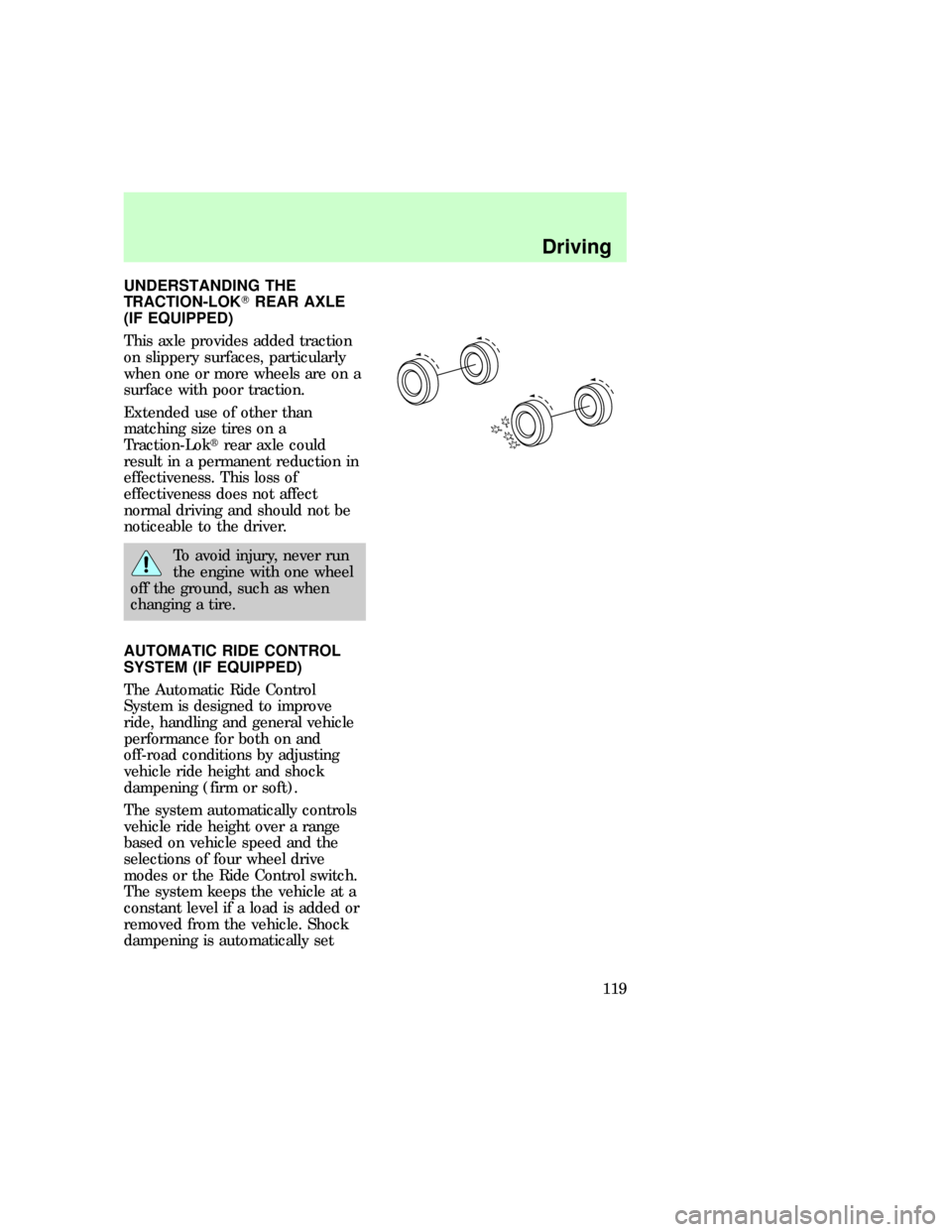
This axle provides added traction
on slippery surfaces, particularly
when one or more wheels are on a
surface with poor traction.
Extended use of other than
matching size tires on a
Traction-Loktrear axle could
result in a permanent reduction in
effectiveness. This loss of
effectiveness does not affect
normal driving and should not be
noticeable to the driver.
To avoid injury, never run
the engine with one wheel
off the ground, such as when
changing a tire.
AUTOMATIC RIDE CONTROL
SYSTEM (IF EQUIPPED)
The Automatic Ride Control
System is designed to improve
ride, handling and general vehicle
performance for both on and
off-road conditions by adjusting
vehicle ride height and shock
dampening (firm or soft).
The system automatically controls
vehicle ride height over a range
based on vehicle speed and the
selections of four wheel drive
modes or the Ride Control switch.
The system keeps the vehicle at a
constant level if a load is added or
removed from the vehicle. Shock
dampening is automatically set
uno_automatic_ride
Driving
119
Page 130 of 236

accelerator slowly and avoid
spinning the wheels.
Driving through mud and water
After driving through mud, clean
off residue stuck to rotating
driveshafts and tires. Excess mud
stuck on tires and rotating
driveshafts causes an imbalance
that could damage drive
components.
If you must drive through high
water, drive slowly. Traction or
brake capability may be limited.
When driving through water,
determine the depth; avoid water
higher than the bottom of the hubs
(if possible) and proceed slowly. If
the ignition system gets wet, the
vehicle may stall.
Once through water, always try the
brakes. Wet brakes do not stop the
vehicle as effectively as dry brakes.
Drying can be improved by moving
your vehicle slowly while applying
light pressure on the brake pedal.
If the transmission and transfer
case are submerged in water, their
fluids should be checked and
changed, if necessary.
If the rear axle is submerged in
water, the rear axle lubricant
should be checked and changed, if
necessary. The rear axle is filled
with a synthetic lubricant and does
not normally require a lubricant
change for the life of the vehicle.
Rear axle lubricant quantities
should not need to be checked
unless a leak is suspected.
uno_driving_mud_water
uno_driving_hill
Driving
131
Page 135 of 236

²GAWR (Gross Axle Weight
Rating) ÐCarrying capacity
for each axle system (front and
rear). The GAWR is specific to
each vehicle and is listed on the
Safety Compliance Certification
Label on the driver door pillar.
²GCW (Gross Combined
Weight) ÐThe GCW is the
maximum combined weight of
the towing vehicle (including
passengers and cargo) and the
loaded trailer. The GCW is
specified by the manufacturer to
indicate the combined maximum
loaded weight that the vehicle is
designed to tow.
Payload = GVWR minus Base
curb weight
To obtain the correct weights for
your vehicle, try taking your
vehicle to a shipping company or
an inspection station for trucks.
Do not use replacement tires with
lower weight capacities than the
originals because they might lower
the vehicle's GVWR and GAWR.
(Replacement tires with a higher
weight limit than the originals do
not increase the GVWR or the
GAWR limitations.)
In high altitudes, engines will lose
power at a rate of 3% power per
300 m (1000 ft) increase in
elevation. A reduction in GVW and
GCW is recommended for
maximum vehicle performance.
Driving
136
Page 136 of 236
Do not exceed the GVWR
or the GAWR specified on
the Safety Compliance
Certification Label.
It is extremely dangerous
to ride in a cargo area,
inside or outside of a vehicle. In
a collision, people riding in these
areas are more likely to be
seriously injured or killed. Do not
allow people to ride in any area
of your vehicle that is not
equipped with seats and safety
belts. Be sure everyone in your
vehicle is in a seat and using a
safety belt properly.
Driving with a heavy load
The total vehicle weight plus the
total weight of passengers and
cargo should never exceed the
GVWR.
The weight that the vehicle carries
over the front and rear axles
should never exceed the GVWR for
the respective axle.
The weight limits of your vehicle's
tires affect the GVWR or GAWR
limitations. Using tires with higher
weight limits than the original tires
will not increase the GVWR or
GAWR of your vehicle; using tires
with lower weight limits may lower
the GVWR or GAWR of your
vehicle.
uno_driving_heavy_load
uno_trailer_title
Driving
137
Page 137 of 236

TRAILER TOWING
Trailer towing with your vehicle
may require the use of a trailer
tow option package.
Trailer towing puts additional loads
on your vehicle's engine,
transmission, axle, brakes, tires,
and suspension. For your safety
and to maximize vehicle
performance, be sure to use the
proper equipment while towing.
Follow these guidelines to ensure
safe towing procedure:
²Stay within your vehicle's load
limits.
²Thoroughly prepare your vehicle
for towing. Refer toPreparing
to towin this chapter.
²Use extra caution when driving
while trailer towing. Refer to
Driving while towingin this
chapter.
²Service your vehicle more
frequently if you tow a trailer.
Refer to the severe duty
schedule in the ªService Guideº.
²Do not tow a trailer until your
vehicle has been driven at least
800 km (500 miles).
²Refer to the instructions
included with towing accessories
for the proper installation and
adjustment specifications.
²Speed control may shut off if
you are towing on long, steep
grades.
Driving
138
Page 155 of 236
Relay number Circuits protected
1 Wiper run relay
2 Horn relay
3 Wiper HI/LO relay
4 WOT A/C relay
5 PCM power relay
6 Fuel pump relay
Diode number Circuits protected
1 ABS diode
2 PCM diode
CHANGING TIRES
Tire change procedure
1. Park on a level surface.
2. Activate the hazard flashers.
²Before beginning the tire change
procedure, ensure that the
Automatic Ride Control service
switch is turned off.
0P RND21
UNLEADED
FUEL ONLY
RPM x 100012345
6H
C
F
E
RSM
SET
ACC
COAST OFF ON
SRS
- +H
H
L L020
1030405060
70
80
90
110
120000000oooo
km/h10020406080100
120
140
160
180
uno_tire_change_procedure
Roadside emergencies
156
Page 158 of 236
16. Install the lug nuts and tighten
until snug.
17. Lower the vehicle and tighten
the lug nuts as shown.
18. Unblock the wheels and place
the flat tire, jack hhandle and lug
wrench away.
Stowing flat tires
Stow aluminum wheel and tire
with the valve stem down.
To stow largest flat tire, place it
inside the vehicle and secure with
a webbing retainer.
The conventional spare tire
(if equipped)
Your vehicle may be equipped with
a conventional spare tire which
can be used as a spare or a regular
tire. This spare tire is identical to
the other tires on your vehicle,
although the wheel style may not
match.
The temporary spare tire
(if equipped)
Your vehicle may be equipped with
a temporary spare tire. This spare
is smaller than a regular tire and is
intended for emergency use only.
Us this spare when you get a flat
1
4
2
5 3
uno_stowing_flat_tires
uno_conventional_spare
uno_temporary_spare
Roadside emergencies
159
Page 194 of 236
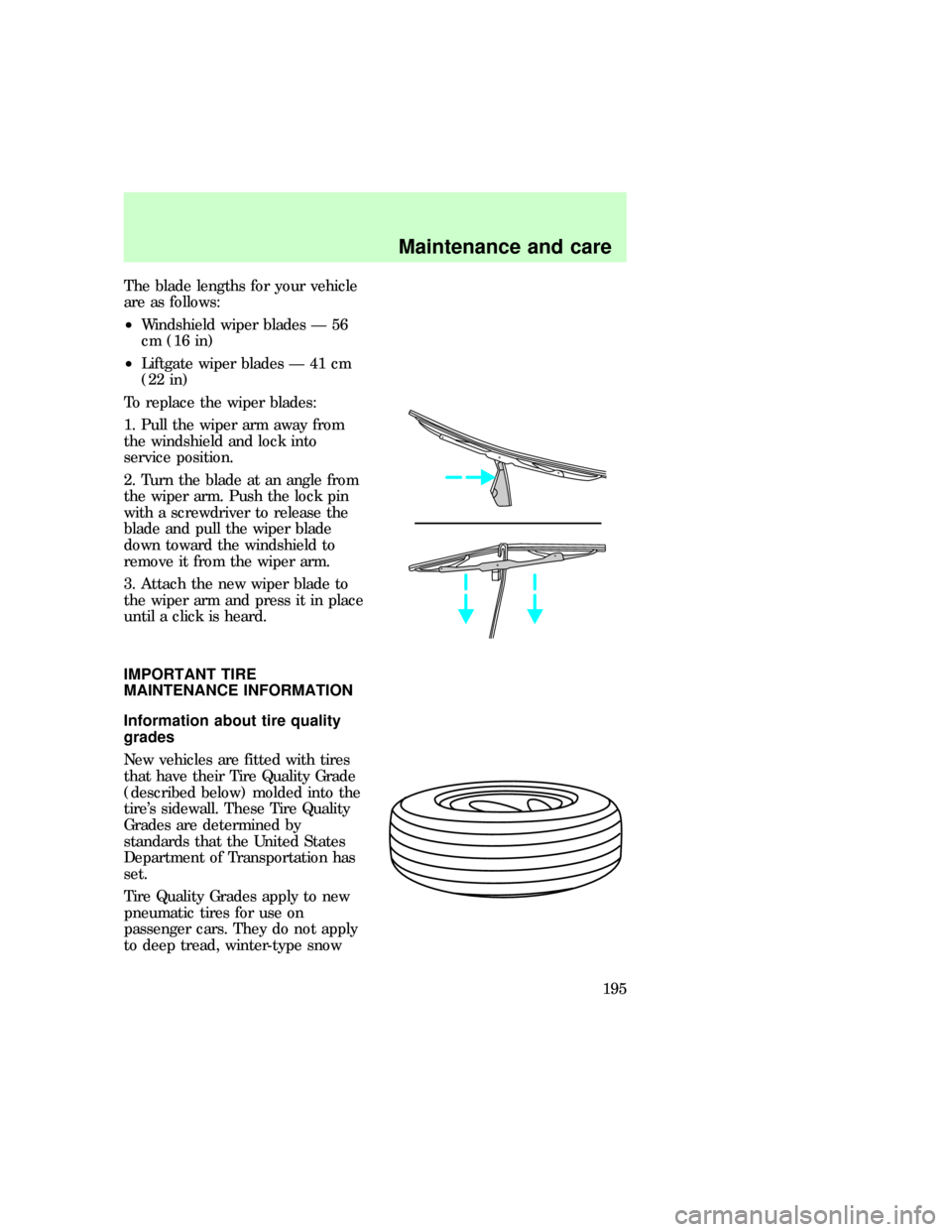
The blade lengths for your vehicle
are as follows:
²Windshield wiper blades Ð 56
cm (16 in)
²Liftgate wiper blades Ð 41 cm
(22 in)
To replace the wiper blades:
1. Pull the wiper arm away from
the windshield and lock into
service position.
2. Turn the blade at an angle from
the wiper arm. Push the lock pin
with a screwdriver to release the
blade and pull the wiper blade
down toward the windshield to
remove it from the wiper arm.
3. Attach the new wiper blade to
the wiper arm and press it in place
until a click is heard.
IMPORTANT TIRE
MAINTENANCE INFORMATION
Information about tire quality
grades
New vehicles are fitted with tires
that have their Tire Quality Grade
(described below) molded into the
tire's sidewall. These Tire Quality
Grades are determined by
standards that the United States
Department of Transportation has
set.
Tire Quality Grades apply to new
pneumatic tires for use on
passenger cars. They do not apply
to deep tread, winter-type snow
uno_title_tires
com_about_tire_grades.01
Maintenance and care
195