Page 129 of 236
Driving off-road with 4WD
Your vehicle is specially equipped
for driving on snow, sand, mud or
other rough terrain and has
operating characteristics that differ
from those of other conventional
vehicles.
When using 4WD, maintain
steering wheel control at all times,
especially in rough terrain. Since
sudden changes in terrain can
result in abrupt steering motion,
always grip the steering wheel
from the outside. Do not grip the
spokes.
Drive cautiously to avoid vehicle
damage from road debris such as
rocks or stumps. Be sure to map
out your route before driving in
any off road area.
For more information on driving
off-road and proper operation of
your 4WD vehicle, refer the ªFour
Wheelingº supplement in your
Owners Portfolio.
Driving over sand
When driving over sand, try to
keep all four wheels on the most
solid area of the trail. Do not
reduce the tire pressures but shift
to a lower gear and drive steadily
through the terrain. Apply the
uno_driving_sand
Driving
130
Page 130 of 236

accelerator slowly and avoid
spinning the wheels.
Driving through mud and water
After driving through mud, clean
off residue stuck to rotating
driveshafts and tires. Excess mud
stuck on tires and rotating
driveshafts causes an imbalance
that could damage drive
components.
If you must drive through high
water, drive slowly. Traction or
brake capability may be limited.
When driving through water,
determine the depth; avoid water
higher than the bottom of the hubs
(if possible) and proceed slowly. If
the ignition system gets wet, the
vehicle may stall.
Once through water, always try the
brakes. Wet brakes do not stop the
vehicle as effectively as dry brakes.
Drying can be improved by moving
your vehicle slowly while applying
light pressure on the brake pedal.
If the transmission and transfer
case are submerged in water, their
fluids should be checked and
changed, if necessary.
If the rear axle is submerged in
water, the rear axle lubricant
should be checked and changed, if
necessary. The rear axle is filled
with a synthetic lubricant and does
not normally require a lubricant
change for the life of the vehicle.
Rear axle lubricant quantities
should not need to be checked
unless a leak is suspected.
uno_driving_mud_water
uno_driving_hill
Driving
131
Page 131 of 236

Driving Through Water
Do not drive quickly through
standing water, especially if the
depth is unknown. Traction or
brake capability may be limited
and if the ignition system gets wet,
your engine may stall. Water may
also enter your engine's air intake
and severely damage your engine.
If driving through deep or standing
water is unavoidable, proceed very
slowly. Never drive through water
that is higher than the bottom of
the hubs (truck) / wheel rims
(car).
Once through the water, always try
the brakes. Wet brakes do not stop
the vehicle as effectively as dry
brakes. Drying can be improved by
moving your vehicle slowly while
applying light pressure on the
brake pedal.
Driving on hill or slope terrain
When driving on a hill, avoid
driving crosswise or turning on
steep slopes. You could lose
traction and slip sideways. Drive
straight up, straight down or avoid
the hill completely. Know the
conditions on the other side of a
hill before driving over the crest.
When climbing a steep hill, start in
a lower gear rather than
downshifting to a lower gear from
a higher gear once the ascent has
started. This reduces strain on the
engine and the possibility of
stalling.
Driving
132
Page 133 of 236

Allow more stopping distance and
drive slower than usual. Consider
using one of the lower gears.
Control trac system indicator
lights
4WD and 4WD LOW indicator
lights are located in the instrument
cluster. If either light flashes, see
your dealer or qualified service
technician.
The indicator lights will also
illuminate under the following
conditions:
²4WD AUTO modeÐ Neither
light will illuminate.
²4WD HIGH modeÐ Only the
4WD high light illuminates.
²4WD LOW modeÐ The 4WD
LOW light illuminates.
ALL WHEEL DRIVE (AWD)
SYSTEM (5.0L ENGINES ONLY)
Your vehicle is equipped with an
all wheel drive (AWD) transfer
case. Power is constantly supplied
to all four wheels through the
transfer case. The AWD system is
full time and has no external
controls.
Like all utility type vehicles, your
AWD vehicle has special design
and equipment features that make
it capable of performing in a
variety of off-road applications.
Specific design characteristics give
these vehicles higher centers of
gravity than ordinary passenger
cars.
4WD
4WD
LOW
uno_indicator_lights
uno_awd
Driving
134
Page 134 of 236
Utility and four-wheel
drive vehicles are NOT
designed for cornering at speeds
as high as passenger cars any
more than low-slung sports cars
are designed to perform
satisfactorily under off-road
conditions. Avoid sharp turns or
abrupt maneuvers in these
vehicles.
LOADING YOUR VEHICLE
Before loading your vehicle,
familiarize yourself with these
terms:
²Base curb weight ÐWeight of
the vehicle including any
standard equipment, fluids,
lubricants, etc. It does not
include passengers or
aftermarket equipment.
²Payload ÐCombined
maximum allowable weight of
passengers, cargo and optional
equipment.
²GVW (Gross Vehicle Weight)
ÐBase curb weight plus the
payload weight. The GVW is not
a limit or a specification.
²GVWR (Gross Vehicle Weight
Rating) ÐMaximum total
weight of the base vehicle,
passengers, optional equipment
and cargo. The GVWR is specific
to each vehicle and is listed on
the Safety Compliance
Certification Label on the
driver's door pillar.
uno_heavy_load
Driving
135
Page 143 of 236

working properly, the warning
lights in the instrument cluster
may not work properly.
Using a hitch
Do not use hitches that:
²clamp onto the vehicle bumper
²attach to the axle.
Distribute the load so that only 10
to 15% of the total weight of the
trailer is on the tongue. tie down
the load so that it does not shift
and change the weight on the
hitch. Follow the towing
instructions of a reputable rental
agency.
Driving while towing a trailer
Do not drive faster than 70 km/h
(45 mph) while towing a 454 kg
(1000 lb) trailer. Do not drive
faster than 72 km/h (45 mph) with
any weight trailer while towing in
hilly terrain or on hot days.
Speed control (if equipped) may
not work properly while towing on
long, steep grades.
If driving with an automatic
transmission:
²use D or L rather than while
towing up or down steep hills
²anticipate stops and brake
gradually.
Towing behind another vehicle
Do not tow your vehicle behind
another vehicle, such as an RV,
unless front wheel dollies are used.
uno_hitch
uno_driving_towing
uno_towing_behind
Driving
144
Page 144 of 236

Your vehicle can not be flat towed
with all wheels on the ground.
Servicing while towing
If you tow a trailer for long
distances, your vehicle requires
more frequent service than a
vehicle not used for towing. Refer
to the ªService Guideº for more
information on maintenance
intervals.
Using a step bumper
The rear bumper is equipped with
an integral hitch and requires only
a ball with a ô inch shank
diameter. The bumper has a Class
II capability (1590 kg / 3500 lb
trailer weight and 159 kg / 350 lb
tongue weight).
Use a frame mounted weight
distributing hitch for trailers over
1590 kg (3500 lb).
Launching or retrieving a boat
When backing down a ramp during
boat launching or retrieval,
²Do not allow the static water
level to rise above the bottom
edge of the rear bumper and
²Do not allow waves to break
higher than 15 cm (six inches)
above the bottom edge of the
rear bumper.
Exceeding these limits may allow
water to enter critical vehicle
components, adversely affecting
driveability, emissions and
reliability.uno_servicing_while_towing
uno_step_bumper_towing
com_launch-retrieving_boat.01
uno_roof-rack_title
Driving
145
Page 145 of 236
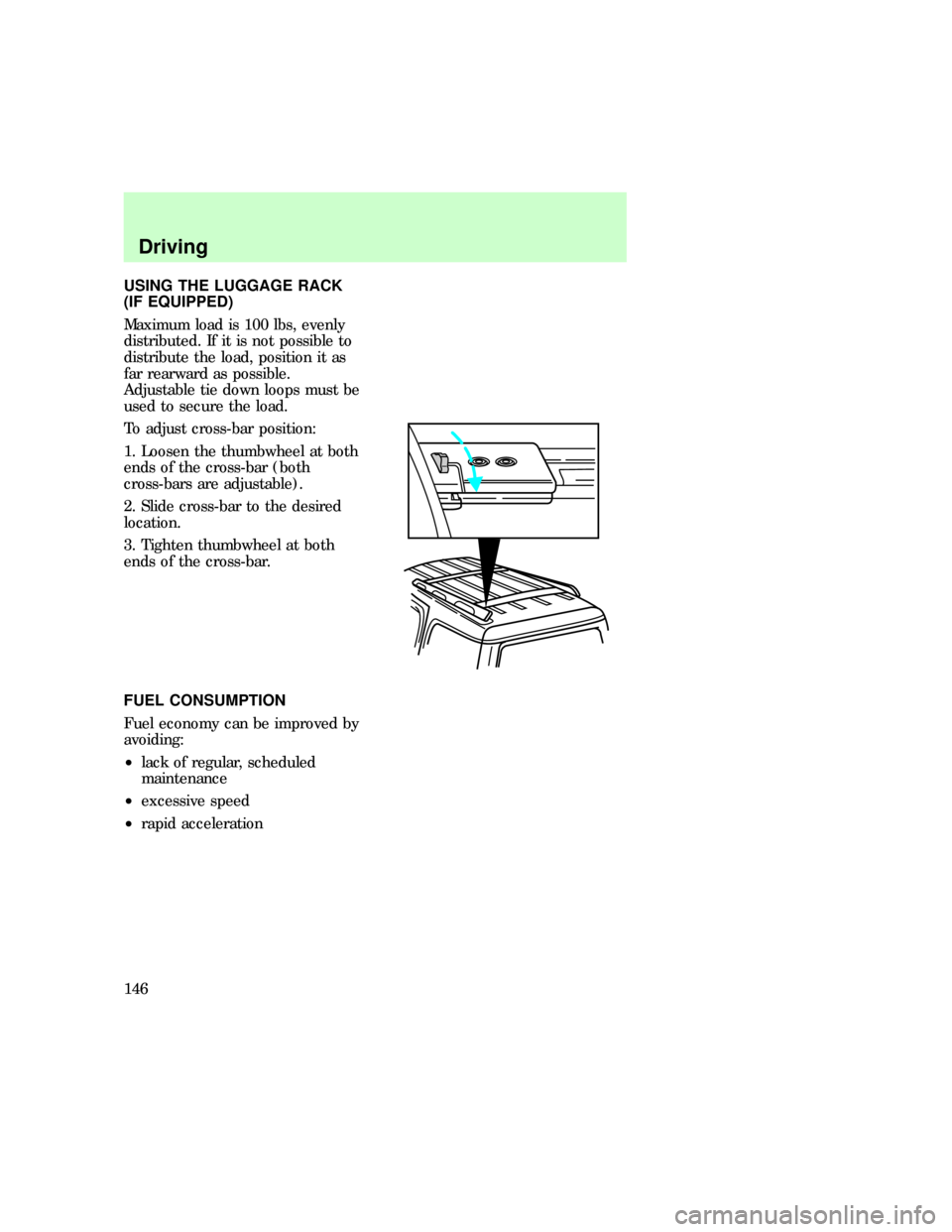
USING THE LUGGAGE RACK
(IF EQUIPPED)
Maximum load is 100 lbs, evenly
distributed. If it is not possible to
distribute the load, position it as
far rearward as possible.
Adjustable tie down loops must be
used to secure the load.
To adjust cross-bar position:
1. Loosen the thumbwheel at both
ends of the cross-bar (both
cross-bars are adjustable).
2. Slide cross-bar to the desired
location.
3. Tighten thumbwheel at both
ends of the cross-bar.
FUEL CONSUMPTION
Fuel economy can be improved by
avoiding:
²lack of regular, scheduled
maintenance
²excessive speed
²rapid acceleration
com_fuel_consumption.01
Driving
146