Page 52 of 236
variety of aftermarket garage door
openers:
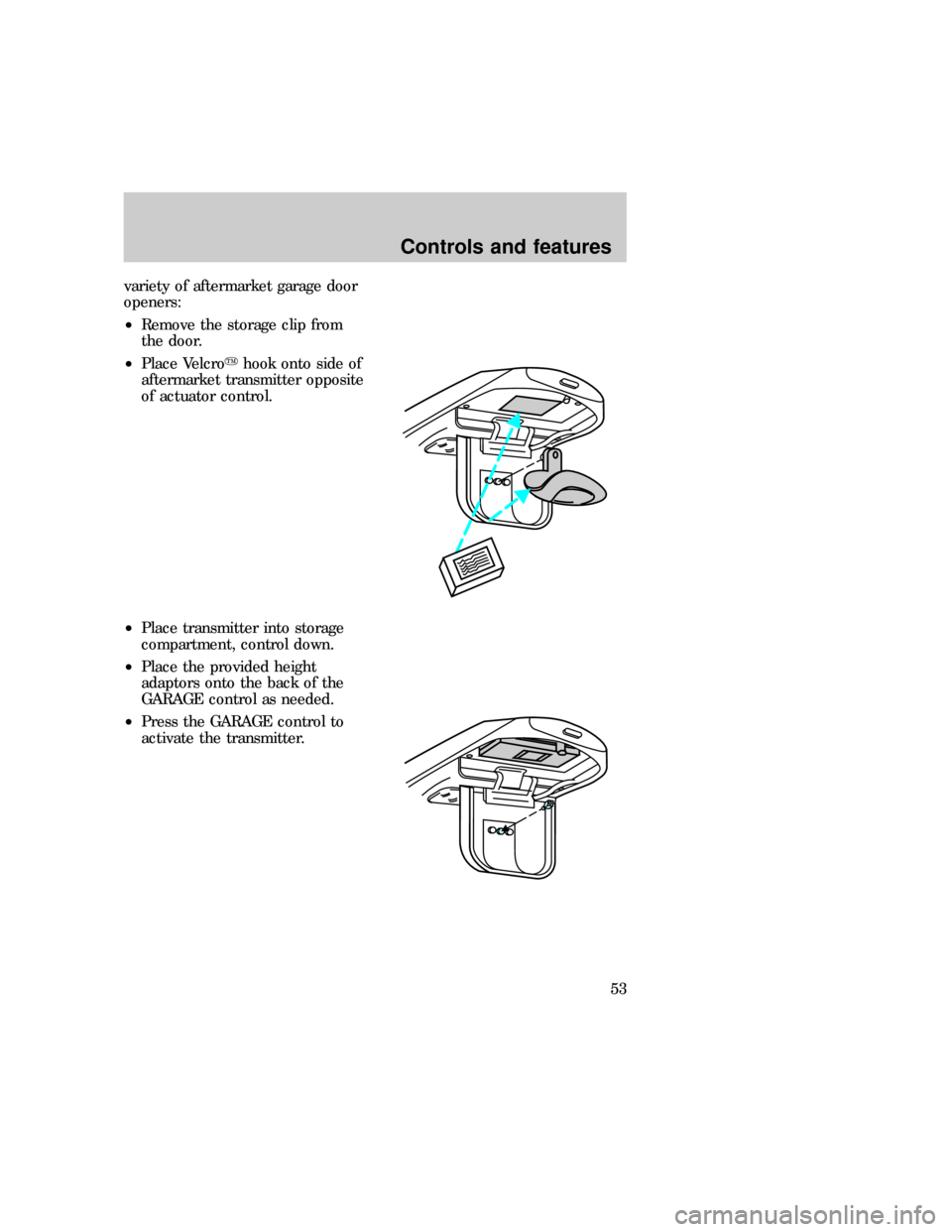
²Remove the storage clip from
the door.
²Place Velcroyhook onto side of
aftermarket transmitter opposite
of actuator control.
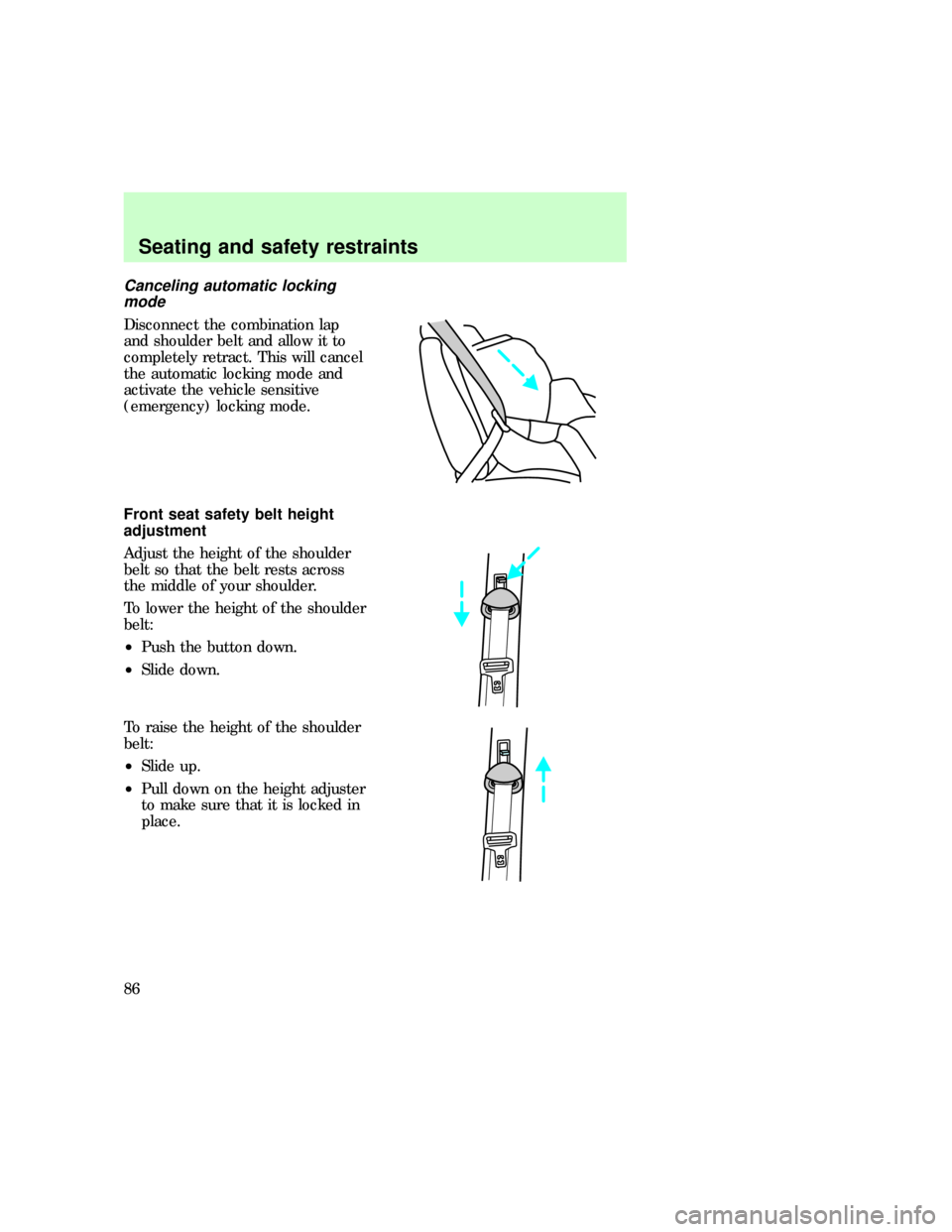
²Place transmitter into storage
compartment, control down.
²Place the provided height
adaptors onto the back of the
GARAGE control as needed.
²Press the GARAGE control to
activate the transmitter.
uno_moonroof
Controls and features
53
Page 85 of 236
Canceling automatic locking
mode
Disconnect the combination lap
and shoulder belt and allow it to
completely retract. This will cancel
the automatic locking mode and
activate the vehicle sensitive
(emergency) locking mode.
Front seat safety belt height
adjustment
Adjust the height of the shoulder
belt so that the belt rests across
the middle of your shoulder.
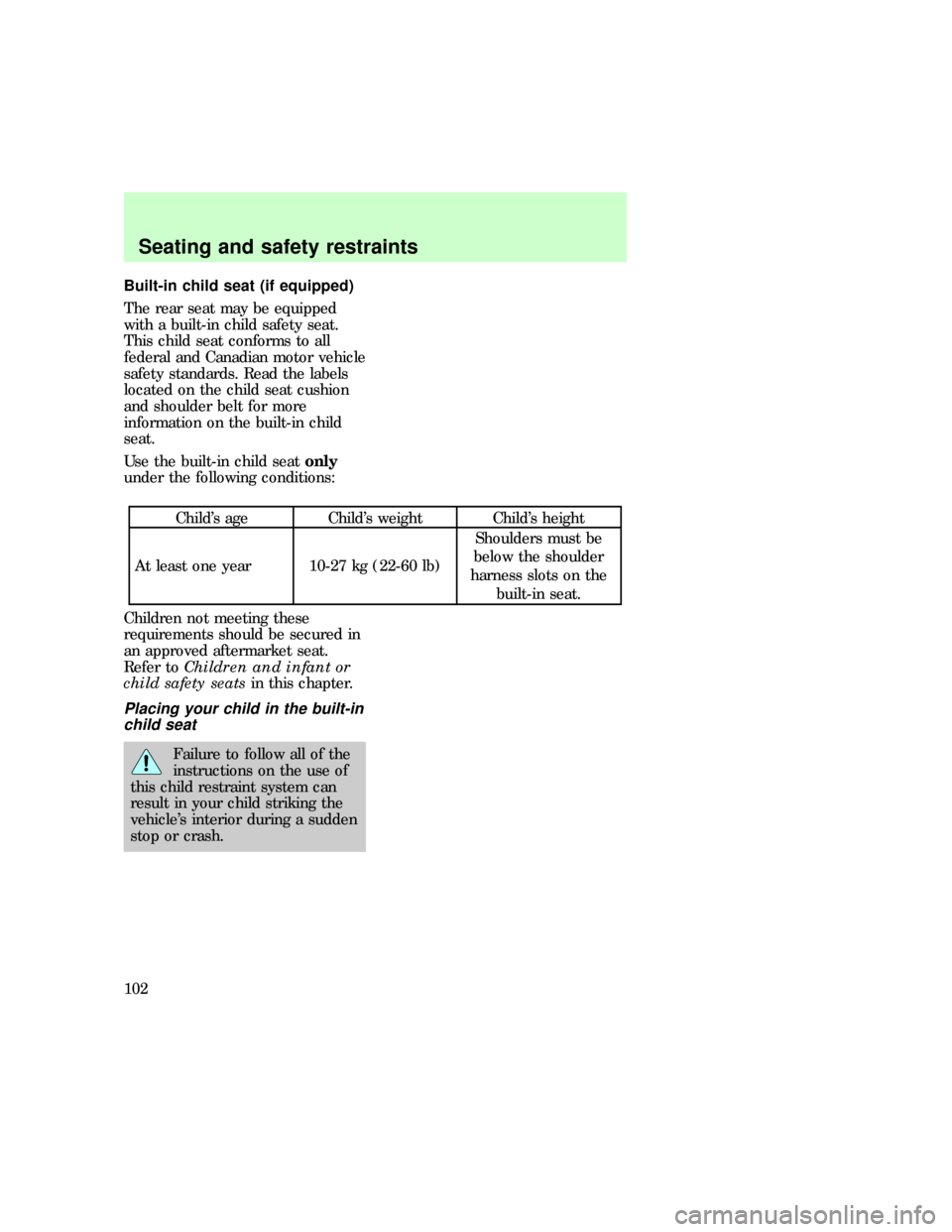
To lower the height of the shoulder
belt:
²Push the button down.
²Slide down.
To raise the height of the shoulder
belt:
²Slide up.
²Pull down on the height adjuster
to make sure that it is locked in
place.uno_front_sbelt_height_adjust
uno_lap_belts
Seating and safety restraints
86
Page 101 of 236
Built-in child seat (if equipped)
The rear seat may be equipped
with a built-in child safety seat.
This child seat conforms to all
federal and Canadian motor vehicle
safety standards. Read the labels
located on the child seat cushion
and shoulder belt for more
information on the built-in child
seat.
Use the built-in child seatonly
under the following conditions:
Child's age Child's weight Child's height
At least one year 10-27 kg (22-60 lb)Shoulders must be
below the shoulder
harness slots on the
built-in seat.
Children not meeting these
requirements should be secured in
an approved aftermarket seat.
Refer toChildren and infant or
child safety seatsin this chapter.
Placing your child in the built-in
child seat
Failure to follow all of the
instructions on the use of
this child restraint system can
result in your child striking the
vehicle's interior during a sudden
stop or crash.
uno_placing_child_in_seat
Seating and safety restraints
102
Page 118 of 236
UNDERSTANDING THE
TRACTION-LOKTREAR AXLE
(IF EQUIPPED)
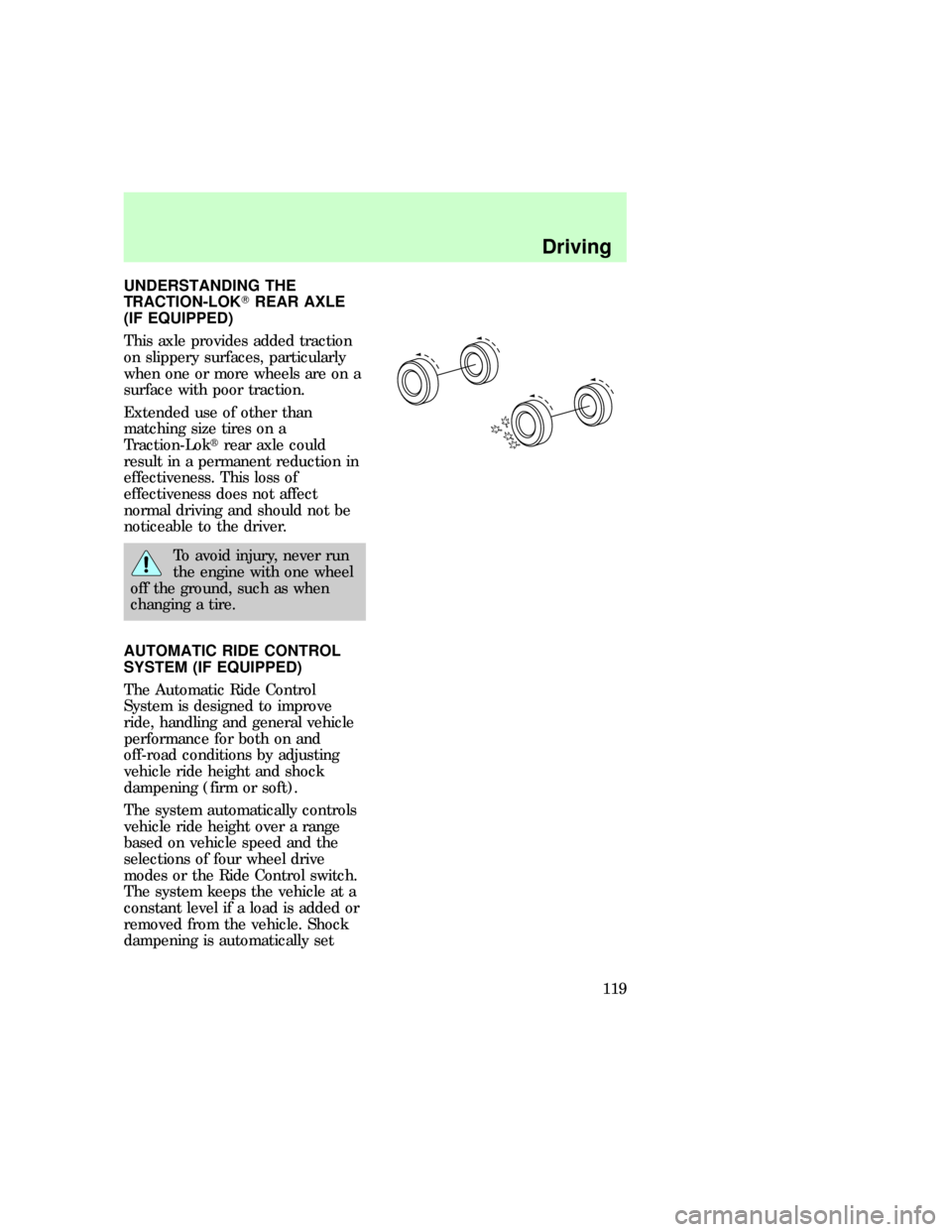
This axle provides added traction
on slippery surfaces, particularly
when one or more wheels are on a
surface with poor traction.
Extended use of other than
matching size tires on a
Traction-Loktrear axle could
result in a permanent reduction in
effectiveness. This loss of
effectiveness does not affect
normal driving and should not be
noticeable to the driver.
To avoid injury, never run
the engine with one wheel
off the ground, such as when
changing a tire.
AUTOMATIC RIDE CONTROL
SYSTEM (IF EQUIPPED)
The Automatic Ride Control
System is designed to improve
ride, handling and general vehicle
performance for both on and
off-road conditions by adjusting
vehicle ride height and shock
dampening (firm or soft).
The system automatically controls
vehicle ride height over a range
based on vehicle speed and the
selections of four wheel drive
modes or the Ride Control switch.
The system keeps the vehicle at a
constant level if a load is added or
removed from the vehicle. Shock
dampening is automatically set
uno_automatic_ride
Driving
119
Page 119 of 236

based on driver and road inputs to
optimize ride. The combination of
firm dampening and height change
also provides maximum suspension
feedback for improved off-road
safety and performance.
The vehicle will drop to its lowest
position when the ignition is
turned to the Off position to
provide easy entry and exit to of
the vehicle. As a safety
consideration, whenever a door is
opened (including the liftgate and
liftgate glass), the system
memorizes and maintains the
height at the moment the door was
opened. The system will maintain
this height either until all doors
are closed or until vehicle speed
exceeds 16 kph (10 mph).
An on board air compressor and
solenoids are used to raise and
lower the vehicle. It is normal to
occasionally a buzz or clicking
from the vehicle even when the
ignition is turned to Off. The
system stays energized for 40
minutes after the ignition is turned
off to compensate for any load
changes after the vehicle is parked.
The Automatic Ride Control
system operation can be monitored
through the message center. Refer
toMessage centerin the
Instrumentationchapter.
uno_ride_cont_switch
Driving
120
Page 219 of 236

vinyl cleaner or a mild soap.
Cleaning and maintaining the
safety belts
Clean the safety belts with a mild
soap solution recommended for
cleaning upholstery or carpets. Do
not bleach or dye the belts,
because these actions may weaken
the belt webbing.
All safety belt assemblies,
including retractors, buckles, front
seat belt buckle support assemblies
(slide bar) (if equipped), shoulder
belt height adjusters (if equipped),
child safety seat tether bracket
assemblies (if equipped) and
attaching hardware should be
inspected after any collision. Ford
recommends that all safety belt
assemblies used in vehicles
involved in a collision be replaced.
However, if the collision was minor
and a qualified technician finds
that the belts do not show damage
and continue to operate properly,
they do not need to be replaced.
Safety belt assemblies not in use
during a collision should also be
inspected and replaced if either
damage or improper operation is
noted.
Cleaning the built-in child seat
(if equipped)
Clean the built-in child seat with
mild soap and water. Do not use
household cleaning products
because they may weaken the
safety belt webbing or damage the
vinyl parts of the seat.
com_safety_belts_cleaning.01
com_child-seat_cleaning.01
Maintenance and care
220
Page 227 of 236
3Add 4±ounces of additive friction
modifier C8AZ-19B546±A, Ford
specification EST-M2C118±A, for
complete Traction-lok rear axles.
ENGINE DATA
Engine 4.0L 2V V-64.0L 2V V-6
SOHC5.0L 2V V-8
Cubic inches 245 245 302
Horsepower 160 @ 4200 rpm 205 @ 5000 rpm 211 @ 4600
Torque 225 @ 2800 rpm 250 @ 3000 rpm 274 @ 3200 rpm
Required fuel
grade87 octane 87 octane 87 octane
Firing order 1-4-2-5-3-6 1-4-2-5-3-6 1-3-7-2-6-5-4-8
Spark plug gap 1.3-1.4 mm
(0.052-0.056
inch)1.3-1.4 mm
(0.052-0.056
inch)1.3-1.4 mm
(0.052-0.056
inch)
Ignition system DIS DIS DIS
VEHICLE DIMENSIONS
Dimensions cm(inches)
1Overall length 468 cm (184.3 in)
2Overall width 187 cm (70.2 in)
3Maximum height 170 cm (67.3 in)
4Wheelbase 284 cm (111.9 in)
5Front track / rear 148 cm (58.3 in)
uno_engine_data
uno_vehicle_dimensions
Capacities and specifications
228