Page 110 of 224
UNDERSTANDING THE
TRACTION-LOKTREAR AXLE
(IF EQUIPPED)
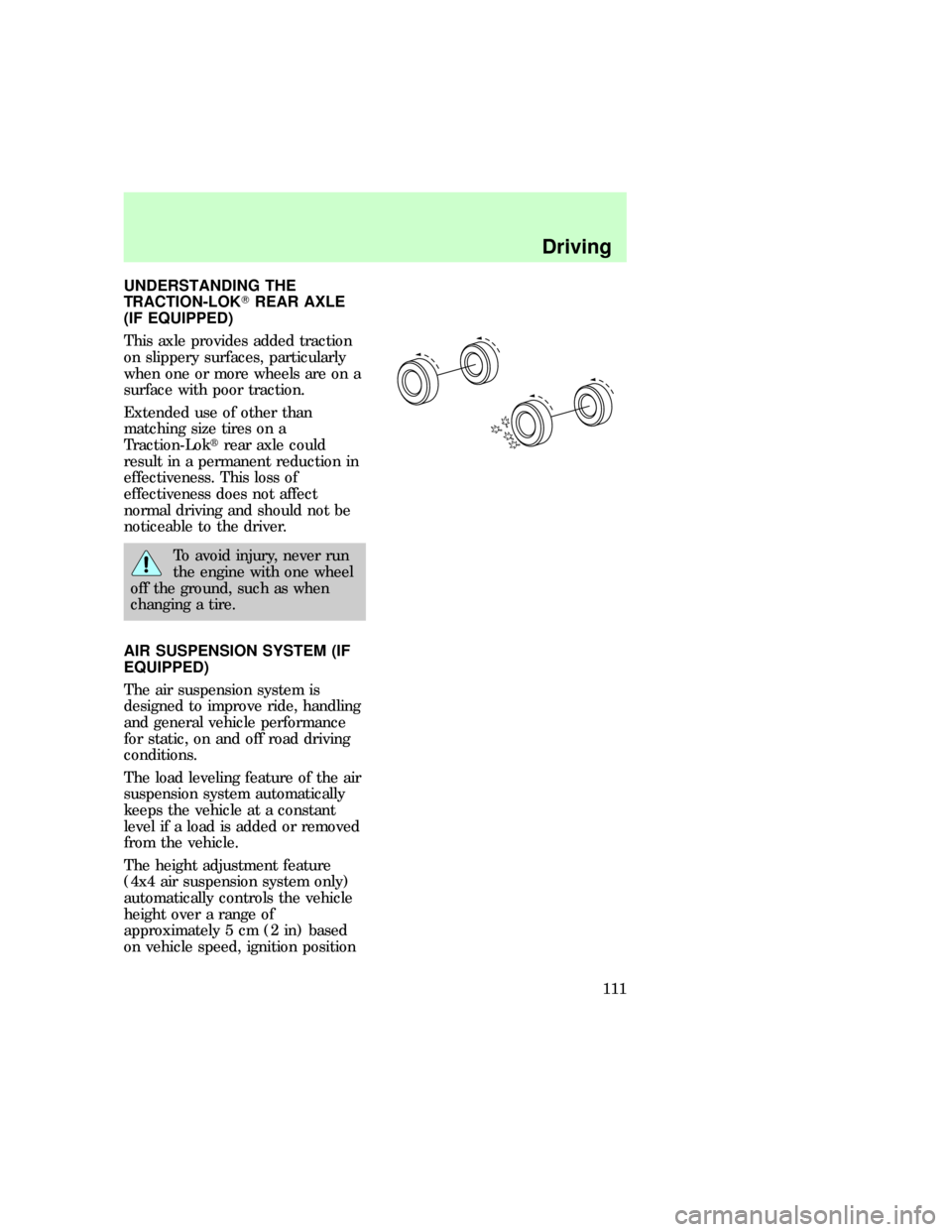
This axle provides added traction
on slippery surfaces, particularly
when one or more wheels are on a
surface with poor traction.
Extended use of other than
matching size tires on a
Traction-Loktrear axle could
result in a permanent reduction in
effectiveness. This loss of
effectiveness does not affect
normal driving and should not be
noticeable to the driver.
To avoid injury, never run
the engine with one wheel
off the ground, such as when
changing a tire.
AIR SUSPENSION SYSTEM (IF
EQUIPPED)
The air suspension system is
designed to improve ride, handling
and general vehicle performance
for static, on and off road driving
conditions.
The load leveling feature of the air
suspension system automatically
keeps the vehicle at a constant
level if a load is added or removed
from the vehicle.
The height adjustment feature
(4x4 air suspension system only)
automatically controls the vehicle
height over a range of
approximately 5 cm (2 in) based
on vehicle speed, ignition position
exd_air_suspension
Driving
111
Page 111 of 224

and selection of two or four-wheel
drive modes.
The air suspension system places
the vehicle at its lowest height to
provide easy entry and exit when
the vehicle is parked, the ignition
is turned off and all doors are
closed.
The air suspension system raises
the vehicle approximately 2.5 cm
(1 in) to its normal ride position
when the ignition is turned on, the
transmission is initially shifted into
the drive or reverse mode and all
doors are closed.
In 4WD Low, the air suspension
system raises the vehicle an
additional 2.5 cm (1 in) above the
normal ride height to improve
vehicle ground clearance. However,
if the vehicle speed exceeds 40
km/h (25 mph), the system will
lower the vehicle to its normal ride
height to maximize ride comfort.
The vehicle will raise again if
vehicle speed is less than 13 km/h
(8 mph) for one minute. In 4WD
Low, do not exceed 56 km/h (35
mph).
As a safety consideration,
whenever a door is opened
(including the liftgate and liftgate
glass) the system memorizes and
maintains the height at the
moment the door was opened. The
system will maintain this height
until all doors are closed or until
vehicle speed exceeds 16 km/h (10
mph).
Driving
112
Page 118 of 224
CONTROL TRAC-AUTOMATIC
FOUR-WHEEL DRIVE SYSTEM
(IF EQUIPPED)
Your 4x4 features a heavy-duty
Control Trac system, includes a
computer-operated transfer case.
Coupled with a
center-disconnected front axle, this
unique system is interactive with
the road, continually monitoring
and adjusting torque delivery to
the front and rear wheels to
optimize vehicle control.
Positions of the Control Trac
system
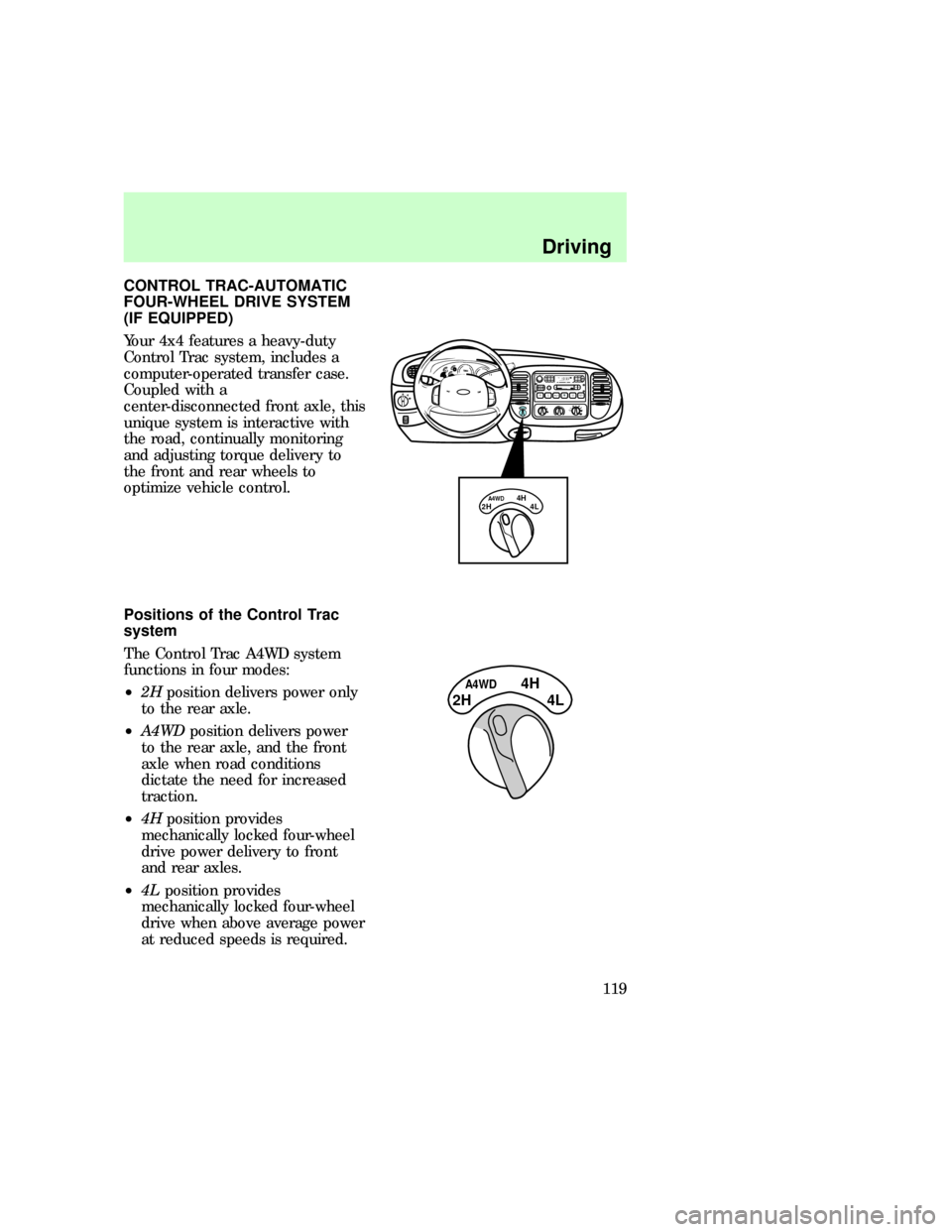
The Control Trac A4WD system
functions in four modes:
²2Hposition delivers power only
to the rear axle.
²A4WDposition delivers power
to the rear axle, and the front
axle when road conditions
dictate the need for increased
traction.
²4Hposition provides
mechanically locked four-wheel
drive power delivery to front
and rear axles.
²4Lposition provides
mechanically locked four-wheel
drive when above average power
at reduced speeds is required.
PHI LO
2H4LA4WD4HOFF*A/C*MAX
A/CREW
1FF
2SIDE 1-2
3
FM 1STVOL – PUSH ON
AM
FMBASS TREBBAL FADE
AUTO
SET CLKSEEKTUNE
DISCSSCAN4DOLBY SYSTEMEJTAPE CDCOMP5SHUFFLE
6
2H 4LA4WD4H
2H 4L
A4WD4H
exd_control_trac_info
Driving
119
Page 119 of 224
Utility and four-wheel
drive vehicles arenot
designed for cornering at speeds
as high as passenger cars any
more than low-slung sports cars
are designed to perform
satisfactorily under off-road
conditions. Avoid sharp turns or
abrupt maneuvers in these
vehicles.
Using the Control Trac system
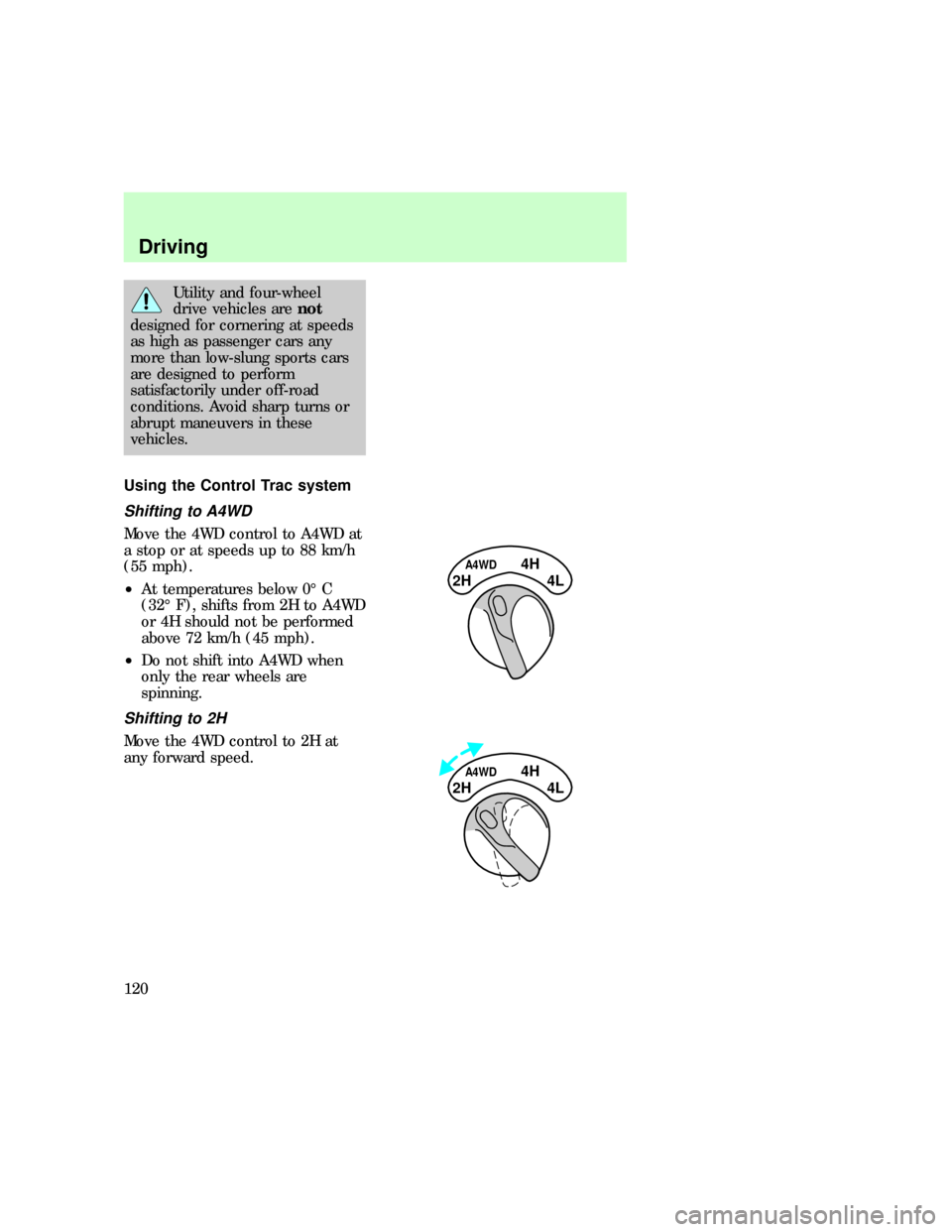
Shifting to A4WD
Move the 4WD control to A4WD at
a stop or at speeds up to 88 km/h
(55 mph).
²At temperatures below 0É C
(32É F), shifts from 2H to A4WD
or 4H should not be performed
above 72 km/h (45 mph).
²Do not shift into A4WD when
only the rear wheels are
spinning.
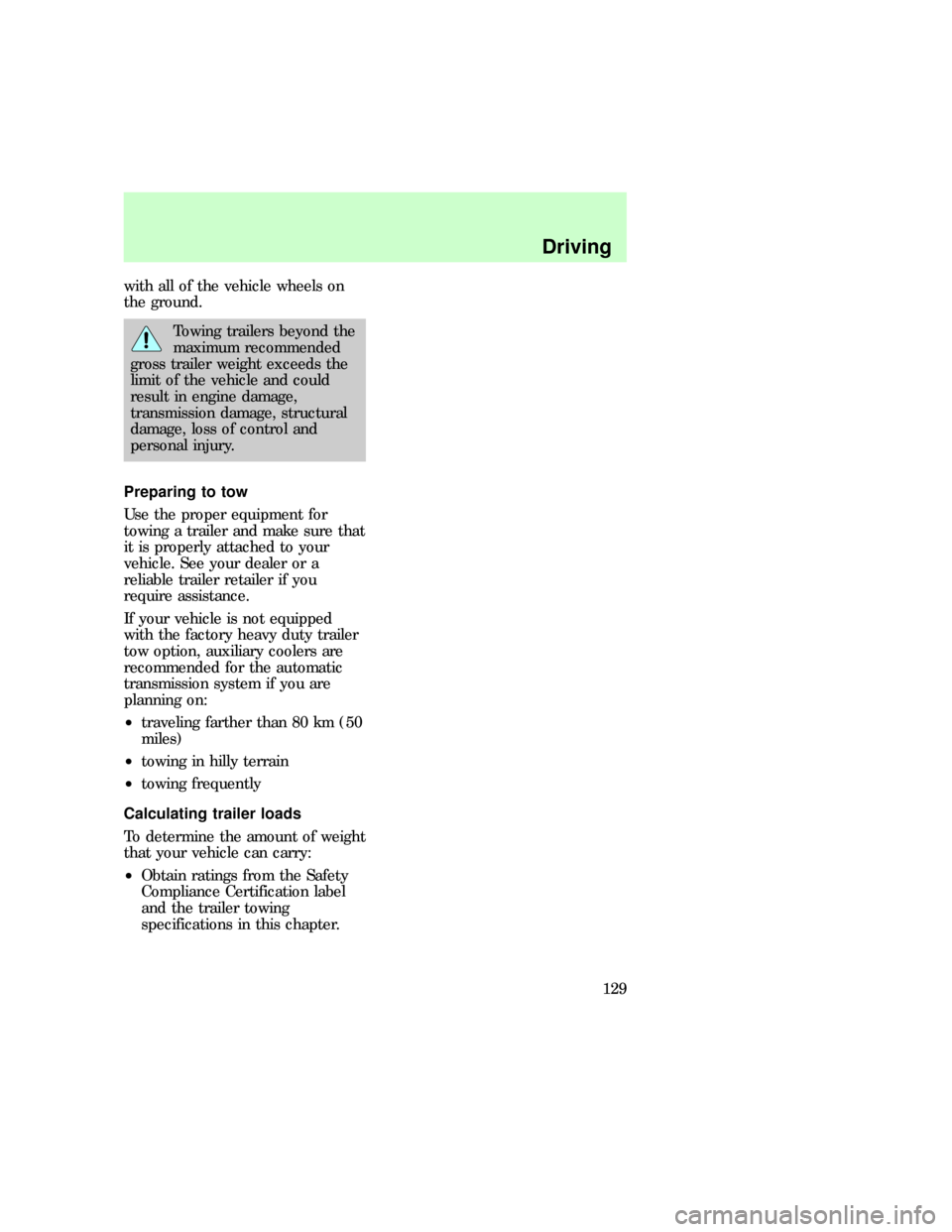
Shifting to 2H
Move the 4WD control to 2H at
any forward speed.
2H 4L
A4WD4H
2H 4L
A4WD4H
exd_overall_positions
exd_2h_to_a4wd
exd_a4wd_to_2h exd_a4wd_to_4h_or_4l
Driving
120
Page 121 of 224
Driving off-road with 4WD
Your vehicle is specially equipped
for driving on snow, sand, mud or
other rough terrain and has
operating characteristics that differ
from those of other conventional
vehicles.
When using 4WD, maintain
steering wheel control at all times,
especially in rough terrain. Since
sudden changes in terrain can
result in abrupt steering motion,
always grip the steering wheel
from the outside. Do not grip the
spokes.
Drive cautiously to avoid vehicle
damage from road debris such as
rocks or stumps. Be sure to map
out your route before driving in
any off road area.
For more information on driving
off-road and proper operation of
your 4WD vehicle, refer theFour
Wheelingsupplement in your
Owner's Portfolio.
exd_loading_vehicle
Driving
122
Page 128 of 224
with all of the vehicle wheels on
the ground.
Towing trailers beyond the
maximum recommended
gross trailer weight exceeds the
limit of the vehicle and could
result in engine damage,
transmission damage, structural
damage, loss of control and
personal injury.
Preparing to tow
Use the proper equipment for
towing a trailer and make sure that
it is properly attached to your
vehicle. See your dealer or a
reliable trailer retailer if you
require assistance.
If your vehicle is not equipped
with the factory heavy duty trailer
tow option, auxiliary coolers are
recommended for the automatic
transmission system if you are
planning on:
²traveling farther than 80 km (50
miles)
²towing in hilly terrain
²towing frequently
Calculating trailer loads
To determine the amount of weight
that your vehicle can carry:
²Obtain ratings from the Safety
Compliance Certification label
and the trailer towing
specifications in this chapter.
exd_preparing_tow
exd_calculating_load
Driving
129
Page 131 of 224
should the vehicle weight ratings
per axle or combination truck and
trailer exceed the weight ratings
listed on the Safety Compliance
Certification label located on the
driver's side door.
When connecting a trailer hitch:
1. Turn off the air suspension
switch.
2. Connect the trailer.
3. Turn the air suspension back on.
Adjusting an equalizing
hitch so the rear bumper
of the vehicle is lower or higher
than it was unloaded will defeat
the function of the load
equalizing hitch and may cause
unpredictable handling.
Driving while towing a trailer
Speed control (if equipped) may
not work properly while towing on
long, steep grades.
Driving with an automatic
transmission:
²use D, 1 or 2 rather than
Dwhile towing up or down
steep hills
²anticipate stops and brake
gradually.
Towing behind another vehicle
Your vehicle can not be flat towed
with all wheels on the ground.
No neutral tow kit is available for
your vehicle.
exd_driving_trailer
exd_towing_another_vehicle
exd_servicing_while_towing
Driving
132
Page 137 of 224
Slot number Fuse
amperage
ratingCircuits protected
13 30 amp Auxiliary blower
14 60 amp Four wheel anti-lock brake system
(4WABS)
15 50 amp Air suspension compressor
16 40 amp Trailer tow battery charge, engine
minifuse box fuse #2, engine minifuse
box fuse #4
17 30 amp Four-wheel drive (4WD) transfer case
motor and clutch
18 30 amp Driver power seat
19 20 amp Fuel pump
20 50 amp Junction box ignition switched feed
21 50 amp Junction box ignition switched feed
22 50 amp Junction box battery feed
23 40 amp Front blower
24 30 amp Powertrain control module power
25 30 C.B. Windows
26 - not used
27 40 amp Heated backlite and mirrors
28 30 amp Trailer tow electric brake
29 30 amp Hybrid fan, moon roof, flip windows
Slot number Description
1 - not used
2 - PCM diode
Slot number Description
1 - Windshield wipers high/low speed
2 - Windshield wipers run/park
3 - Front washer pump relay
4 - Fuel pump relay
Roadside emergencies
138