Page 156 of 224
1. Inside the vehicle, pull the hood
release handle located under the
bottom left corner of the
instrument panel.
2. Outside the vehicle, release the
auxiliary latch located under the
center of the hood.
3. Lift the hood.
4. To close the hood, shut it so
that the auxiliary latch is closed.
After closing the hood, try lifting it
to ensure that it is closed securely.
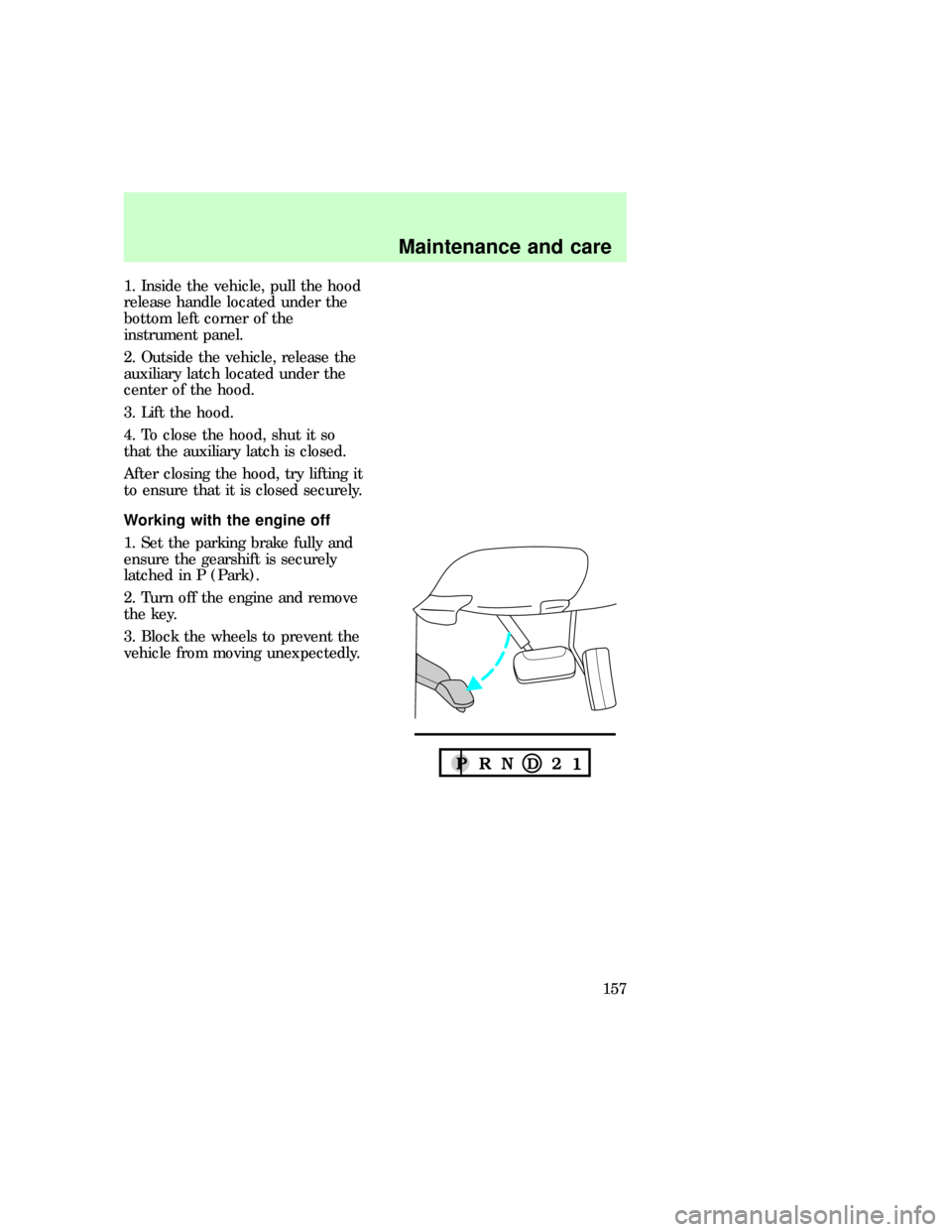
Working with the engine off
1. Set the parking brake fully and
ensure the gearshift is securely
latched in P (Park).
2. Turn off the engine and remove
the key.
3. Block the wheels to prevent the
vehicle from moving unexpectedly.
exd_working_off
exd_working_on
Maintenance and care
157
Page 157 of 224
Working with the engine on
1. Set the parking brake fully and
ensure the gearshift is securely
latched in P (Park).
2. Block the wheels to prevent
your vehicle from moving
unexpectedly.
Do not start your engine
with the air cleaner
removed and do not remove it
while the engine is running.
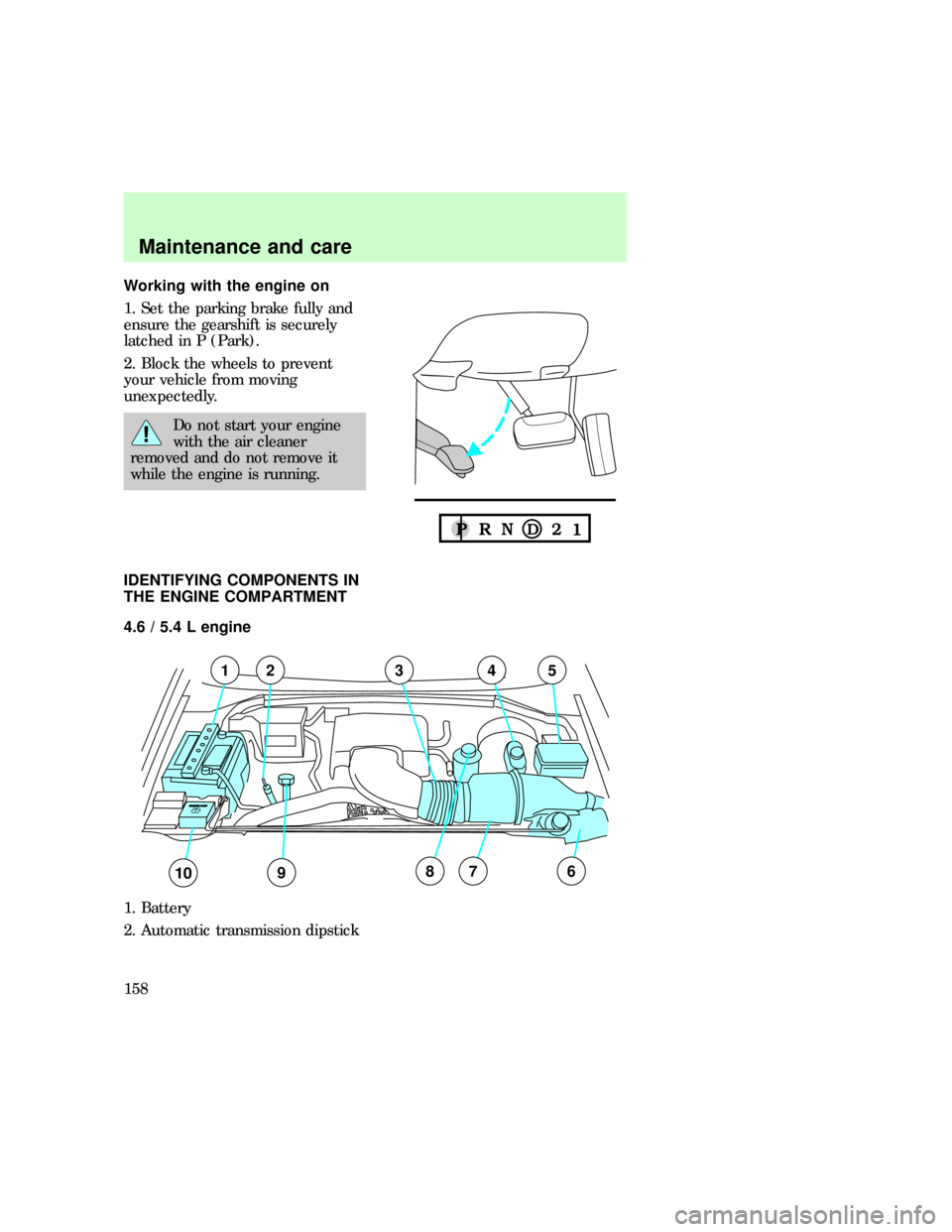
IDENTIFYING COMPONENTS IN
THE ENGINE COMPARTMENT
4.6 / 5.4 L engine
1. Battery
2. Automatic transmission dipstick
12
107869
345
exd_title_engine_compartments
exd_2_engine_compartment
Maintenance and care
158
Page 175 of 224
TRACTION-LOK REAR AXLE (IF
EQUIPPED)
This axle provides added drive
away traction on slippery surfaces,
particularly when one or more
wheels are on a surface with poor
traction.
Extended use of other than
matching size tires on a
Traction-Lok rear axle could result
in a permanent reduction in
effectiveness. This loss of
effectiveness does not effect
normal driving and should not be
noticeable to the driver.
To avoid injury, never run
the engine with one wheel
off the ground, such as when
changing a tire.
BATTERY
If the original equipment
maintenance-free battery needs
replacing, it may be replaced with
a low-maintenance battery. For
information on replacement
batteries, refer toMotorcraft part
numbersin theCapacities and
specificationschapter.
The gases around the
battery can explode if
exposed to flames, sparks, or lit
cigarettes. An explosion could
result in injury or vehicle
damage.
exd_battery
Maintenance and care
176
Page 182 of 224

100. The relative performance of
tires depends upon the actual
conditions of their use, however,
and may depart significantly from
the norm due to variations in
driving habits, service practices,
and differences in road
characteristics and climate.
Traction A B C
The traction grades, from highest
to lowest are A, B, and C, and they
represent the tire's ability to stop
on wet pavement as measured
under test surfaces of asphalt and
concrete. A tire marked C may
have poor traction performance.
Warning: The traction grade
assigned to this tire is based on
braking (straightahead) traction
tests and does not include
cornering (turning) traction.
Temperature A B C
The temperature grades are A (the
highest), B, and C, representing
the tire's resistance to the
generation of heat and its ability to
dissipate heat when tested under
controlled conditions on a
specified indoor laboratory test
wheel. Sustained high temperature
can cause the material of the tire
to degenerate and reduce tire life,
and excessive temperature can
lead to sudden tire failure. The
grade C corresponds to a level of
performance which all passenger
car tires must meet under the
Federal Motor Vehicle Safety
Standard No. 109. Grades B and A
represent higher levels of
com_traction_abc.01
com_temperature_abc.01
Maintenance and care
183
Page 183 of 224
performance on the laboratory test
wheel than the minimum required
by law.
The temperature grade for
this tire is established for a
tire that is properly inflated and
not overloaded. Excessive speed,
underinflation, or excessive
loading, either separately or in
combination, can cause heat
buildup and possible tire failure.
Checking the tire pressure
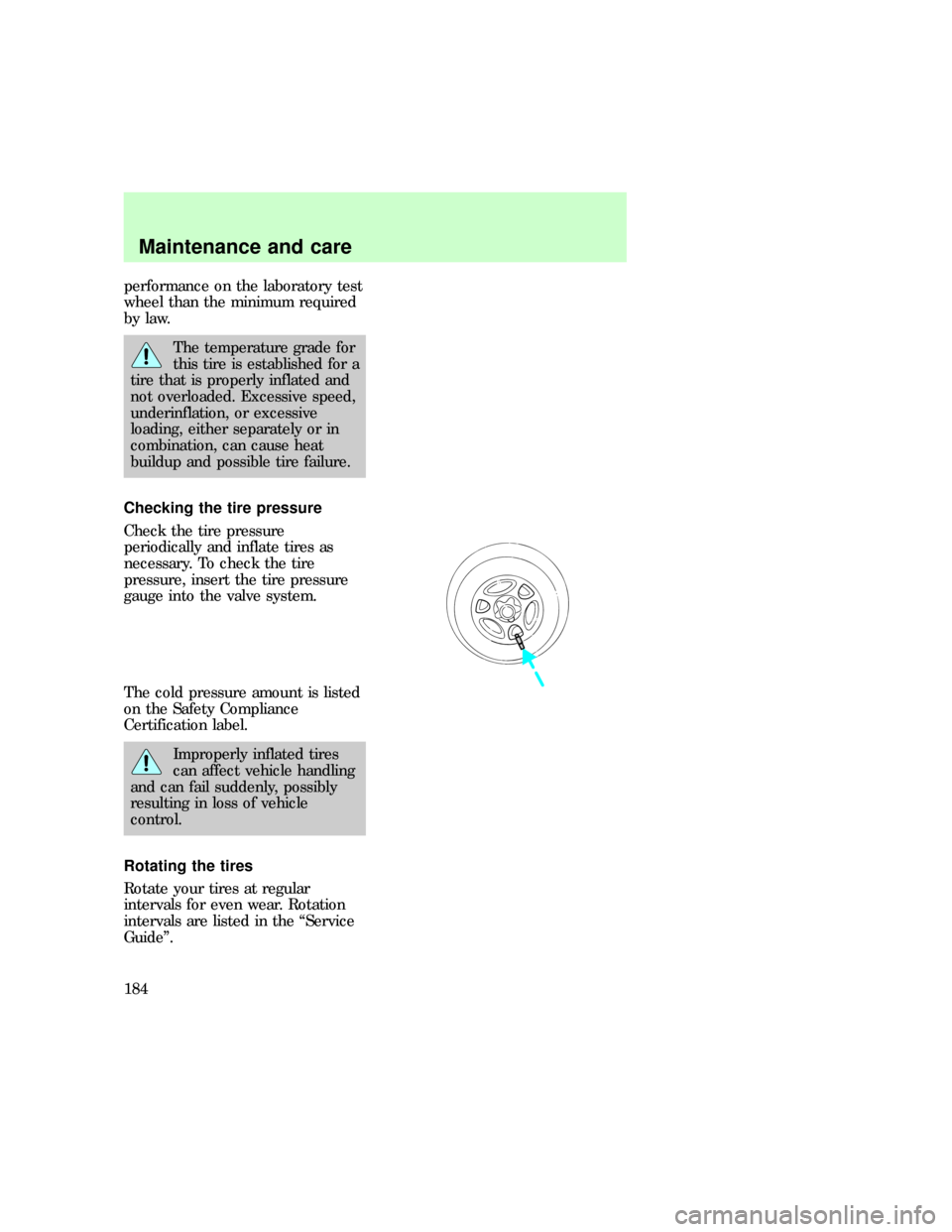
Check the tire pressure
periodically and inflate tires as
necessary. To check the tire
pressure, insert the tire pressure
gauge into the valve system.
The cold pressure amount is listed
on the Safety Compliance
Certification label.
Improperly inflated tires
can affect vehicle handling
and can fail suddenly, possibly
resulting in loss of vehicle
control.
Rotating the tires
Rotate your tires at regular
intervals for even wear. Rotation
intervals are listed in the ªService
Guideº.
exd_pressure_checking
exd_rotating_tires
Maintenance and care
184
Page 206 of 224
such as antennas, before entering
a car wash.
²After washing, apply the brakes
several times to dry them.
Waxing your vehicle
The best way to determine when
the paintwork needs waxing is by
noting when water stops beading
on the surface. This could be every
three or four months, depending
on operating conditions.
Use only carnauba or
synthetic-based waxes. Remove
any bugs and tar before waxing
vehicle. Use cleaning fluid or
alcohol with a clean cloth to
remove. Use tar remover to
remove any tar spots.
Repairing paint chips
Minor scratches or paint damage
from road debris may be repaired
with touch-up paint, paint repair
foil or aerosol paint spray from the
Ford accessory line. Observe the
application instructions on the
products.
Remove particles such as bird
droppings, tree sap, insect
remains, tar spots, road salt and
industrial fallout immediately.
com_waxing_vehicle.01
com_repairing_chips
com_wheels_cleaning.01
Maintenance and care
207
Page 207 of 224
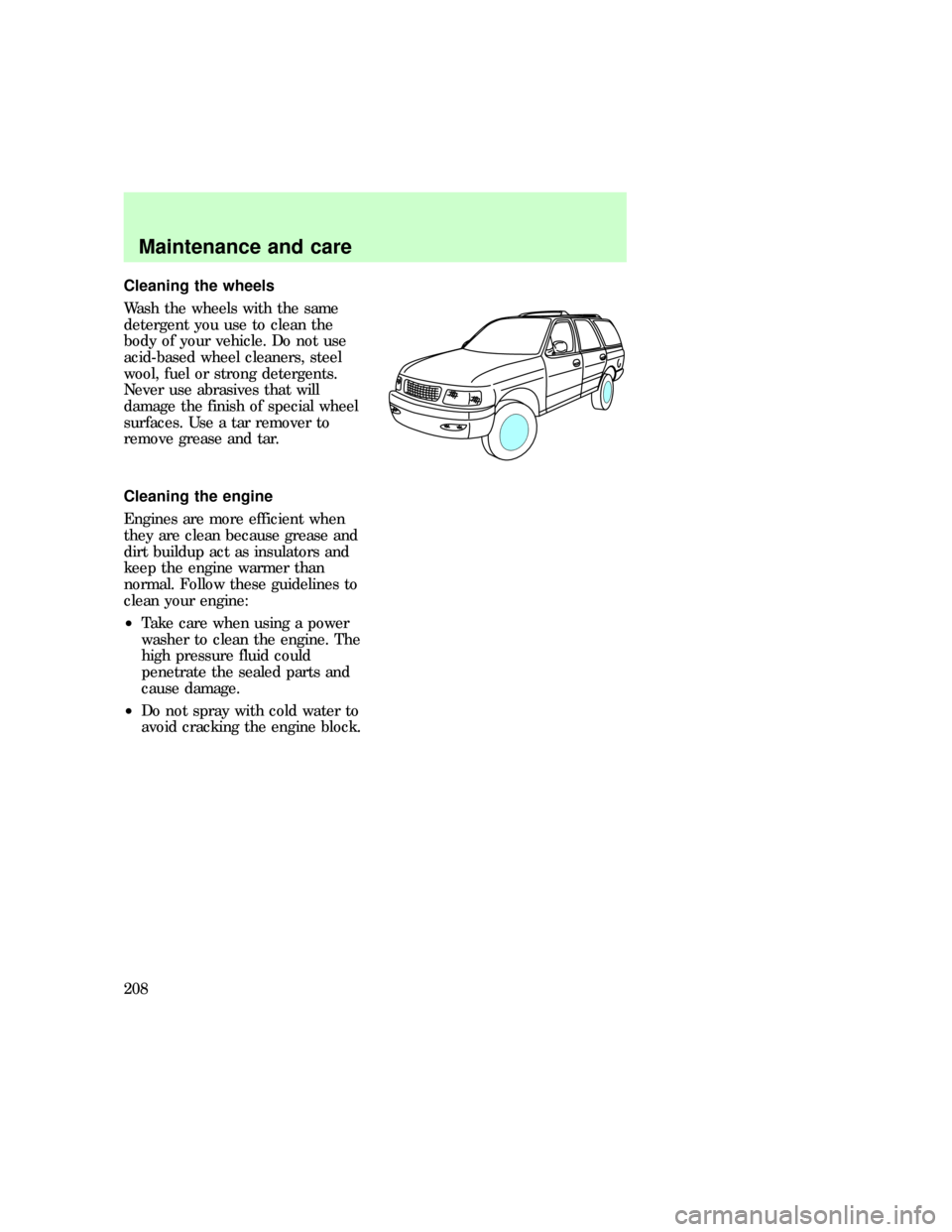
Cleaning the wheels
Wash the wheels with the same
detergent you use to clean the
body of your vehicle. Do not use
acid-based wheel cleaners, steel
wool, fuel or strong detergents.
Never use abrasives that will
damage the finish of special wheel
surfaces. Use a tar remover to
remove grease and tar.
Cleaning the engine
Engines are more efficient when
they are clean because grease and
dirt buildup act as insulators and
keep the engine warmer than
normal. Follow these guidelines to
clean your engine:
²Take care when using a power
washer to clean the engine. The
high pressure fluid could
penetrate the sealed parts and
cause damage.
²Do not spray with cold water to
avoid cracking the engine block.
com_engine_cleaning.01
Maintenance and care
208
Page 215 of 224
Item Ford part nameFord part
numberFord
specification
Driveshaft, slip
sline, double
Carden joint
center ballPremium Long
Life GreaseXG-1-C ESA-M13P4-A
Door
weather-stripsSilicone
LubricantsCOAZ-19553-AA
AND
D7AZ-19553-AAESR-M13P4-A
Engine coolant Ford Premium
Cooling System
FluidE2FZ-19549-AA ESE-M97B44-A
Steering linkage Premium Long
Life GreaseXG-1-C ESA-M1C75-B
Engine oil Motorcraft Motor
Oil 5W30 Super
PremiumXO-5W30-QSP WSS-M2C153-F
with API
Certification
Mark
4x4 front wheel
bearings, 4x4
spindle needle
bearings,
spindle thrust
bearings & front
drive axle
u-joint/slip slineHigh
Temperature
4x4 Front Axle
& Wheel
Bearing GreaseE8TZ-19590-A ESA-M1C198-A
Automatic
transmissionMotorcraft
MERCONT
Automatic
Transmission
Fluidxt-2-qdx MERCONT
Power steering
reservoirPremium Power
Steering FluidE6AZ-19582-AA ESW-M2C33-F
Capacities and specifications
216