Page 141 of 191
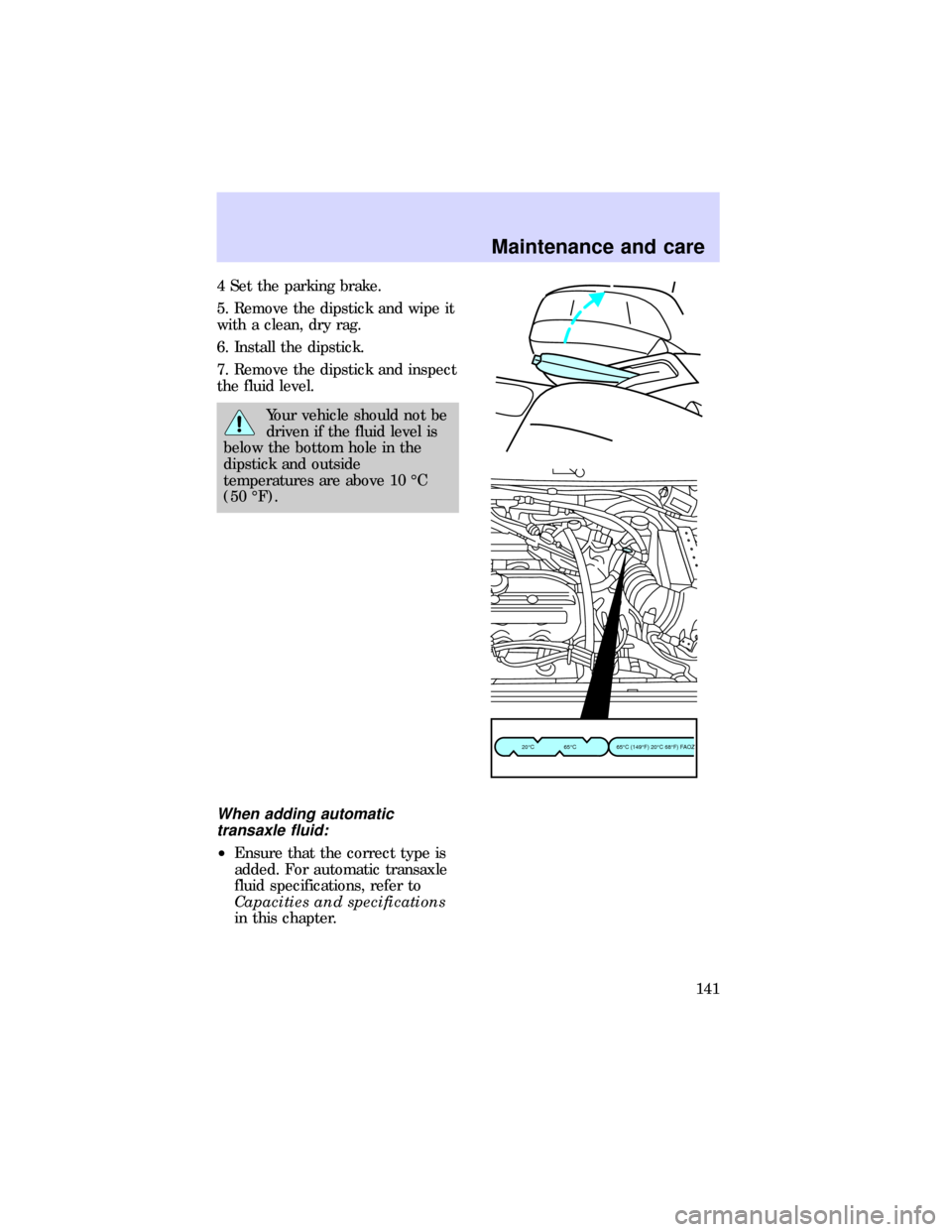
4 Set the parking brake.
5. Remove the dipstick and wipe it
with a clean, dry rag.
6. Install the dipstick.
7. Remove the dipstick and inspect
the fluid level.
Your vehicle should not be
driven if the fluid level is
below the bottom hole in the
dipstick and outside
temperatures are above 10 ÉC
(50 ÉF).
When adding automatic
transaxle fluid:
²Ensure that the correct type is
added. For automatic transaxle
fluid specifications, refer to
Capacities and specifications
in this chapter.
20¡C65¡C65¡C (149¡F) 20¡C 68¡F) FAOZ
Maintenance and care
141
Page 153 of 191
²Install chains securely, verifying
that the chains do not touch any
wiring, brake lines, or fuel lines.
²Install tire chains on front tires
only.
²Drive cautiously. If you hear the
chains rub or bang against your
vehicle, stop and retighten the
chains. If this does not work,
remove the chains to prevent
damage to your vehicle.
²When possible, avoid
overloading your vehicle.
²Remove the tire chains when
they are no longer needed. Do
not use tire chains on dry roads.
²The suspension insulation and
bumpers will help prevent
vehicle damage. Do not remove
these components from your
vehicle when using snow tires
and chains.
WHAT YOU SHOULD KNOW
ABOUT AUTOMOTIVE FUEL
Automotive fuels can
cause serious injury or
death if misused or mishandled.
Observe the following guidelines
when handling automotive fuel:
²Extinguish all smoking material
and any open flames before
fueling your vehicle.
²Automotive fuels can be harmful
or fatal if swallowed. If fuel is
swallowed, call a physician
immediately, even if no
Maintenance and care
153
Page 160 of 191
EXTERIOR LAMPS
REPLACING THE EXTERIOR
BULBS
Check the operation of the
following lamps frequently:
²headlamps
²foglamps (if equipped)
²high-mount brakelamp
²license plate lamp
²tail lamps/backup lamps
²interior overhead lamp
Maintenance and care
160
Page 164 of 191
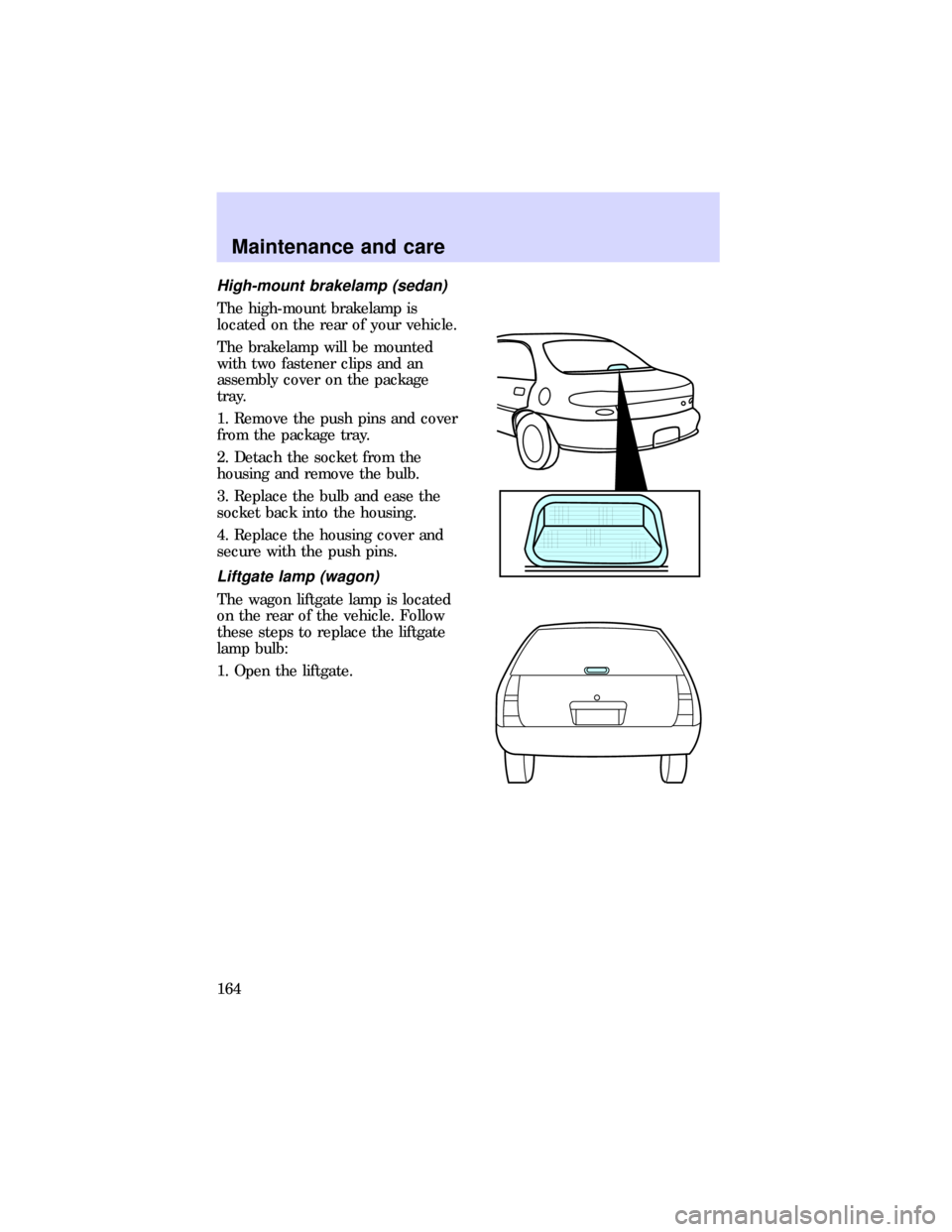
High-mount brakelamp (sedan)
The high-mount brakelamp is
located on the rear of your vehicle.
The brakelamp will be mounted
with two fastener clips and an
assembly cover on the package
tray.
1. Remove the push pins and cover
from the package tray.
2. Detach the socket from the
housing and remove the bulb.
3. Replace the bulb and ease the
socket back into the housing.
4. Replace the housing cover and
secure with the push pins.
Liftgate lamp (wagon)
The wagon liftgate lamp is located
on the rear of the vehicle. Follow
these steps to replace the liftgate
lamp bulb:
1. Open the liftgate.
Maintenance and care
164
Page 172 of 191
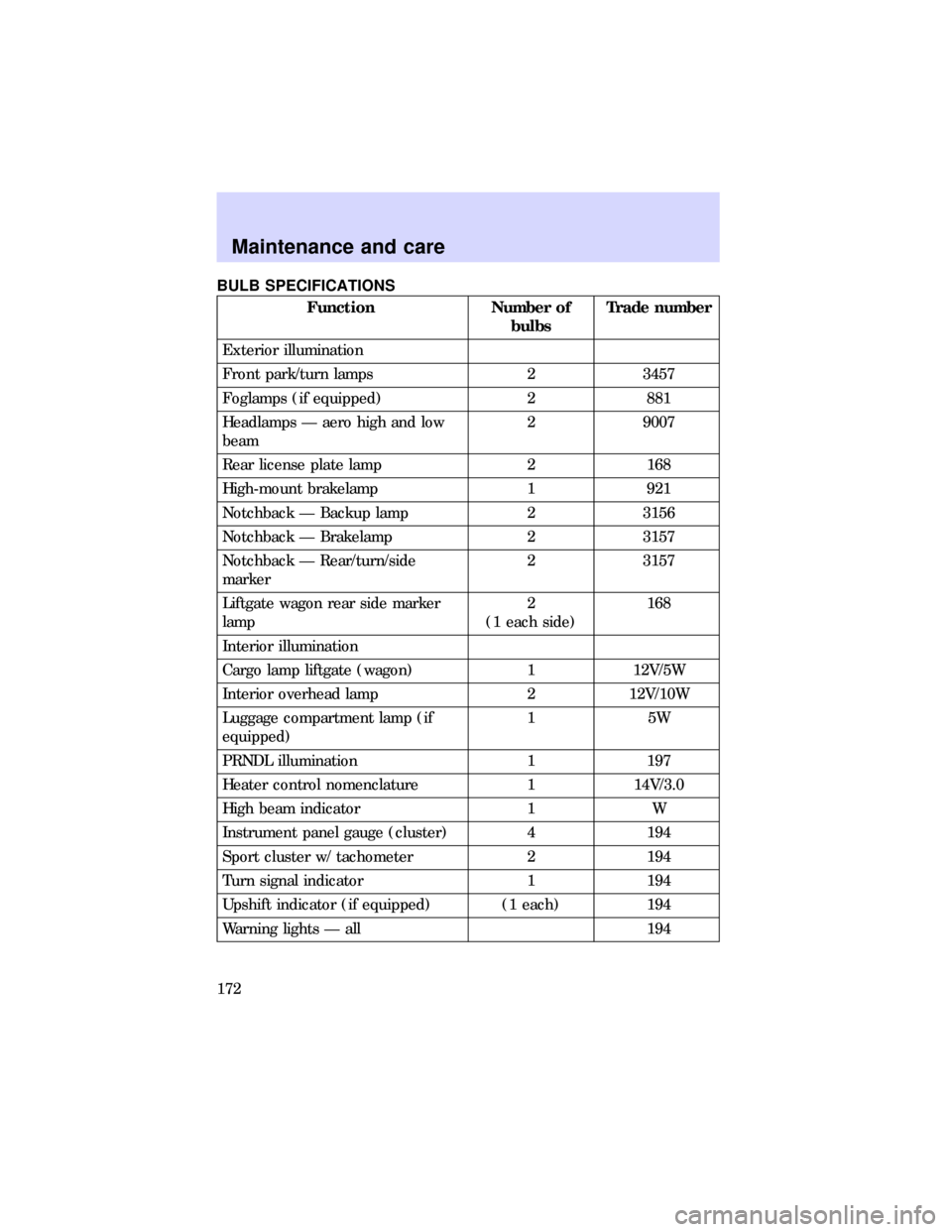
BULB SPECIFICATIONS
Function Number of
bulbsTrade number
Exterior illumination
Front park/turn lamps 2 3457
Foglamps (if equipped) 2 881
Headlamps Ð aero high and low
beam2 9007
Rear license plate lamp 2 168
High-mount brakelamp 1 921
Notchback Ð Backup lamp 2 3156
Notchback Ð Brakelamp 2 3157
Notchback Ð Rear/turn/side
marker2 3157
Liftgate wagon rear side marker
lamp2
(1 each side)168
Interior illumination
Cargo lamp liftgate (wagon) 1 12V/5W
Interior overhead lamp 2 12V/10W
Luggage compartment lamp (if
equipped)15W
PRNDL illumination 1 197
Heater control nomenclature 1 14V/3.0
High beam indicator 1 W
Instrument panel gauge (cluster) 4 194
Sport cluster w/ tachometer 2 194
Turn signal indicator 1 194
Upshift indicator (if equipped) (1 each) 194
Warning lights Ð all 194
Maintenance and care
172
Page 176 of 191
After washing your vehicle, apply
the brakes several times to dry
them.
Repairing paint chips
Minor scratches or paint damage
from road chippings may be
camouflaged with Ford exterior
lacquer touch-up paint,
AL81-XXXX-B or
ALBZ-19500-XXXXA. XXXX
indicates the code, meeting Ford
specification ESR-M2P100-C.
Follow the application instructions
on the product. Be sure to remove
aggressive particles such as bird
droppings, tree resins, insect
remains, tar spots, and road salt,
that may damage your paint.
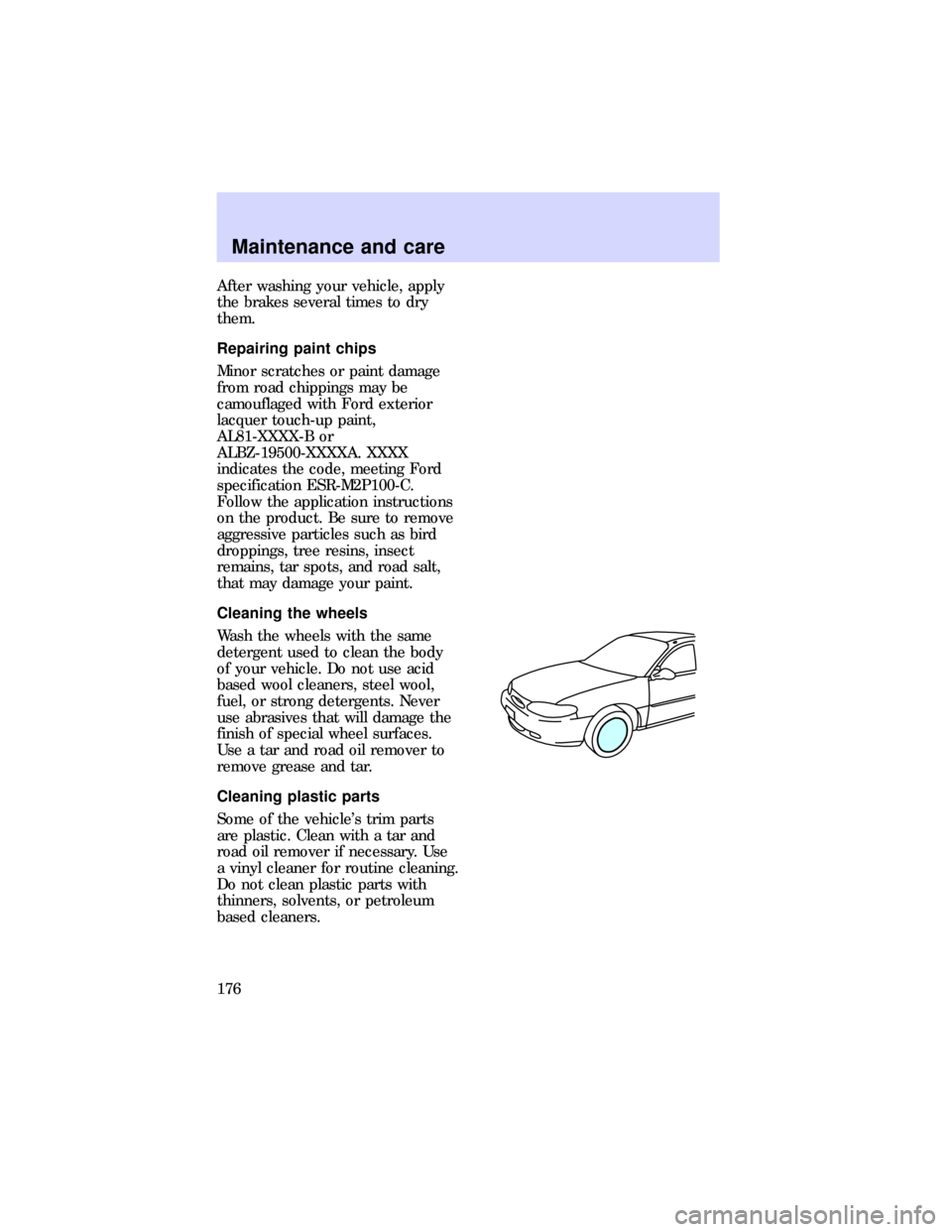
Cleaning the wheels
Wash the wheels with the same
detergent used to clean the body
of your vehicle. Do not use acid
based wool cleaners, steel wool,
fuel, or strong detergents. Never
use abrasives that will damage the
finish of special wheel surfaces.
Use a tar and road oil remover to
remove grease and tar.
Cleaning plastic parts
Some of the vehicle's trim parts
are plastic. Clean with a tar and
road oil remover if necessary. Use
a vinyl cleaner for routine cleaning.
Do not clean plastic parts with
thinners, solvents, or petroleum
based cleaners.
Maintenance and care
176
Page 180 of 191
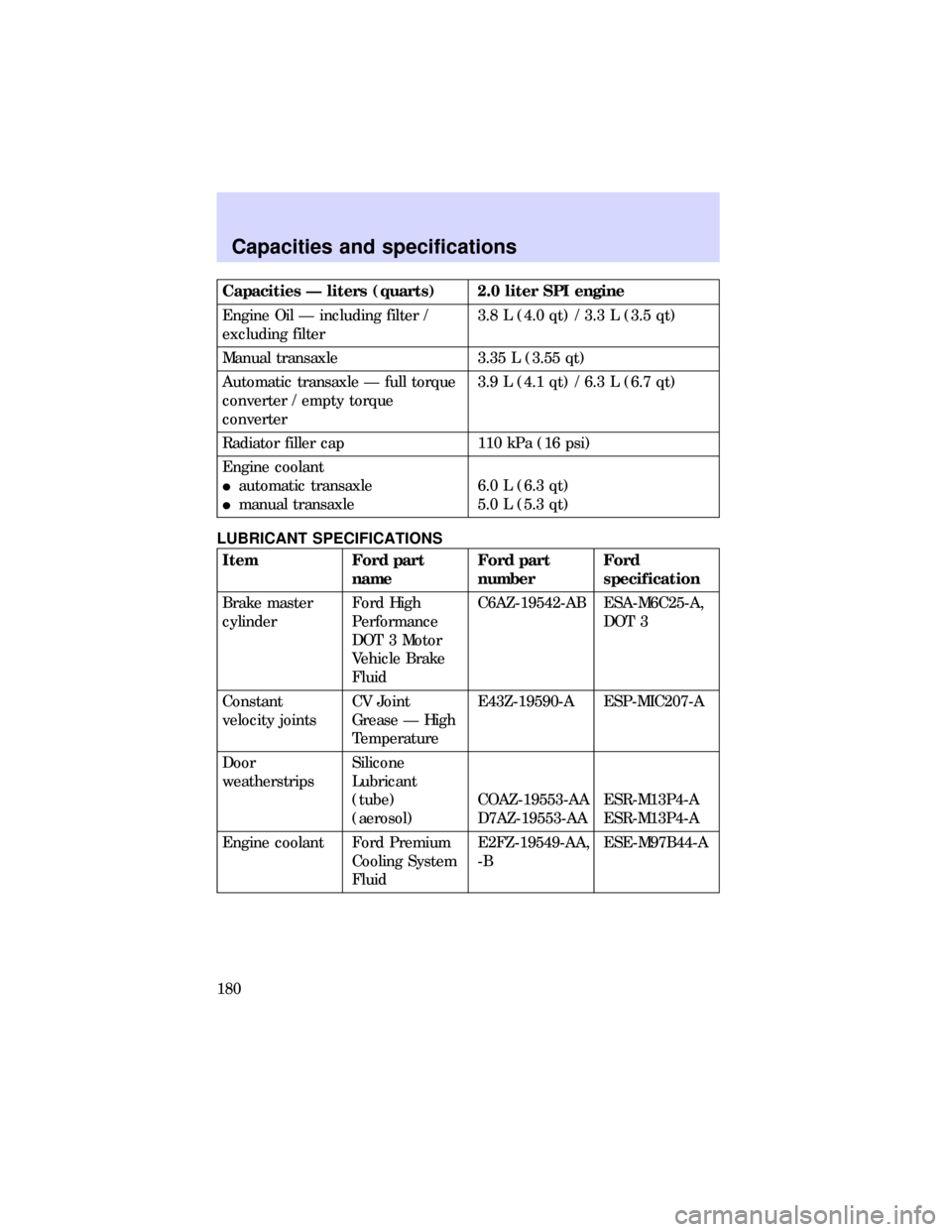
Capacities Ð liters (quarts) 2.0 liter SPI engine
Engine Oil Ð including filter /
excluding filter3.8 L (4.0 qt) / 3.3 L (3.5 qt)
Manual transaxle 3.35 L (3.55 qt)
Automatic transaxle Ð full torque
converter / empty torque
converter3.9 L (4.1 qt) / 6.3 L (6.7 qt)
Radiator filler cap 110 kPa (16 psi)
Engine coolant
Iautomatic transaxle
Imanual transaxle6.0 L (6.3 qt)
5.0 L (5.3 qt)
LUBRICANT SPECIFICATIONS
Item Ford part
nameFord part
numberFord
specification
Brake master
cylinderFord High
Performance
DOT 3 Motor
Vehicle Brake
FluidC6AZ-19542-AB ESA-M6C25-A,
DOT 3
Constant
velocity jointsCV Joint
Grease Ð High
TemperatureE43Z-19590-A ESP-MIC207-A
Door
weatherstripsSilicone
Lubricant
(tube)
(aerosol)COAZ-19553-AA
D7AZ-19553-AAESR-M13P4-A
ESR-M13P4-A
Engine coolant Ford Premium
Cooling System
FluidE2FZ-19549-AA,
-BESE-M97B44-A
Capacities and specifications
180
Page 187 of 191

Aiming headlamps ....................173
Air bag supplemental restraint
system ..........................................62
description ...........................62,63
disposal ......................................63
driver air bag ............................64
indicator light ........................7,64
operation ...................................63
tone generator ..........................64
wearing safety belts .................64
Air cleaner filter .......................145
replacing ..................................146
Air conditioning
manual heating and air
conditioning system .................19
Anti-lock brake system (ABS) ...93
noise ..........................................93
see also Brake ...........................93
warning light .............................94
Anti-theft system ........................45
arming the system ....................50
description ................................50
disarming a triggered system ..52
disarming an untriggered
system .......................................51
warning light ...............................9
Automatic transaxle ...................96
driving with ...............................96
fluid, adding ............................141
fluid, checking ........................140
Battery .......................................142
servicing ..................................143
Brakes ..........................................93
anti-lock .....................................93
anti-lock brake system (ABS)
warning light ...............................9
fluid, checking and adding ....133
power braking ...........................93
Break-in period .............................2
Bulbs, replacing ........................160
halogen ....................................161
headlamps ...............................162high-mount brakelamp ...........164
rear lamps ..........164,165,167,168
specifications ..........................172
Cargo area shade ........................41
Changing a tire .........................114
Charging system warning light ....9
Child safety seats
and air bags ............................185
Childproof locks ..........................33
Cleaning your vehicle ...............175
built-in child seat ...................178
engine compartment ..............177
exterior ....................................177
instrument panel ....................177
plastic parts ............................176
safety belts ..............................178
washing ....................................175
waxing .....................................175
wheels ......................................176
wiper blades ............................178
Climate control system ..............17
air conditioning .........................19
air distribution dial ...................19
temperature dial .......................18
Clutch
fluid ..........................................134
Controls ...................15,31,36,39,40
steering column ........................25
Daytime running light system ...26
Defects, reporting .....................186
Disabled vehicle (see Towing) 123
Driving under special
conditions
towing a trailer .......................105
Emergencies, roadside .............107
Emission control system ...157,158
Engine .................................129,182
check engine warning light .......7
Engine block heater ...................91
Engine coolant
checking and adding ..............136
low coolant warning light ........10
Index
187