Page 5 of 191
* if equipped with air conditioning
HI LO
OFFA/C
MAX
A/C
TUNE
SEEK
SCAN
EJ REW FF
H
M
BAL BASS
TREB
FADE TAPE
AM
FM
–+1
SIDE 1-22
345
6
VOL
PUSH ON
R.DEF
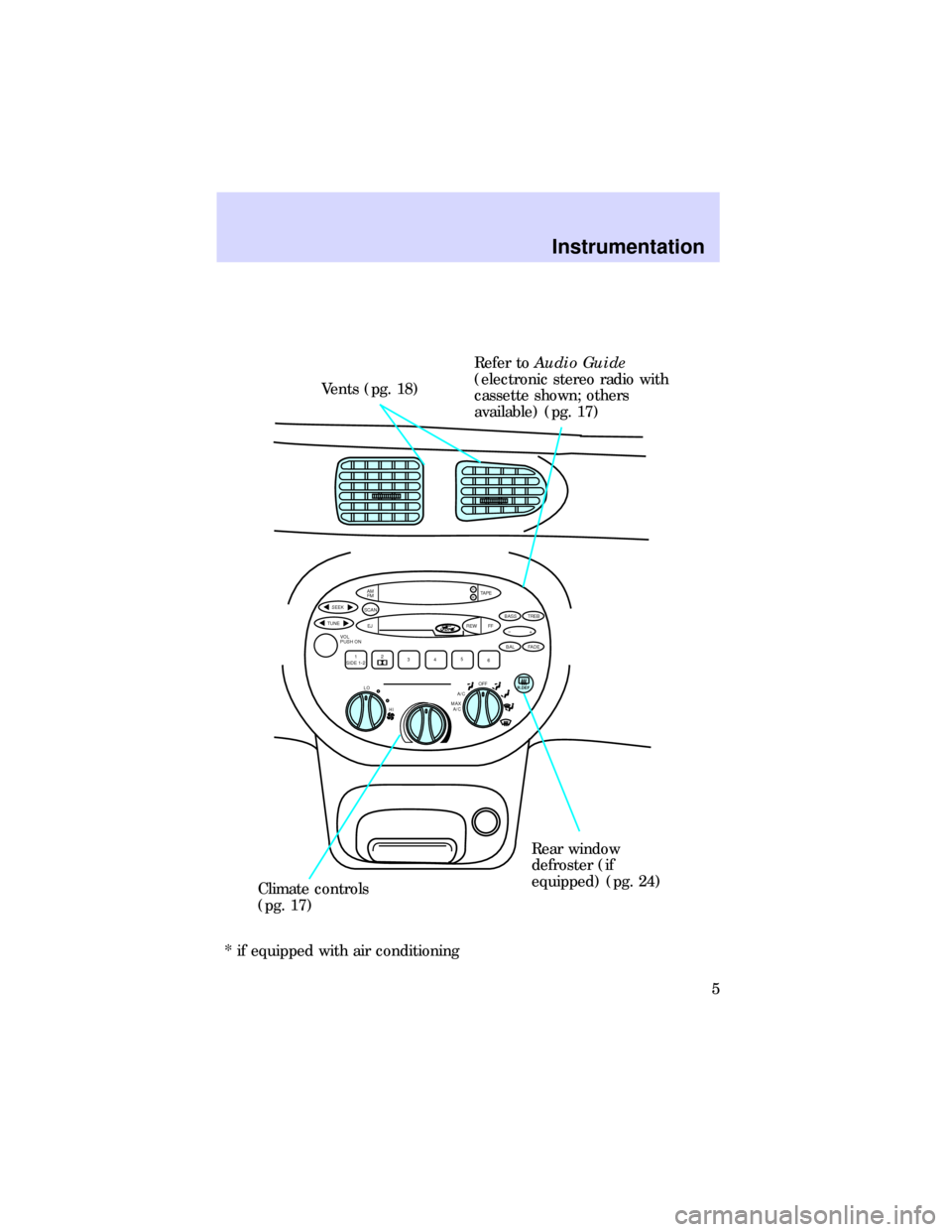
Vents (pg. 18)Refer toAudio Guide
(electronic stereo radio with
cassette shown; others
available) (pg. 17)
Rear window
defroster (if
equipped) (pg. 24)
Climate controls
(pg. 17)
Instrumentation
5
Page 28 of 191
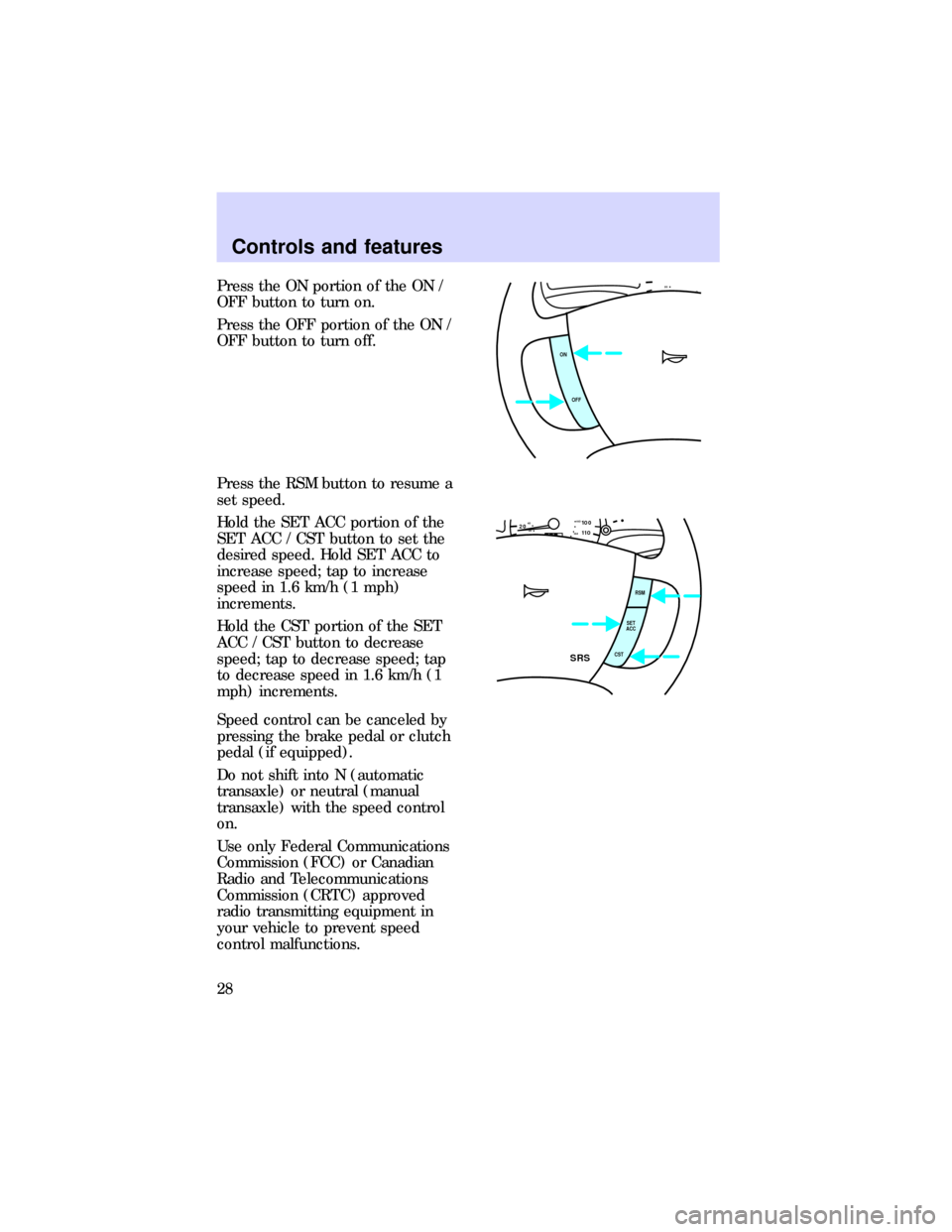
Press the ON portion of the ON /
OFF button to turn on.
Press the OFF portion of the ON /
OFF button to turn off.
Press the RSM button to resume a
set speed.
Hold the SET ACC portion of the
SET ACC / CST button to set the
desired speed. Hold SET ACC to
increase speed; tap to increase
speed in 1.6 km/h (1 mph)
increments.
Hold the CST portion of the SET
ACC / CST button to decrease
speed; tap to decrease speed; tap
to decrease speed in 1.6 km/h (1
mph) increments.
Speed control can be canceled by
pressing the brake pedal or clutch
pedal (if equipped).
Do not shift into N (automatic
transaxle) or neutral (manual
transaxle) with the speed control
on.
Use only Federal Communications
Commission (FCC) or Canadian
Radio and Telecommunications
Commission (CRTC) approved
radio transmitting equipment in
your vehicle to prevent speed
control malfunctions.020
OFF ON
2010 0
11 020 4016 0
18 0
RSM
SET
ACC
CST
SRS
Controls and features
28
Page 46 of 191
cold temperatures) or structures
around the vehicle (buildings,
other vehicles, radio and TV
towers, etc.). Typical operating
range will allow you to be up to 10
meters (33 ft) away from your
vehicle.
Unlocking the doors and wagon
liftgate
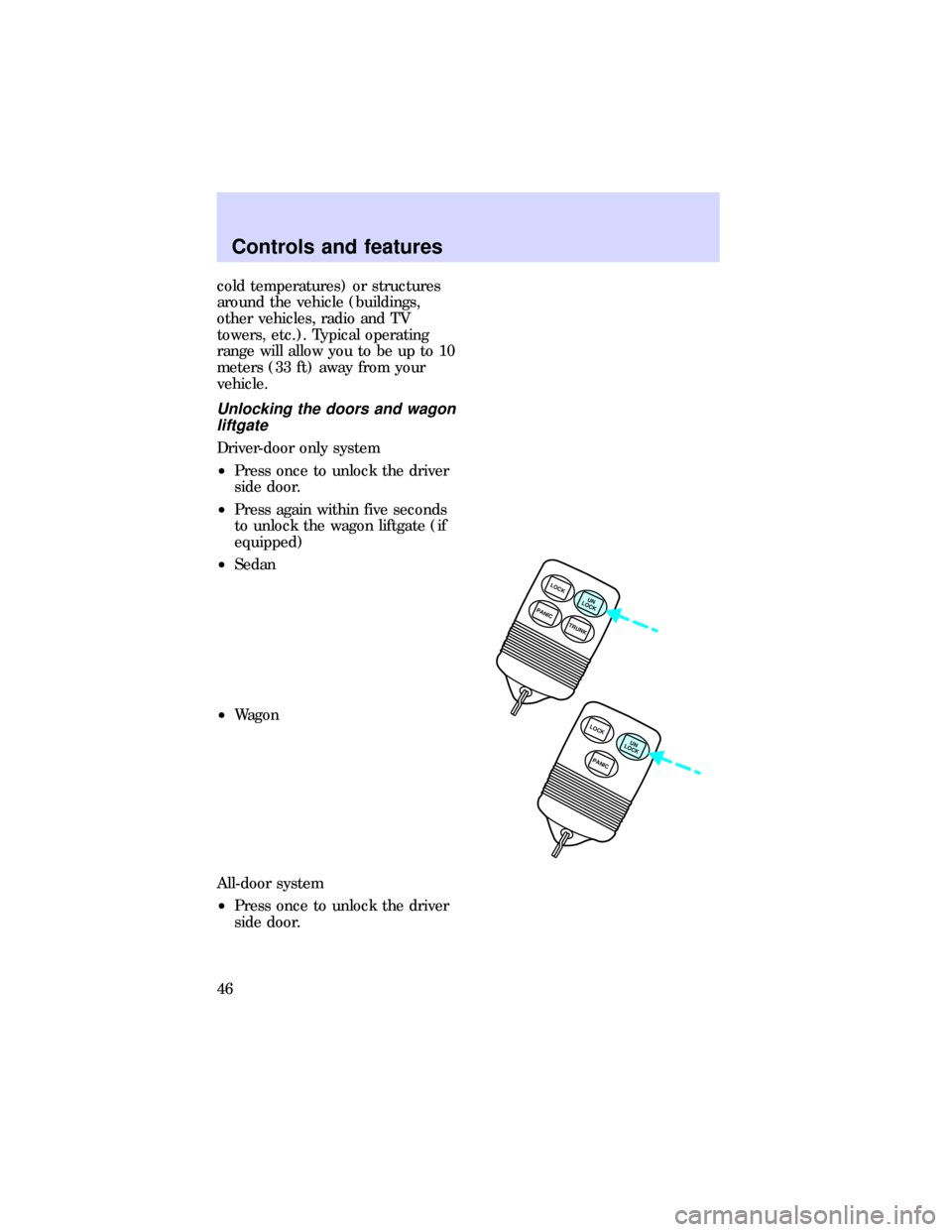
Driver-door only system
²Press once to unlock the driver
side door.
²Press again within five seconds
to unlock the wagon liftgate (if
equipped)
²Sedan
²Wagon
All-door system
²Press once to unlock the driver
side door.
UN
LOCK
LOCK
PANIC
UN
LOCKLOCK
TRUNK
PANIC
Controls and features
46
Page 86 of 191
PREPARING TO START THE
VEHICLE
Engine starting is controlled by the
spark ignition system. This system
meets all Canadian
Interference-Causing Equipment
standard requirements regulating
the impulse electrical field strength
of radio noise.
Before starting the vehicle:
1. Make sure all vehicle occupants
have buckled their safety belts. For
more information on safety belts
and their proper usage, refer to
theSeating and safety restraints
chapter.
2. Make sure the headlamps and
vehicle accessories are off.
If starting a vehicle with an
automatic transaxle:
²Make sure the parking brake
is set.
OFF
Starting
86
Page 111 of 191
Fuse rating Color
10 amp Red
15 amp Blue
20 amp Yellow
30 amp Light Green
30 amp fuse link Pink
40 amp Green
60 amp fuse link Yellow
80 amp fuse link Black
100 amp fuse link Blue
Instrument panel fuse panel
Number Fuse amperage
ratingCircuits protected
1 Stop 15 amp Brakelamps, shift lock
2 Tail 15 amp Instrument cluster
illumination, license
plate lamp, parking
lamps, side marker
lamps, tail lamps,
(radio, climate control
illumination)
3 Sun roof Ð Not used
4 ASC 10 amp Speed control
5 Ð Ð Not used
6 (Door lock) 30 amp Power door locks
7 Horn 15 amp Horn
8 (Air Conditioning) 15 amp A/C, clutch
Roadside emergencies
111
Page 112 of 191
Number Fuse amperage
ratingCircuits protected
9 Meter 10 amp Backup lamps, shift
lock, gauges, speed
control, turn signals,
key-in-ignition
reminder chime
10 Wiper 20 amp Windshield wipers
and washer
11 (Rear wiper) 10 amp Rear wiper and
washer
12 Hazard 15 amp Hazard flashers, turn
signals
13 Room 10 amp Clock, interior lamp,
luggage compartment
lamp, safety belt
warning chime, radio
power
14 Engine 15 amp Engine control system
15 Mirrors 5 amp Power mirrors
16 Ð Ð Not used
17 Ð Ð Not used
18 (Fog) 10 amp Daytime running
lamps / fog lamps
19 Ð Ð Not used
20 Cigar 20 amp Cigar lighter
21 (Radio) 15 amp Radio (Premium
sound)
Roadside emergencies
112
Page 145 of 191
of your vehicle may be adversely
affected until the idle is
eventually relearned.
²If the battery has been
disconnected or a new battery
has been installed, the clock and
preset radio stations must be
reset once the battery is
reconnected.
²Always dispose of used
automotive batteries in a
responsible manner. Follow your
community's standards for
disposal. Call your local
recycling center to find out
more about recycling automotive
batteries.
CHECKING AND CHANGING
YOUR AIR FILTER
If the vehicle is operated in very
dusty or sandy areas, replace the
filter more often than the
recommended intervals.
Do not drive without an air
filter; this could result in
excessive engine wear.
Maintenance and care
145