Page 99 of 191
Manual
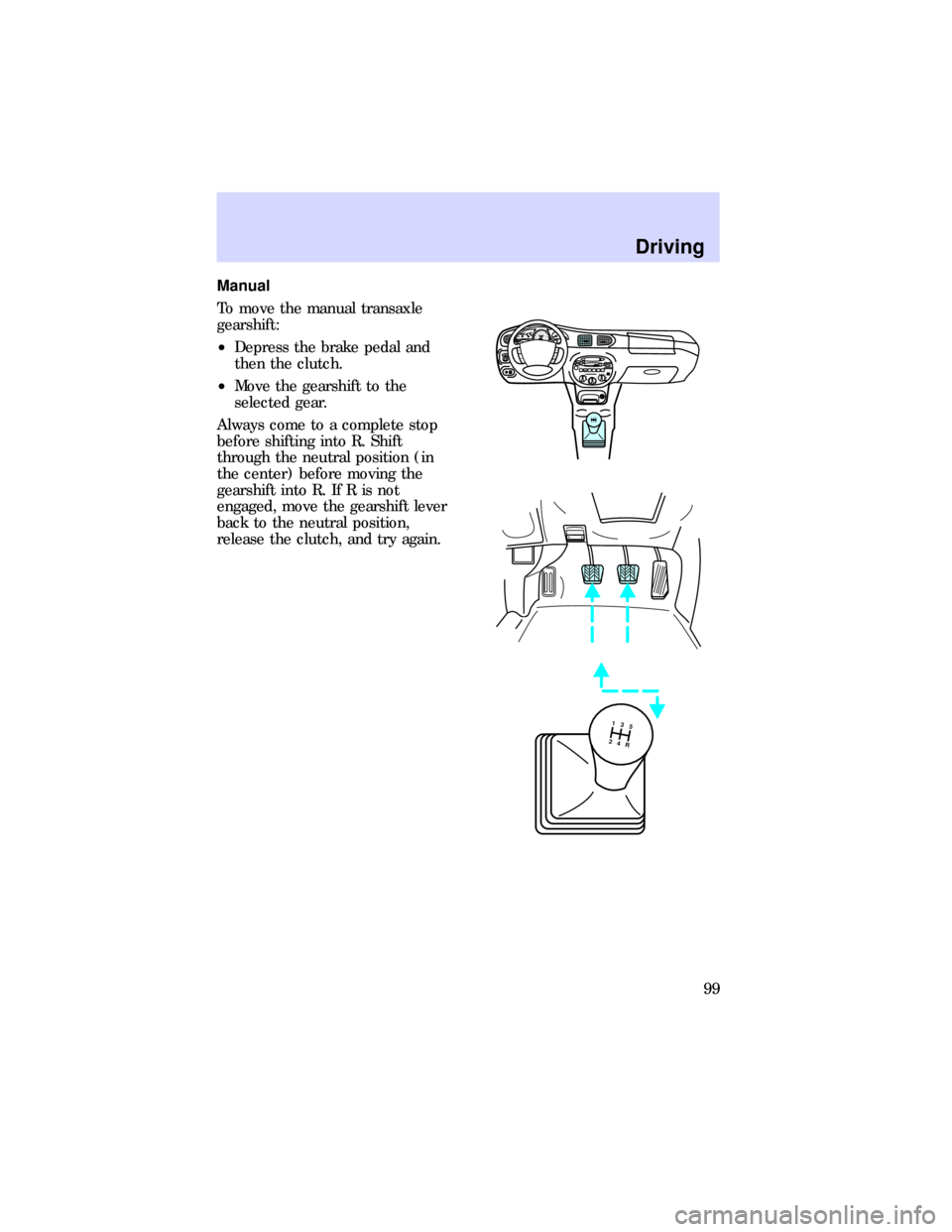
To move the manual transaxle
gearshift:
²Depress the brake pedal and
then the clutch.
²Move the gearshift to the
selected gear.
Always come to a complete stop
before shifting into R. Shift
through the neutral position (in
the center) before moving the
gearshift into R. If R is not
engaged, move the gearshift lever
back to the neutral position,
release the clutch, and try again.
HI LOOFF*A/C*MAX
A/CTUNE
DISCS
SEEK
TUNE
SCAN
EJ REW FF
BAL BASSTREBFADE TAPE
CD AM
FM
–+1
SIDE 1-22
345
COMP1
SIDE 1-2VOL–
PUSH ONLMIRRORR0000000002030405060
70
80
90
10 0
11 020 40608010 0
12 0
16 0
18 0 140FUEL FILLCHEF1/22
13RPM x 1000RESET
SET
ACC
SET XXXX XXXOFF
4 25 3 1
R
2INT
1 OFF MIST
4 25 3 1
R
Driving
99
Page 100 of 191
Upshifting
For normal acceleration:
Upshift from... At the following speed:
1 to 2 22 km/h (14 mph)
2 to 3 40 km/h (25 mph)
3 to 4 58 km/h (36 mph)
4 to 5 72 km/h (45 mph)
For cruising:
Upshift from... At the following speed:
1 to 2 18 km/h (11 mph)
2 to 3 35 km/h (22 mph)
3 to 4 51 km/h (32 mph)
4 to 5 66 km/h (41 mph)
Upshift light (if equipped)
Thelight in the instrument
cluster illuminates to indicate
when to shift for the best fuel
economy. The vehicle will not be
harmed if the transaxle is not
shifted when the light illuminates,
but the vehicle will use more fuel.
The
light can be ignored when
you are:
²downshifting
²driving on steep hills
²using the engine to brake the
vehicle
²seeking more power for a
difficult acceleration
To maximize gearshift
performance:
Driving
100
Page 101 of 191

²Do not drive with your foot
resting on the clutch pedal and do
not use the clutch pedal to hold
the vehicle at a standstill. These
actions will reduce clutch life.
²Downshift on steep hills to
reduce the vehicle's chances of
stalling and to prevent
unnecessary brake wear.
LOADING YOUR VEHICLE
Before loading a vehicle, familiarize
yourself with these terms:
²Base curb weightÐ weight of
the vehicle including any
standard equipment, fluids,
lubricants, etc. It does not
include passengers or
aftermarket equipment.
²PayloadÐ combined maximum
allowable weight of cargo,
passengers and optional
equipment.
²GVW (Gross vehicle weight)
Ðbase curb weight plus the
payload weight (including
passengers, cargo and optional
equipment). Remember, the
GVW is not a limit or a
specification.
²GVWR (Gross vehicle weight
rating)Ð maximum total
weight of the base vehicle,
passengers, optional equipment,
and cargo. The GVWR is specific
to each vehicle and is listed on
the Safety Compliance
Certification Label on the
driver's door pillar.
Driving
101
Page 104 of 191
and change the weight on the
hitch.
Using trailer brakes
Use electric brakes or manual,
automatic, or surge-type hydraulic
brakes that meet federal and local
regulations. Install and adjust the
brakes according to the
manufacturer's instructions.
Do not connect a trailer's
hydraulic brake system
directly to your vehicle's brake
system. Your vehicle may not
have enough braking power and
your chances of having a
collision greatly increase.
Using safety chains
Always connect the trailer's safety
chains to the vehicle. To connect
the chains, cross the chains under
the trailer tongue and attach to the
vehicle frame or hook retainers
(not the bumper). Make sure there
is enough slack to allow the vehicle
to turn corners.
Using trailer lamps
See your local trailer dealer or
rental agency for the proper
instructions and equipment for
hooking up trailer lamps.
Do not hook the trailer lights
directly into the vehicle's lighting
system wiring. If the trailer lamps
are not installed properly, the
warning lights in the instrument
cluster may not work properly.
Driving
104
Page 105 of 191

Driving while towing a trailer
Do not drive faster than 88 km/h
(55 mph) while towing a 454 kg
(1000 lb) trailer. Do not drive
faster than 72 km/h (45 mph) with
any weight trailer while towing in
hilly country or on hot days.
Speed control (if equipped) may
not work properly while towing on
very long, steep grades.
If driving with an automatic
transaxle:
²use D or L rather than
Dwhile towing up or down
steep hills.
²anticipate stops and brake
gradually.
If driving with a manual transaxle:
²select a gear that avoids jerking
or excessive engine speed.
²avoid driving excessively in first
or second gear. In first or
second gear the trailer may be
too big or too heavily loaded for
the vehicle drivetrain.
²shift to a lower gear while
towing up or down steep hills.
²anticipate stops and brake
gradually.
Servicing while towing
If you tow a trailer for long
distances, your vehicle requires
more frequent service than a
vehicle not used for towing. Refer
to theService Guidefor more
information.
Driving
105
Page 106 of 191
Towing behind a recreational
vehicle (RV)
Do not tow your vehicle behind
another vehicle, such as an RV,
unless front wheel dollies are used.
Luggage rack (if equipped)
Load luggage as far back as it will
safely go on the rack without
causing the vehicle to exceed the
gross vehicle weight rating
(GVWR) or gross axle weight
rating (GAWR).
FUEL CONSUMPTION
Fuel economy can be improved by
avoiding:
²lack of regular, scheduled
maintenance
²excessive speed
²rapid acceleration
²driving with the brake pedal
depressed
²sudden stops
²extended engine idling
²use of speed control in hilly
terrain
²extended use of the air
conditioner, defroster, rear
window defroster and other
accessories
²underinflated tires
²heavy loads
²aftermarket add-ons such as
bike, ski or luggage racks, bug
deflectors, etc.
Driving
106
Page 111 of 191
Fuse rating Color
10 amp Red
15 amp Blue
20 amp Yellow
30 amp Light Green
30 amp fuse link Pink
40 amp Green
60 amp fuse link Yellow
80 amp fuse link Black
100 amp fuse link Blue
Instrument panel fuse panel
Number Fuse amperage
ratingCircuits protected
1 Stop 15 amp Brakelamps, shift lock
2 Tail 15 amp Instrument cluster
illumination, license
plate lamp, parking
lamps, side marker
lamps, tail lamps,
(radio, climate control
illumination)
3 Sun roof Ð Not used
4 ASC 10 amp Speed control
5 Ð Ð Not used
6 (Door lock) 30 amp Power door locks
7 Horn 15 amp Horn
8 (Air Conditioning) 15 amp A/C, clutch
Roadside emergencies
111
Page 114 of 191
Number Fuse amperage
ratingCircuits protected
4 BTN 40 amp Passenger
compartment fuses 1,
2, 6, 12, 13, 7
5 (ABS) 60 amp Anti-lock brake
system (ABS)
6 Cooling fan 40 amp Cooling fan
7 Head Ð Head lamp relay
8 Not used Ð Ð
9 OBD II 10 amp On-board diagnostics
10 Fuel pump 20 amp Fuel pump
11 Head RH 20 amp Passenger side
headlamps
12 Head LH 20 amp Driver side headlamps
CHANGING THE TIRES
Temporary spare tire
information
The temporary spare tire for your
vehicle is labeled as such. It is
smaller than a regular tire and is
designed for emergency use only.
If you use the temporary
spare tire continuously or
do not follow these precautions,
the tire could fail, causing you to
lose control of the vehicle,
possibly injuring yourself or
others.
When driving with the temporary
spare tire,do not:
Roadside emergencies
114