Page 183 of 388

Once you are moving on the freeway, make certain you
allow a reasonable following distance. Expect to move
slightly slower at night.
When you want to leave the freeway, move to the proper
lane well in advance. If you miss your exit, do not,
under any circumstances, stop and back up. Drive on to
the next exit.
The exit ramp can be curved, sometimes quite sharply.
The exit speed is usually posted.
Reduce your speed according to your speedometer, not
to your sense of motion. After driving for any distance
at higher speeds, you may tend to think you are going
slower than you actually are.
Before Leaving on a Long Trip
Make sure you’re ready. Try to be well rested. If you
must start when you’re not fresh
-- such as after a day’s
work
-- don’t plan to make too many miles that first part
of the journey. Wear comfortable clothing and shoes you
can easily drive in.
Is your vehicle ready for a long trip? If you keep it
serviced and maintained, it’s ready
to go. If it needs
service, have it done before starting out. Of course,
you’ll find experienced and able service experts in Geo
dealerships all across North America. They’ll be ready
and willing
to help if you need it.
Here are some things you can check before a trip:
0
0
a
0
0
0
a
Windshield Washer Fluid: Is the reservoir full? Are
all windows clean inside and outside?
Wiper Blades: Are they in good shape?
Fuel, Engine Oil, Other Fluids: Have you checked
all levels?
Lamps: Are they all working? Are the lenses clean?
Tires: They are vitally important to a safe,
trouble-free trip. Is the tread good enough for
long-distance driving? Are the tires all inflated to the
recommended pressure?
Weather Forecasts: What’s the weather outlook
along your route? Should
you delay your trip a short
time
to avoid a major storm system?
Maps: Do you have up-to-date maps?
4-37
I
ProCarManuals.com
Page 190 of 388

Run your engine only as long as you must. This saves
fuel. When you run the engine, make it go a little faster
than just idle. That is, push the accelerator slightly. This
uses less fuel for the heat that you get and it keeps the
battery charged. You will need a well-charged battery to
restart the vehicle, and possibly for signaling later on with your headlamps. Let the heater run for awhile.
Then, shut the engine off and close the window almost
all the way to preserve the heat. Start the engine again
and repeat this only when you feel really uncomfortable
from the cold. But
do it as little as possible. Preserve the
fuel as long as you can.
To help keep warm, you can get
out of the vehicle and do some fairly vigorous exercises
every half hour or
so until help comes.
Re - -1tional Vehicle Towing
There may be times when you want to tow your Geo
behind another vehicle for use at your destination. Be
sure to use the proper towing equipment designed
for
recreational towing. Follow the instructions for the
towing equipment.
Towing Your Vehicle frc -:: :I: I Rc 1-r
The best way to tow your Geo is from the rear. Follow
these steps:
1. Put the rear wheels on a dolly.
4-44
ProCarManuals.com
Page 206 of 388

2. Get the vehicles close enough so the jumper cables
can reach, but be sure the vehicles aren’t touching
each other.
If they are, it could cause a ground
connection you don’t want. You wouldn’t be able
to
start your Geo, and the bad grounding could damage
the electrical systems.
3. Turn off the ignition on both vehicles. Unplug
unnecessary accessories plugged into the cigarette
lighter. Turn
off all lamps that aren’t needed as well
as radios. This will avoid sparks and help save both
batteries.
In addition, it could save your radio!
NOTICE:
If you leave your radio on, it could be badly
damaged. The repairs wouldn’t be covered by
your warranty.
4. Open the hoods and locate the batteries. Find the
positive
+ and negative (-) terminals on each battery.
I A CAUTION:
I
An electric fan can start up even when the
is not running and can injure you. Keep hands,
clothing and
tools away from any underhood
electric fan.
-
CAUTION:
If your vehicle has air conditioning, the auxiliary
electric fan under the hood can start
up even
when the engine
is not running and can injure
you. Keep hands, clothing and tools away from
any underhood electric fan.
5-4
ProCarManuals.com
Page 207 of 388
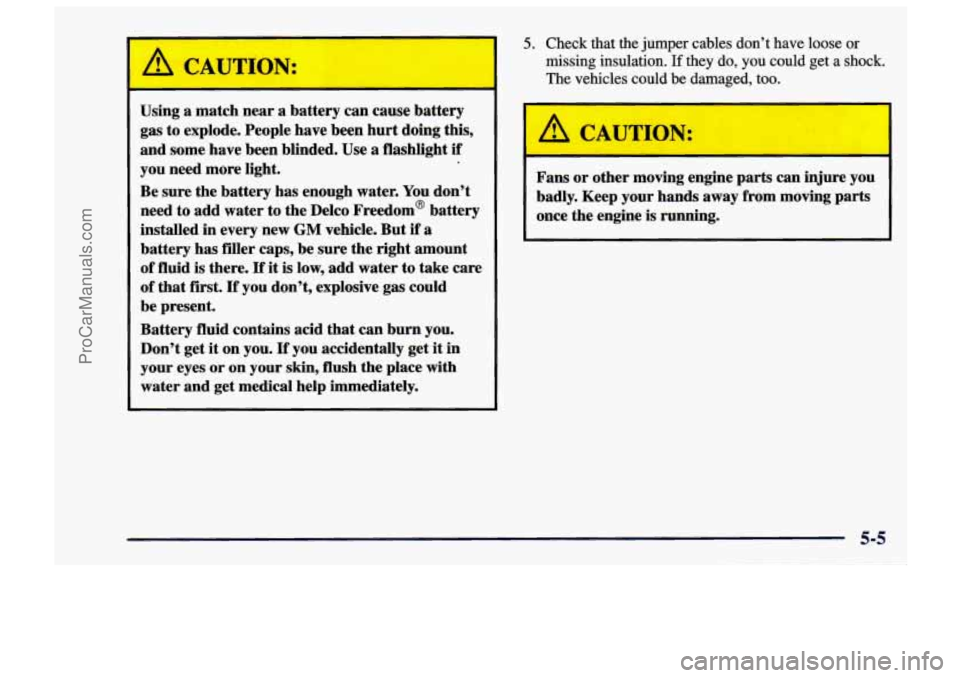
Using a match near a battery can cause battery
gas to explode. People have been hurt doing this,
and some have been blinded. Use a flashlight
if
you need more light.
Be sure the battery has enough water. You don’t
need to add water to the Delco Freedom@ battery
installed in every new
GM vehicle. But if a
battery has filler caps, be sure the right amount
of
fluid is there. If it is low, add water to take care
of that first. If you don’t, explosive gas could
be present.
Battery fluid contains acid that can burn you.
Don’t get
it on you. If you accidentally get it in
your eyes or
on your skin, flush the place with
water and get medical help immediately.
5. Check that the jumper cables don’t have loose or
missing insulation. If they do, you could get a shock.
The vehicles could be damaged, too.
A CAUTION:
-
Fans or other moving engine parts can injure you
badly. Keep your hands away from moving parts
once the engine is running.
5-5
I
ProCarManuals.com
Page 237 of 388
Rocking Your Vehicle To Get It Out
First, turn your steering wheel left and right. That will
clear the area around your front wheels. Then shift back
and forth between REVERSE
(R) and a forward gear (or
with a manual transmission, between FIRST (1) or
SECOND
(2) and REVERSE(R)), spinning the wheels
as little
as possible. Release the accelerator pedal while
you shift, and press lightly
on the accelerator pedal
when the transmission is
in gear. If that doesn’t get you
out after a few tries, you may need
to be towed out, Or,
you can use your recovery hooks if your vehicle has
them. If you do need to be towed
out, see “Towing Your
Vehicle”
in the Index.
Using the Recovery Hooks
Your vehicle is equipped with recovery hooks. The
recovery hooks are provided
at the front and rear of your
vehicle. You may need to
use them if you’re stuck
off-road and need to be pulled
to some place where you
can continue driving.
5-35
I
ProCarManuals.com
Page 244 of 388

The cap is behind a hinged door on the passenger’s side
of your vehicle. On four-door models, use the key to the
vehicle to unlock the
fuel door.
To take off the cap, turn it slowly
to the left
(counterclockwise).
1 /1 CAUTION:
If you get gasoline on yourself and then
something ignites it, you could be badly burned.
Gasoline can spray out on you
if you open the
fuel filler cap
too quickly. This spray can happen
if your tank is nearly full, and is more likely in
hot weather. Open the fuel filler cap slowly and
wait for any “hiss” noise
to stop. Then unscrew
the cap all the
way.
Be careful not to spill gasoline. Clean gasoline from
painted surfaces
as soon as possible. See “Cleaning the
Outside of Your Geo”
in the Index. When you
put the cap back on, turn it to the right
(clockwise)
until you hear at least three clicks. Make
sure you
fully install the cap. The diagnostic system can
determine
if the fuel cap has been left off or improperly
installed. This would allow fuel to evaporate into the
atmosphere. See “Malfunction Indicator Lamp”
in
the Index.
I
NOTICE:
If you need a new cap, be sure to get the right
type. Your dealer can get one for you. If you get
the wrong type, it may not fit or have proper
venting. This may cause
your malfunction
indicator lamp to light and your fuel tank and
emissions system may be damaged. See
“Malfunction Indicator Lamp” in the Index.
6-6
ProCarManuals.com
Page 248 of 388
Before closing the hood, be sure all the filler caps
are on.
Then lift the hood to relieve pressure
on the hood prop.
Remove the hood prop from the slot in the hood and
return the prop to its retainer. Then let the hood down
and close it firmly.
Engine Oil
If the engine oil pressure
light
on the instrument
panel comes on, it means
you need to check your
engine oil
level right away.
For more information, see “Engine Oil Pressure Light”
in the Index. You should check your engine oil level
regularly; this is an added reminder. It’s
a good idea
to check your engine oil every time you
get fuel. In order
to get an accurate reading, the oil must
be warm and
the vehicle must be on level ground.
Turn off the engine and
give the oil a few minutes
to drain back into the oil
pan. If
you don’t, the oil
dipstick might not show the
actual level.
6-10
ProCarManuals.com
Page 261 of 388

Front Axle
When to Check and Change Lubricant
Refer to the Maintenance Schedule to determine how
often to check the lubricant and when to change it. See
“Periodic Maintenance Inspections” and “Scheduled
Maintenance Services” in the Index.
How to Check Lubricant
If the differential is at operating temperature (warm),
add enough lubricant to raise the level to the bottom of
the filler plug
hole.
If the differential is cold, add enough lubricant to raise
the level to 1/2 inch
(I 2 mm) below the filler plug hole.
What to Use
Refer to the Maintenance Schedule to determine what
kind
of lubricant to use. See “Recommended Fluids and
Lubricants”
in the Index.
Engine Coolant
The following explains your cooling system and how to
add coolant when it is low. If you have a problem with
engine overheating, see “Engine Overheating” in
the Index.
If the level is below the bottom of the filler plug hole,
you’ll need to add some lubricant.
A 50/50 mixture of water and the proper coolant will:
0 Give freezing protection down to -33°F (-36°C).
0 Give boiling protection up to 258°F (125°C).
0 Protect against rust and corrosion.
0 Help keep the proper engine temperature.
Let the warning lights and gages work as
they should.
6-23
I
ProCarManuals.com