Page 170 of 402
Downloaded from www.Manualslib.com manuals search engine Hydroplaning
Hydroplaning usually happens .at higher s.peeds. There
just isn’t a hard and fast rule about hydroplanirgi The.
best advice is to slow down whenit is raining.
Driving Through Deep Standing Watw
NOTICE:
If you drive too quickly through deep puddles or
standing, water; water
can come in through your
engine’s air intake and badly damage your
engine. Never driv.e through water that is slightly
lower than the underbody
of your vehicle. If’you
can’t avoid deep puddles
or standing water, drive
through them very
slowly.
Some 0the.r Rainy Weat
Besides slowi~~g down, allow some extra following
distance.
And be especially careful when you pass
another vehicle,. Allow yourself more dear room
ahead, and be prepared to have y~ur view restricted
by mad spray.
Have good tires with proper tread depth. (See
“Tires”
in the Index.)
4-33
Page 171 of 402
Downloaded from www.Manualslib.com manuals search engine C.ity Driving.
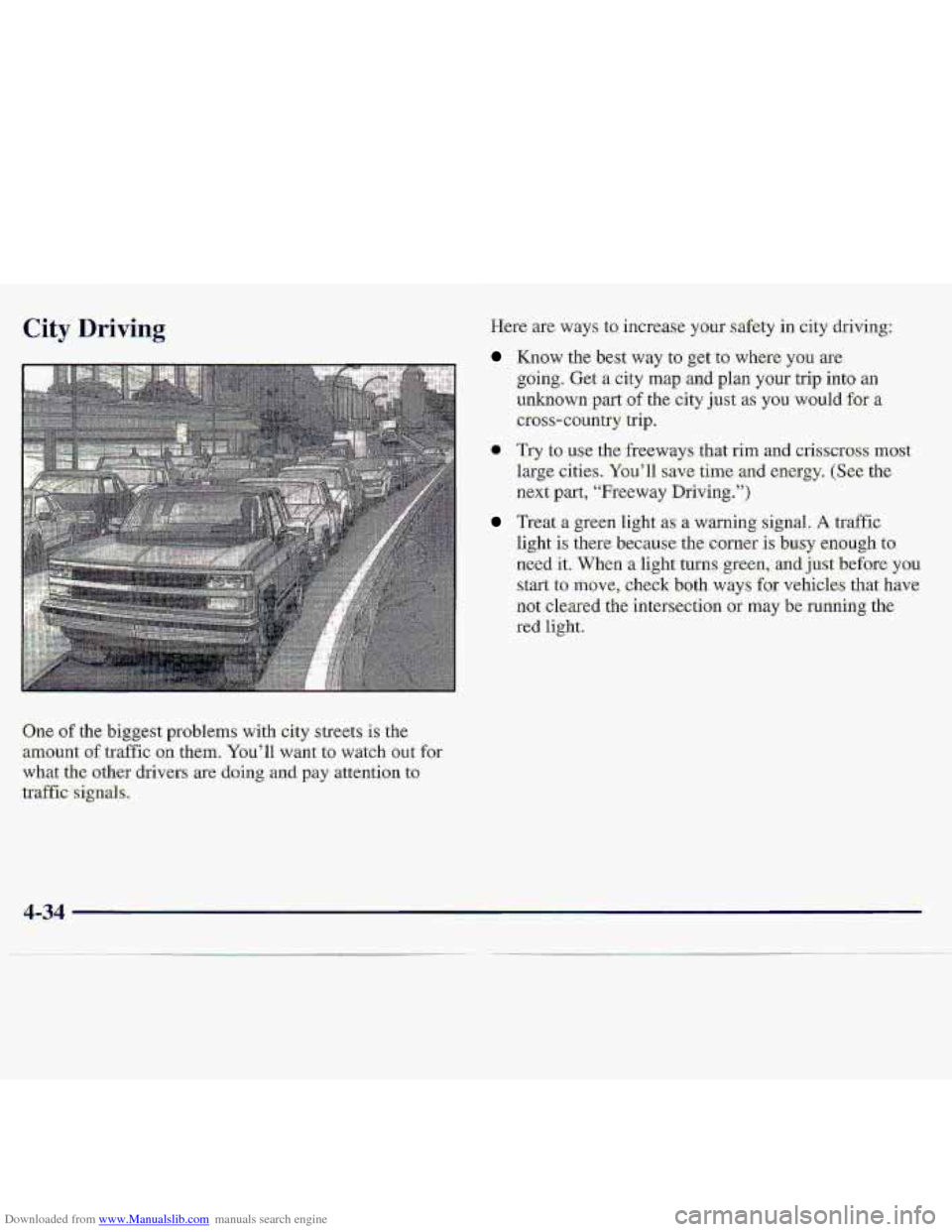
Orkof the bigg.est problems with city streets is the
:amount of traffic on them. You’ll want to watch o.ut for
what the other drivers are doing and pay attention to
traffic -.signals.
Here -are ways to increase y.ou safety in city driving.:
.Know the best way to get to where you are.
going, Get a city map and plan your trip into an
unknown part .of the city just as you wo.uld for a
cross-country trip.
m Try to use the freeways that-rim and.erisscr.oss mmst
large &tie-s. You’ll save time -and energy (See. the
next part, “Freeway Driving.”)
Treat a green light as a warning signal. A traffic
ligh.t-is there because the corner is busy emugh to,
need it. When a light turns gre,en, and just before you
start to Iimve, check both ways for vehicle-s that have
not cleared the intersection Or may be running the’
red li-ght.
4-34
Page 176 of 402
Downloaded from www.Manualslib.com manuals search engine Winter Driving
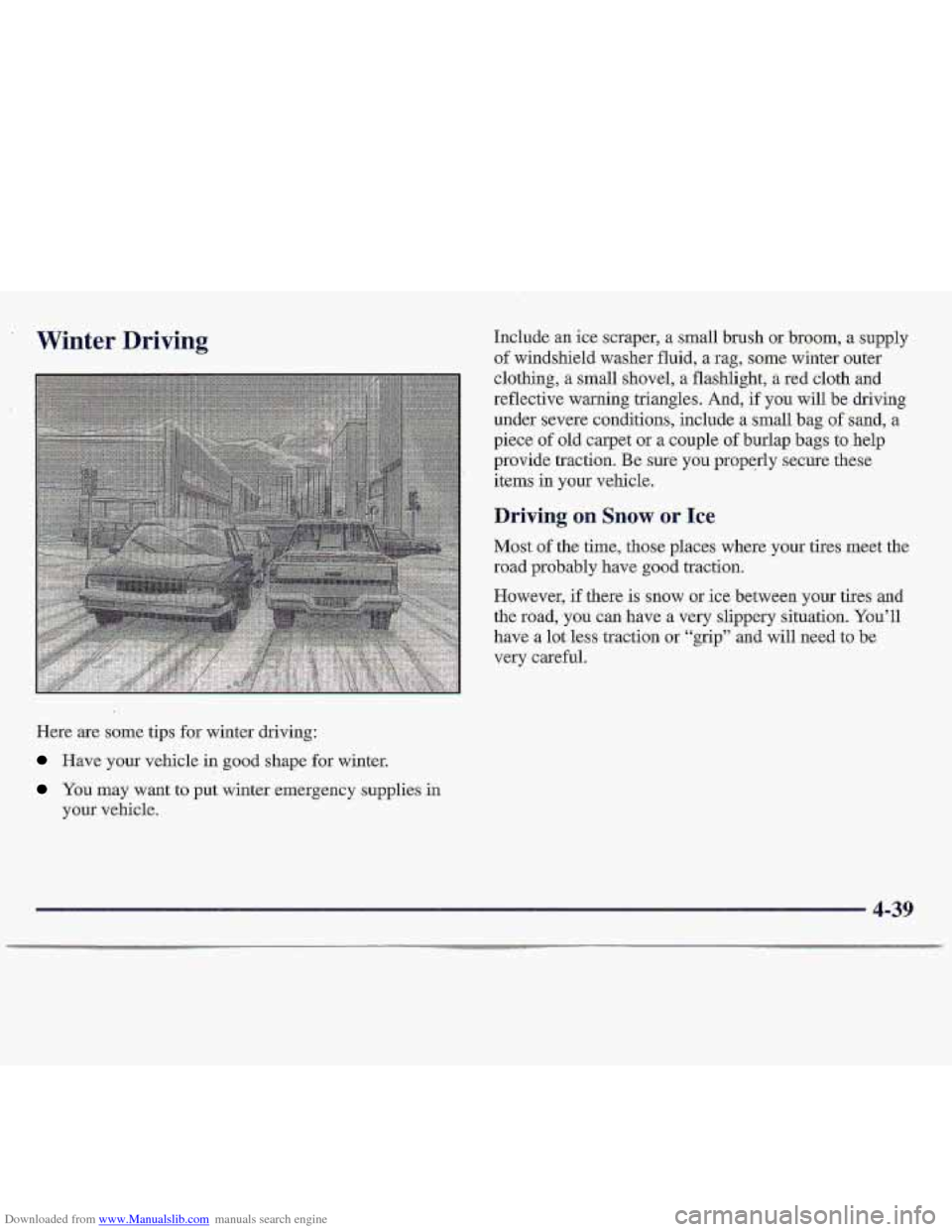
Here are some tips for winter driving:
Have your vehicle in good shape for winter.
You may want to put winter emergency supplies in
your vehicle. Include
an ice scraper, a small brush. or
broom, n supply
of windshield washer fluid, a rag, some winter outer
clothing,
a small shovel, a flashlight, a red cloth and
reflective warning triangles. And,
if you will be driving.
under severe conditions, include-a small bag
of sand, a
piece
of old carpet or a couple of burlap bags to help
provide traction. Be sure you properly secure these
items in your vehicle.
Driving on Snow or Ice
Most of the time, those places where your tires meet the
road probably have good traction.
However,
if there is snow or ice between your tires and
the road, you can have
a very slippery situation. You’ll
have a
lot less traction or “grip” and will need to be
very careful.
4-39
Page 179 of 402
Downloaded from www.Manualslib.com manuals search engine Snow can trap exhaust gases under yo.ur vehicle.
This.can cause
deadly CO (carbon rncmoxide) gas
to get: inside. CO could overcome you and kill
you.
'You can't .see it or smell it, so you might not
know it is in your vehicle. Clear away snow from
aruund the. base of your vehicle, especially any
that
is blocking your exhaust pipe. And check
around again
from time to time- to be.sure snow
doesn't col1ect:there.
Open a window just a, little on the side of the
vehicle that% away
froin the wind. This will help
keep
CO out.
Run your engine o111y as long as you h~ust. This s&veS-
fu.eL When you run the engine, make it g.-a little faster
than just idle. That is, push. the, accelerator..slightIy. This
uses less fuel far the heat that .you get and it keeps- the.
battery
charg.ed. You willl neecia well-charged battery 'to
restart the vehicle, and possibly for signaling later an
with. your headamps.. Let the heatex run for a while.
Then,. shut the-engine off and dose the window almost
all the way to' p&erve the heat. Start the e.ngine again
and repe.at
.this only when you feel ceally qxkbmfortable
from the cold. But. do it as little as possible, Preserve the
fuel as- long- as you can. To help keep warm, you can get
out of the vehicle. and do some .faidy vlgorous -exercises
every half how os so until help comes.
Page 202 of 402
Downloaded from www.Manualslib.com manuals search engine 4. Open the hoods and locate the batteries. Find
the positive
(+) and negative (-) terminals on
each battery.
Using a match near .a battery can cause battery
gas to explode. People have been hurt doing this,
and some have been blinded. Use a flashiight
if
you need more light.
Be sure the battery has enough water.
You don’t
need to add water
to the Delco Freedom@ battery
installed
in every new GM vehicle. But if a
battery has filler caps, be sure the right amount
of fluid is there. .If it is‘low, add water to take care
of that fist, If you don’t, explosive gas could
be present.
Battery
fluid contains acid that can burn you.
Don’t get it on you. If you accidentally get it in
your eyes or on your skin, flush the place with
water and get medical help immediately.
5. Check that the jumper cables don’t have loose or
missing insulation.
If they do, you could. get a shock.
The-vehicles could be damaged too.
Before you connect the cables, here are some- basic
things
you should know. Positive (+> will ga
to positive (+) and negative (-) will go to a
metal engine
part. Don’t connect positive (+) to
negative
(-) or you’ll get a short that would damage
the battery and maybe other parts too.
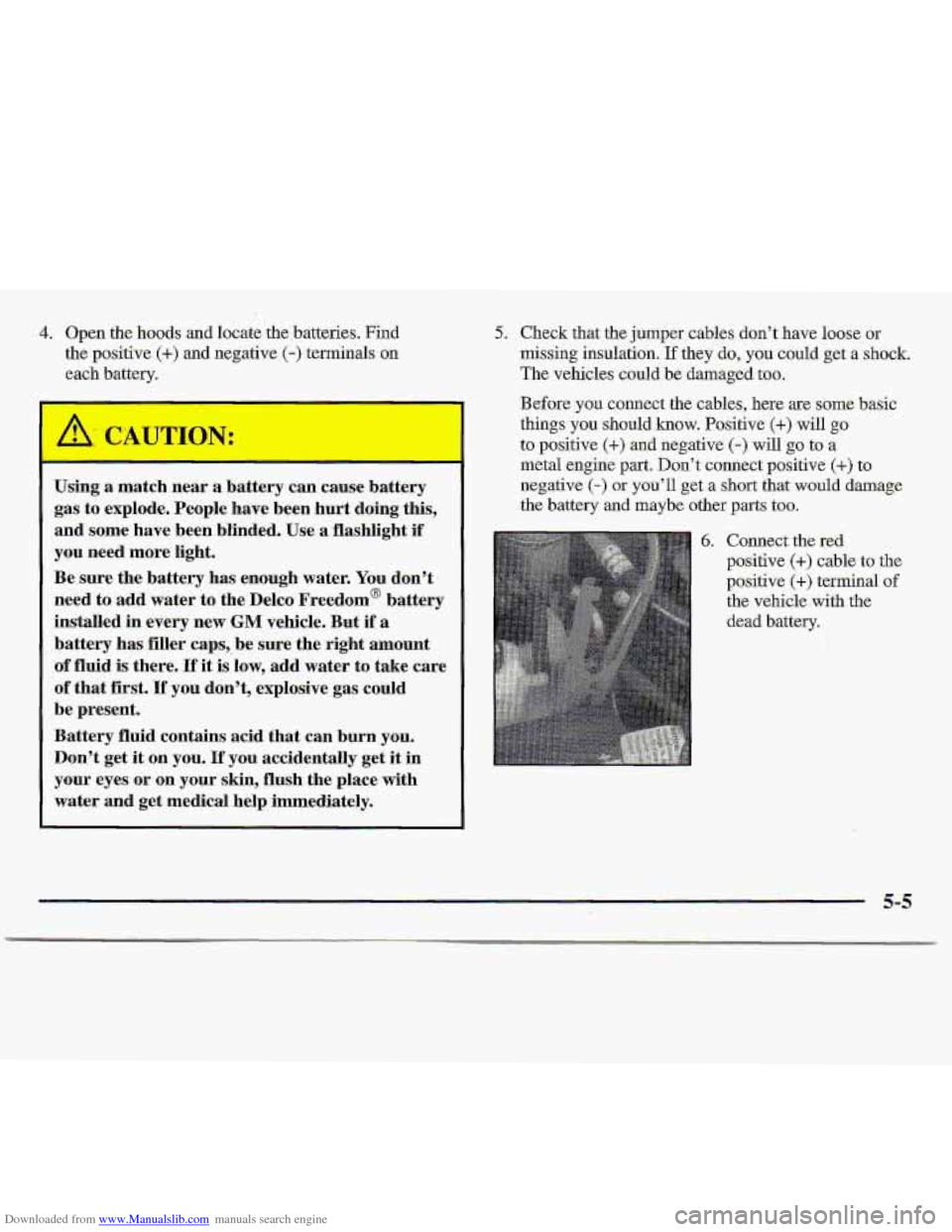
6. Connect the red
positive
(+) cable to the
positive
(+) terminal of
the vehicle with the
dead btittery.
Page 225 of 402
Downloaded from www.Manualslib.com manuals search engine 1. Using the wheel wrench, lomen all the wheel nuts.
Don't remove them yet.
2. Turn the jack handle clockwise slightly to raise the
jack lift head.
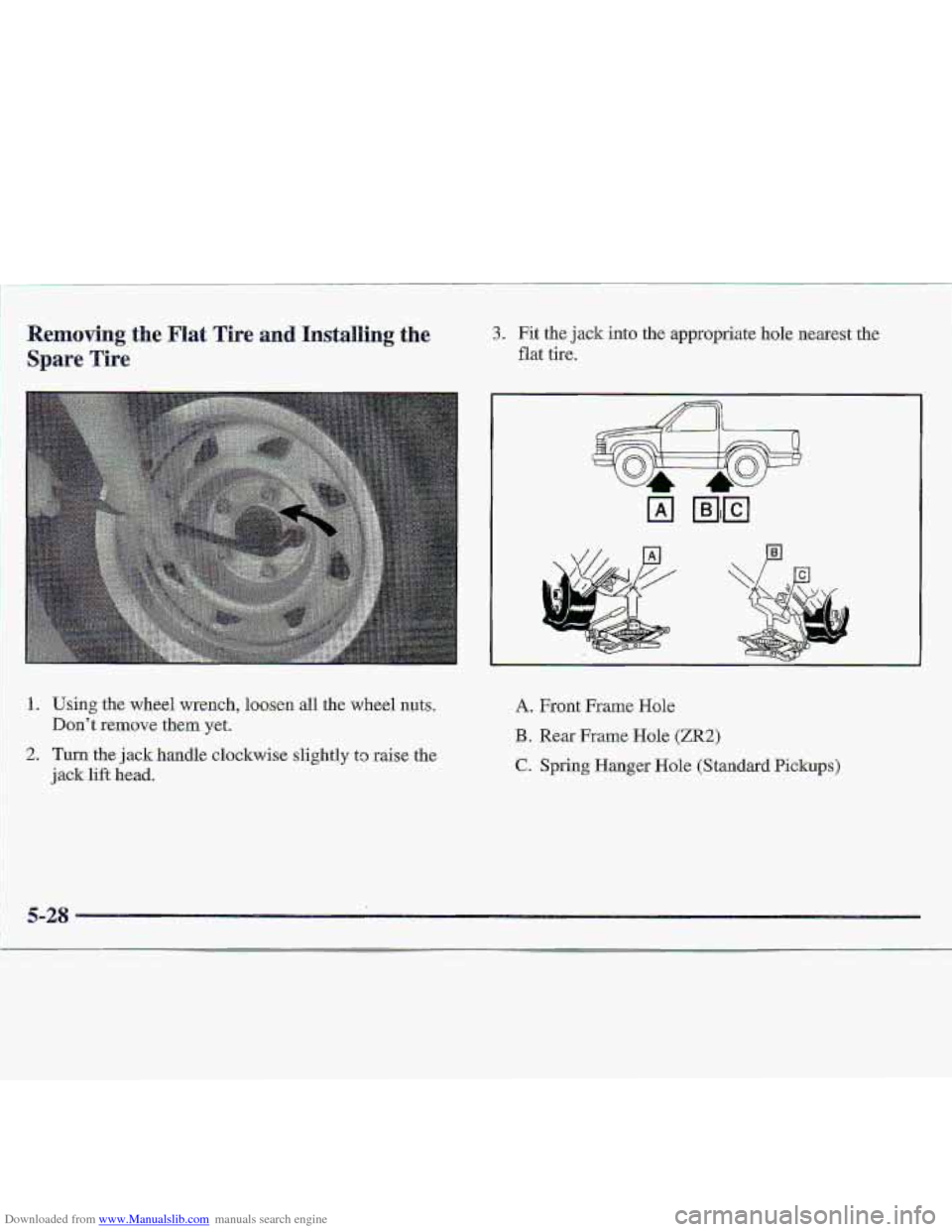
3. Fit the jack into the appropriate ho1.e nearest the
flat
tire.
A. Front Frame Hole.
B. Rear Frame Hole (ZR2)
C. Spring Hanger Hole (Standard Pickups)
5-28
Page 234 of 402
Downloaded from www.Manualslib.com manuals search engine NOTICE:
Spinning your wheels can destroy parts of your
vehicle as we11 as the tires. If you spin the wheels
too fast while shifting your transmission back
and forth, you can destroy your- transmission.
For information about using tire chains on your vehicle,
see “Tire Chains” in the Index.
Rocking Your Vehicle To Get It Out
First, turn your steering wheel left and right. That will
;clear the area around your front wheels. Then
shift back
,;and forth between REVERSE (R) and a forward gear (or
*with
a manual transmission, between FIRST (1) or
SECOND (2) and REVERSE(R)), spinning the wheels
as little
as possible. Release the accelerator pedal while
you shift, and press lightly on the accelerator pedal
when the transmission is in g,ear. If that doesn’t get
you
out after a few tries,. you may need to be towed out. Or,
you c.an use.your recovery hooks if your vehicle. has
::them. IT you do need
to be tawed out, see “Towing Your
”Vehicle” in the
Index,.
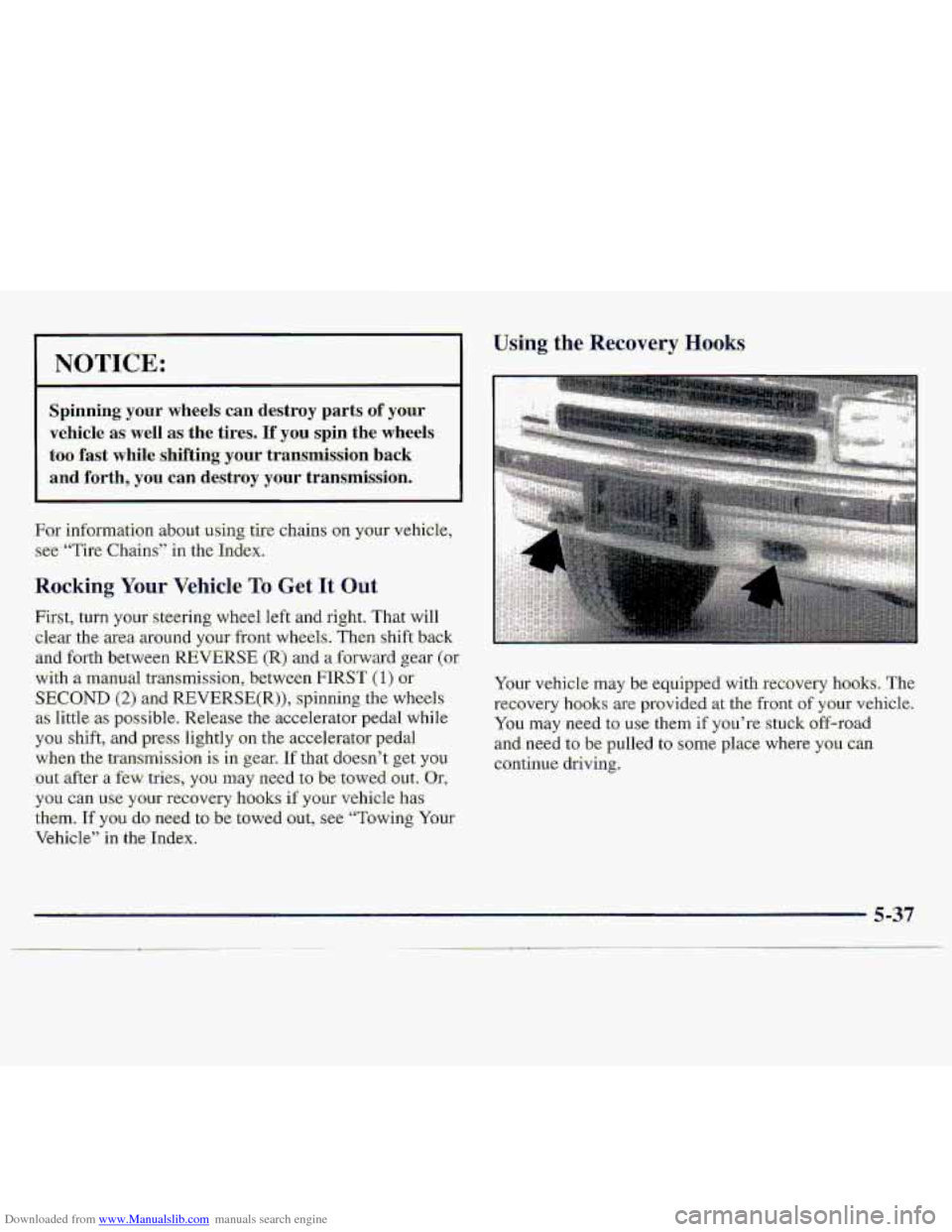
U-sing the Recovery Hooks
Tour vihilfe may be equipped with recovery hooks. The
recovery
hooks are pmvided at the front of yo-ur vehicle.
You may need to use them if you’re stuck off-road
and need to be pulled to some place where you can
wntinue driving.
5-37
____
Page 258 of 402
Downloaded from www.Manualslib.com manuals search engine %heck the fluid level only when your engine is .off, the
vehi-dle is parked on a level place and the lrtrarrsI’nissionisCool
e’nough
for you torest your fingers :on the transmissision case.
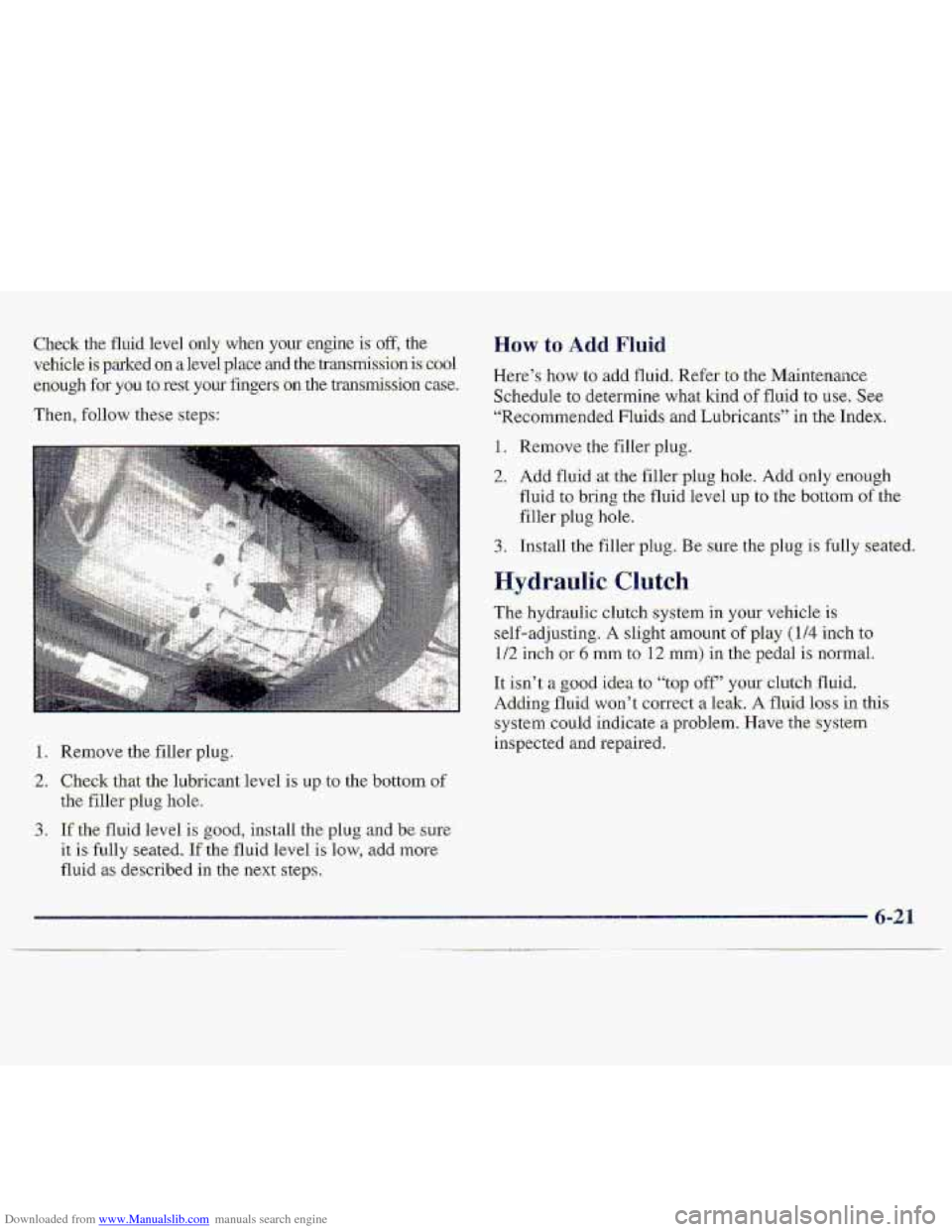
Then, follow these steps:
1. Remove the filler plug.
2. Check that the lubxicant level is up.to the bott,om ~f
the fill&- plug hdle.
H-OW to Add Fluid
Here’s how to add fluid. Refer-to the Mailiteaance
Schedule
to determine what kind of fluid to use. See
“Recommended Fluid-s and Lubricants” in the Index.
1. Remove the filler plug.
2. Add fluid at the filler plug ho1.e. Add ~nIy enough
fluid to bring the fluid level up to th-e bottom of the
filler plug-
hole.
3. Install the filler plug. Be sure the plug is fully seated.
Hydraulic Clutch
The hydfaulic clutch system in your vehicle is
self-adjusting. A slight amount of play (1/4 inch .to
1/2 inch or 6 rnm to 12 mm) in the p.edal is normal.
It isn’t a gaod ‘idea to “top off” your -clutch..fluid,,
Ad,dingfluid won’t correct a leak. A fluid loss in this
system could indicate-a poblem. Have the :syste.m
inspected and repaired.
5. If’b-fl uid level is good,. install the plug adbe. sur&.
it is .ft111y seated. Fthe fluid level is low, add more
fluid as described in the next steps.
-6-21