Page 170 of 402
Downloaded from www.Manualslib.com manuals search engine Hydroplaning
Hydroplaning usually happens .at higher s.peeds. There
just isn’t a hard and fast rule about hydroplanirgi The.
best advice is to slow down whenit is raining.
Driving Through Deep Standing Watw
NOTICE:
If you drive too quickly through deep puddles or
standing, water; water
can come in through your
engine’s air intake and badly damage your
engine. Never driv.e through water that is slightly
lower than the underbody
of your vehicle. If’you
can’t avoid deep puddles
or standing water, drive
through them very
slowly.
Some 0the.r Rainy Weat
Besides slowi~~g down, allow some extra following
distance.
And be especially careful when you pass
another vehicle,. Allow yourself more dear room
ahead, and be prepared to have y~ur view restricted
by mad spray.
Have good tires with proper tread depth. (See
“Tires”
in the Index.)
4-33
Page 174 of 402
Downloaded from www.Manualslib.com manuals search engine Highway Hypnosis
:,Is there actually such a condtion as “highway hypnosis”?
“Or is it just plain falling asleep at the wheel? .Call it
highway hypnosis, lack of awareness; or whatevm.
There is something. about an easy stretch of road with the
same scenery, along with the hum of the tires on th.e road,
the drone
of the engine, and the rush of the wind :against
.the vehcle that cai~ ~ake you sleepy. Don’t let it happen
.?to
you! If it does, your vehicle can leave the soad h.Eess
tlzan a second, and you could crash and be injured.
What can you
do about h.ighway hypnosis? First, be
aware that it can .happen.
Then
here a-e some tips:
0 Make sure. your vehicle: is well ventilated; with a
comfortably cool interior.
0 Keep your eyes moving. Scan -the road ahead
and to
the sides. Cheek y-our mirrors and your
imtruine’nts frequently.
Hill and Mountain Roads-
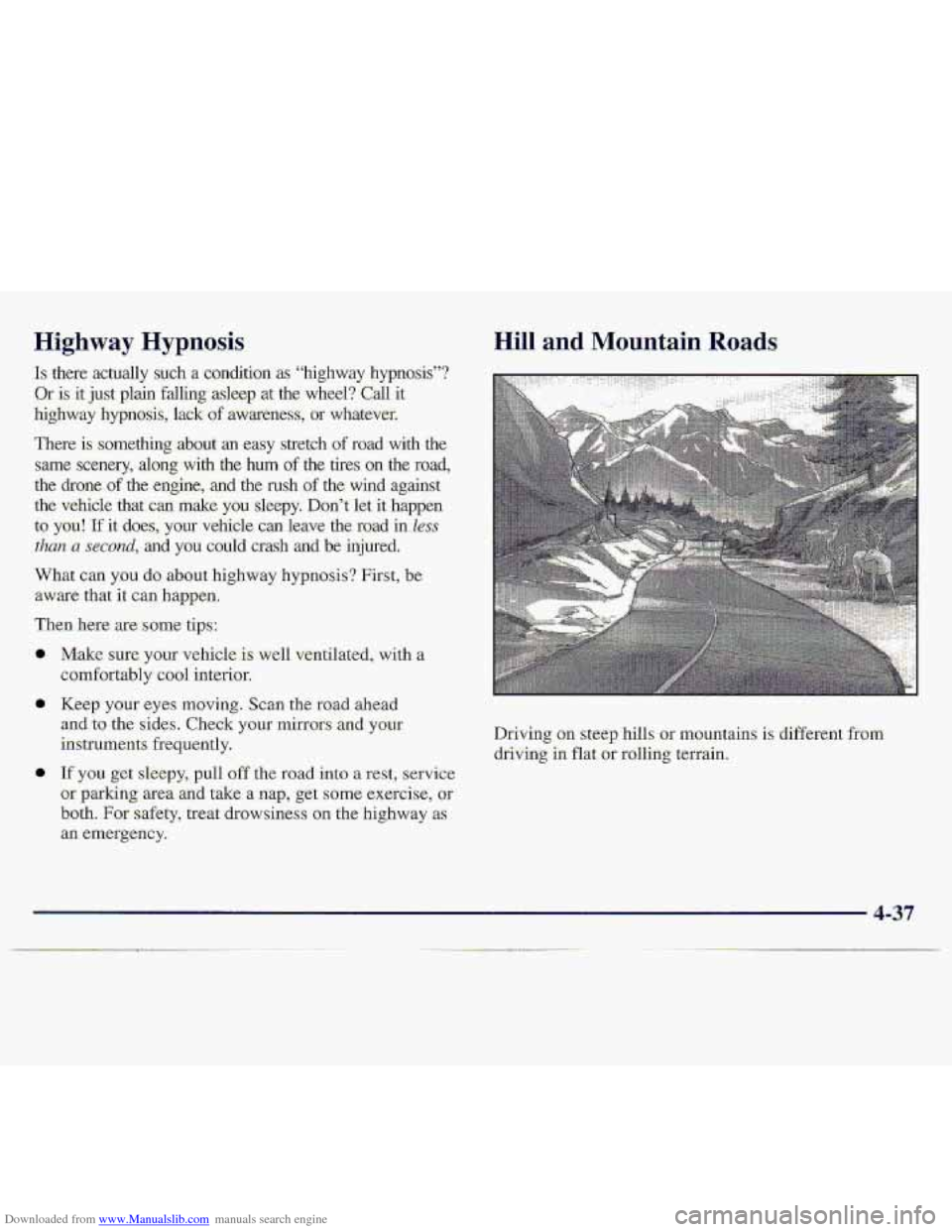
Driving on steep hills or mountains is different from
drivjng .in
flat or.ro1ling terrain.
0. If-you get sleepy, p.ull off-the road into a rest, service
or-par.king- area and take
a asp, get some exercise, or
both. For safety, treat drowsiness on the highway as
an emergency.
4-37
Page 175 of 402
Downloaded from www.Manualslib.com manuals search engine If you drive regularly in steep country, or if you're
planning to visit there, here are some tips that can make
your trips safer-and more enjoyable. (See "Off-Road
Driving" in the Index
for information ab.out driving
off-road.)
Keep your vehicle in good shape; Check all fluid
levels and
also the brakes, tires, cooling system and
transmission. These pqrts
@a work hard on
mountain roads.
Know how to go down hills. The most important
thing
to 'know is this: let: your engine do. some of the
slowing. down. Shift
-to a lower gear when you go
down
a steep or long hill.
If you .don't shift down, your brakes could get
so hot that,they wouldn't work well. You would
then have
po.or braking or even none going
down
a hill. You could crash. Shift down to let
your engine assist your brakes .on a steep
downhill
slope.
I
Coasting downhill in NEUTRAL (N) or WILII the
ignition
off is dangerous. Your brakes will have to
do all the work of slowing down. They could get so
hot that they wouldn't work wen. You would then
have poor braking
or even none going down a hill.
You could crash. Always have your enbe running
and your vehicle in gear when you go downhill.
Know how to go uphill. You may want to-shift down
to a lower gear. The lower gears help cool your engine
and transmission, and you can climb the hill better.
Stay in your own lane when driving on two-lane
roads
in hills- or mountains. Don't swing wide or cut I
across the center-of the road, Drive at speeds that let
-you stay in your own lane.
As YOU go over the top of--a hill, be alert. There could be
something in your lane, like a stalled car or an accident.
YQU may see highway signs an mountains that warn of
special problems. Examples are long grades, passing or
no-passing zones, a falling rocks area or winding
roads. Be alert to these and take appropriate action.
4-38
Page 176 of 402
Downloaded from www.Manualslib.com manuals search engine Winter Driving
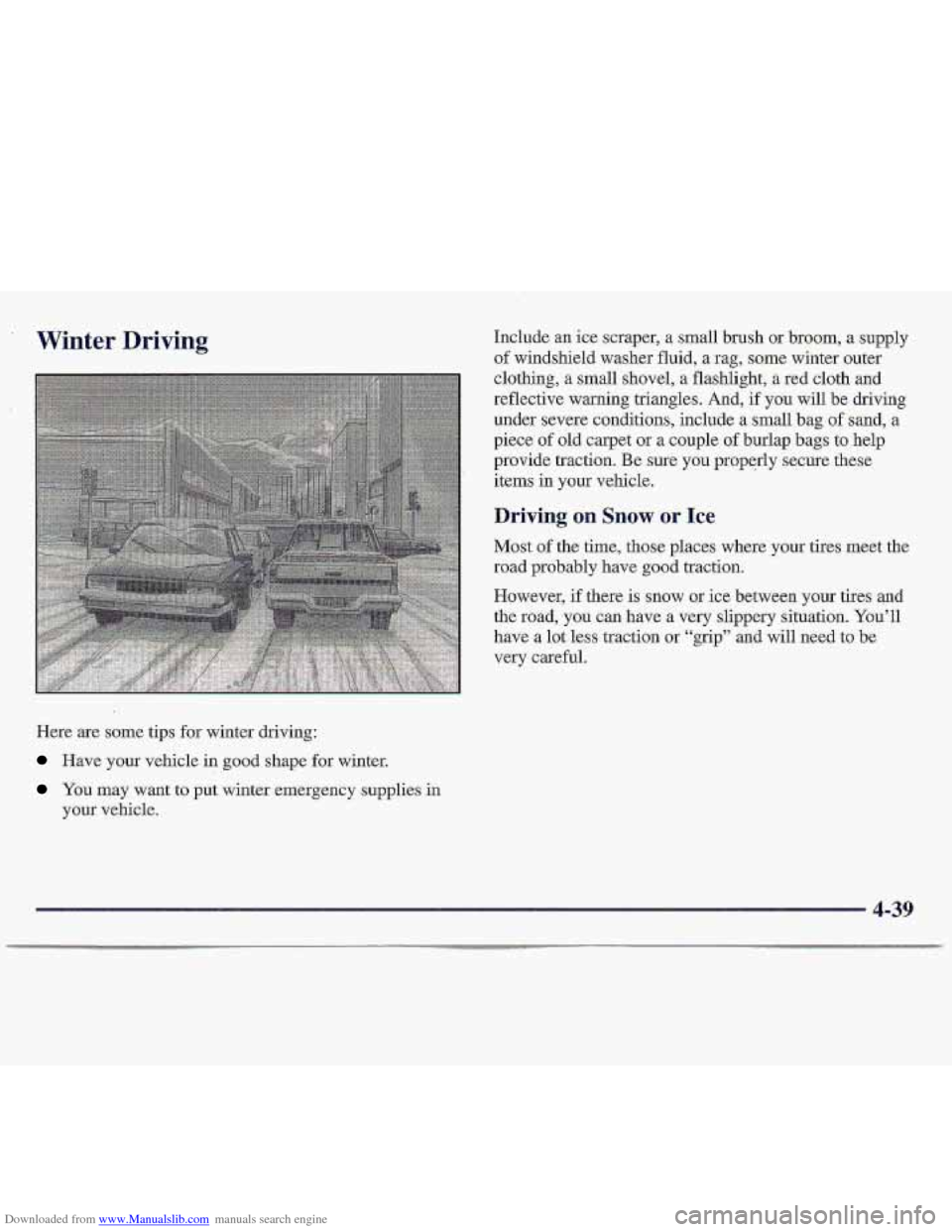
Here are some tips for winter driving:
Have your vehicle in good shape for winter.
You may want to put winter emergency supplies in
your vehicle. Include
an ice scraper, a small brush. or
broom, n supply
of windshield washer fluid, a rag, some winter outer
clothing,
a small shovel, a flashlight, a red cloth and
reflective warning triangles. And,
if you will be driving.
under severe conditions, include-a small bag
of sand, a
piece
of old carpet or a couple of burlap bags to help
provide traction. Be sure you properly secure these
items in your vehicle.
Driving on Snow or Ice
Most of the time, those places where your tires meet the
road probably have good traction.
However,
if there is snow or ice between your tires and
the road, you can have
a very slippery situation. You’ll
have a
lot less traction or “grip” and will need to be
very careful.
4-39
Page 177 of 402
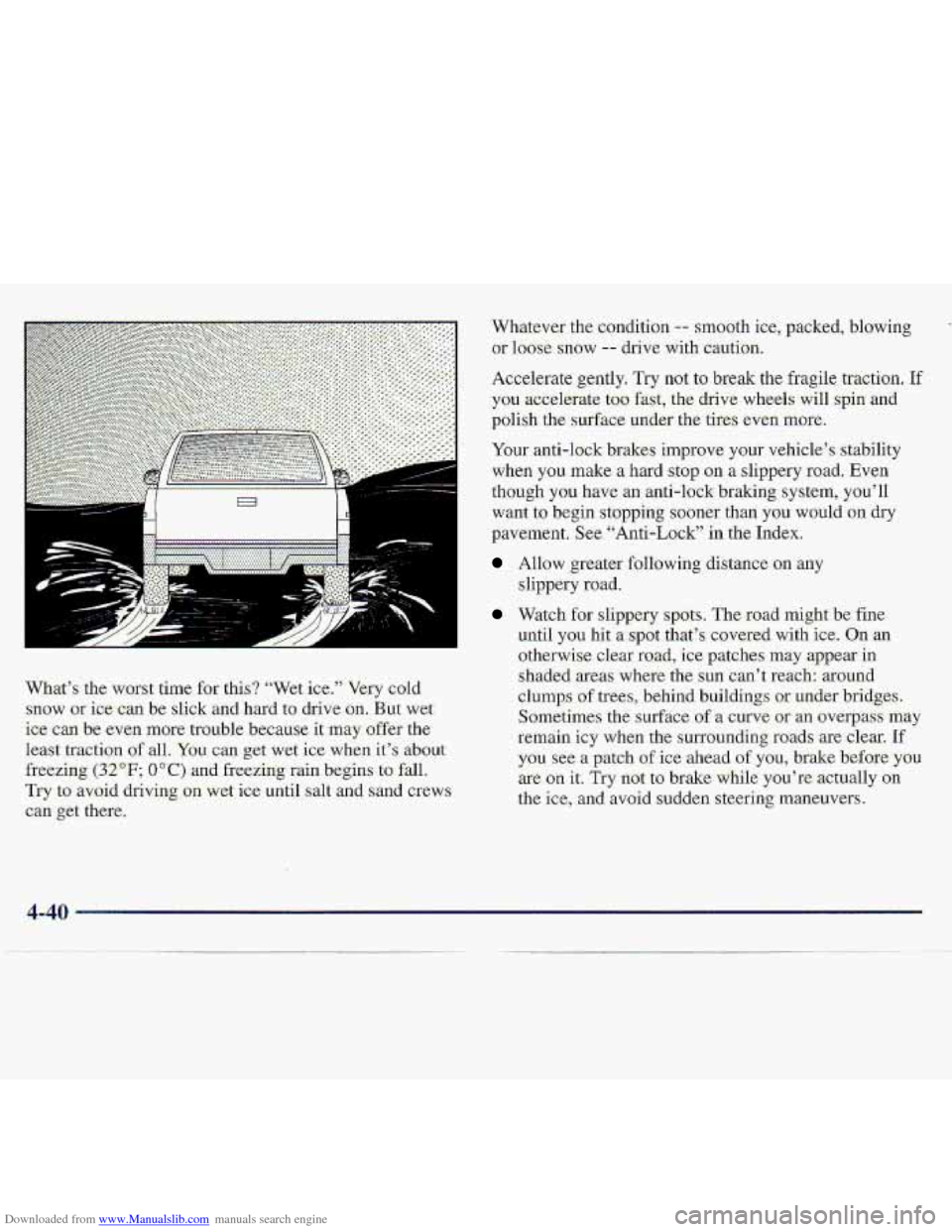
Downloaded from www.Manualslib.com manuals search engine Wh8t’s:the worst time for this? “Wet-.ice.” Very cold
snow or-ice-can be slick and hard to drive on. But wet
ice c.m- be even m-ore. trouble be-cause -it ‘may .offer the
1-east iraction
of all. You can get wet ice when it’s about
fxce.zag C32”F; 0°C) .and fieeziag rain begins tQ fall.
Try to avoid driving .on wet ice untG salt and sand crews
can get there.
Whatever:the G-ondition -- smooth ice, packe.d, blowing
or loose: snow -- drive with Cautibn.
Accelerate gently. Try
not to break the fragile. traction. If
you accelerate t6o fait, the dr5v-e whee1.s will spin-and
polish the -surface under the tires even more..
Your anti-lock brakes improve your vehicle’s stability
when you,make-
a hard stop on a slippery road. Even
tho.ugh you have an anti-lock brxking system, you’ll’
want to begin
stopping sooner tha-n you would on dry
pavement. S,ee: “Anti-Lo-ck” in the Index.
Allow greater following distance :on any
slippery road.
Watch for dippery spots. The road might be fine
until you hit a,spat.th&s covered. with ice. Qn an
.otherwise clear road,: ice -patches may app-ear in
shaded areas where the
sun mn’t reach/ arou-nd
clump>s of. trees, :behind buikdings under bridges.
Sometiines the:surface of a curve air an overpa% may
remain icy when the surrounding raxds are clear. If
you see a-patch &ice ahead of YOLI-, brake:before you
axe on it, Try notto brake while you’=re .actually on
.the ice, .and avoid sadden st_e.Gring maneuvers.
Page 181 of 402
Downloaded from www.Manualslib.com manuals search engine Load& Your Vehicle
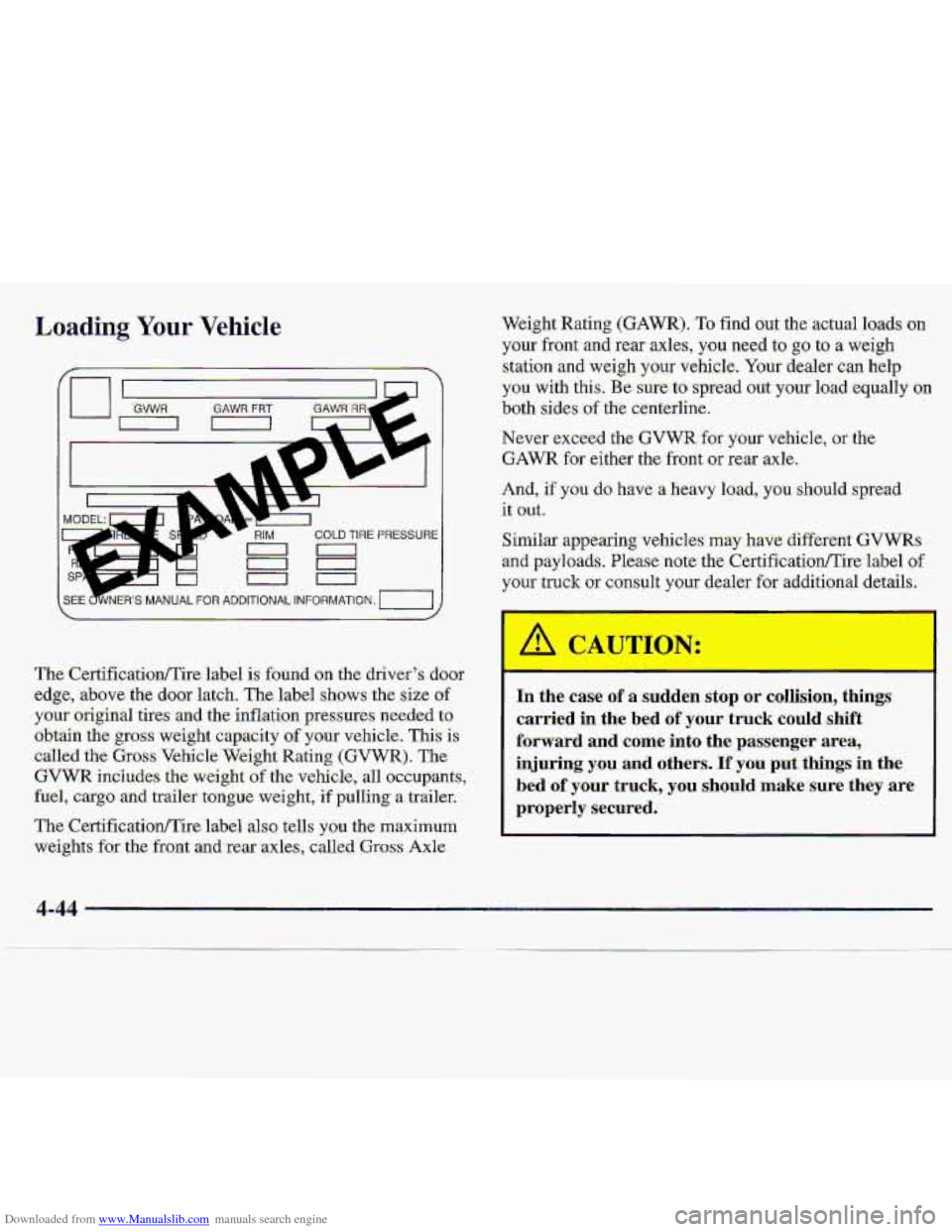
The Certification/Tire.iabel is found on the driver's door
edge, -above the door latch. The label shows the size of
your original. tires and the inflation pressures needed to
obtain the grass weight capacity of your vehicle. This is
called
the Gro-ss- Vehicle Weight Rating (GVWR). The
GVWR
includes the weight of the vehicle, all occupants,
fuel,
cargo aild trailer tongue weight, if pulling a-trailer.
The C&tification/Tire. label
also tells you the maximum
weights for the front and-re,ar axl.es, called Grass Axle Weight
.Rating (GAWR).
To find Qut the actual loads on
your front and rear axles, you need to go to a we.igh
station and weigh your-vehicle. Your dealer
can help
you with this. Be sure to spread out your load equally on
bath sides of the centerline..
Never exceed the GVWR for your vehicle, or the
GAWR
hi either the front or rear axle.
And, if you do have a heavy load, you- sho,uld spfead.
it
out.
Similar appearing vehicles. may have. differeQt GVWRs
and payloads. Please note the Certificatioflire. label sf
your truck or consult your dealer for additional details.
In the.case of a gudden stop or collision, things
carried in the bed of your truck could shift^
forward and come into the passenger area,
injuring you and others. 'If you put things in the
bed of your truck, you should rnake.su.re they are
properly
secured.
I
Page 188 of 402
Downloaded from www.Manualslib.com manuals search engine '0 If you have- an automatic transsinission5. you can
use DRIVE (Dj (m,as you need to, a lower gear)
when -towing a.tr-ailer. Operating your vehickin
DRIVE (P) when towing a trail& will minimize. heat
buildup a-nd extend the life of your transmission. If
you have -a manual eansmission and YQU'W~ towing-
a trailer, it-'s :better not to 'use FIFTH (5) gear. Just
drive in FOURTH (4). gear (or, as y-ou necd to, a
1Qwer ge.a).
Three importmt considerations have to do. with weight:
the; weight Qf the- trailer,
0 the weight of the traiirer?tongne
and the weight on-your vehicle's tires.
Weight of the Trailer
How he-avy can - a trail& safely be?'
It depends on how yosll plan to use your rig. For
example, speed, altitude, mad grades, outside
-temp&ature and how much yaw vehicle is used to pull a
trailer are -all important. An,d~, it can also depend an any
.-special equipment that you have on your vehicle.
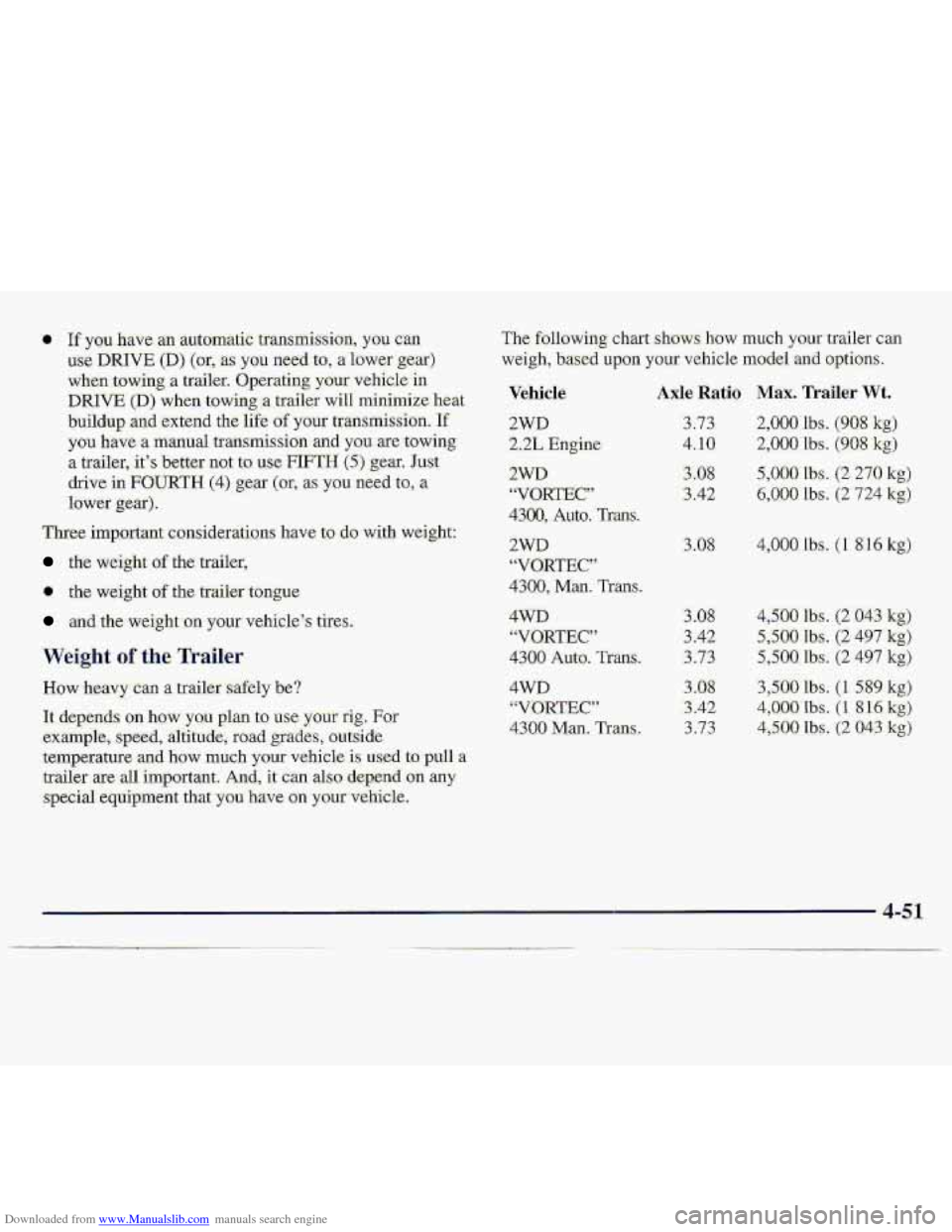
The follo-w%g chart shows haw much your trailer can
weigh, based upon your: vehicle rno.&l and. options.
Vehicle
2wD
2.2L Engine:
2wJ-J
'VOREC"'
4300, Auto. Trans.
Axle Ratio Max. Trailer Wt.
3.73
4.10
2,000.Il.?s. (90.8 kg)
2,000 lbs. (908 kg:)
3 .m
3.42
5,000.lbs. (2 270 kg)
6,O.OO lhs. (2 724 kg)
3.08 4,000 lbs. (1 g.16 kg)
4m 3.08
"VORTEC" 3 -42
4300 Auta:. Trans. 3.73
4.,500 hs. (2 043 kg)
5,500 1b.s. (2 497 kg)
$,5OOllbs.. (2 497 kg)
3,500 ibs. (I 589 kg,)
4,500 lbs. (2 043 .kg)
4,000, lbs. (1 8 1.6 kg)
Page 190 of 402
Downloaded from www.Manualslib.com manuals search engine Total We-ight. .on Your Vehicle 9s- Tires.
Hitches.
It’s important to have the correct hitch: -eq.uipn%ent.
Cross&nds,
large tru&s :gaing-by and mughmads are a
few reasons why -you’ll need the-right hitch. Here -are.
some rules to follow:
4-53