1997 CHEVROLET S10 weight
[x] Cancel search: weightPage 140 of 402
Downloaded from www.Manualslib.com manuals search engine Drunken Driving
Death and injury asscxiated with drinking md driving is
a nati0n.a.l .tragedy. 11's the. riumber one c6ntjribLttor tQ
the h.ighway de.ath toll, claiming thomands of victims
.every year.
Judgment
m Muscular Coordination
. vision
The BLo.o,d Alcohc\l Cowentratiorr (BAC) of someone
who is drinking depends upon four things:
The'amount of alcohol .consume,d
The.drinker 's- body weight
The-:mount of fo:od that is con~urnedlhefo.re a1
The length of time it has taken the drinber'to
durin-g
-drinking
consumE the-
alcohol.
Ac.cording
tq the, AniGrican Medical. As:Sso.c.iati~n, a
18U-lb. (-8.2 kg) person wha drinks three. 12-ounce
(3.55 ml) bottles, uf.beer in an -hour will, end up with.-&
BAC :of ab0u.t 0.06 perc.ent.-The person would reach the
same BAC by drinking three &ounce (~120 rnl) glasses
of wine or three mixed drinks if :ex& had. 1- 1/2 ~unces
(45 ml) -.of.& liquor like. whiskey, .gin a~ vodka
4-3
Page 141 of 402
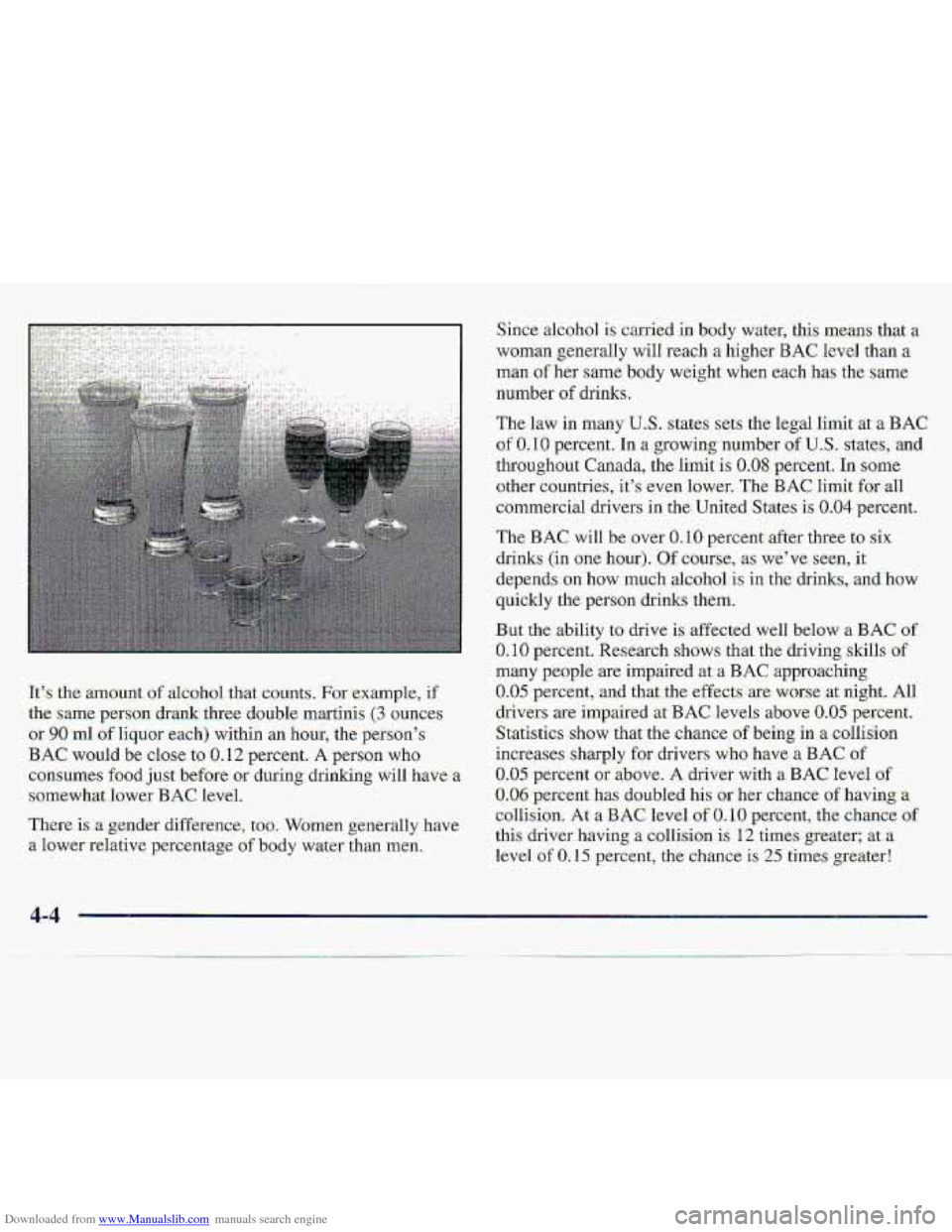
Downloaded from www.Manualslib.com manuals search engine It% the- amount of alcohol that counts For. example, if
the same person drank three double martiriis (3- ounces-
or 90 ml of liquor-each) within an hour, the person's
BAC would be close to 0.12 percent. A person who
consumes
food just before or during drinking-will have a
somewhat lower BAC level.
There
is a gender difference, too. Women generally have
a lower relative percentage of body water than men. Since
alcohol
is carried in body water, this rneansIthat a
woman gerieitally will reach a higher BAC level tlia a
man of her s:ame body weight when each has the.sa-me
-number of drinks.
The law in many U.S. states sets the legal lim.it at P BAC
of 0,l-0 percent. In a growing number af US. stsltes, and
throughout Canada, the limit is 0.08 percent. In surne
other countries,
if's even lower. The BAC limit for? all
commercial drivers
in the United-States is 0.04 percent.
The BAC will be over 0.1'0 percent after three to six
.drinks (in one hour). Of co.urse, as wek seen, it
depe.nds on haw muGh alcoho1.k in the &irk,. ana-how
quickly the person
drinks hem.
But the ability to drive is affected well below a BAC of
0.10 percent. Research shows that the driving, skills of
many peep-le are impaired at a BAC .approaching
0.05 percent, and that the effects are wo1s.e af night. All:
'drivers are impaired at BAC-levels above 0.05 percent.
Statistics show that the chance
of being in a collision
increases sharply for drivers who have
a BAC of
0.05 ',percent or above. A driver with. a'BAC level of
:0.06 percent- has doubledhis or her chance of haying- a
cdolli&on. At a.BAC level of 0...10 percent? the chance of
this drives having a collision is 12 times greater; at a
level of 0. I5 percent, the chance is 25 times greater!
4-4
. . ..
Page 143 of 402
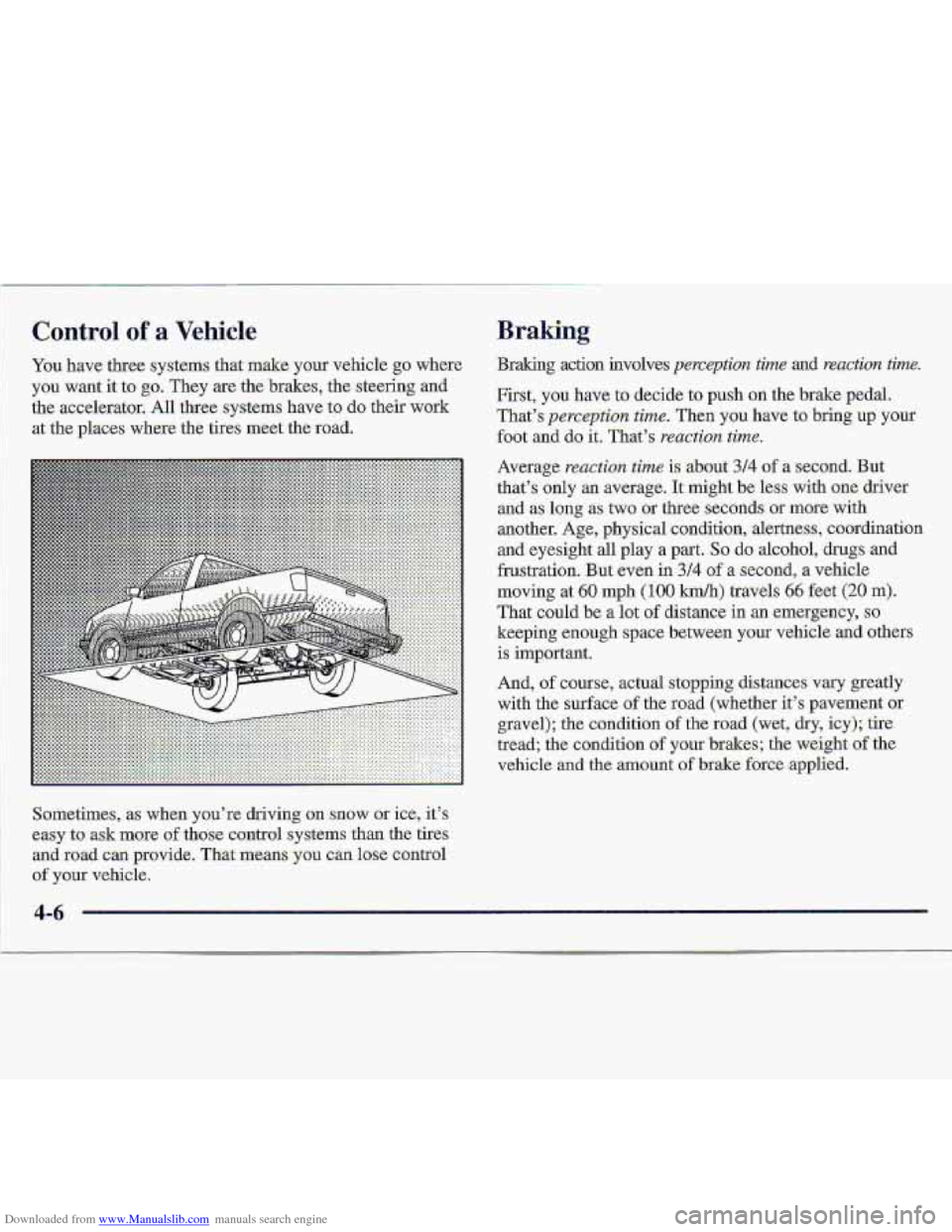
Downloaded from www.Manualslib.com manuals search engine You have three systems that make your vehicle go where
you want it to
go. They are the brakes, the steering and
the accelerator. All three systems have to do their work
at the places where the tires meet the-road. Braking action involves
perception
time and reaction time
First, you have to decide to push ob the brake pedal.
That’s
perception time. Then you.have to bring up your
foot and
do it. That’s reaction time.
Average reaction time is -about 3/4 of a second. But
that’s only an average. It might
.be less with me driver
and
as long as two or three seconds or more with
another. Age., physical condition, alertness, co.ordinati.on
and eyesight
all play a part. So do aIcohol, drugs and
frustration.
But even in 314 of a second, a vehicle
moving at
60 mph (100 km/h) travels 66 feet (20 m).
That could be a lot of distance in an emergency, so
keeping -enough space between your vehicle and others
is important,
And,
of course, actual stopping distances vary greatly
with the surface
of the road (whether it’s pavement or
gravel); the condition
of the road (wet, dry, icy); tire
tread; the condition of your brakes; the weight of the
vehicle and the amount
.of brake force applied.
Sometimes,
as when you’re driving on snow or ice, it’s
easy
to ask more of those control systems than the tires
and road can provide. That means you can lase c.ontrol
of
your vehicle.
4-6 .-
Page 181 of 402
Downloaded from www.Manualslib.com manuals search engine Load& Your Vehicle
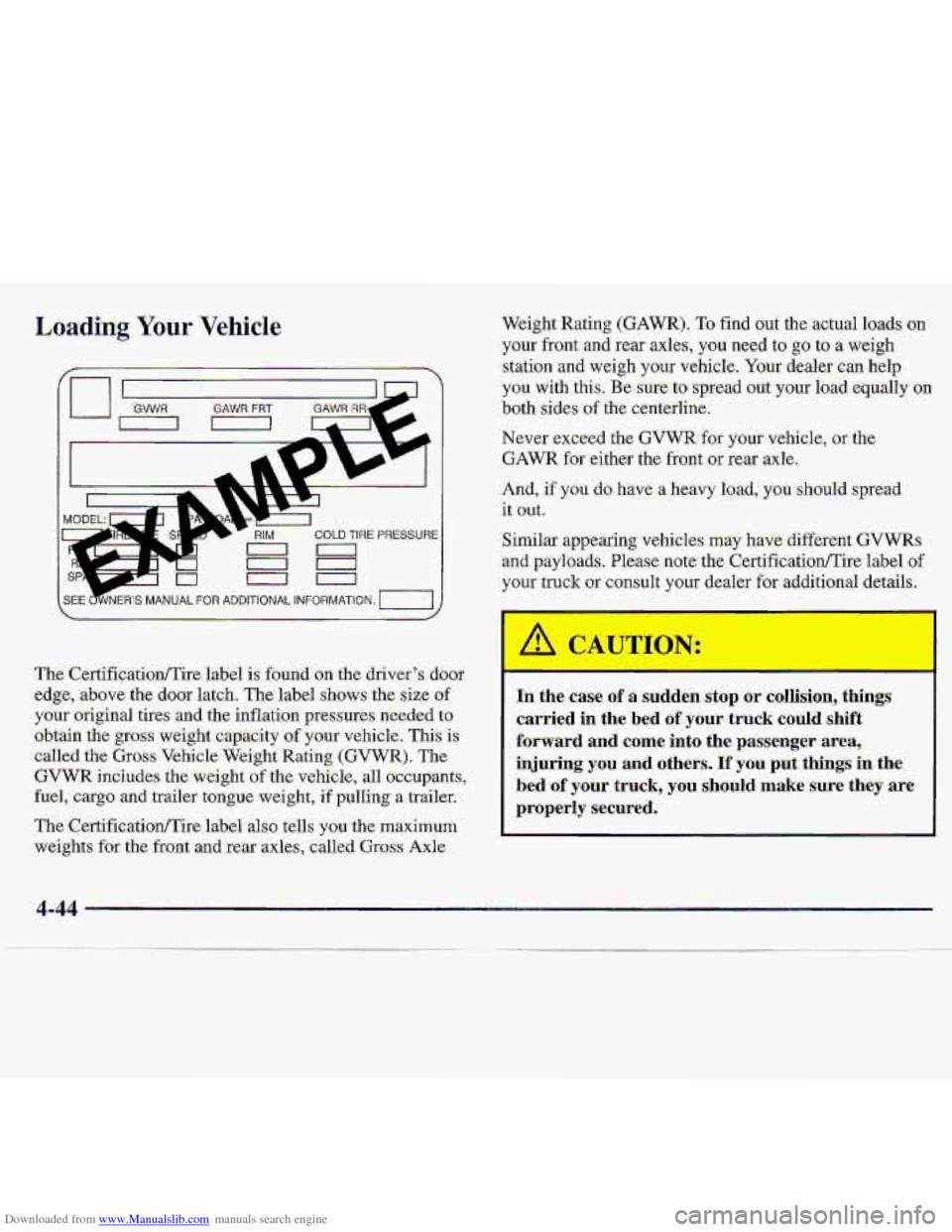
The Certification/Tire.iabel is found on the driver's door
edge, -above the door latch. The label shows the size of
your original. tires and the inflation pressures needed to
obtain the grass weight capacity of your vehicle. This is
called
the Gro-ss- Vehicle Weight Rating (GVWR). The
GVWR
includes the weight of the vehicle, all occupants,
fuel,
cargo aild trailer tongue weight, if pulling a-trailer.
The C&tification/Tire. label
also tells you the maximum
weights for the front and-re,ar axl.es, called Grass Axle Weight
.Rating (GAWR).
To find Qut the actual loads on
your front and rear axles, you need to go to a we.igh
station and weigh your-vehicle. Your dealer
can help
you with this. Be sure to spread out your load equally on
bath sides of the centerline..
Never exceed the GVWR for your vehicle, or the
GAWR
hi either the front or rear axle.
And, if you do have a heavy load, you- sho,uld spfead.
it
out.
Similar appearing vehicles. may have. differeQt GVWRs
and payloads. Please note the Certificatioflire. label sf
your truck or consult your dealer for additional details.
In the.case of a gudden stop or collision, things
carried in the bed of your truck could shift^
forward and come into the passenger area,
injuring you and others. 'If you put things in the
bed of your truck, you should rnake.su.re they are
properly
secured.
I
Page 182 of 402
Downloaded from www.Manualslib.com manuals search engine A CAUTION:
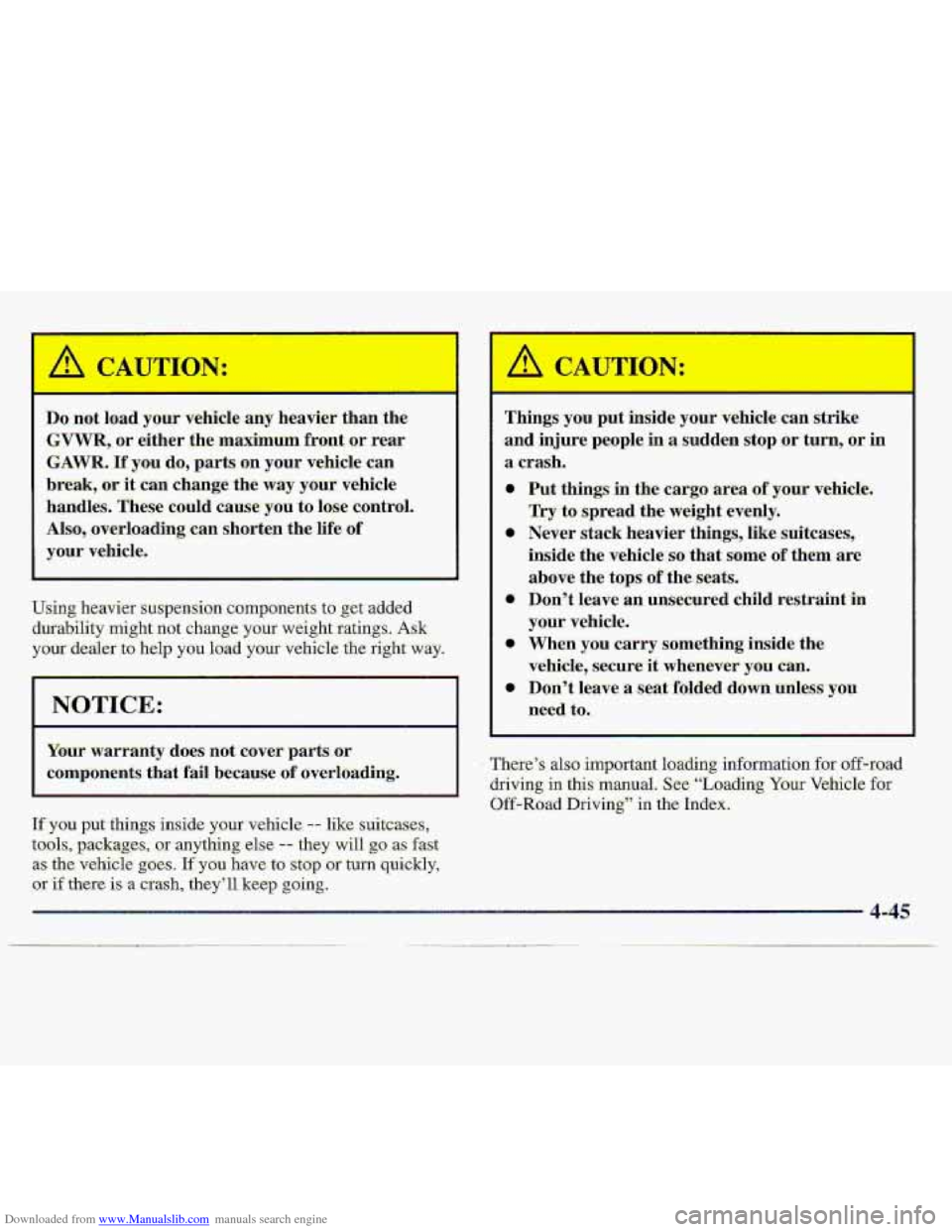
Do not load your vehicle any heavier than the
GVWR, or either the maximum €ront .or rear
GAWR. Ifyou do, parts on your vehicle can
break, or it can change the way your- vehicle
handles. These couId cause-you to lose control.
Also, .overloading can shorten the life of
~ your vehicle.
Using he-avier s.uspension comp'onents to get added
durability might not
change. your weight ratings. Ask
your dealer to help you load your vehicle the right way.
I NOTICE.:
Your warranty does not cover-parts. or
components that fail because of overloading.
If you put t Igs imide your vehicle. -- like suitcases,
tools, p.ackages, ~r anything else -- they will go as fast
as.
ae. vehicle goes. 1f'yo.u have t~ st0.p or turn quickly,
or if there is a crash, they'll keep going.
h CAUTION:
Things you pnt inside your vehicle can strike
-and .injure people in-a- sudden
stop or-turn-, 0r.m
a. crash.
0. Put things in the cargo area .of your vehicle.
Try to spread the weight evenly.
Never stack heavier things, like .suitcases.,.
inside the vehickso that
some of them are
above the top.s'of 'the seats.
0- Don't leave 'an unsecured child restraint in
your vehicle.
@ When you carry something inside the
vehicle, secure. it whenever yon can.
+. Don't leave a seat-folded down mle!sS you
need tu.
There's also important loading information for off -road
driving in this manual. See "Loading Your- Vehicle for
Off-Road Driving" in the Index.
4-45
Page 183 of 402
Downloaded from www.Manualslib.com manuals search engine The payload capacity ;is- shown on the CertificatiodTire
label.
This is the maximum load cap.aeity that. Y;QU
vehicle can- carry. Be- sure to includej the weight ~f the
‘occupants as part of your load.. If you a.dded any
accemxies or equipment after your vehicle-left the
factory, remember
tQ sub&acJ the weight of these tla:ngs
fi-om the payload.
Your deal&- can help you. with this-.
Add-on Equipment
Wh-en you cary -rem-csivable items., ym may meid to put a
limit on how many pe,ople you c,arry inside. your ve-hide.
Be sure to weigh ycru’l; vehicle beWe you buy arid install
.the new equipment.
NOTICE:
Your warranty due.m’t cover parts, or
,camp!on,ents that fai1,because of ow-rloading.
Page 184 of 402
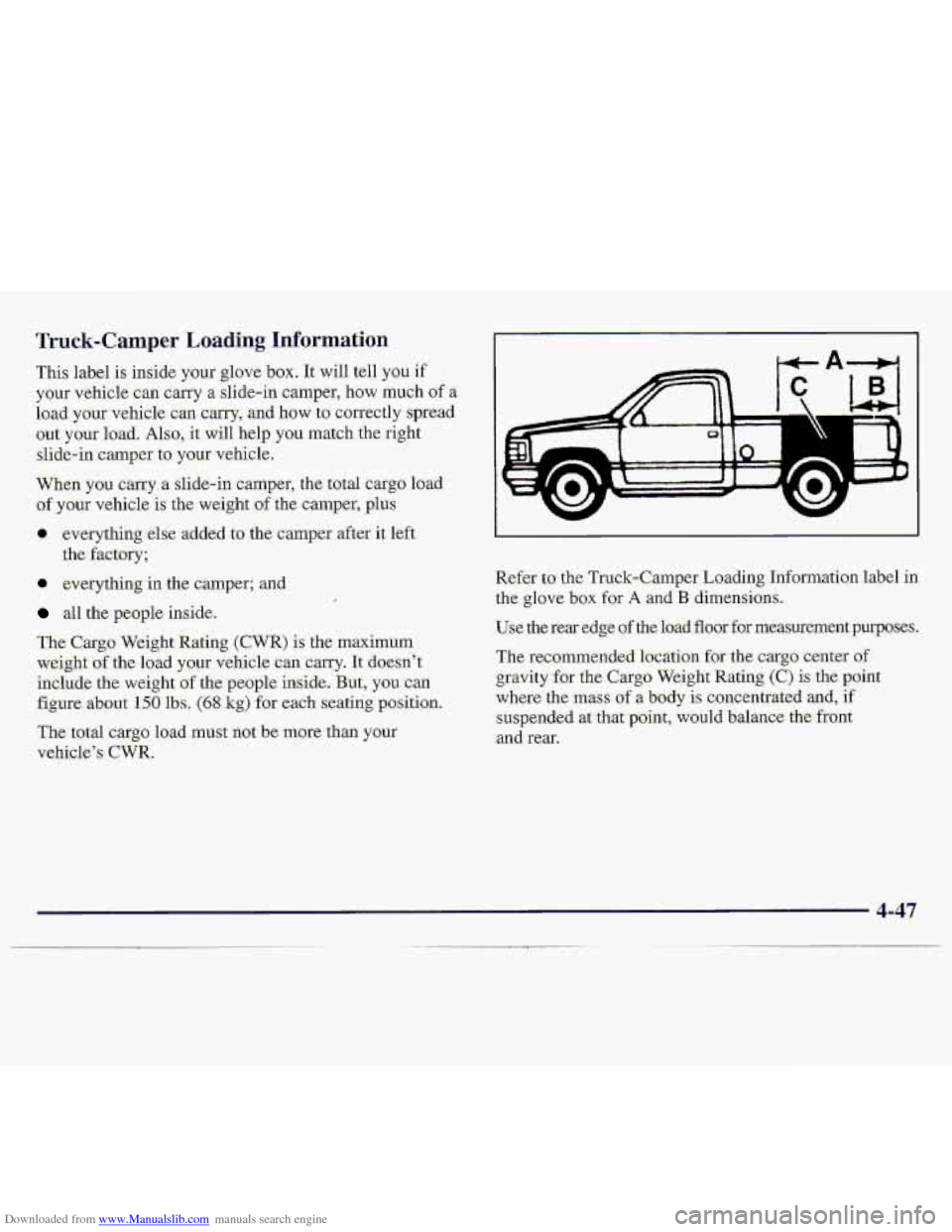
Downloaded from www.Manualslib.com manuals search engine Truck-Camper Loading. In.forrnatbon
This label is inside your glove box. It will tell you if
your vehicle can ca.my a- slide-in camper, how much df a
laad yo-ur vehicle can carry, and how to correctly spread
out your
I-oad. Also, it will help you match the right
slide-in rcamper to your vehicle.
When you c&ry a slide-in camper, the- total
cargo load
of
-your vehicle is the weight of the Camper, plus
@ evefything eke added to the- camper after-it left
the factory;
@ everything in the camper; and
all the people inside.
The Cargo Weight, Rating (CWR) is the maximum
weight of; the -load ,your vehicle %.an carry. It doesn’t
include the we?ght
af the-people inside. But, yo~r.can
figure about
150 lbs. (68, kg) for each. seating position.
The total
cargo load must r be m ! than vour
vehicle’s CWR. Refer
to the Truck-Camper Loading IDformation label in
the
gIove box for A and B dimensions.
Use
the rear edge-of the. load floor for measurement purposes.
The recommended- location for the cargo center of
gravity for the Cargo Weight Rating (C) is the p-oint
where the
mass of a body is concentrated and, if
suspended at.that point, would balance the front
and rear.
4-47
Page 188 of 402
Downloaded from www.Manualslib.com manuals search engine '0 If you have- an automatic transsinission5. you can
use DRIVE (Dj (m,as you need to, a lower gear)
when -towing a.tr-ailer. Operating your vehickin
DRIVE (P) when towing a trail& will minimize. heat
buildup a-nd extend the life of your transmission. If
you have -a manual eansmission and YQU'W~ towing-
a trailer, it-'s :better not to 'use FIFTH (5) gear. Just
drive in FOURTH (4). gear (or, as y-ou necd to, a
1Qwer ge.a).
Three importmt considerations have to do. with weight:
the; weight Qf the- trailer,
0 the weight of the traiirer?tongne
and the weight on-your vehicle's tires.
Weight of the Trailer
How he-avy can - a trail& safely be?'
It depends on how yosll plan to use your rig. For
example, speed, altitude, mad grades, outside
-temp&ature and how much yaw vehicle is used to pull a
trailer are -all important. An,d~, it can also depend an any
.-special equipment that you have on your vehicle.
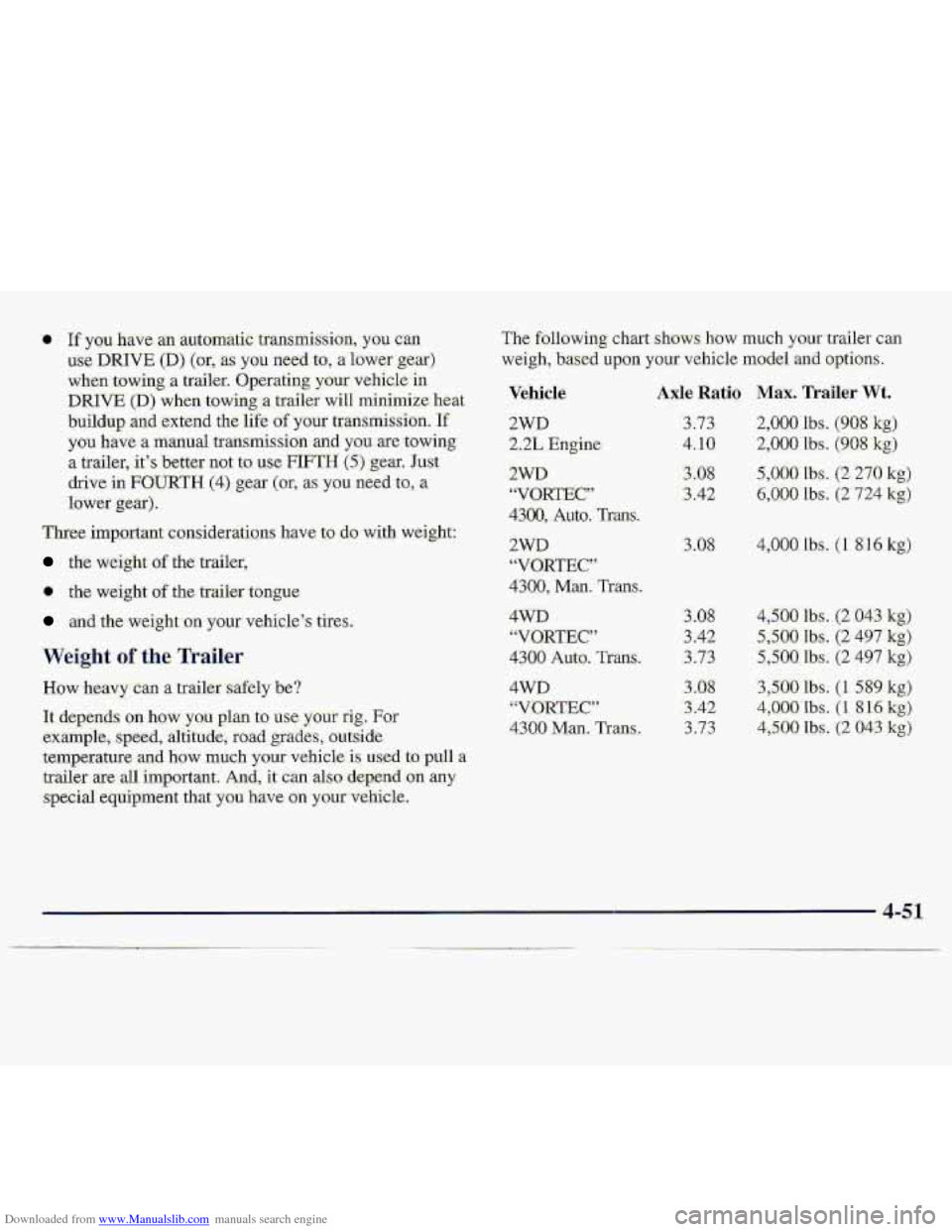
The follo-w%g chart shows haw much your trailer can
weigh, based upon your: vehicle rno.&l and. options.
Vehicle
2wD
2.2L Engine:
2wJ-J
'VOREC"'
4300, Auto. Trans.
Axle Ratio Max. Trailer Wt.
3.73
4.10
2,000.Il.?s. (90.8 kg)
2,000 lbs. (908 kg:)
3 .m
3.42
5,000.lbs. (2 270 kg)
6,O.OO lhs. (2 724 kg)
3.08 4,000 lbs. (1 g.16 kg)
4m 3.08
"VORTEC" 3 -42
4300 Auta:. Trans. 3.73
4.,500 hs. (2 043 kg)
5,500 1b.s. (2 497 kg)
$,5OOllbs.. (2 497 kg)
3,500 ibs. (I 589 kg,)
4,500 lbs. (2 043 .kg)
4,000, lbs. (1 8 1.6 kg)