1997 CHEVROLET CORVETTE ECU
[x] Cancel search: ECUPage 174 of 356
Downloaded from www.Manualslib.com manuals search engine 5. Press MN and 000 will appear on the display.
6. Press MN again to make the last two digits agree
with your code.
7. Press HR to make the first one or two digits agree
8. Press AM-FM after you have confirmed that the
with
your code.
code matches the secret code you have written down.
The display will show
REP to let you know that you
need to repeat Steps
5 through 7 to confirm your
secret code.
9. Press AM-FM and this time the display will show
SEC to let you know that your radio is secure. The
indicator by the volume control will begin flashing
when the ignition is turned off.
Unlocking the Theft-Deterrent Feature After a
Power Loss
Enter your secret code as follows; pause no more than
15 seconds between steps:
1. LOC appears when the ignition is on.
2. Press MN and 000 will appear on the display.
3. Press MN again to make the last two digits agree
with your code.
with your code.
4. Press HR to make the first one or two digits agree
5. Press AM-FM after you have confirmed that the
code matches the secret code you have written down.
The display will show SEC, indicating the radio
is
now operable and secure.
If you enter the wrong code eight times, INOP will
appear on the display. You will have to wait an hour
with the ignition on before you can try again. When you
try again, you will only have three chances to enter the
correct code before INOP appears.
If you lose or forget your code, contact your dealer.
3-27
Page 175 of 356
Downloaded from www.Manualslib.com manuals search engine Disabling the Theft-Deterrent Feature
Enter your secret code as follows; pause no more than
15 seconds between steps:
1. Turn the ignition to ACCESSORY or ON.
2. Turn the radio off.
3. Press the 1 and 4 buttons together. Hold them down
4. Press MN and 000 will appear on the display.
5. Press MN again to make the last two digits agree
6. Press HR to make the first one or two digits agree
7. Press AM-FM after you have confirmed that the
until SEC
shows on the display.
with your code. with your code.
code matches the secret code you have written down.
The display will show
---, indicating that the radio is
no longer secured.
If the code entered is incorrect, SEC will appear on the
display. The radio will remain secured until the correct
code is entered.
When battery power is removed and later applied to a
secured radio, the radio won’t turn on and LOC will
appear
on the display.
To unlock a secured radio, see “Unlocking the
Theft-Deterrent Feature After a Power
Loss” earlier
in this section.
Understanding Radio Reception
FM Stereo
FM stereo will give you the best sound, but FM signals
will reach only about
10 to 40 miles (16 to 65 km). Tall
buildings or hills can interfere with
FM signals, causing
the sound to come and go.
AM
The range for most AM stations is greater than for FM,
especially
at night. The longer range, however, can
cause stations to interfere with each other.
AM can pick
up noise from things like storms and power lines. Try
reducing the treble to reduce this noise if you ever get it.
Tips About Your Audio System
Hearing damage from loud noise is almost undetectable
until
it is too late. Your hearing can adapt to higher
volumes of sound. Sound that seems normal can be loud
and harmful to your hearing. Take precautions by
adjusting the volume control on your radio to
a safe
sound level before your hearing adapts to it.
3-28
Page 205 of 356
Downloaded from www.Manualslib.com manuals search engine Winter Driving
Here are some tips for winter driving:
0 Have your vehicle in good shape for winter.
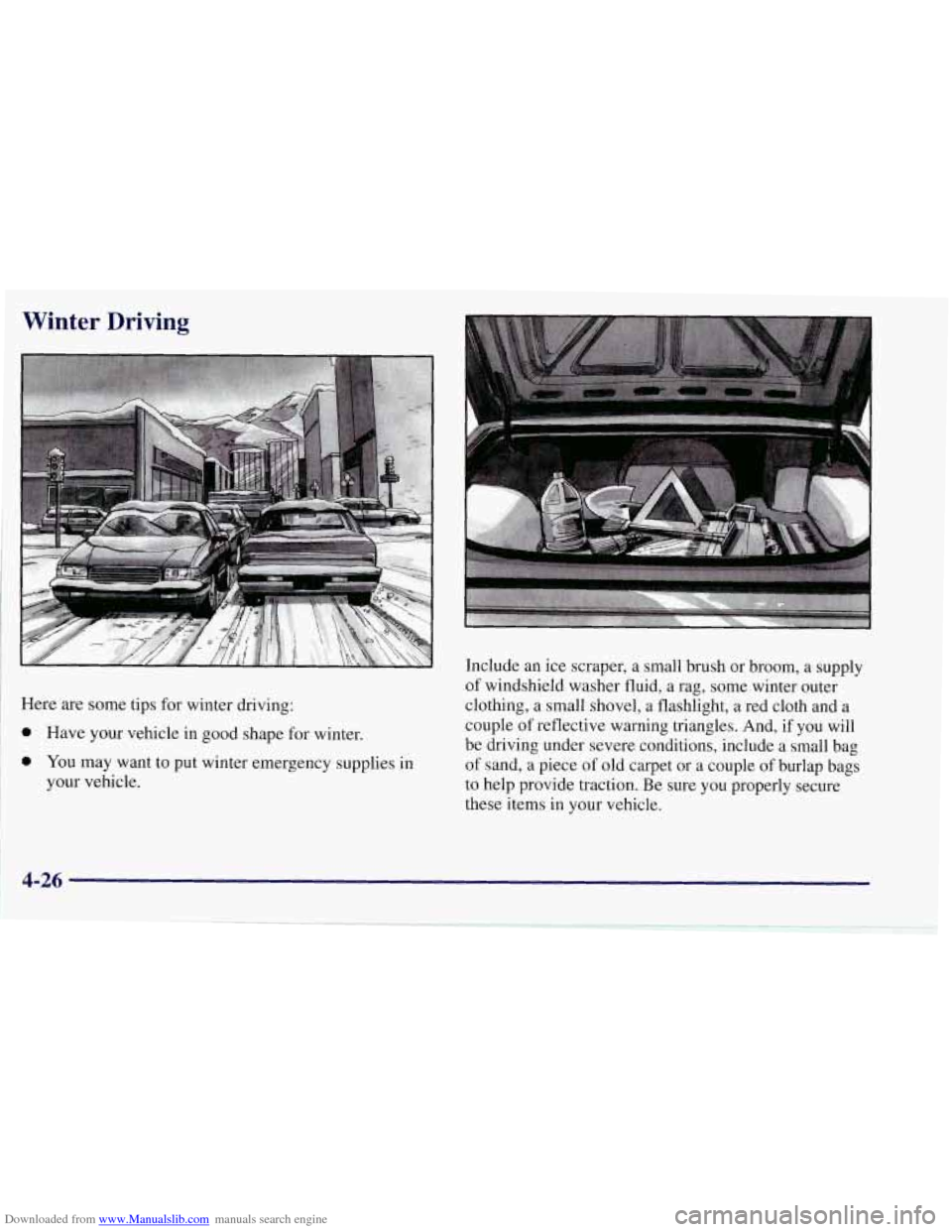
0 You may want to put winter emergency supplies in
your vehicle. Include
an ice scraper, a small brush or broom, a supply
of windshield washer fluid, a rag, some winter outer
clothing, a small shovel, a flashlight, a red cloth and a
couple of reflective warning triangles. And,
if you will
be driving under severe conditions, include a small bag
of sand, a piece of old carpet or a couple of burlap bags
to help provide traction. Be sure you properly secure
these items in your vehicle.
Page 210 of 356
Downloaded from www.Manualslib.com manuals search engine ' A CA"T1ON:
-
Do not load your vehicle any heavier than the
GVWR, or either the maximum front or rear
GAWR. If you do, parts on your vehicle can
break, or
it can change the way your vehicle
handles. These could cause you to lose control.
Also, overloading can shorten the life of
your vehicle.
NOTICE:
Your warranty does not cover parts or
components that fail because of overloading.
~~ ~ ~ ~ ~~ ~ ~~~ ~ ~~ ~
If you put things inside your vehicle -- like suitcases,
tools, packages or anything else
-- they will go as fast as
the vehicle goes.
If you have to stop or turn quickly, or
if there is a crash, they'll keep going.
__ --_I ,
Things you put inside your vehicle can strike
and injure people in a sudden stop or turn,
or in
a crash.
0 Put things in the rear area of your vehicle.
Try to spread the weight evenly.
0 Never stack heavier things, like suitcases,
inside the vehicle
so that some of them are
above the tops
of the seats.
0 Don't leave an unsecured child restraint in
your vehicle.
0 When you carry something inside the
vehicle, secure
it whenever you can.
Towing A Trailer
Your Corvette is neither designed nor intended to tow
a trailer.
4-31
Page 220 of 356
Downloaded from www.Manualslib.com manuals search engine I
’
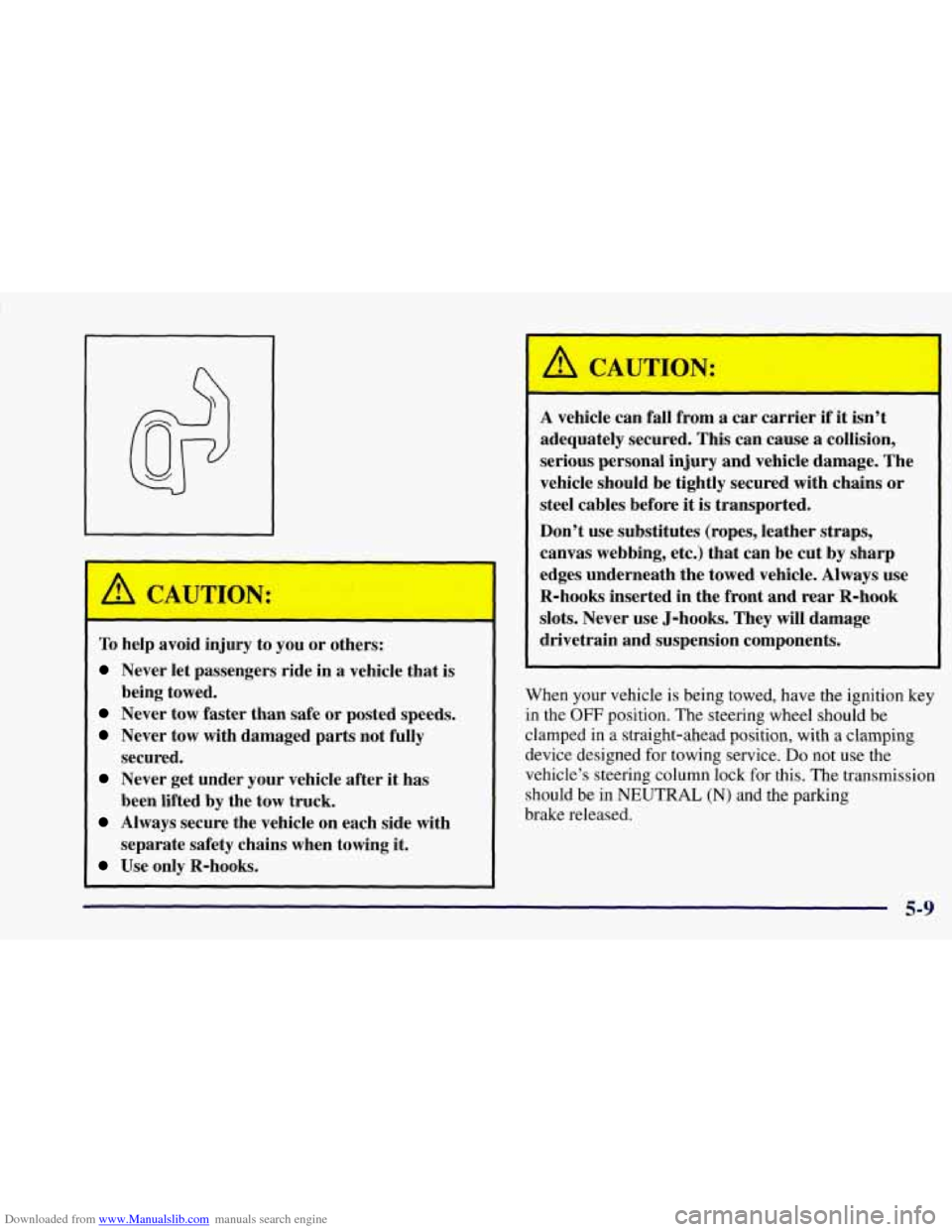
A CAUTION:
I
To help avoid injury to you or others:
Never let passengers ride in a vehicle that is
Never tow faster than safe or posted speeds.
Never tow with damaged parts not fully
Never get under your vehicle after it has
Always secure the vehicle on each side with
Use only R-hooks. being towed.
secured.
been lifted by the tow truck.
separate safety chains when towing it.
A vehicle can fall from a car carrier if it isn’t
adequately secured. This can cause
a collision,
serious personal injury and vehicle damage. The
vehicle should be tightly secured with chains or
steel cables before it is transported.
Don’t use substitutes (ropes, leather straps,
canvas webbing, etc.) that can be cut by sharp
edges underneath the towed vehicle. Always use
R-hooks inserted
in the front and rear R-hook
slots. Never use J-hooks. They will damage
drivetrain and suspension components.
When your vehicle is being towed, have the ignition key
in the
OFF position. The steering wheel should be
clamped in
a straight-ahead position, with a clamping
device designed for towing service.
Do not use the
vehicle’s steering column lock for this. The transmission
should be in
NEUTRAL (N) and the parking
brake released.
5-9
Page 221 of 356
Downloaded from www.Manualslib.com manuals search engine Front Towing
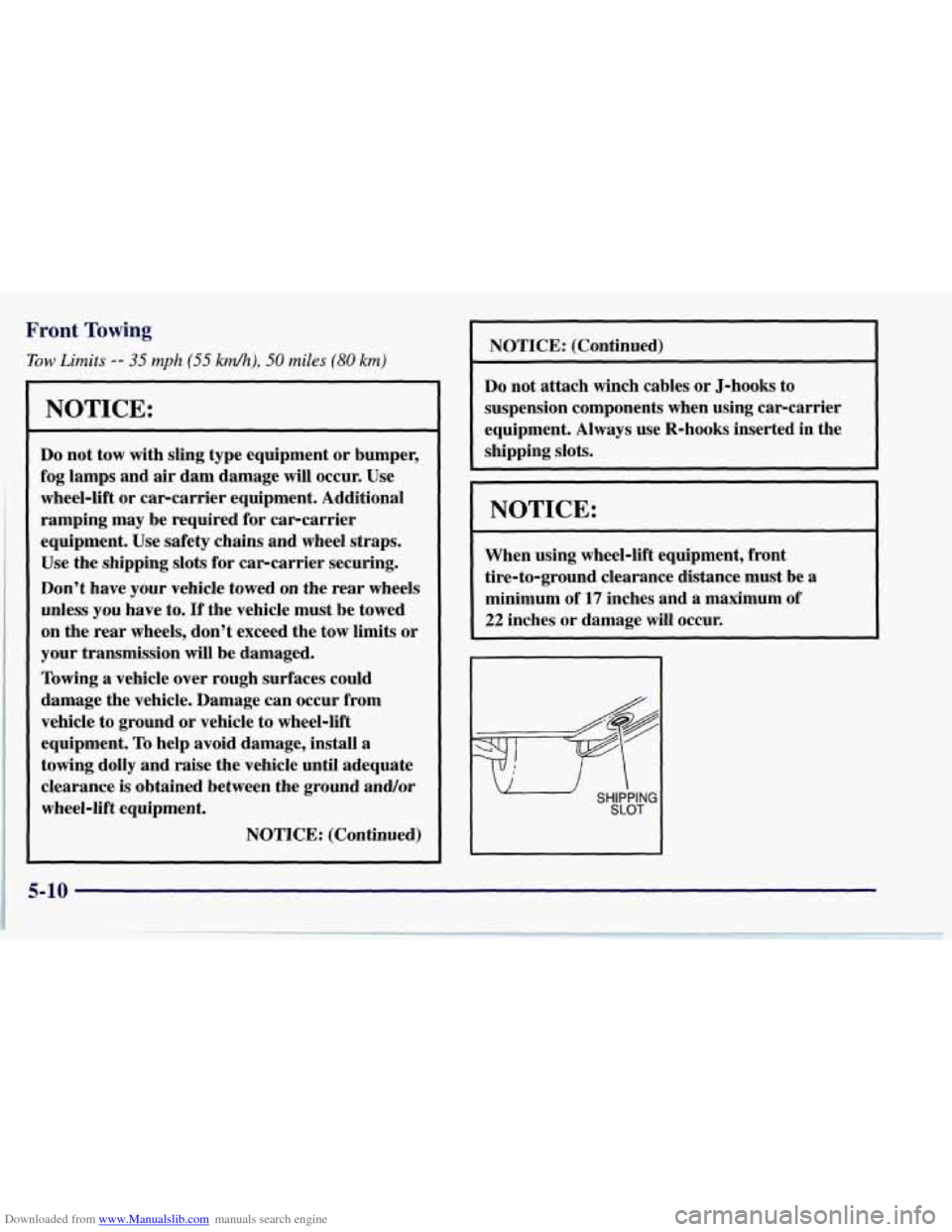
Tow Limits -- 35 mph (55 kd), 50 miles (80 km)
NOTICE:
Do not tow with sling type equipment or bumper,
fog lamps and
air dam damage will occur. Use
wheel-lift or car-carrier equipment. Additional
ramping may be required for car-carrier
equipment. Use safety chains and wheel straps.
Use the shipping slots for car-carrier securing.
Don’t have your vehicle towed on the rear wheels
unless you have to. If the vehicle must be towed
on the rear wheels, don’t exceed the tow limits or
your transmission will be damaged.
Towing
a vehicle over rough surfaces could
damage the vehicle. Damage can occur from
vehicle to ground or vehicle to wheel-lift
equipment.
To help avoid damage, install a
towing dolly and raise the vehicle until adequate
clearance
is obtained between the ground and/or
wheel-lift equipment.
NOTICE: (Continued)
NOTICE: (Continued)
Do not attach winch cables or J-hooks to
suspension components when using car-carrier
equipment. Always use R-hooks inserted in the
shipping
slots.
NOTICE:
When using wheel-lift equipment, front
tire-to-ground clearance distance must be
a
minimum of 17 inches and a maximum of
22 inches or damage will occur.
SLOT
5-10
Page 222 of 356
Downloaded from www.Manualslib.com manuals search engine Rear Towing
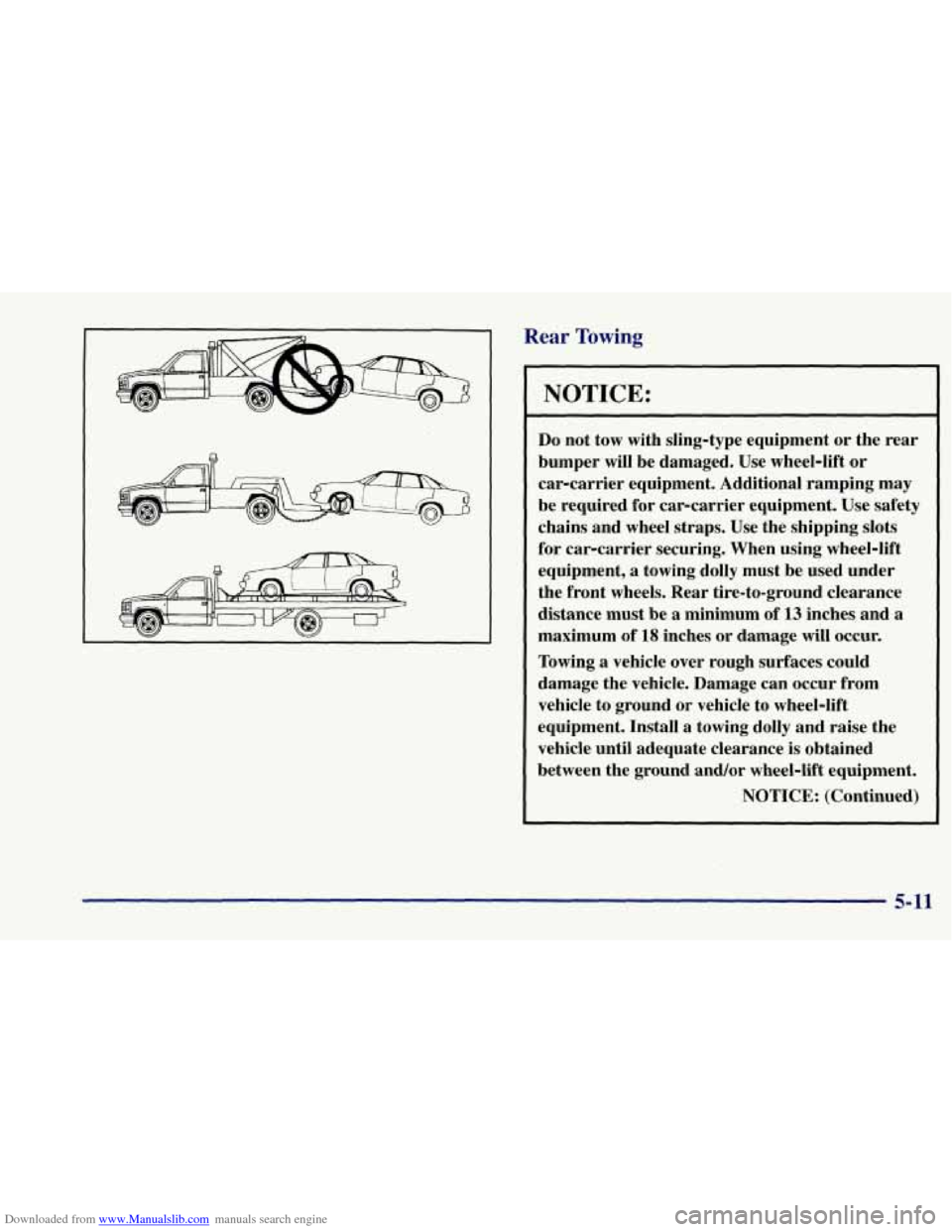
NOTICE:
Do not tow with sling-type equipment or the rear
bumper will be damaged. Use wheel-lift or
car-carrier equipment. Additional ramping may
be required for car-carrier equipment. Use safety
chains and wheel straps. Use the shipping slots
for car-carrier securing. When using wheel-lift
equipment, a towing dolly must be used under
the front wheels. Rear tire-to-ground clearance
distance must be a minimum of
13 inches and a
maximum of
18 inches or damage will occur.
Towing
a vehicle over rough surfaces could
damage the vehicle. Damage can occur from
vehicle to ground or vehicle to wheel-lift
equipment. Install a towing dolly and raise the
vehicle until adequate clearance is obtained
between the ground and/or wheel-lift equipment.
NOTICE: (Continued)
5-11
Page 288 of 356
Downloaded from www.Manualslib.com manuals search engine Cleaning Coated Moldings
These moldings are around the hatch opening in your
Corvette’s rear area.
0 When lightly soiled, wipe with a sponge or soft
When heavily soiled, use warm soapy water.
lint-free cloth dampened with
water.
You can remove scratches from a coated molding by
wiping briskly with the solvent-type cleaner described
earlier. If a ring forms, repeat the procedure over a larger
area, wiping toward the center of the ring. If the ring
still remains, wipe the whole molding.
Cleaning Leather
Use a soft cloth with lukewarm water and a mild soap or
saddle soap and wipe dry with a soft cloth. Then, let the
leather dry naturally.
Do not use heat to dry.
0 For stubborn stains, use a leather cleaner. See your
Never use oils, varnishes, solvent-based or abrasive
dealer
for this product.
cleaners, furniture polish or shoe polish on leather.
immediately. If dirt
is allowed to work into the
finish, it can harm the leather.
Soiled or stained leather should be cleaned
Cleaning the Top of the Instrument Panel
Use only mild soap and water to clean the top surfaces
of the instrument panel. Sprays containing silicones or
waxes may cause annoying reflections in the windshield
and even make it difficult to see through the windshield
under certain conditions.
Cleaning Soft-Touch Paint Surfaces
Use only mild soap and water to clean the Soft-Touch
paint surfaces
in your Corvette.
Cleaning the Security Shade and
Convenience Net
Wash with warm water and mild detergent, rinse with
cold water and tumble dry on low.
Do not use chlorine
bleach.
6-53