1997 CHEVROLET CAVALIER towing
[x] Cancel search: towingPage 219 of 388
Downloaded from www.Manualslib.com manuals search engine NOTICE:
Do not tow your Cavalier from the rear with
the front wheels on the ground or your transaxle
can be damaged.
Do not tow with sling-type
equipment or rear fascia will be damaged. Use
wheel-lift or car-carrier equipment. Additional
ramping may be required for car-carrier
equipment. Use safety chains and wheel straps.
Towing
a vehicle over rough surfaces could
damage
a vehicle. Damage can occur from vehicle
to ground or vehicle to wheel-lift equipment. To
help avoid damage, install
a towing dolly and
raise vehicle until adequate clearance is obtained
between the ground and/or wheel-lift equipment.
Do not attach winch cables or J-hooks to
suspension components when using car-carrier
equipment. Always use T-hooks inserted in the
T-hook slots.
r
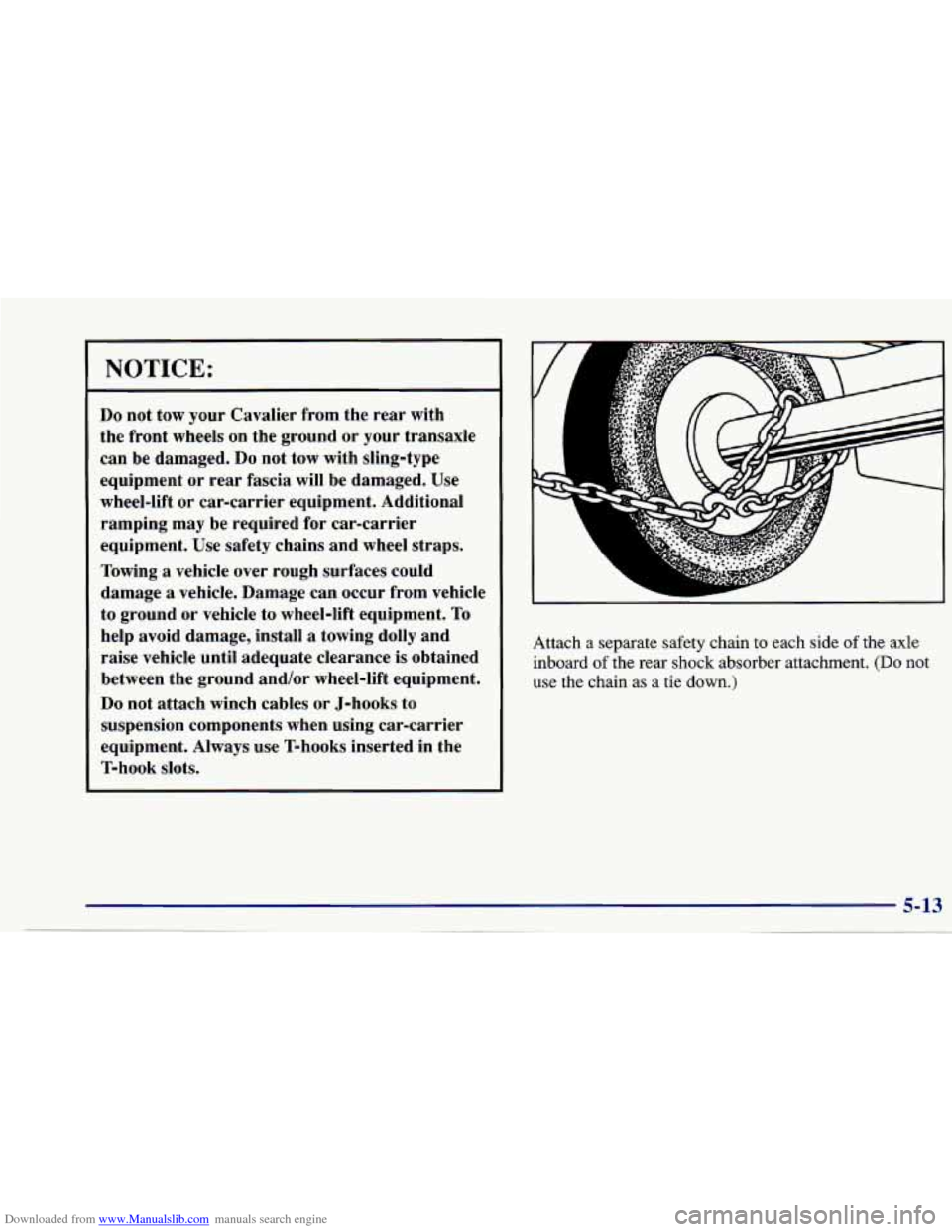
Attach a separate safety chain to each side of the axle
inboard
of the rear shock absorber attachment. (Do not
use the chain as a tie down.)
5-13
Page 241 of 388
Downloaded from www.Manualslib.com manuals search engine If You’re Stuck: In Sand, Mud,
Ice or Snow
What you don’t want to do when your vehicle is stuck is
to spin your wheels too fast. The method known as
“rocking” can help you get
out when you’re stuck, but
you must use caution.
If you let your tires spin at high speed, they can
explode, and you or others could be injured.
And, the transaxle or other parts of the vehicle
can overheat. That could cause an engine
compartment fire or other damage. When you’re
stuck, spin the wheels
as little as possible. Don’t
spin the wheels above
35 mph (55 km/h) as shown
on the speedometer.
I NOTICE:
Spinning your wheels can destroy parts of your
vehicle as well as the tires.
If you spin the wheels
too fast while shifting your transaxle back and
forth, you can destroy your transaxle.
For information about using tire chains on your vehicle,
see “Tire Chains” in the Index.
Rocking Your Vehicle To Get It Out
First, turn your steering wheel left and right. That will
clear the area around your front wheels. Then shift back
and forth between REVERSE
(R) and a forward gear
(or with a manual transaxle, between FIRST
(1) or
SECOND
(2) and REVERSE (R)), spinning the wheels
as little as possible.
(If your vehicle has the Enhanced
Traction System, shift back and forth between
REVERSE (R) and FIRST
(1) or SECOND (2),
spinning the wheels as little as possible.) Release the
accelerator pedal while you shift, and press lightly on
the accelerator pedal when the transaxle is in gear. If
that doesn’t get you out after a few tries, you may need
to be towed out. If you do need to be towed out, see
“Towing Your Vehicle” in
the Index.
5-35
Page 260 of 388
Downloaded from www.Manualslib.com manuals search engine A CAU‘LOA .:
Operating the engine with the air cleaner off
can cause you or others to be burned. The air
cleaner not only cleans the air, it stops flame
if
the engine backfires. If it isn’t there, and the
engine backfires, you could be burned. Don’t
drive with it
off, and be careful working on the
engine with the air cleaner
off.
NOTICE:
If the air cleaner is off, a backfire can cause a
damaging engine fire. And, dirt can easily get
into your engine, which will damage it. Always
have the air cleaner in place when you’re driving.
Automatic Transaxle Fluid
(Except
2.4L Code T Engine)
When to Check and Change
A good time to check your automatic transaxle fluid
level is when the engine oil is changed.
Change both the fluid and filter every
50,000 miles
(83 000 km) if the vehicle is mainly driven under one or
more of these conditions:
In heavy city traffic where the outside temperature
regularly reaches
90 OF (32 O C) or higher.
0 In hilly or mountainous terrain.
When doing frequent trailer towing.
0 Uses such as found in taxi, police or delivery service.
If
you do not use your vehicle under any of these
conditions, the fluid and filter do not require changing.
See “Scheduled Maintenance Services” in the Index.
Page 263 of 388
Downloaded from www.Manualslib.com manuals search engine How to Add Fluid
Refer to the Maintenance Schedule to determine what
kind
of transaxle fluid to use. See “Recommended
Fluids and Lubricants” in the Index.
If the fluid level is low, add only enough of the proper
fluid to bring the level into the cross-hatched area on
the dipstick.
1. Pull out the dipstick.
2. Using a long-neck funnel, add enough fluid at the
dipstick hole to bring it to the proper level.
It doesn’t
take much fluid, generally less than one pint
(0.5 L). Don’t ove@ll.
NOTICE:
We recommend you use only fluid labeled
DEXRON@-111, because fluid with that label
is
made especially for your automatic transaxle.
Damage caused by fluid other than DEXRON-III
is not covered by your new vehicle warranty.
3. After adding fluid, recheck the fluid level as
4. When the correct fluid level is obtained, push the
described
under “How to Check.”
dipstick back
in all the way.
Automatic Transaxle Fluid
(2.4L Code T Engine Only)
If you have the optional 2.4L Code T engine (see
“Engine Identification” in the Index) and an automatic
transaxle, it is not necessary to check the transaxle fluid
level.
A transaxle fluid leak is the only reason for fluid
loss.
If a leak occurs, take the vehicle to your Chevrolet
dealership Service Department and have it repaired as
soon as possible. You may also have your fluid level
checked by your dealer or service center when you have
your oil changed.
Change both the fluid and filter every
50,000 miles
(83 000 km) if the vehicle is mainly driven under one
or more
of these conditions:
In heavy city traffic where the outside temperature
0 In hilly or mountainous terrain.
0 When doing frequent trailer towing.
Uses such as found in taxi, police or delivery service.
regularly
reaches
90 OF (32 O C) or higher.
Page 313 of 388
Downloaded from www.Manualslib.com manuals search engine Maintenance Schedule
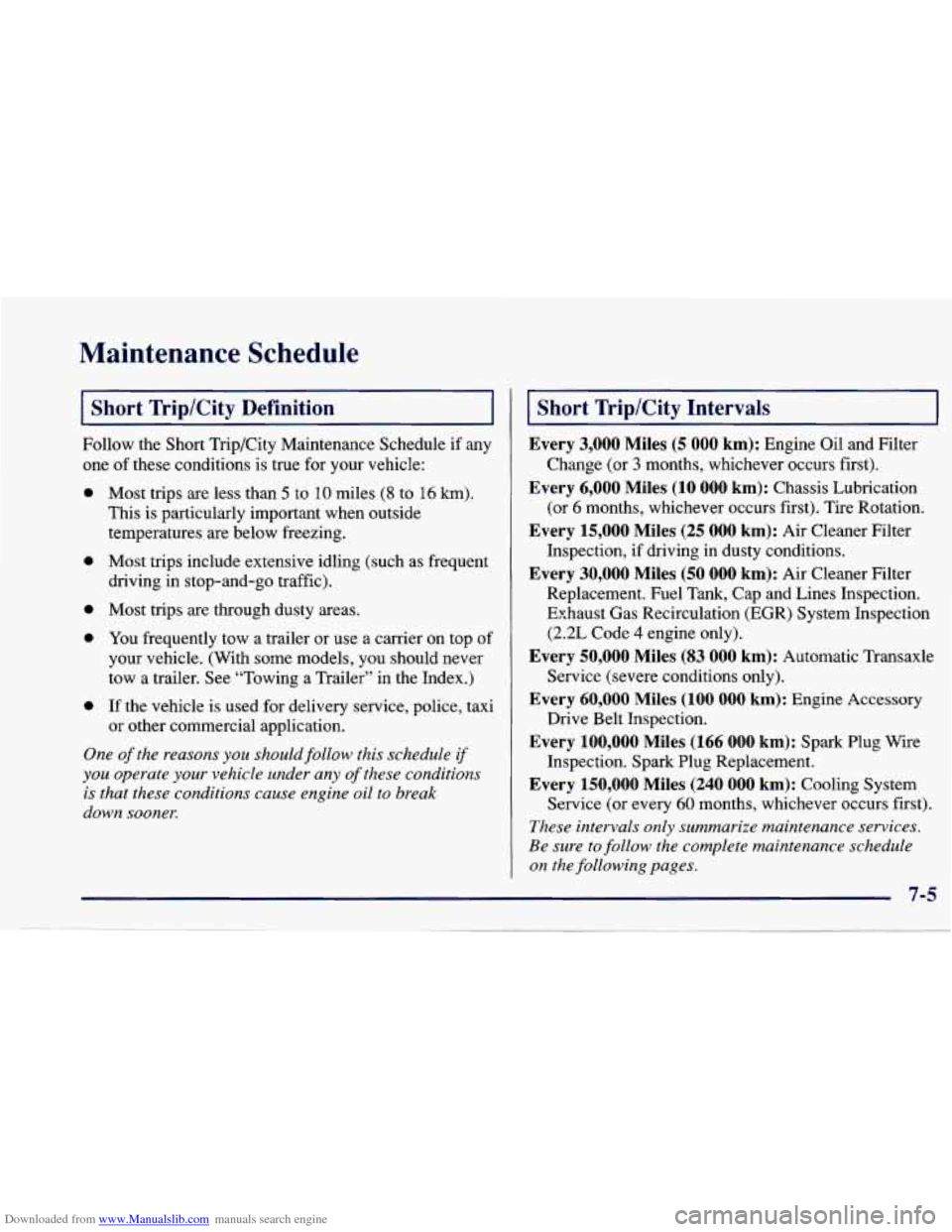
(Short Trip/City Definition
Follow the Short Trip/City Maintenance Schedule if any
one of these conditions is true for your vehicle:
0
e
0
0
e
Most trips are less than 5 to 10 miles (8 to 16 km).
This is particularly important when outside
temperatures are below freezing.
Most trips include extensive idling (such as frequent
driving in stop-and-go traffic).
Most trips are through dusty areas.
You frequently tow a trailer or use a carrier on top of
your vehicle. (With some models,
you should never
tow a trailer. See “Towing
a Trailer’’ in the Index.)
If the vehicle is used for delivery service, police, taxi
or other commercial application.
One of the reasons you should follow this schedule if
you operate your vehicle under any of these conditions
is that these conditions cause engine oil to break
down sooney.
Short Trip/City Intervals
Every 3,000 Miles (5 000 km): Engine Oil and Filter
Every 6,000 Miles (10 000 km): Chassis Lubrication
Every 15,000 Miles (25 000 km): Air Cleaner Filter
Every 30,000 Miles (50 000 km): Air Cleaner Filter
Change
(or
3 months, whichever occurs first).
(or
6 months, whichever occurs first). Tire Rotation.
Inspection, if driving in dusty conditions.
Replacement. Fuel Tank, Cap and Lines Inspection.
Exhaust Gas Recirculation (EGR) System Inspection
(2.2L Code
4 engine only).
Every 50,000 Miles (83 000 km): Automatic Transaxle
Service (severe conditions only).
Every 60,000 Miles (100 000 km): Engine Accessory
Drive Belt Inspection.
Every 100,000 Miles (166 000 km): Spark Plug Wire
Inspection. Spark Plug Replacement.
Every 150,000 Miles (240 000 km): Cooling System
Service (or every
60 months, whichever occurs first).
These intervals only summarize maintenance services.
Be
sure to follow the complete maintenance schedule
on the following pages.
Page 314 of 388
Downloaded from www.Manualslib.com manuals search engine Maintenance Schedule
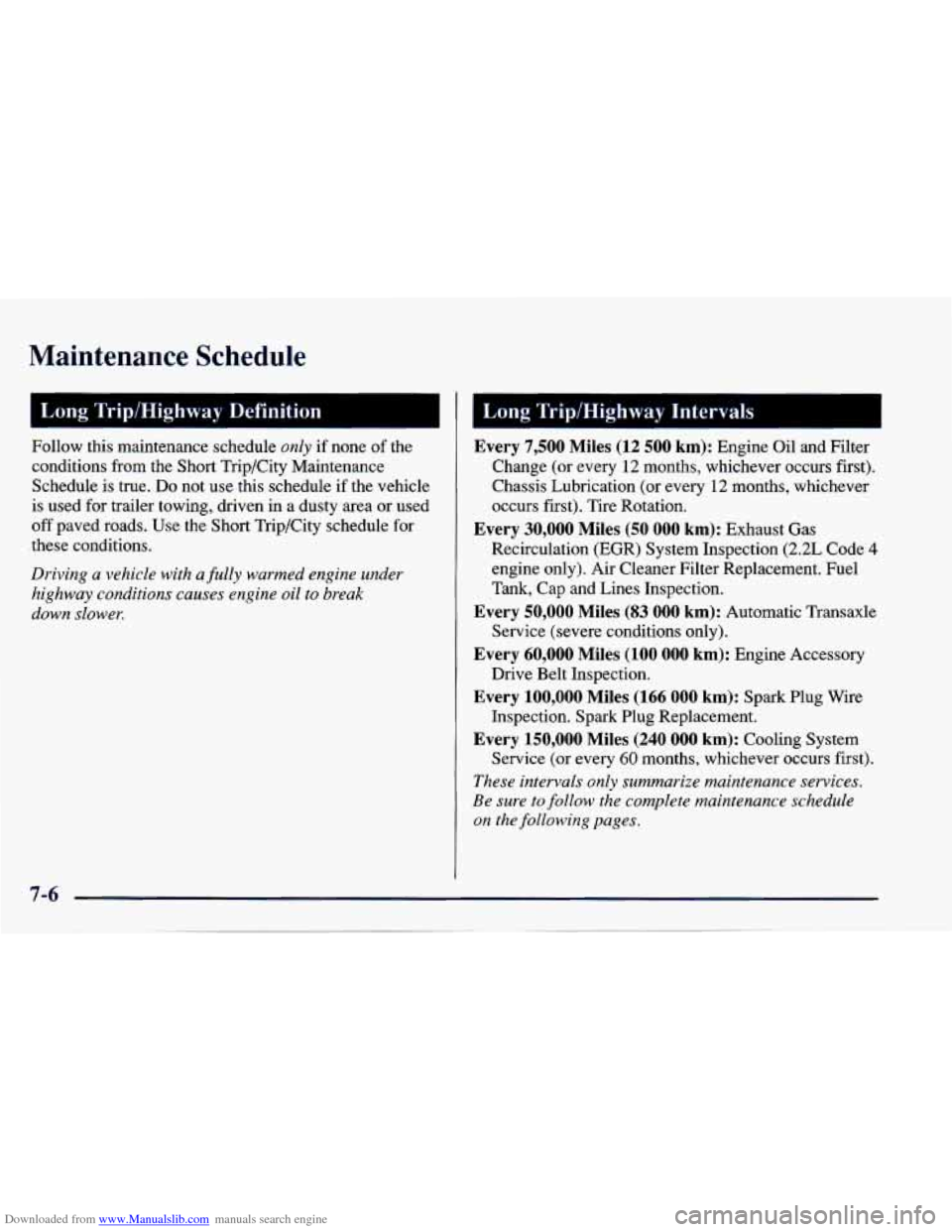
I Long Trip/Highway Definition
Follow this maintenance schedule only if none of the
conditions from the Short Trip/City Maintenance
Schedule is true.
Do not use this schedule if the vehicle
is used for trailer towing, driven in a dusty area or used
off paved roads. Use the Short Trip/City schedule for
.these conditions.
Driving a vehicle with a fully warmed engine under
highway conditions causes engine oil to break
down slower.
I 1 Long Trip/Highway Intervals
Every 7,500 Miles (12 500 km): Engine Oil and Filter
Change (or every
12 months, whichever occurs first).
Chassis Lubrication (or every 12 months, whichever
occurs first).
Tire Rotation.
Recirculation (EGR) System Inspection (2.2L Code
4
engine only). Air Cleaner Filter Replacement. Fuel
Tank, Cap and Lines Inspection.
Every 50,000 Miles (83 000 km): Automatic Transaxle
Service (severe conditions only).
Every 60,000 Miles (100 000 km): Engine Accessory
Drive Belt Inspection.
Every 100,000 Miles (166 000 km): Spark Plug Wire
Inspection. Spark Plug Replacement.
Every 150,000 Miles (240 000 km): Cooling System
Service (or every
60 months, whichever occurs first).
These intervals only summarize maintenance services.
Be sure
to follow the complete maintenance schedule
on the following pages.
Every 30,000 Miles (50 000 km): Exhaust Gas
Page 325 of 388
Downloaded from www.Manualslib.com manuals search engine I Short Trip/City Maintenance Schedule I
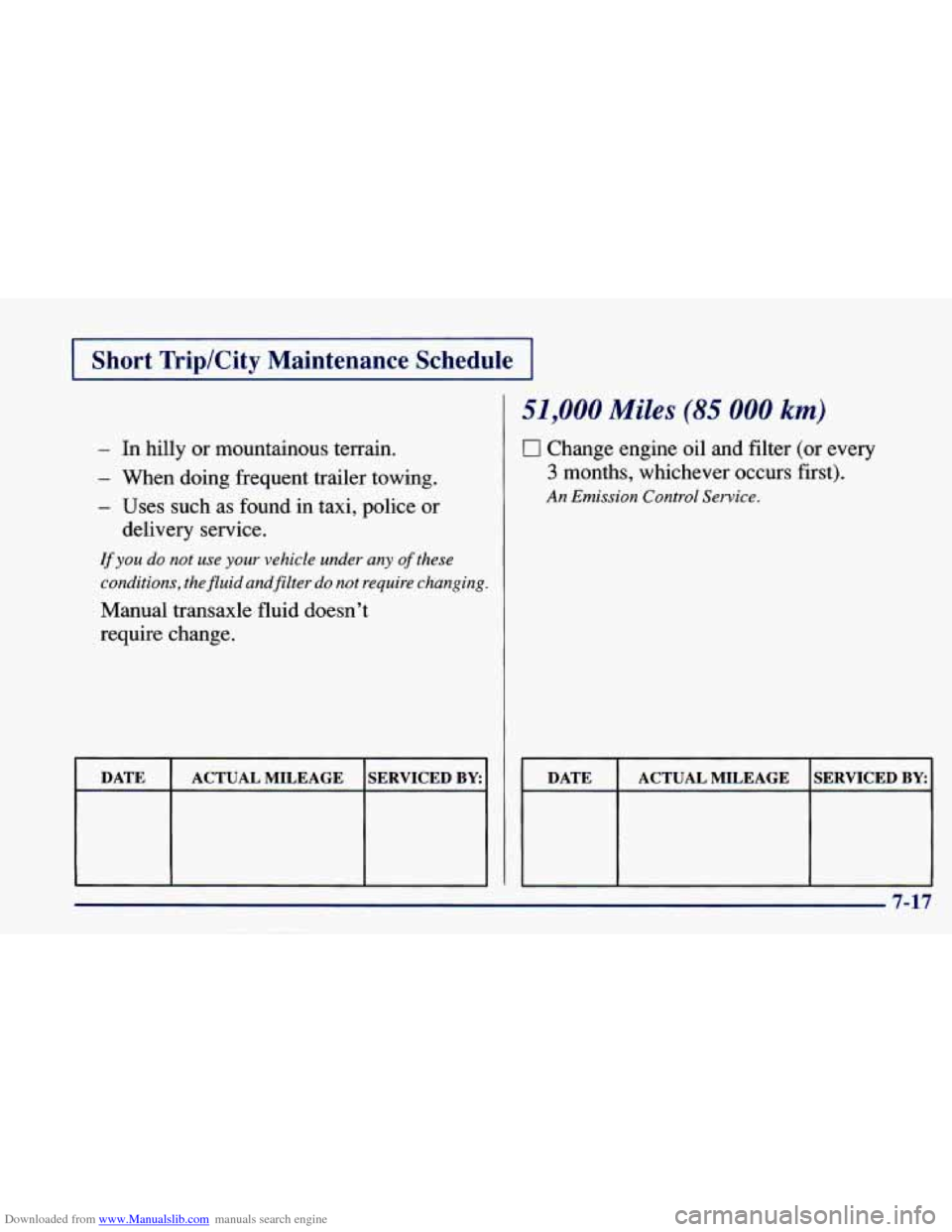
- In hilly or mountainous terrain.
- When doing frequent trailer towing.
- Uses such as found in taxi, police or
delivery service.
If you do not use your vehicle under any of these
conditions, the fluid andfilter do not require changing.
Manual transaxle fluid doesn’t
require change.
I DATE I ACTUALMILEAGE SERVICED BY:
51,000 Miles (85 000 km)
0 Change engine oil and filter (or every
3 months, whichever occurs first).
An Emission Control Service.
DATE SERVICED BY: ACTUAL MILEAGE
b
7-17
Page 336 of 388
Downloaded from www.Manualslib.com manuals search engine I I
Short Trip/City Maintenance Schedule
100,000 Miles (1 66 000 km) (Continued)
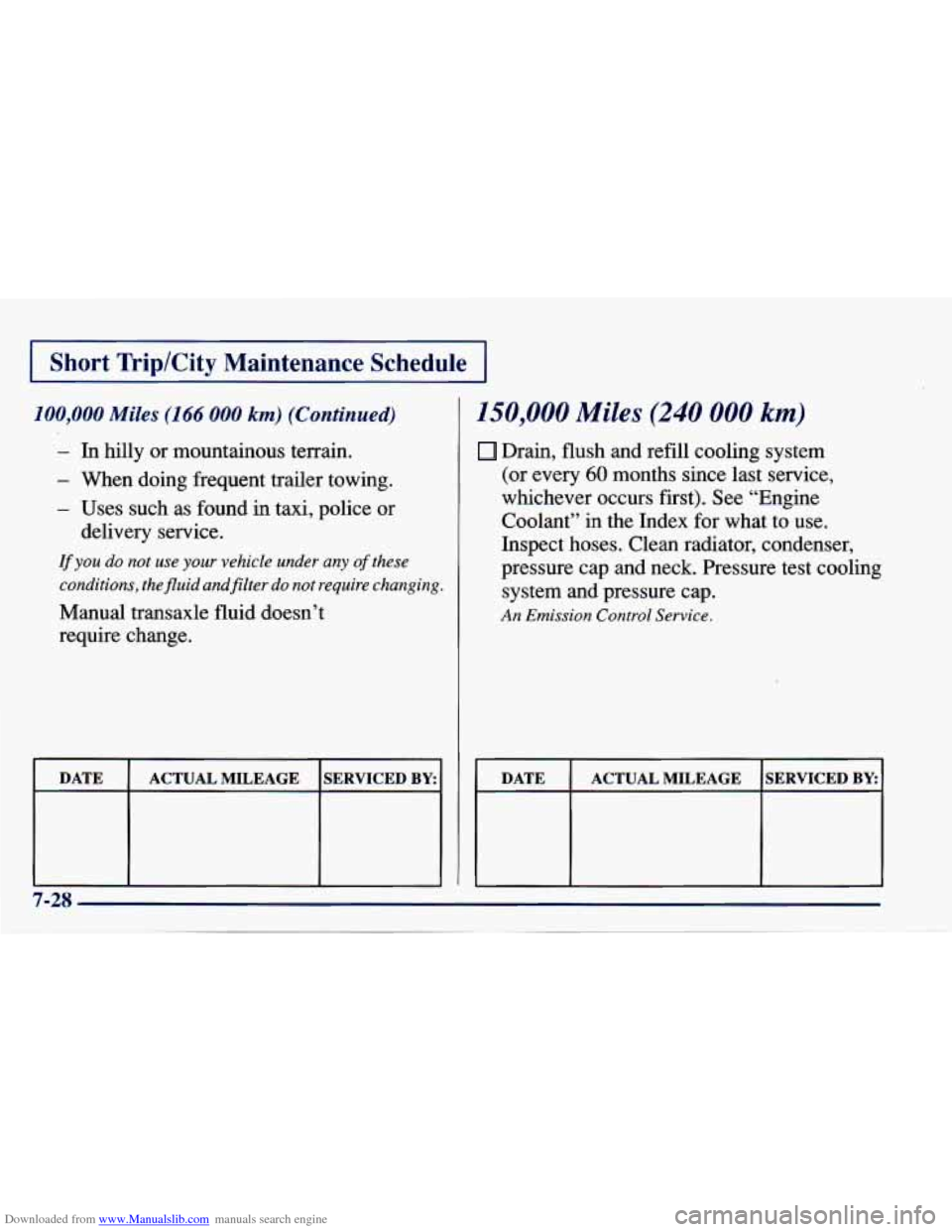
- In hilly or mountainous terrain.
- When doing frequent trailer towing.
- Uses such as found in taxi, police or
If you do not use your vehicle under any of these
conditions, the
fluid andfilter do not require changing.
Manual transaxle fluid doesn’t
require change. delivery service.
DATE
ACTUAL MILEAGE SERVICED BY:
150,000 Miles (240 000 km)
Drain, flush and refill cooling system
(or every
60 months since last service,
whichever occurs first). See “Engine
Coolant’’ in the Index for what
to use.
Inspect hoses. Clean radiator, condenser,
pressure cap and neck. Pressure test cooling
system and pressure cap.
An Emission Control Service.
DATE
SERVICED BY: ACTUAL MILEAGE
- -.