Page 156 of 404
Downloaded from www.Manualslib.com manuals search engine AM-FM Stereo with Compact Disc Player
and Automatic Tone Control
(If Equipped)
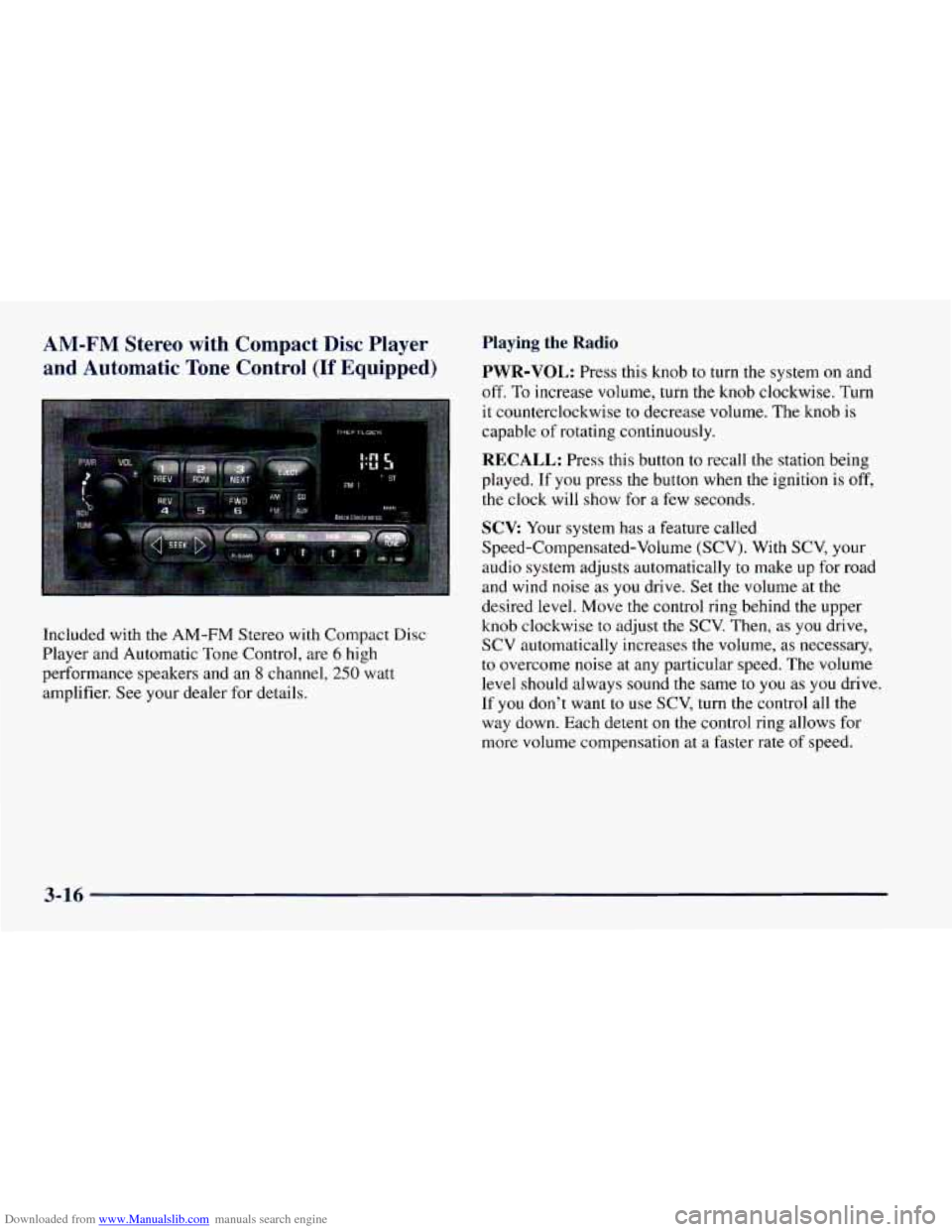
Included with the AM-FM Stereo with Compact Disc
Player and Automatic Tone Control, are
6 high
performance speakers and an
8 channel, 250 watt
amplifier. See your dealer for details.
Playing the Radio
PWR-VOL: Press this knob to turn the system on and
off. To increase volume, turn the knob clockwise. Turn
it counterclockwise to decrease volume. The knob is
capable of rotating continuously.
RECALL: Press this button to recall the station being
played.
If you press the button when the ignition is off,
the clock will
show for a few seconds.
SCV: Your system has a feature called
Speed-Compensated-Volume (SCV). With SCV, your
audio
system adjusts automatically to make up for road
and wind noise as
you drive. Set the volume at the
desired level. Move the control ring behind the upper
knob clockwise
to adjust the SCV. Then, as you drive,
SCV automatically increases the volume, as necessary,
to overcome noise at any particular speed. The volume
level should always sound the same to you as you drive.
If
you don’t want to use SCV, turn the control all the
way down. Each detent on the control ring allows for
more volume compensation at
a faster rate of speed.
3-16
Page 157 of 404

Downloaded from www.Manualslib.com manuals search engine Finding a Station
AM-FM: Press this button to switch between AM, FMl
and
FM2. The display shows your selection.
TUNE: Press this knob lightly so it extends. Turn it to
choose radio stations. Push the knob back into its stored
position when you’re not using it.
SEEK: Press the right or left arrow to go to the next
higher or lower station and stay there.
The sound will
mute while seeking.
SCAN: Press one of the SEEK arrows for two seconds,
and SCAN will appear on
the display. Use SCAN to
listen to stations for a few seconds. The radio will go to
a station, stop for a few seconds, then go on to the next
station. Press
SEEK again to stop scanning. The sound
will mute while scanning.
PUSHBUTTONS: The six numbered pushbuttons let
you return to your favorite stations. You can set up to
18 stations (six AM, six FM1 and six FM2). Just:
1. Press AM-FM to select the band.
2. Tune in the desired station.
3. Press AUTO TONE to select the equalization that
best suits the type
of station selected.
4. Press and hold one of the six numbered buttons. The
sound will mute. When it returns, release the button.
Whenever you press that numbered button, the
station
you set will return and the AUTO TONE
equalization that
you selected will also be
automatically selected for that button.
5. Repeat the steps for each pushbutton.
P.SCAN: Press this button to listen to each of your
favorite stations stored on your pushbuttons for a few
seconds. The radio will scan through each
of the stations
stored on your pushbuttons, except those stations with
weak reception. The AUTO TONE setting stored for
that pushbutton will be automatically chosen. Press
P.SCAN or one of the pushbuttons again to stop
scanning. P.SCAN will be displayed whenever the
tuner is
in the P.SCAN mode. The channel number
(PI -P6) will appear momentarily just before the
frequency is displayed.
Setting the Tone
BASS:
Press this knob lightly so it extends. Turn the
knob clockwise to increase bass and counterclockwise to
decrease bass. When you use this control, the radio’s
AUTO TONE setting will switch to manual.
3-17
Page 158 of 404

Downloaded from www.Manualslib.com manuals search engine TREB: Press this knob lightly so it extends. Turn the
knob clockwise
to increase treble and counterclockwise
to decrease treble. When
you use this control, the radio’s
AUTO TONE setting will switch to manual. If
a station
is weak or noisy, you may want to decrease the treble.
Push these knobs back into their stored positions when
you’re not using them.
AUTO TONE: This feature allows you to choose
preset bass and treble equalization settings designed for
classical, news, rock, pop, country/western and jazz
stations.
C/W will appear on the display when you first
press AUTO TONE. Each time you press it, another
setting will appear
on the display. Press it again after
JAZZ appears and the AUTO TONE display will go
blank. Tone control will return to the BASS and TREB
knobs. Also, if you use the BASS and TREB knobs,
control will return to them and the AUTO TONE
display will go blank.
Adjusting the Speakers
BAL:
Press this knob lightly so it extends. Turn the
knob clockwise for right speakers and counterclockwise
for left speakers. The middle position balances the
sound between the speakers.
FADE: Press this knob lightly so it extends. Turn the
knob clockwise to adjust the sound to the front speakers
and counterclockwise
for the rear speakers. The middle
position balances the sound between the speakers.
Push these knobs back into their stored positions when
you’re not using them.
Playing a Compact Disc
Insert a disc partway into the slot, label side up. The
player will pull it in.
The disc should begin playing. The
display will show CD and the CD symbol.
If you’re driving
on a very rough road or if it’s very hot,
the disc may not play and ERR (error) may appear on
the display. Press RECALL to take ERR off the display.
When things get back to normal, the disc should play.
If the disc comes out, it could be that:
The disc is upside down.
It is dirty, scratched or wet.
It is very humid. (If so, wait about an hour and
try again.)
3-18
Page 176 of 404

Downloaded from www.Manualslib.com manuals search engine Steering in Emergencies
There are times when steering can be more effective
than braking. For example,
you come over a hill and
find a truck stopped in your lane, or a car suddenly
pulls out from nowhere, or a child darts
out from
between parked cars and stops right in front
of you.
You can avoid these problems by braking -- if you
can stop in time. But sometimes you can’t; there isn’t
room. That’s the time for evasive action
-- steering
around the problem.
Your Chevrolet can perform very well in emergencies
like these. First apply your brakes. (See “Braking in
Emergencies” earlier
in this section.) It is better to
remove as much speed
as you can from a possible
collision. Then steer around the problem,
to the left
or right depending
on the space available. An
emergency like this requires close attention
and a
quick decision. If you are holding the steering wheel at
the recommended 9 and 3 o’clock positions, you can
turn it a full 180 degrees very quickly without removing
either hand. But you have
to act fast, steer quickly, and
just as quickly straighten the wheel once you have
avoided the object.
The fact that such emergency situations are always
possible is a good reason
to practice defensive driving at
all times and wear safety belts properly.
4-12
Page 225 of 404
Downloaded from www.Manualslib.com manuals search engine How to Add Coolant to the Radiator
(V6 Engine Only)
1 NOTICE:
Your engine has a specific radiator fill procedure.
Failure to follow this procedure could cause your engine
to overheat and be severely damaged.
1. You can remove the pressure cap when the cooling
system, including the pressure cap and upper radiator
hose,
is no longer hot. Turn the pressure cap slowly
counterclockwise until it first stops. (Don’t press
down while turning the pressure cap.)
If you hear a hiss, wait for that to stop. A hiss means
there
is still some pressure left.
5-2 1
Page 229 of 404
Downloaded from www.Manualslib.com manuals search engine How to Add Coolant to the Radiator
(VS Engine Only)
I NOTICE:
The LT1 Engine (Code P) has a specific radiator
fill procedure. Failure to follow this procedure could cause your engine to overheat and be
severely damaged.
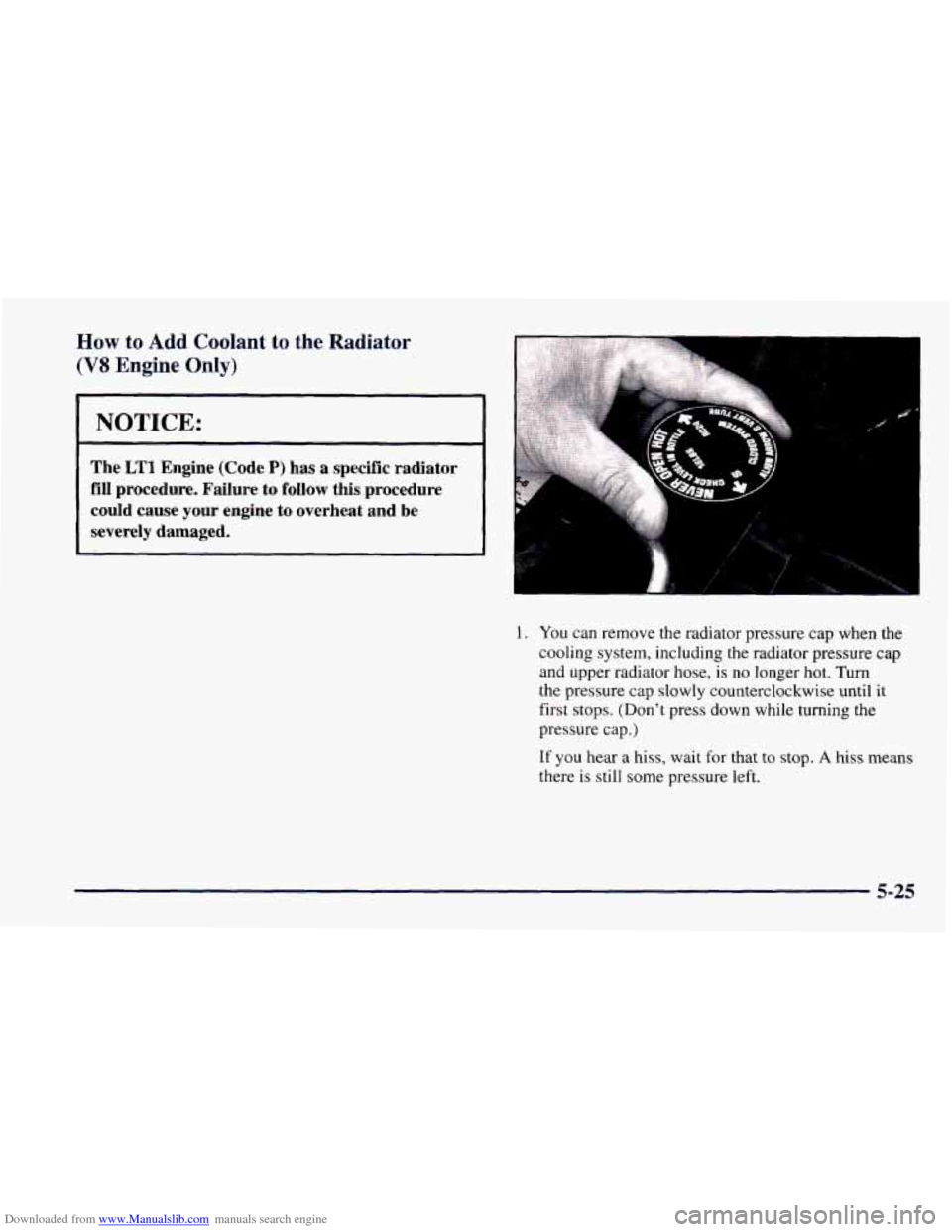
1. You can remove the radiator pressure cap when the
cooling system, including the radiator pressure cap
and upper radiator hose, is no longer hot. Turn
the pressure cap slowly counterclockwise until
it
first stops. (Don't press down while turning the
pressure cap.)
If you hear a hiss, wait for that to stop. A hiss means
there is still some pressure left.
5-25
Page 237 of 404
Downloaded from www.Manualslib.com manuals search engine Removing the Flat Tire and Installing the Spare Tire
1. Using the wheel wrench, loosen all the wheel nuts.
Don’t remove them
yet.
Attach the wheel lock key to the socket of the wheel
wrench. Remove the locking wheel
nut by turning
counterclockwise.
2. Position the jack under the vehicle. There is a notch
in the vehicle’s rocker flange. Raise the jack head
until it fits firmly into the notch nearest the flat tire.
On convertible models, place the jack in a
similar location.
5-33
Page 239 of 404
Downloaded from www.Manualslib.com manuals search engine 4. Remove any rust or dirt
from the wheel bolts,
mounting surfaces and
spare wheel.
3. Raise the vehicle by rotating the wheel wrench
clockwise. Raise
the vehicle far enough off the
ground
so there is enough room for the spare tire
to fit.
Remove all the wheel nuts and take off the flat tire.
5-35