1997 CHEVROLET BLAZER four wheel drive
[x] Cancel search: four wheel drivePage 256 of 402
Downloaded from www.Manualslib.com manuals search engine Section 6 Service and Appearance Care
Here you will find information about the care of your vehicle. This section begins with service and fuel information,
and then
it shows how to check important fluid and lubricant levels. There is also technical information about your
vehicle, and a part devoted
to its appearance care.
6-3
6-4
6-5
6-6
6-9 6-
13
6- 14
6-18
6- 19
6-
20
6-2 1
6-23
6-26
6-26
6-26 6-27
Fuel
Fuels in Foreign Countries
Filling Your Tank
Checking Things Under the Hood
Engine Oil
Air Cleaner
Automatic Transmission Fluid
Manual Transmission Fluid
Hydraulic Clutch
Rear Axle
Four-wheel Drive and All-Wheel Drive
Engine Coolant Radiator Pressure Cap
Thermostat Power Steering Fluid
Windshield Washer Fluid 6-28
6-32
6-3 3 6-3 8
6-40 6-49
6-49
6-52
6-54
6-5
7
6-5 8
6-58
6-58
6-62
6-63
6-64
Brakes
Battery
Bulb Replacement
Windshield Wiper Blade Replacement
Tires
Appearance Care
Cleaning the Inside
of Your Vehicle
Care
of Safety Belts
Cleaning the Outside of Your Vehicle
Appearance Care Materials Chart
Vehicle Identification Number
(VIN)
Service Parts Identification Label
Electrical System
Replacement Bulbs
Capacities and Specifications
Air Conditioning Refrigerants
Page 267 of 402
Downloaded from www.Manualslib.com manuals search engine Engine Oil Additives
Don't add anything to your oil. Your GM dealer is ready
to advise if you think something should be added.
When to Change Engine Oil
If any one of these is true for you. use the short tripkity
. maintenance schedule:
a
a
a
0
a
Most trips are less than 5 to 10 miles (8 to 16 km).
This is particularly important when outside
temperatures are below freezing.
Most trips include extensive idling (such
as frequent
driving in stop-and-go traffic).
You operate
your vehicle in dusty areas or
off-road frequently.
You frequently tow
a trailer or use a currier on top of
your vehicle.
The vehicle is used for delivery service. police, taxi
or other commercial application. Driving under
these conditions causes engine oil
to
break down sooner. If any one of these is true for your
vehicle, then you need
to change your oil and filter
every
3.000 miles (5 000 km) or 3 months -- whichever
occllrs first.
If none of them is true, use the long trip/highway
maintenance schedule. Change the oil and filter every
7,500 miles ( 12 500 km) or 12 months -- whichever
occurs first. Driving
a vehicle with a fully warmed
engine under highway conditions causes engine oil
to
break down slower.
Remote Oil Filter (Four-wheel Drive)
The access door for the remote oil filter is in the steering
linkage shield assembly located under the radiator
support.
Twist the screw to unlock or lock the door.
Make sure
if you open the door. it is securely closed
when
~OLI are finished.
6-12
Page 276 of 402
Downloaded from www.Manualslib.com manuals search engine Four-wheel Drive and
All-Wheel Drive
Most lubricant checks in this section also apply to
four-wheel-drive vehicles. However,
they have two
additional systems
that need lubrication.
Transfer Case
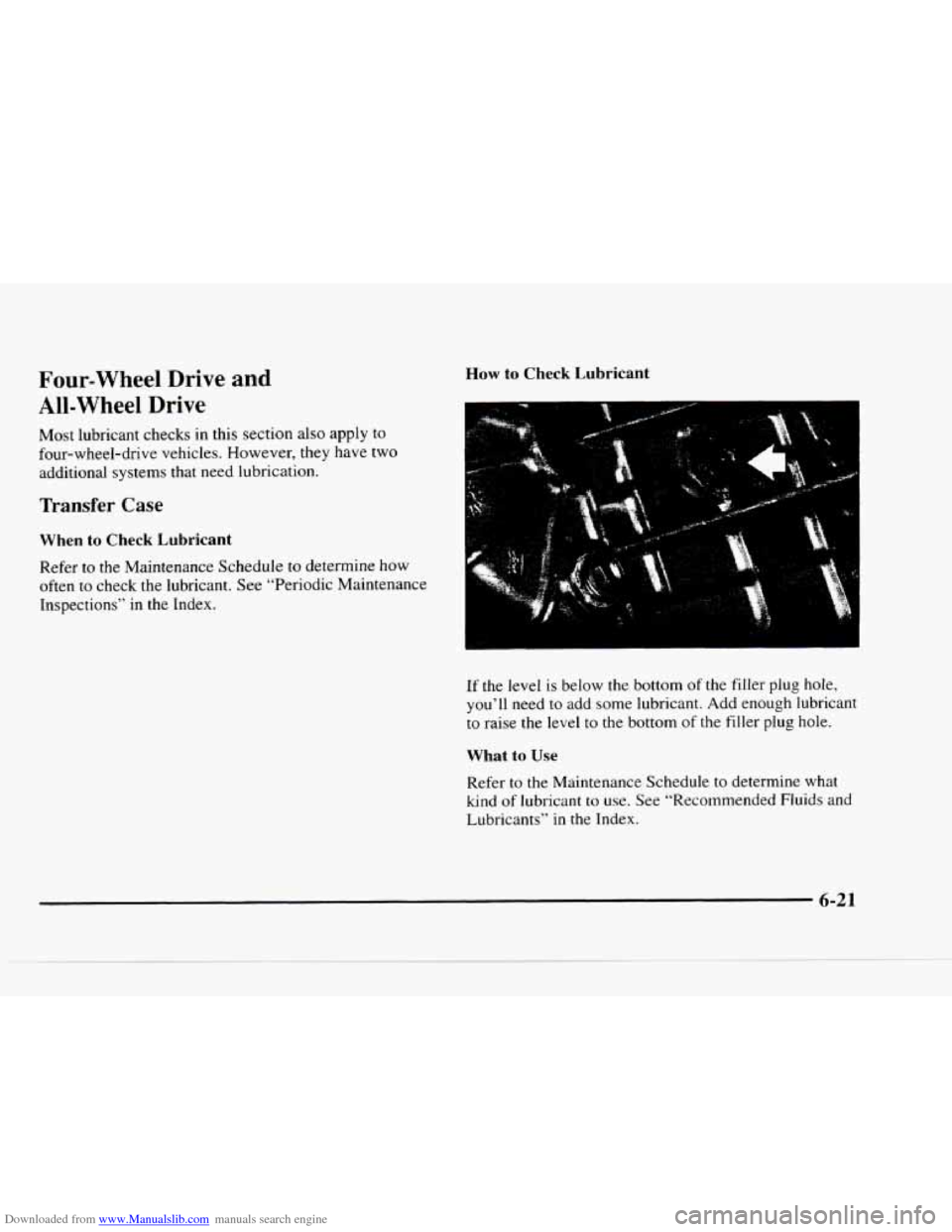
How to Check Lubricant
When to Check Lubricant
Refer to the Maintenance Schedule to determine how
often
to check the lubricant. See “Periodic Maintenance
Inspections’’ in the Index.
If
the level is below the bottom of the filler plug hole,
you’ll need to add some lubricant. Add enough lubricant
to raise the level to the bottom of the filler plug hole.
What to Use
Refer to the Maintenance Schedule to determine what
kind
of lubricant to use. See “Recommended Fluids and
Lubricants”
in the Index.
6-21
Page 303 of 402
Downloaded from www.Manualslib.com manuals search engine Tire Chains
NOTICE:
If your vehicle has P235/75R15, P235/70R15 or
31x10.50Rl5LT/C size tires, don’t use tire chains.
They can damage your vehicle because there’s
not enough clearance.
Use another type of traction device only if its
manufacturer recommends
it for use on your
vehicle and tire size combination and road
conditions. Follow that manufacturer’s
instructions.
To help avoid damage to your
vehicle, drive slowly, readjust or remove the
device
if it’s contacting your vehicle, and don’t
spin your wheels.
NOTICE: (Continued) NOTICE:
(Continued)
If you do find a traction device that will fit, install
them on the rear tires.
If you have other size tires, use tire chains only
where legal and
only when you must. Use only
SAE Class “S”’type chains that are the proper
size for your tires. Install them
on the drive axle
tires (four-wheel-drive vehicles can use chains on
both axles) and tighten them
as tightly as possible
with the ends securely fastened. Drive slowly and
follow the chain manufacturer’s instructions..
If
you can .hear the chains contacting your vehicle,
, stop and retighten them. If the contact continues,
slow down until it stops. Driving too fast or
spinning the wheels with chains
on will damage
your vehicle.
6-48
I
Page 315 of 402

Downloaded from www.Manualslib.com manuals search engine rnrl WOO ACCY d co A w
FuseKircuit Breaker
A
B
Usage
Power Door Locks, Power Seat,
Power Seat Lumbar, Remote
Keyless Entry
Power Windows, Sunroof
Module/Motor
FuseKircuit
Breaker Usage
1
2
3
4
Stoplamps, Hazard Lamps, Chime,
Center High-Mounted Stoplamp Relay,
Center High-Mounted Stoplamp
Dome Lamps. Cargo Lamps, Visor
Vanity Mirror, Cigarette Lighter,
Inside Rearview Mirror Lamp,
Overhead Console Lamps, Glove
Box Lamp, Horns, Horn Relay, IP
Courtesy Lamps, Power Outside
Rearview Mirror, Liftglass Release
Motor, Illuminated Entry Module
Parking
Lamps, License Plate Lamps.
Electric Shift Transfer Case Module,
Underhood Lamp, Rear Wiper. Fog
Lamp Relay, Door Switch Lamp,
Ashtray Lamp, Headlamp Switch
A/C Compressor Relay, Cluster
Chime Module, DRL Relay Coil,
Four-Wheel-Drive Indicator Lamp,
DRL Module, Rear Defog Timer,
Transfer Case Control Module
Ignition, SIR Redundant Ignition,
RKE Ignition. Fuel Sender Module
6-60
Page 323 of 402
Downloaded from www.Manualslib.com manuals search engine Part A: Scheduled Maintenance
Services
Using Your Maintenance Schedule
We at General Motors want to help you keep your
vehicle in good working condition. But we don't know
exactly
how you'll drive it. You may drive very short
distances only a few times
a week. Or you may drive
long distances
all the time in very hot. dusty weather.
You may use your vehicle
in making deliveries. Or
you may drive
it to work. to do errands or in many
other ways.
Because
of all the different ways people use their GM
vehicles, maintenance needs vary. You may even need
more frequent checks and replacements than
you'll find
in the schedules in this section. So please read this
section and note how you drive.
If you.have any
questions
on how to keep your vehicle in good
condition, see your
GM dealer.
This part tells
you the maintenance services you should
have done and when you should schedule them.
If you
that GM-trained and supported service people
will
perform the work using genuine GM parts.
s 00 to your dealer for your service needs. you'll know The proper fluids
and lubricants
to use are listed in Part D.
Make sure whoever services your vehicle uses these. All
parts should be replaced and all necessary repairs done
before
you or anyone else drives the vehicle.
These schedules are
for vehicles that:
0
0
0
carry passengers and cargo within recommended
limits. You
will find these limits on your vehicle's
Certification/Tire label. See "Loading Your Vehicle"
in the Index.
are driven on reasonable road surfxes
within legal
driving limits.
are driven off-road
in the recommended manner. See
"Off-Road Driving With Your Four-Wheel-Drive
Vehicle''
in the Index.
use the recommended fuel. See "Fuel"
in the Index.
Selecting the Right Schedule
First you'll need to decide which of the two schedules is
right for your vehicle. Here's how to decide which
schedule to follow:
7-4
Page 370 of 402

Downloaded from www.Manualslib.com manuals search engine Drive Axle Service
Check readfront axle fluid level and add as needed.
Check constant velocity joints and axle seals
for leaking.
Transfer Case (All-Wheel Drive) Inspection
Every 12 months or at oil change intervals, check front
axle and transfer case and add lubricant
when necessary.
Check vent hose
at transfer case for kinks and
proper installation.
nansfer Case (Four-wheel Drive)
Inspection
Every 12 months or at oil change intervals, check front
axle and transfer case and add lubricant when necessary.
Check vent hose
at transfer case for kinks and proper
installation. More frequent lubrication may be required
on off-road use.
Brake System Inspection (Two-Wheel and
Four-wheel Drive)
Inspect the complete system. Inspect brake lines and
hoses for proper hook-up, binding, leaks, cracks,
chafing, etc. Inspect disc brake pads for wear and rotors
for surface condition. Also inspect drum brake linings
for wear and cracks. Inspect other brake parts, including
drums, wheel cylinders, calipers, parking brake, etc.
Check parking brake adjustment. You may need to have
your brakes inspected more often if your driving habits
or conditions result
in frequent braking.
Brake System Inspection (All-Wheel-Drive)
Inspect the complete system. Inspect brake lines and
hoses for proper hook-up, binding, leaks, cracks,
chafing, etc. Inspect disc brake pads
for wear and rotors
for surface condition. Inspect other brake parts,
including calipers, parking brake, etc. Check parking
brake adjustment.
You may need to have your brakes
inspected more often
if your driving habits or conditions
result
in frequent braking.
7-5 1
Page 393 of 402
Downloaded from www.Manualslib.com manuals search engine Engine ........................................ 6-8
Coolant Heater
............................... 2- 17
Coolant Level Check
.......................... 7-46
Coolant Temperature Gage
..................... 3-76
Exhaust ..................................... 2-34
FanNoise
................................... 5-22
Identification ................................ 6-58
Oil Level Check .............................. 7-46
Running While Parked ......................... 2-35
Specifications ................................ 6-63
Overheating
................................. 5-12
Starting
..................................... 2-15
Engineoil
..................................... 6-9
Adding ..................................... 6-10
Additives ................................... 6- 12
Checking .................................... 6-9
Kind to Use ................................. 6-10
Pressure Gage ................................ 2-79
Used
....................................... 6-13
Whentochange .............................. 6-12
Exhaust.Engine
................................ 2-34
Express-Down Window .......................... 3-36
Exterior Metal Parts. Protecting
.................... 6-55
Fabric Cleaning
............................... 6-50
Fifth Gear
. Manual Transmission ................... 2-21
FillingYourTank ................................ 6-5
Fi 1 ter
Air
........................................ 6-13
Remote Oil .................................. 6- 12
Finish Care .................................... 6-54
Finish Damage
................................. 6-56
First Gear
Automatic Transmission
....................... 2-20
Manual Transmission .......................... 2-21
Flashers
. Hazard Warning ......................... 5-2
Flat Tire . Changing ............................. 5-23
Fluids and Lubricants ....................... 6-64. 7-52
FogLampSwitch ............................... 2-47
Foreign Countries. Fuel
........................... 6-4
Fourth Gear, Manual Transmission ................. 2-21
Four-wheel Drive ......................... 2-23, 6-21
French Language Manual 11
FrontAxle .................................... 6-22
.. ...........................
Front ivlap Lamps ............................... 2-48
Front Reading Lamps .................. 2-47. 2-5 1.6-38
Front Storage Area
.............................. 2-56
Front
Sidemarker Lamp Bulb Replacement
........... 6-36
FrontTowing
.................................. 5-10
Front Turn Signal Lamp Bulb Replacement .......... 6-36
Fuel .......................................... 6-3
Filling Your Tank .............................. 6-5
Foreign Countries
.............................. 6-4
Gage ....................................... 2-81
Fuses and Circuit Breakers ....................... 6-59
Gages Engine Coolant Temperature
.................... 2-76
Engine Oil Pressure ........................... 2-79
Fuel
....................................... 2-81
9-4