1997 CHEVROLET BLAZER Neutral
[x] Cancel search: NeutralPage 214 of 402
Downloaded from www.Manualslib.com manuals search engine A CAUTION:
7 .?
It can be dangerous to get out of your vehicle if
the shift lever is not fully in
PARK (P) with the
parking brake firmly set. Your vehicle can roll.
If you have left the engine running, the vehicle
can move suddenly. You
or others could be
i injured. To be sure your vehicle won’t move, even
when you’re on fairly
level ground, use the steps
that follow.
transfer case shift lever and your transfer case is
in
NEUTRAL (N), your vehicle will be free to
roll, even if your shift lever is in
PARK (P). So, be
sure the transfer case is in a drive gear
-- not in
NEUTRAL (N).
I If you have four-wheel drive with a manual
Page 221 of 402
Downloaded from www.Manualslib.com manuals search engine 2. Get the vehicles close enough so the jumper cabIes
can reach. but be sure the vehicles aren't touching
each other.
If they are, it could cause a ground
connection
you don't want. You wouldn't be able to
start your vehicle. and the bad grounding could
damage the electrical systems.
You could be injured if the vehicles roll. Set the
parking brake firmly on each vehicle. Put
an
automatic transmission in PARK (Pj or a manual
transmission
in NEUTRAL (N). If you have a
four-wheel-drive vehicle with a manual transfer case
shift lever. be sure the transfer case is not
in
NEUTRAL (N).
I A CAUTION:
An electric fan can start up even when the engine
is not running and can injure you. Keep hands,
clothing and tools away from any underhood
electric
Fan.
3. Turn off the ignition on both vehicles. Unplug
unnecessary accessories plugged into
the cigarette
lighter. or accessory power outlets,
if you have this
option.
Turn off all lamps that aren't needed as well
as radios. This will avoid sparks and help save both
batteries.
In addition, it could save your radio!
I NOTICE:
If you leave your radio on, it could be badly
damaged. The repair wouldn't be covered
by
your warranty.
I A CAUTION:
If your vehicle has air conditioning, the auxiliary
electric fan under the hood can
start up even
when the engine
is not running and can injure
you. Keep hands, clothing and tools away from
any underhood electric fan.
Page 226 of 402
Downloaded from www.Manualslib.com manuals search engine When your vehicle is being towed, have the ignition key
turned to the OFF position. The steering wheel should
be clamped in
a straight-ahead position with a clamping
device designed for towing service.
Do not use the
vehicle's steering column lock for this. The transmission
should be in NEUTRAL
(N) and the transfer case, if you
have one, should be in 2HI. The parking brake should
be released.
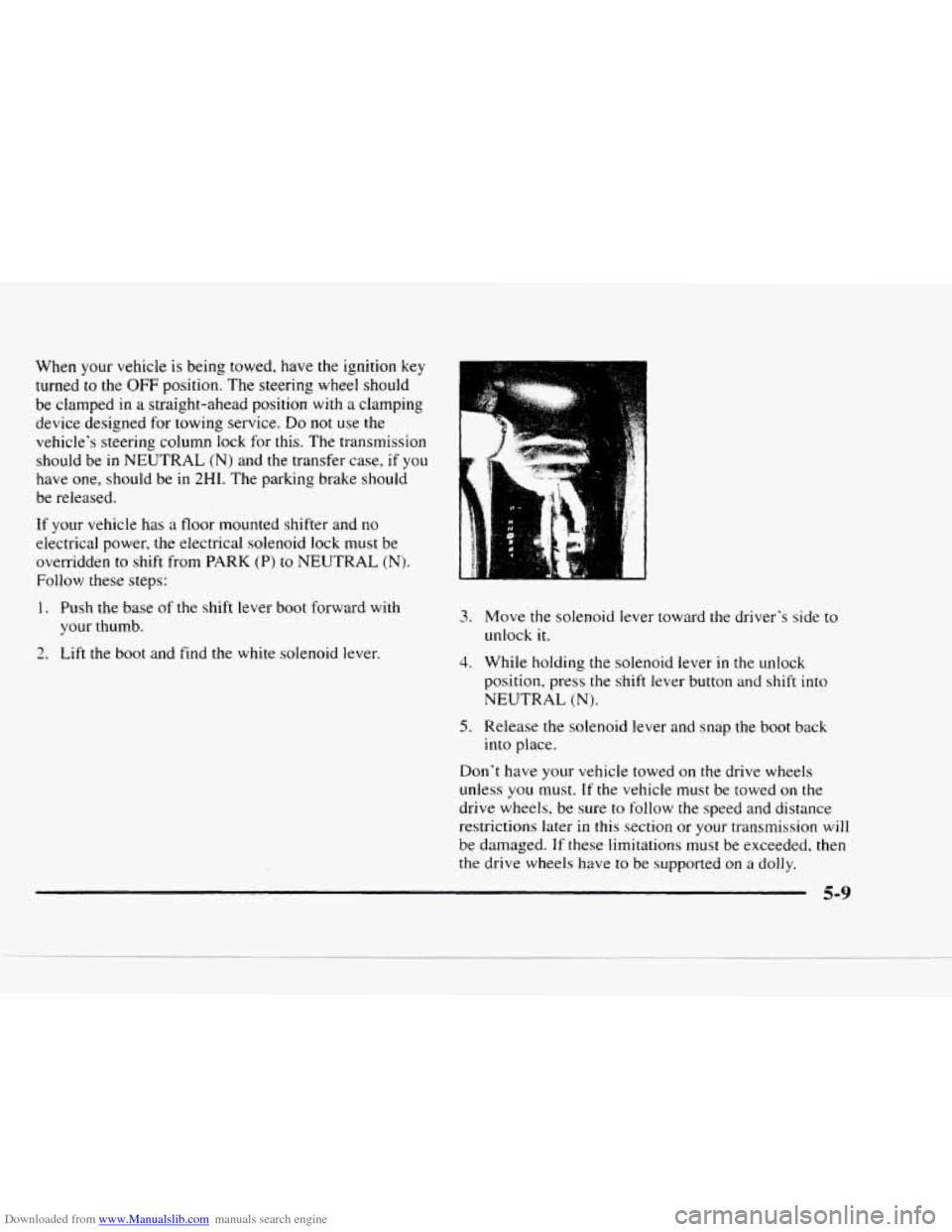
If your vehicie has a floor mounted shifter and no
electrical power, the electrical solenoid lock must be
overridden
to shift from PARK (P) to NEUTRAL (N).
Follow these steps:
1. Push the base of the shift lever boot forward with
your thumb.
2. Lift the boot and find the white solenoid lever.
1-
3.
4.
5.
Move the solenoid lever toward the driver's side to
unlock it.
While holding the solenoid lever in the unlock
position, press the shift lever button and shift into
NEUTRAL
(N).
Release the solenoid lever and snap the boot back
into place.
Don't have your vehicle towed on the drive wheels
unless you must.
If the vehicle must be towed on the
drive wheels, be sure to follow the speed and distance
restrictions later in this section or your transmission will
be damaged.
If these limitations must be exceeded, then
the drive wheels have to
be supported on a dolly.
5-9
Page 230 of 402

Downloaded from www.Manualslib.com manuals search engine If No Steam Is Coming From Your Engine
If you get the overheat warning but see or hear no
steam, the problem may not be too serious. Sometimes
the engine can get a little too hot when you:
Climb a long hill on a hot day.
0 Stop after high-speed driving.
Idle for long periods in traffic.
Tow a trailer. See “Driving on Grades” in the Index.
If you get the overheat warning with no sign of steam,
try
this for a minute or so:
1. Turn off your air conditioner.
2. Turn on your heater to full hot at the highest fan
speed and open the window
as necessary.
3. If you’re in a traffic jam, shift to NEUTRAL (N);
otherwise, shift to the highest gear while
driving
-- AUTOMATIC OVERDRIVE (@) or
DRIVE (D) for automatic transmissions. If
you
no longer have the overheat warning, you
can drive. Just
to be safe, drive slower for about
10 minutes. If the warning doesn’t come back on,
you can drive normally.
If
the warning continues, pull over, stop, and park your
vehicle right away.
If there’s
still no sign of steam, push the accelerator until
the engine speed
is about twice as fast as normal idle
speed. Bring the engine speed back to normal idle speed
after two or three minutes. Now
see if the warning stops.
But then, if you still have the warning,
turn ofthe
engine and get everyone out of the vehicle until it
cools down.
You may decide not to lift the hood but
to get service
help right away.
5-13
Page 240 of 402
Downloaded from www.Manualslib.com manuals search engine Changing a Flat Tire
If a tire goes flat, avoid further tire and wheel damage
by driving slowly to a level
place. Turn on your hazard
warning flashers.
A CAUTION:
Changing a tire can cause an injury. The vehicle
can slip off the jack and roll over you or other
people.
You and they could be badly injured.
Find a level place to change your tire.
To help
prevent the vehicle from moving:
1. Set the parking brake firmly.
2. Put an automatic transmission shift
lever in PARK
(P) or shift a manual
transmission
to FIRST (1) or
REVERSE
(R).
CAUTION: (Continued)
CAUTION: (Continued)
3. If you have a four-wheel-drive vehicle
with a manual transfer case shift lever,
be sure the transfer case is in a drive
gear
-- not in NEUTRAL (N).
4. lbrn off the engine.
5. Put the wheel blocks at the front and
rear
of the tire farthest away from the
one being changed. That would be the
tire
on the other side of the vehicle, at
the opposite end.
5-23
Page 367 of 402
Downloaded from www.Manualslib.com manuals search engine Starter Switch Check
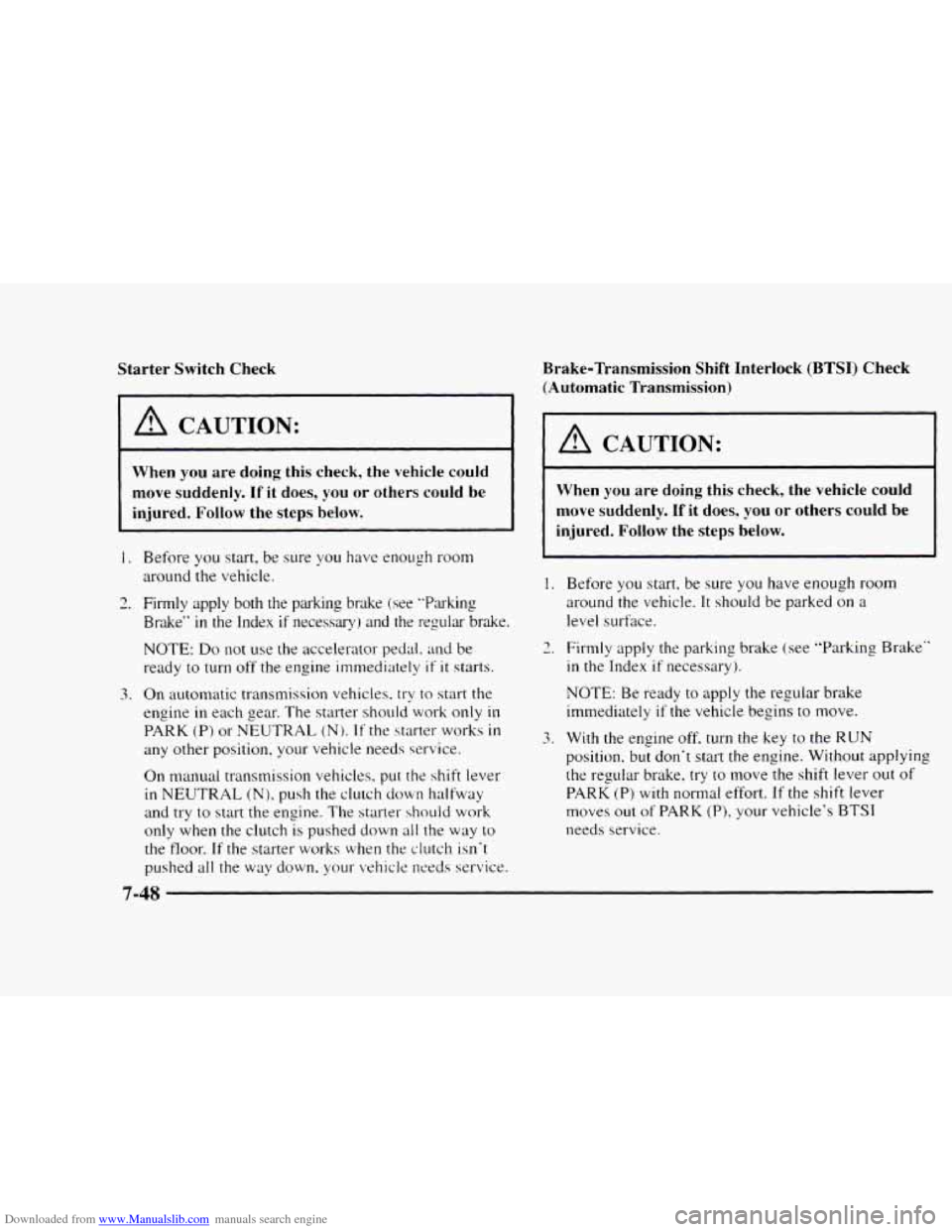
A CAUTION:
When you are doing this check, the vehicle could
move suddenly.
If it does, you or others could be
injured.
Follow the steps below.
1. Before you start, be sure you have enough room
around the vehicle.
2. Firmly apply both the parking brake (see ”Parking
Brake”
in the Index if necessary) and the regular brake
NOTE: Do not use the accelerator pedal. and be
ready to turn
off the engine imnlediately if it starts.
3. On automatic transmission vehicles.
try to start the
engine in each gear. The
starter should work only in
PARK (P) or NEUTRAL (N). If the starter works in
any other position. your vehicle needs service.
On manual transmission vehicles.
put the shift lever
in NEUTRAL (N), push the clutch down halfway
and try
to start the engine. The starter’ shoLlld work
only when the clutch is pushed down all the way to
the floor. If the starter works when the clutch isn’t
pushed all the way down. your vehicle needs service.
Brake-”kansmission Shift Interlock (BTSI) Check
(Automatic Transmission)
I A CAUTION:
When you are doing this check, the vehicle could
move suddenly.
If it does, you or others could be
injured.
Follow the steps below.
’ . Before you start, be sure you have enough room
around the vehicle.
It should be parked on a
level surface.
2. Firmly apply the parking brake (see ”Parking Brake’‘
in the Index if necessary).
NOTE: Be ready to apply the regular brake
immediately
if the vehicle begins to move.
3. With the engine off. turn the key to the RUN
position, but don‘t start the engine. Without applying
the regular brake. try
to move the shift lever out of
PARK (P) with normal effort. If the shift lever
moves out
of PARK (P), your vehicle’s BTSI
needs service.
7-48
Page 368 of 402
Downloaded from www.Manualslib.com manuals search engine Ignition Transmission Lock Check
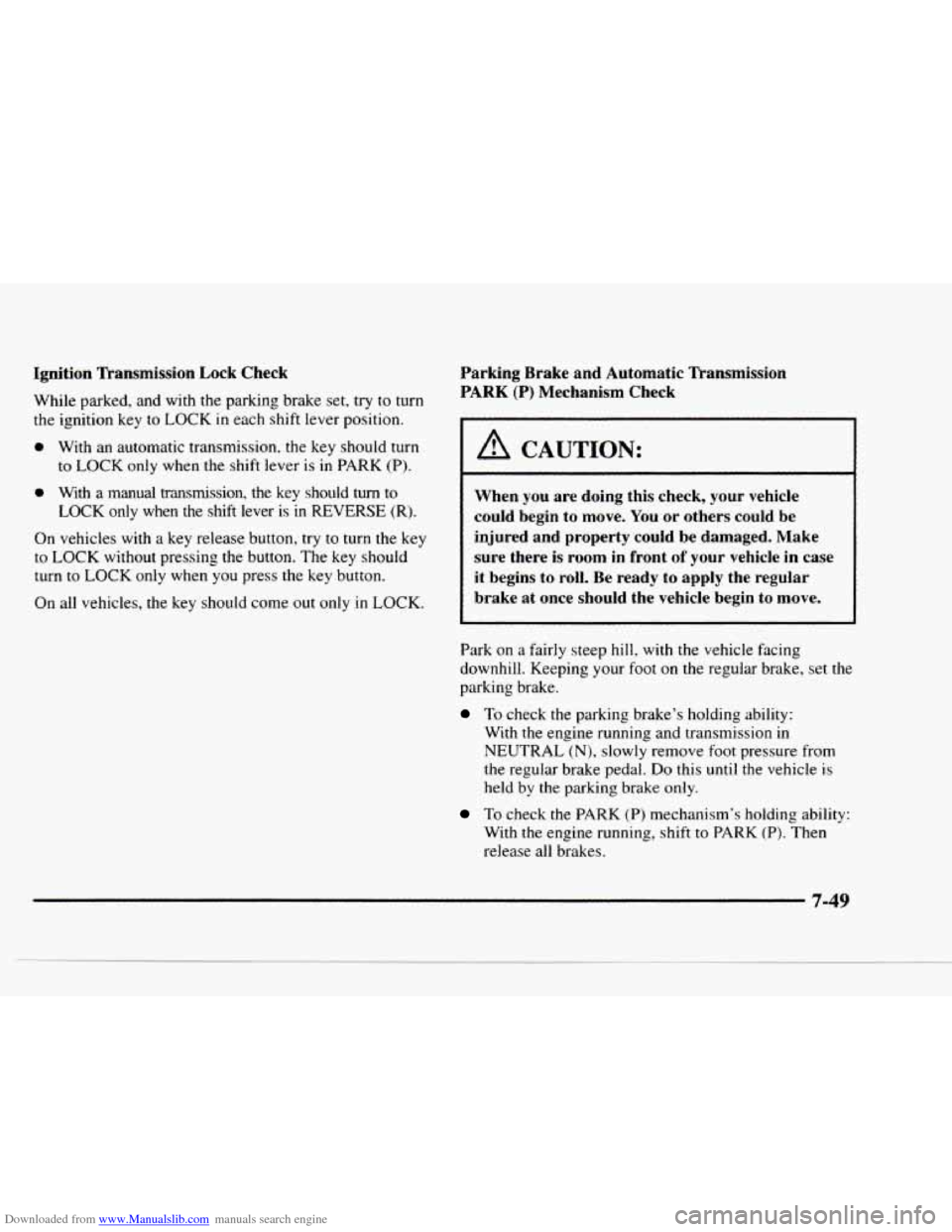
While parked, and with the parking brake set, try to turn
the ignition key to
LOCK in each shift lever position.
0 With an automatic transmission, the key should turn
to LOCK only when the shift lever is in PARK (P).
LOCK only when the shift lever is in REVERSE (R).
0 With a manual transmission, the key should turn to
On vehicles with a key release button, try
to turn the key
to LOCK without pressing the button. The key should
turn to
LOCK only when you press the key button.
On all vehicles, the key should come out only in LOCK.
Parking Brake and Automatic Transmission
PARK (P) Mechanism Check
I A CAUTION:
~~~~ ~~~~~~~~~~~~~~~~~~~~ ~~
When you are doing this check, your vehicle
could begin to move.
You or others could be
injured and property could be damaged. Make
sure there
is room in front of your vehicle in case
it begins to roll. Be ready to apply the regular
brake at once should the vehicle begin to move.
~ ~~~~____~~~~ ~ ~~ ~
Park on a fairly steep hill, with the vehicle facing
downhill. Keeping your
foot on the regular brake, set the
parking brake.
To check the parking brake’s holding ability:
With
the engine running and transmission in
NEUTRAL (N), slowly remove foot pressure from
the regular brake pedal.
Do this until the vehicle is
held by
the parking brake only.
To check the PARK (P) mechanism’s holding ability:
With
the engine running, shift to PARK (P). Then
release all brakes.
7-49
Page 396 of 402
Downloaded from www.Manualslib.com manuals search engine Methanol ...................................... 6-4
Mirrors ....................................... 2-49
Convex Outside .............................. 2-50
Inside Daymight Rearview ..................... 2-49
Outside ..................................... 2-49
Visor Vanity ................................. 2-62
Model Reference ................................. vi
Mountain Roads ................................ 4-35
Multifunction Lever ............................. 2-38
Net. Convenience .............................. 2-57
Neutral
Automatic Transmission
....................... 2- 19
Manual Transmission .......................... 2-22
New Vehicle “Break-In” ......................... 2- 13
Nightvision ................................... 4-28
Normal Maintenance Replacement Parts ............. 6-63
Odometer .................................... 2-68
Off-Road Driving .............................. 4-15
Off-Road Recovery ............................. 4- 1 1
0il.Engine ..................................... 6-9
Opener . Garage Door ............................ 2-51
Ordering Owner and Smite Publications ....... 8- 1 I. 8- 12
Outside Mirror
Manual Adjust ............................... 2-49
Power Remote Control ......................... 2-49
Convex ..................................... 2-50
Overdrive . Automatic Transmission ................ 2-20
Overhead Console .............................. 2-50
Overheating Engine ............................. 5-12
Owner Checks and Services ....................... 7-46
Owner Publications ........................ 8- 1 1. 8. 12
Paint Spotting. Chemical ........................ 6-56
Park
Automatic Transmission
....................... 2-18
Shifting Into ................................. 2-30
Shifting Out of ............................... 2-33
AtNight .................................... 2-12
Brake ...................................... 2-29
Brake Mechanism Check ....................... 7-49
Lots ....................................... 2-12
On Hills with a Trailer ......................... 4-52
Over Things That Burn ........................ 2-34
Your Vehicle. Manual Transmission .............. 2-33
Passing ....................................... 4-12
Payload ....................................... 4-44
Periodic Maintenance Inspections .................. 7-50
Power
Accessory Outlets
............................ 2-63
DoorLocks ................................... 2-5
Remote Control Mirror ........................ 2-49
Steering ..................................... 4-9
Steering Fluid ................................ 6-26
Windows ................................... 2-36
Powerseat ..................................... 1-3
Lumbar Controls .............................. 1-4
Parking