1997 CHEVROLET BLAZER tire size
[x] Cancel search: tire sizePage 203 of 402
Downloaded from www.Manualslib.com manuals search engine Recreational Vehicle Towing (Except Four-wheel Drive
With
Manual Shift Transfer Case) Loading
Your Vehicle
Vehicles
with two-wheel drive or the optional electronic
shift transfer case require special modifications before
they can be towed in this manner. Please contact your
dealer
for the towing information that is appropriate for
your particular vehicle.
Vehicles with all-wheel drive
(AWD) can not be towed
in this manner.
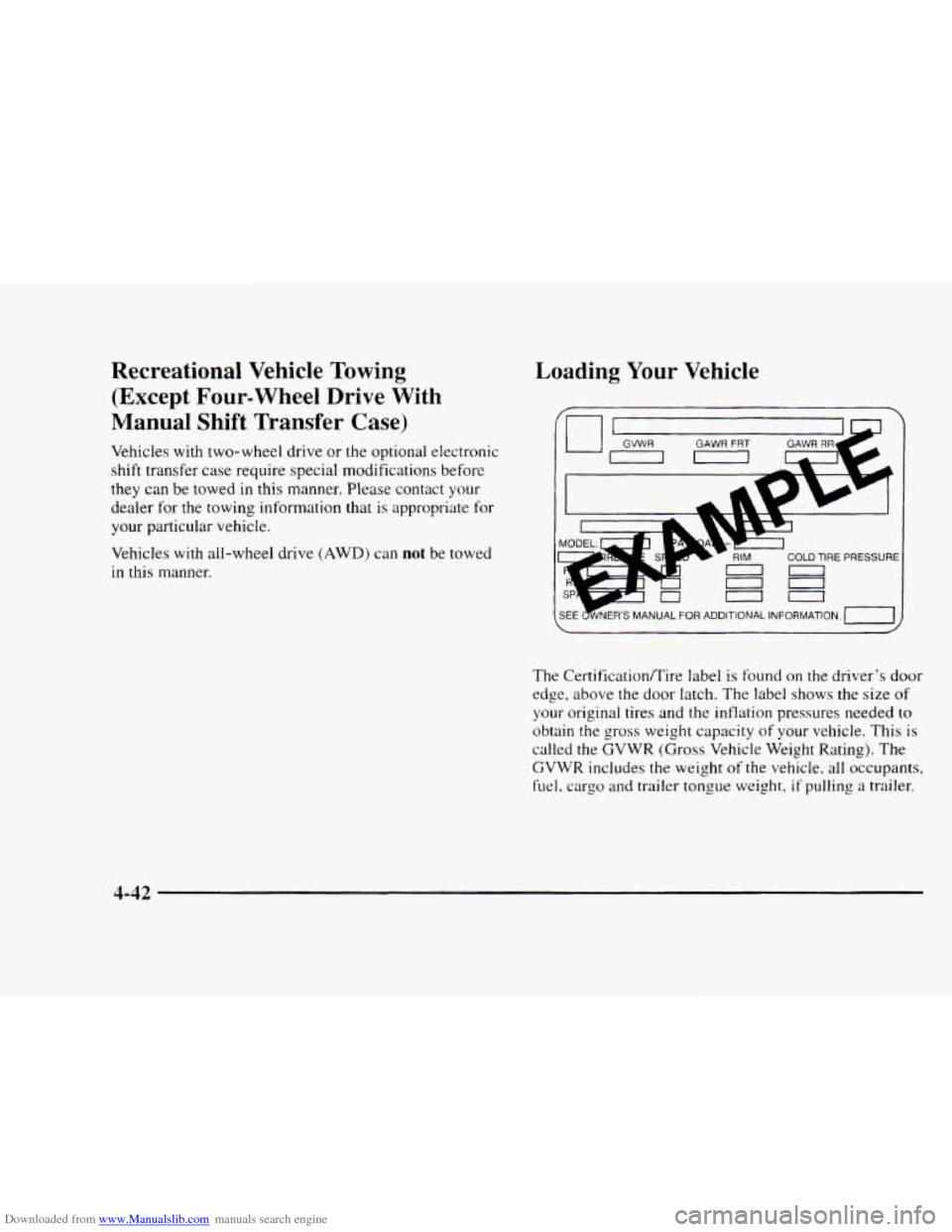
The Certificationflire label is found on the driver’s door
edge, above the
door latch. The label shows the size of
your original tires and the inflation pressures needed to
obtain the gross weight capacity of your vehicle. This is
called the
GVWR (Gross Vehicle Weight Rating). The
GVWR includes the weight of the vehicle. all occupants,
fuel, cargo and trailer tongue weight, if pulling a trailer.
4-42
Page 209 of 402
Downloaded from www.Manualslib.com manuals search engine A B
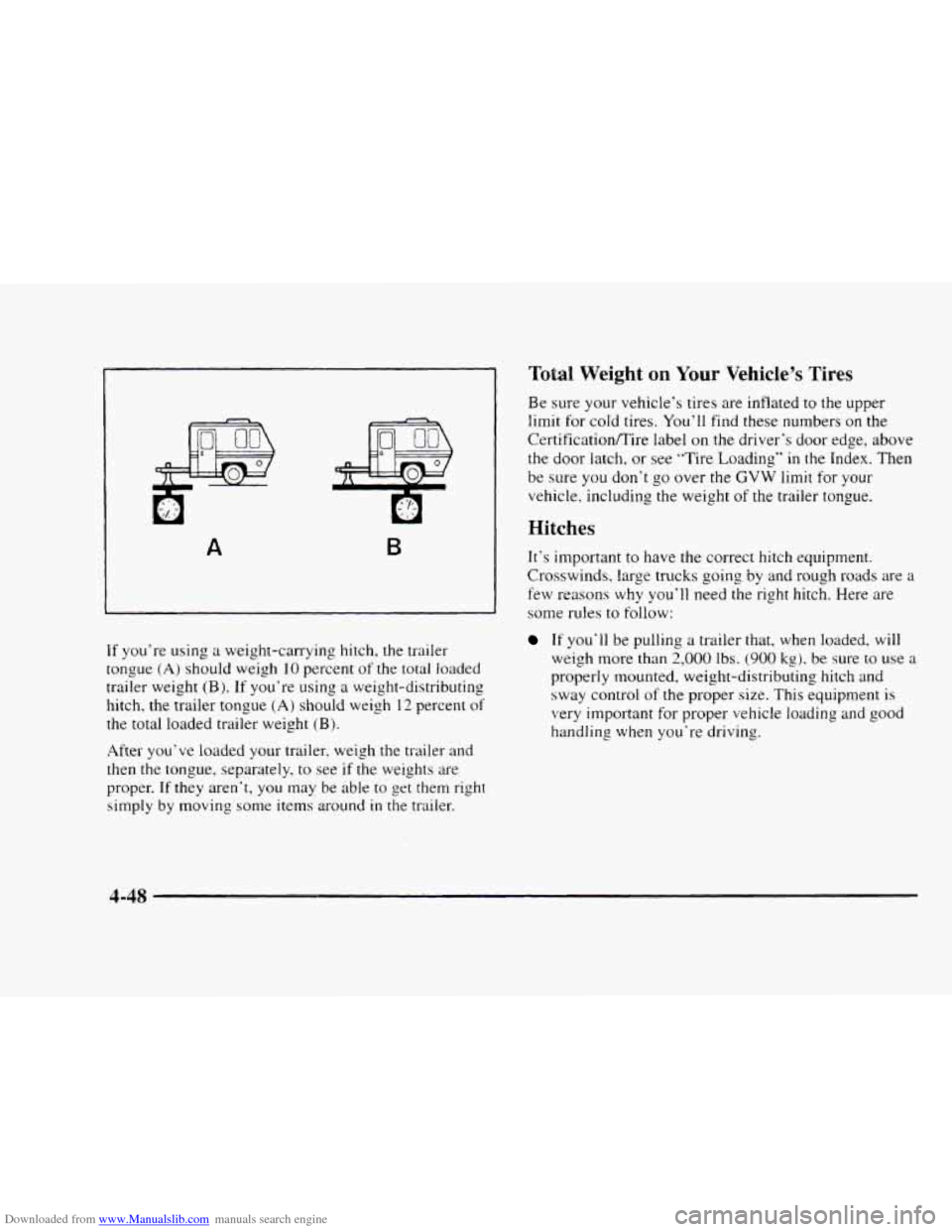
If you’re using a weight-carrying hitch, the trailer
tongue
(A) should weigh 10 percent of the total loaded
trailer weight
(B). If you’re using a weight-distributing
hitch, the trailer tongue
(A) should weigh 12 percent of
the total loaded trailer weight (B).
After you’ve loaded your trailer, weigh the trailer and
then the tongue, separately,
to see if the weights are
proper.
If they aren‘t, you may be able to get them right
simply
by moving some items around in the trailer.
Total Weight on Your Vehicle’s Tires
Be sure your vehicle‘s tires are inflated to the upper
limit for cold tires. You’ll find these numbers on the
CertificationRire label
on the driver’s door edge, above
the
door latch, or see ‘.Tire Loading” in the Index. Then
be sure
you don’t go over the GVW limit for your
vehicle, including the weight
of the trailer tongue.
Hitches
It’s important to have the correct hitch equipment.
Crosswinds, large trucks going by and rough roads are
a
few reasons why you’ll need the right hitch. Here are
some rules to follow:
If you‘ll be pulling a trailer that, when loaded, will
weigh more than
2,000 lbs. (900 kg), be sure to use a
properly mounted, weight-distributing hitch and
sway control
of the proper size. This equipment is
very important for proper vehicle loading and good
handling when you’re driving.
4-48 -
Page 252 of 402
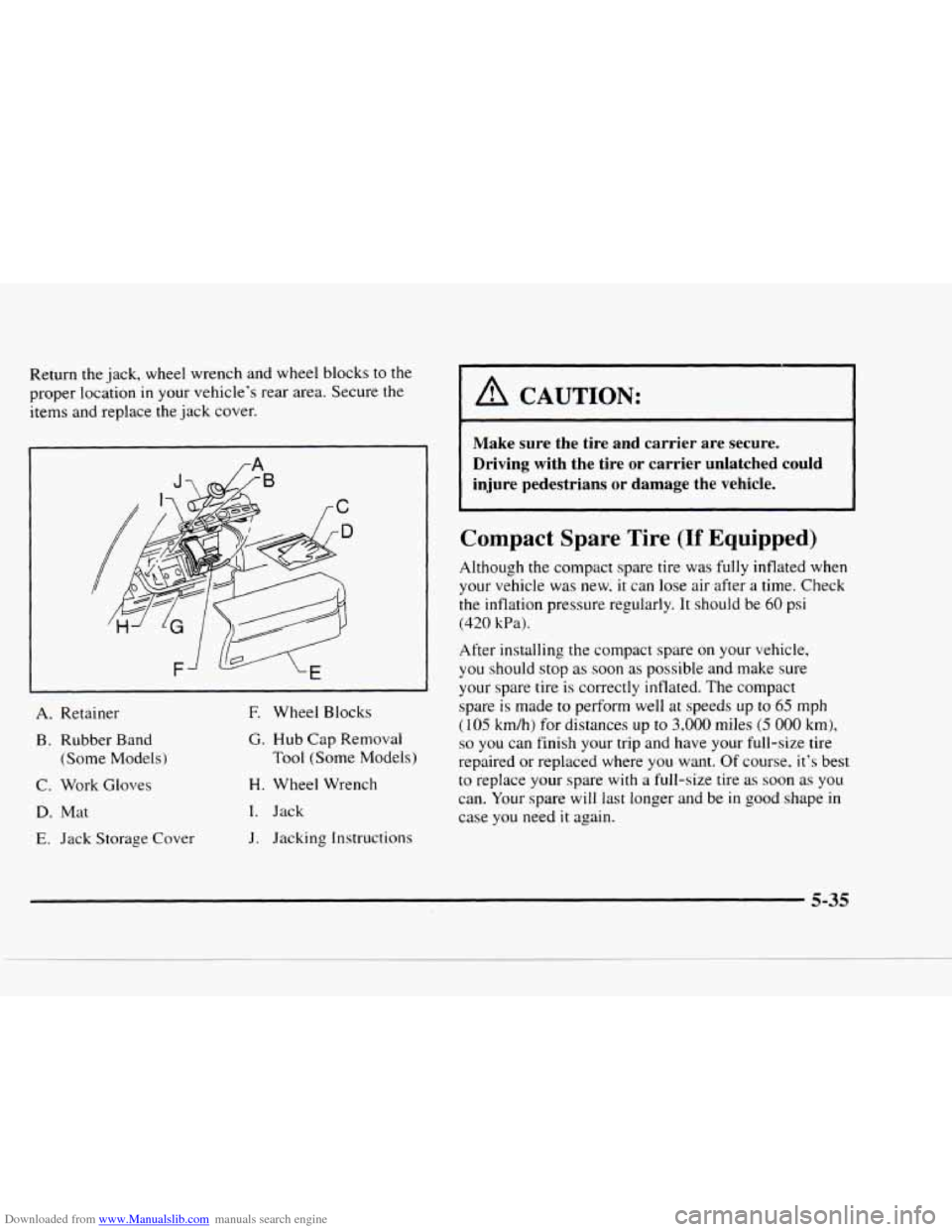
Downloaded from www.Manualslib.com manuals search engine Return the jack, wheel wrench and wheel blocks to the
proper location
in your vehicle’s rear area. Secure the
items and replace
the jack cover.
I
-
A. Retainer E Wheel Blocks
B. Rubber Band
(Some Models
j
C. Work Gloves
D. Mat
E. Jack Storage Cover
G. Hub Cap Removal
Tool (‘Some Models)
H. Wheel Wrench
I. Jack
J. Jacking Instructions
I A CAUTION:
I
Make sure the tire and carrier are secure.
Driving with the tire or carrier unlatched could
injure pedestrians
or damage the vehicle.
Compact Spare Tire (If Equipped)
Although the compact spare tire was fully inflated when
your vehicle was new,
it can lose air after a time. Check
the inflation pressure regularly. It should be 60 psi
(420 kPa).
After installing the compact spare on your vehicle,
you should stop as
soon as possible and make sure
your spare tire
is correctly inflated. The compact
spare
is made to perform well at speeds up to 65 mph
(105 km/h) for distances up to 3,000 miles (5 000 km),
so you can finish your trip and have your full-size tire
repaired or replaced where
you want. Of course, it’s best
to replace your spare with a full-size tire as soon as you
can. Your spare will last longer and be in good shape in
case you need
it again.
5-35
Page 299 of 402
Downloaded from www.Manualslib.com manuals search engine When It's Time for New Tires
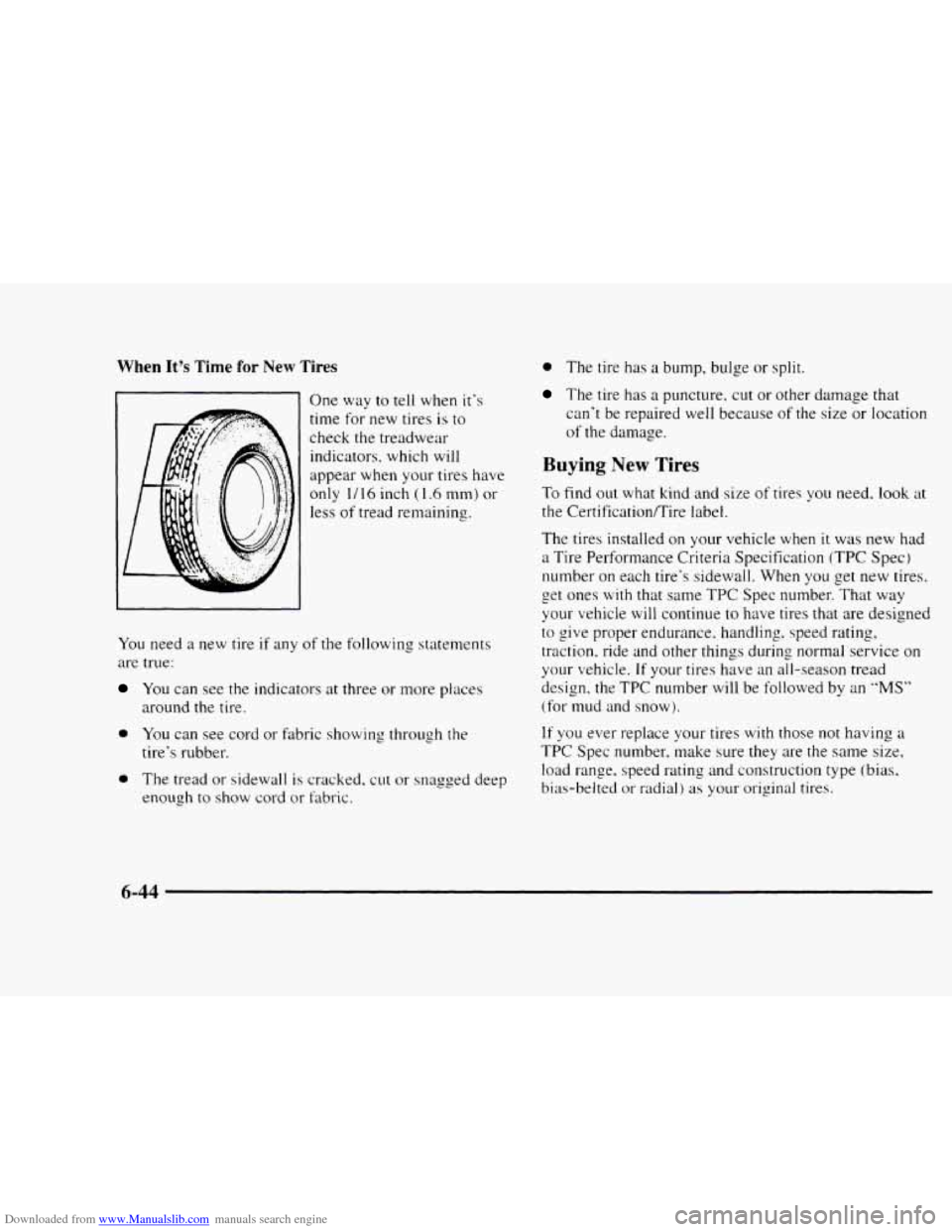
One way to tell when it's
time
for new tires is to
check
the treadwear
indicators, which will
appear when your tires have
only
1 /16 inch ( 1.6 mm) or
less
of tread remaining.
You need
a new tire if any of the following statements
are true:
You can see the indicators at three or more places
around
the tire.
0 You can see cord or fabric showing through the
tire's rubber.
0 The tread or sidewall is cracked, cut or snagged deep
enough to
show cord or fabric.
0 The tire has a bump, bulge or split.
The tire has a puncture, cut or other damage that
can't be repaired well because
of the size or location
of the damage.
Buying New Tires
To find out what kind and size of tires you need. look at
the CertificatiodTire label.
The tires installed on your vehicle when
it was new had
a Tire Performance Criteria Specification (TPC Spec)
number on each tire's sidewall. When
you get new tires.
your vehicle
will continue to have tires that are designed
to give proper endurance. handling, speed rating,
traction. ride and other things during
normal service on
your vehicle. If your tires have an all-season tread
design, the
TPC number will be followed by an "MS"
(for mud and snow).
If you ever replace your tires with those not having a
TPC Spec number, make sure they are the same size,
load range, speed rating and construction type (bias,
bias-belted or radial)
as your original tires.
t oet ones with that same TPC Spec number. That way
6-44
Page 300 of 402
Downloaded from www.Manualslib.com manuals search engine I A CAUTION:
Mixing tires could cause you to lose control while
driving.
If you mix tires of different sizes or types
(radial and bias-belted tires), the vehicle may not
handle properly, and you could have a crash.
Using tires of different sizes may
also cause
damage to your vehicle. Be sure to use the same
size and type tires on all wheels.
It’s all right to drive with your compact spare
(if you have one). It was developed for use on
your vehicle.
Uniform Tire Quality Grading
The following information relates to the system
developed by
the United States National Highway
Traffic Safety Administration, which grades tires by
treadwear, traction and temperature performance. (This
applies only
to vehicles sold in the United States.) The
grades are molded on the sidewalls
of most passenger
car tires.
The Uniform Tire Quality Grading system does
not apply to deep tread, winter-type snow tires,
space-saver or temporary use spare tires, tires with
nominal rim diameters
of 10 to 12 inches (25 to 30 cm),
or
to some lirnited-production tires.
While the tires available
on General Motors passenger
cars and light trucks may vary with respect
to these
grades, they must also conform
to Federal safety
requirements and additional General Motors Tire
Performance Criteria (TPC) standards.
Treadwear
The treadwear grade is a comparative rating based on
the wear rate of the tire when tested under controlled
conditions on a specified government test course. For
example, a tire graded
150 would wear one and a half
(1 1/2) times as well on the government course as a tire
graded
100. The relative performance of tires depends
upon
the actual conditions of their use, however, and
may depart significantly from the norm due to variations
in driving habits, service practices and differences
in
road characteristics and climate.
6-45
Page 303 of 402
Downloaded from www.Manualslib.com manuals search engine Tire Chains
NOTICE:
If your vehicle has P235/75R15, P235/70R15 or
31x10.50Rl5LT/C size tires, don’t use tire chains.
They can damage your vehicle because there’s
not enough clearance.
Use another type of traction device only if its
manufacturer recommends
it for use on your
vehicle and tire size combination and road
conditions. Follow that manufacturer’s
instructions.
To help avoid damage to your
vehicle, drive slowly, readjust or remove the
device
if it’s contacting your vehicle, and don’t
spin your wheels.
NOTICE: (Continued) NOTICE:
(Continued)
If you do find a traction device that will fit, install
them on the rear tires.
If you have other size tires, use tire chains only
where legal and
only when you must. Use only
SAE Class “S”’type chains that are the proper
size for your tires. Install them
on the drive axle
tires (four-wheel-drive vehicles can use chains on
both axles) and tighten them
as tightly as possible
with the ends securely fastened. Drive slowly and
follow the chain manufacturer’s instructions..
If
you can .hear the chains contacting your vehicle,
, stop and retighten them. If the contact continues,
slow down until it stops. Driving too fast or
spinning the wheels with chains
on will damage
your vehicle.
6-48
I