1997 CHEVROLET BLAZER instrument panel
[x] Cancel search: instrument panelPage 141 of 402

Downloaded from www.Manualslib.com manuals search engine Temperature Knob Comfort Controls
With this system. you can control the heating. cooling
and ventilation in your vehicle.
Climate Control System
1
$8
hl
OF
Fan Control
The switch with the fan symbol changes the fan speed.
To increase the fiu1 speed. move the switch upward
toward
HI. To decrease the fan speed, move the switch
downward toward
LO.
The upper knob regulates the temperature of the air
coming through the system. Turn the knob clockwise
for
wrnw air, Turn the knob co~~nterclockwise for
cooler air.
Mode Knob
The lower knob allows you to choose the direction of
air delivery.
OFF: This setting turns the system off. Some outside air
will still enter the vehicle whenever the vehicle is
moving fot-w;lrd.
XlAX A/C: This setting provides maximuM cooling
with the least amount of work. MAX A/C recirculates
much
of the air inside your vehicle so it cools quickly.
NC: This settins cools the air entering your vehicle and
directs it 1111-ough the instrument panel outlets.
.)/J BI-LEVEL A/C: Air is delivered through the
heater 11oor outlets as well as the instrument panel outlets.
/J VENT: This setting directs airflow through the
instrument panel outlets. The air conditioning
conlpressor
is not working when VENT is selected.
+e
+e
3-2
Page 142 of 402

Downloaded from www.Manualslib.com manuals search engine 0
+’ HEATER: This setting directs warmed air through
the heater floor outlets and windshield defroster outlets.
‘H BLEND: Airflow is divided equally between the
heater floor outlet and the windshield defroster outlets.
DEFROST This setting directs most air through
w.
the windshield defroster outlets and some through the
heater outlets.
Air Conditioning
On hot days, open the windows long enough to let hot
inside air escape. This reduces the time it takes for your
vehicle to cool down. Then keep your windows closed
for the air conditioner
to work its best.
For quick cool-down
on very hot days, use MAX A/C
with the temperature knob turned counterclockwise.
This setting should be used to keep odors and/or dust
from entering the vehicle. For normal cooling on
hot days, use
A/C with the temperature knob
turned counterclockwise. On
cool but sunny days, use BI-LEVEL
A/C to deliver
warm
air to the floor and cooler air to the instrument
panel outlets.
When
the air conditioner is on, you may sometimes
notice slight changes in your vehicle‘s engine speed and
power. This is normal because the system is designed
to cycle
the compressor on and off to keep the
desired temperature.
Heating
The heater works best if you keep your windows closed
while using
it. On cold days, use HEATER with the
temperature knob turned clockwise. BLEND is useful
in
cool weather when you have fog or ice on the
windshield
or side windows.
If you use the optional engine coolant heater before
starting your engine, your heating system will produce
warmer
air faster to heat the passenger compartment in
cold weather. See “Engine Coolant Heater” in the Index.
3-3
Page 143 of 402
Downloaded from www.Manualslib.com manuals search engine Ventilation System
ror mild outside temperatures when little heating or
cooling is needed. use VENT to direct outside air
through your vehicle.
Airtlow is through the instrument
panel outlets.
Your vehicle's ventilation system supplies outside air- to
the inside
of yo11r vehicle when it is moving. When the
vehicle
is not moving. you can get outside air to flow
through
by selecting any mode and any fan speed.
You
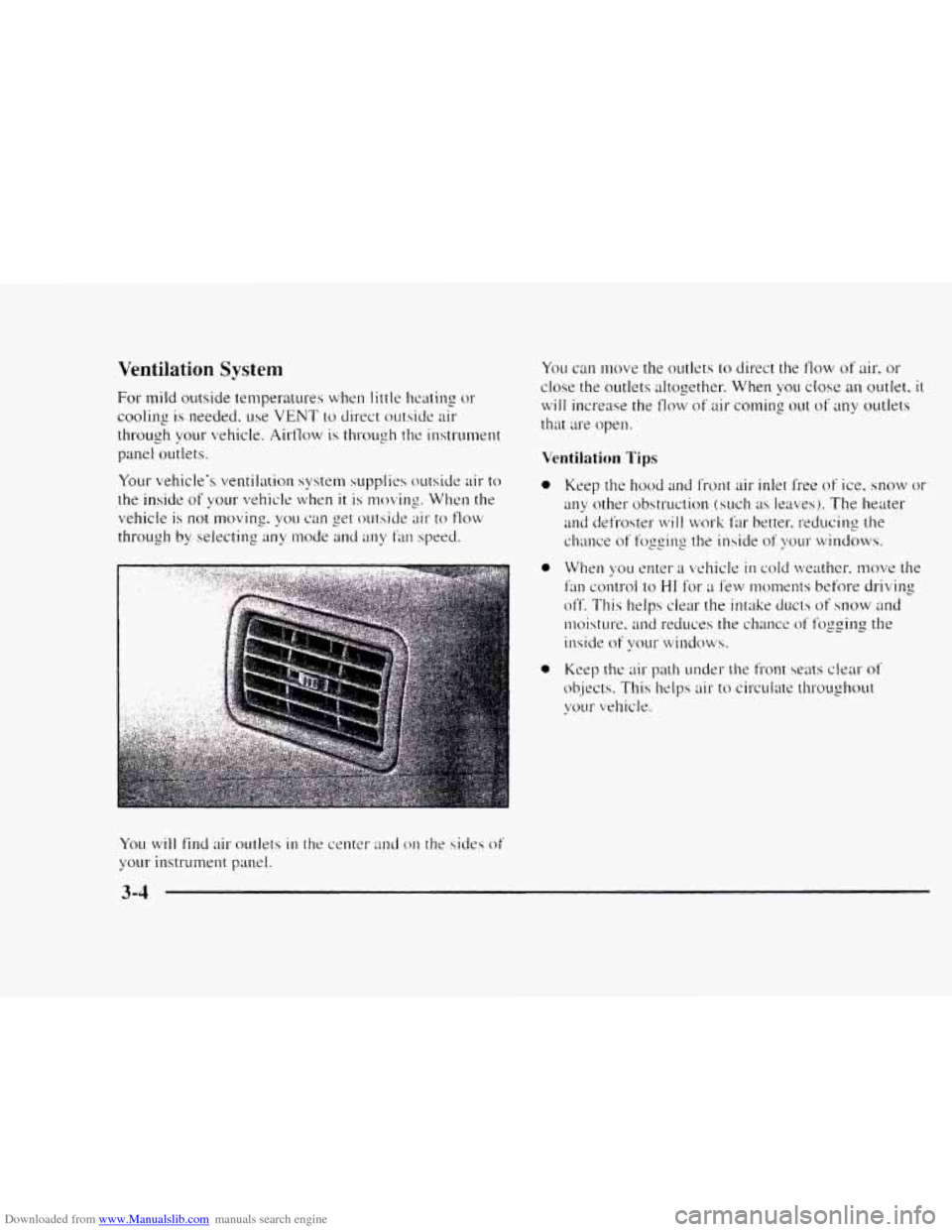
will find air outlets in the center and on the sides of
your instrument panel. You
can move the
outlets to direct the flow of air, or
close the outlets altogether. When you close an outlet. it
will increase the flow of air coming out of my outIets
that are open.
Ventilation Tips
0
0
0
Page 144 of 402

Downloaded from www.Manualslib.com manuals search engine Defogging and Defrosting
On cool, humid days. use BLEND to keep the
windshield and side windows clear.
Use
DEFROST to remove fog or ice from the
windshield quickly
in extreme humid or cold conditions.
Turn the temperature knob clockwise and move the fan
control toward
HI.
Rear Window Defogger (Option)
If your vehicle has this option, the rear window will
have lines that warm the glass. For best results. clear the window
of as
much snow or ice as possible before using
the rear window defogger.
To turn on the rear window defogger. find the switch
marked
REAR DEFOG on your instrument panel below
the headlamp switch. Press
ON until the light in the
switch comes on, then release it. it will
only work if the
ignition switch is turned to RUN.
The rear window defogger will stay on for five to seven
minutes, then turn off.
If you need additional warming
time, turn
it on again. You can turn the defogger off at
any time
by pressing OFF.
Do not attach a temporary vehicle license. tape or decals
across the defogger grid on the rear window.
1 NOTICE:
Don’t use a razor blade or something else sharp
on the inside of the rear window. If you do, you
could cut or damage the warming grid, and the
repairs wouldn’t be covered by your warranty.
3-5
Page 212 of 402
Downloaded from www.Manualslib.com manuals search engine Following Distance
Stay at least twice as far behind the vehicle ahead as you
would when driving your vehicle without a trailer. This
can help
you avoid situations that require heavy braking
and sudden turns.
Passing
You’ll need more passing distance up ahead when
you‘re towing
a trailer. And, because you’re a good deal
longer,
you’ll need to go much farther beyond the
passed vehicle before you can return
to your lane.
Backing Up
Hold the bottom of the steering wheel with one hand.
Then, to move the trailer to the left, just move that hand
to the left. To move the trailer to the right, move your
hand
to the right. Always back up slowly and, if
possible, have someone guide you.
Making Turns
I NOTICE:
Making very sharp turns while trailering could
cause the trailer to come in contact with the
vehicle. Your vehicle could be damaged. Avoid
making very sharp turns while trailering.
When you’re turning with a trailer, make wider turns
than normal.
Do this so your trailer won’t strike soft
shoulders, curbs, road signs, trees or other objects.
Avoid jerky or sudden maneuvers. Signal well
in advance.
I’urn Signals When Towing a Trailer
When you tow a trailer, your vehicle has to have extra
wiring and
a heavy-duty turn signal flasher (included in
the optional trailering package).
The arrows
on your instrument panel will flash
whenever you signal
a turn or lane change. Properly
hooked up, the trailer lamps will
also flash, telling other
drivers you‘re about
to turn, change lanes or stop.
4-51
Page 213 of 402
Downloaded from www.Manualslib.com manuals search engine When towing a trailer, the arrows on your instrument
panel
will flash for turns even if the bulbs on the trailer
are burned out. Thus, you may
think drivers behind you
are seeing your signal when they are not. It's important
to check occasionally to be sure the trailer bulbs are
still working.
Driving On Grades
Reduce speed and shift to a lower gear byfilw you start
down
a long or steep downgrade. If you don't shift
down. you might have to use your brakes
so much that
they would get hot and no longer work well.
On
a long uphill grade. shift down and reduce your
speed
to around 45 mph (70 km/h) to reduce the
possibility of engine and transmission overheating.
if
you have an automatic transmission. you should use
DRIVE (D) when towing a trailer. Operating your
vehicle in DRIVE (D) when towing a trailer will
minimize heat buildup and extend the life
of your
transmission. Or.
if you have a manual transmission. it's
better not to use
FIFTH (5 j gear. just drive in
FOURTH (4) gear (or. as you need to. a lower gear). When
towing
at high altitude on steep uphill grades.
consider the following: Engine coolant will boil at a
lower temperature than at normal altitudes.
If you turn
your engine off immediately after towing at high altitude
on steep uphill grades, your vehicle may show signs
similar to engine overheating.
To avoid this. let the
engine
run while parked (preferably on level ground)
with the automatic transmission in PARK (P) (or the
rnanual transmission out of gear and the parking brake
applied) for a few minutes before turning the engine off.
If you do get the overheat warning, see "Engine
Overheating"
in the Index.
Parking on Hills
You really should not park your vehicle. with a trailer
attached.
on ;I hill. If something goes wrong, your ris
could start to move. People can be injured, and both
your vehicle and the trailer
can be damaged.
4-52
Page 229 of 402
Downloaded from www.Manualslib.com manuals search engine Engine Overheating
You will find a coolant temperature gage on your
vehicle’s instrument panel.
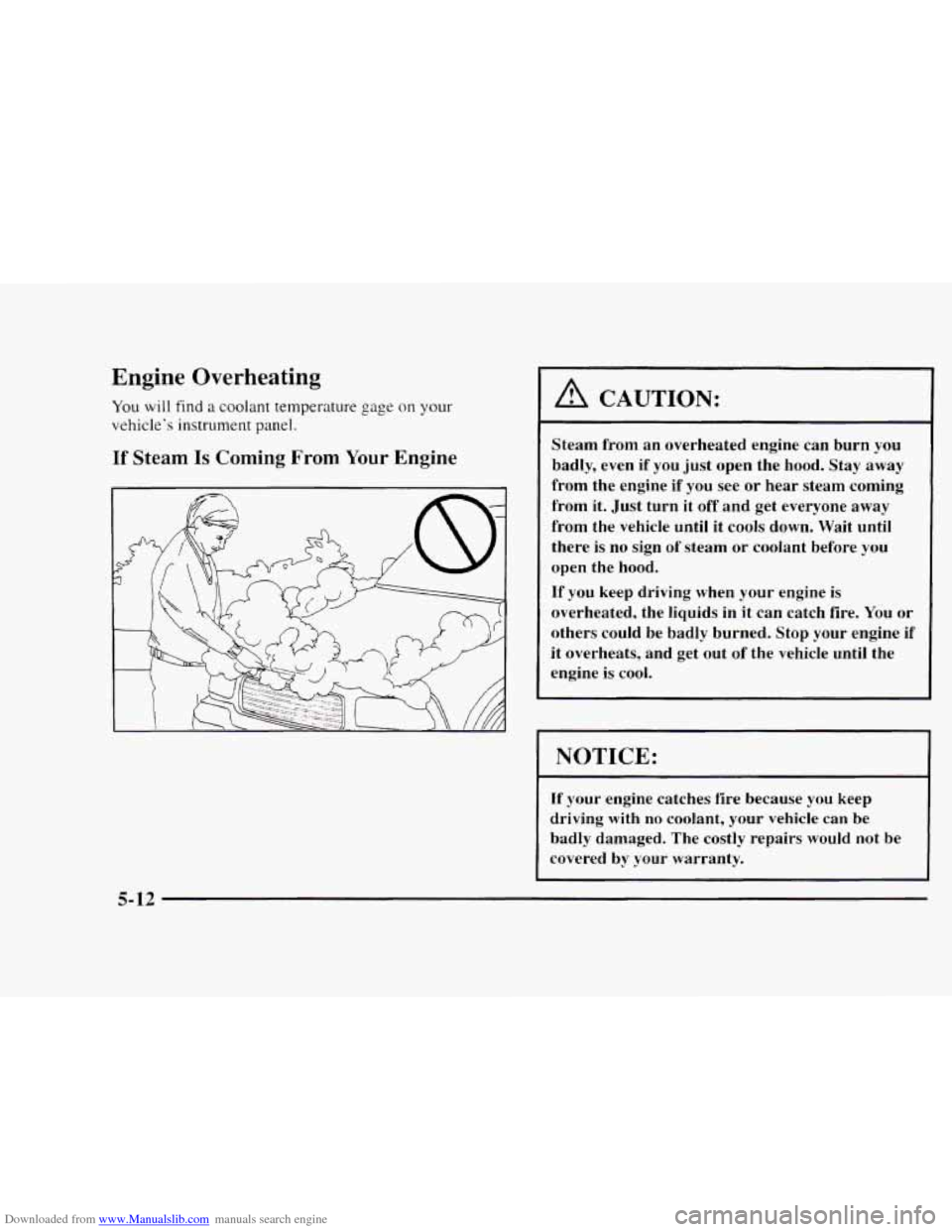
If Steam Is Coming From Your Engine
A CAUTION:
Steam from an overheated engine can burn you
badly, even
if you just open the hood. Stay away
from the engine
if you see or hear steam coming
from it. Just turn
it off and get everyone away
from the vehicle until it cools down. Wait until
there is
no sign of steam or coolant before you
open the hood.
If you keep driving when your engine is
overheated, the liquids in it can catch fire.
You or
others could be badly burned. Stop your engine if
it overheats, and get out
of the vehicle until the
engine
is cool.
NOTICE:
If your engine catches fire because you keep
driving with no coolant, your vehicle can be
badly damaged. The costly repairs would not be
covered
by your warranty.
5-12
Page 258 of 402
Downloaded from www.Manualslib.com manuals search engine Adding Equipment to the Outside of
Your Vehicle
Things you might add to the outside of your vehicle can
affect the airflow around
it. This may cause wind noise
and affect windshield washer performance. Check with
your
GM dealer before adding equipment to the outside
of your vehicle.
Fuel
Use regular unleaded gasoline rated at 87 octane or
higher.
At a minimum, it should meet specifications
ASTM
D48 14 in the United States and CGSB 3.5-M93
in Canada. Improved gasoline specifications have been
developed by the American Automobile Manufacturers
Association
( AAMA) for better vehicle performance
and engine protection. Gasolines meeting the AAMA
specification
could provide improved driveability and
emission
control system protection compared to
other ga~)l i nes.
Be SCII-~ the pos~cl octane is at least 87. If the octane is
less than 87. you ma, gct a heavy knocking noise when
YOLI driirc. If’ it‘ hac1 crlough. it can damage your engine. If
you’re using fuel rated at
87 octane or higher and you
still hear heavy knocking, your engine needs service.
But don’t worry if you hear a little pinging noise when
you’re accelerating or driving up a hill. That’s normal,
and
you don’t have to buy a higher octane fuel to get rid
of pinging. It’s the heavy, constant knock that means
you have a problem.
If your vehicle
is certified to meet California Emission
Standards (indicated on the underhood tune-up label),
it
is designed to operate on fuels that meet California
specifications. If such fuels are
not available in states
adopting California emissions standards, your vehicle
will operate satisfactorily
on fuels meeting federal
specifications, but emission control system performance
may be affected. The malfunction indicator lamp
on
your instrument panel may turn on and/or your vehicle
may fail a smog-check test.
If this occurs, return to your
authorized GM dealer for diagnosis to determine the
cause of failure.
In the event it is determined that the
cause of the condition is the type of fuels used, repairs
may
not be covered by your warranty.
6-3