1997 CHEVROLET BLAZER heating
[x] Cancel search: heatingPage 66 of 402

Downloaded from www.Manualslib.com manuals search engine EndgateLiftgate
A CAUTION:
It can be dangerous to drive with the rear
window, endgate or liftgate open because carbon
monoxide (CO) gas can come into your vehicle.
You can’t see or smell CO. It can cause
unconsciousness and even death.
If you must drive with the rear window, endgate
or liftgate open or
if electrical wiring or other
cable connections must pass through the seal
between the body and the rear window, endgate
or liftgate:
Make sure all windows are shut.
Turn the fan on your heating or cooling
system to
its highest speed with the setting on
VENT. That will force outside air into your
vehicle. See
“Comfort Controis” in the Index.
instrument panel, open them all the way.
If you have air outlets on or under the
See “Engine Exhaust”
in the Index.
Endgate Mounted Spare
If your vehicle has an endgate-mounted spare tire
carrier,
you must move the carrier arm out of the way to
open the glass.
Here’s how to move the arm:
d
I
1. Squeeze the release handle to free the carrier arm.
2. Swing the carrier arm away from the endgate. You
3. To latch the carrier arm, swing it toward the endgate.
may need
to give it a slight tug.
2-9
Page 118 of 402
Downloaded from www.Manualslib.com manuals search engine NOTICE:
Loading cargo that weighs more than 200 lbs.
(91 kg) on the luggage carrier may damage your
vehicle. When you carry large things, never let
them hang over the rear or the sides
of your
vehicle. Load your cargo
so that it rests on the
slats and does not scratch or damage the vehicle.
Put the cargo against the side rails and fasten it
securely to the luggage carrier. Put the main
weight as far forward as you can.
Don’t exceed the maximum vehicle capacity when
loading your vehicle. For more information
on vehicle
capacity and loading, see “Loading Your Vehicle”
in
the Index.
To prevent damage or loss of cargo as you’re driving,
check now and then
to make sure the luggage carrier and
cargo are still securely fastened.
Ashtrays and Cigarette Lighter
To use the lighter, press it in all the way, and let go.
When it’s ready, it will pop back by itself.
NOTICE:
~~~ -~ - ~
Don’t hold a cigarette lighter in with your hand
while it
is heating. If you do, it won’t be able to
back away from the heating element when it’s
ready. That can make it overload, damaging the
lighter and the heating element.
The front ashtray must be completely pulled out to the
open position before the ashtray cover opens and
smoking material can be deposited.
2-6 1
Page 133 of 402
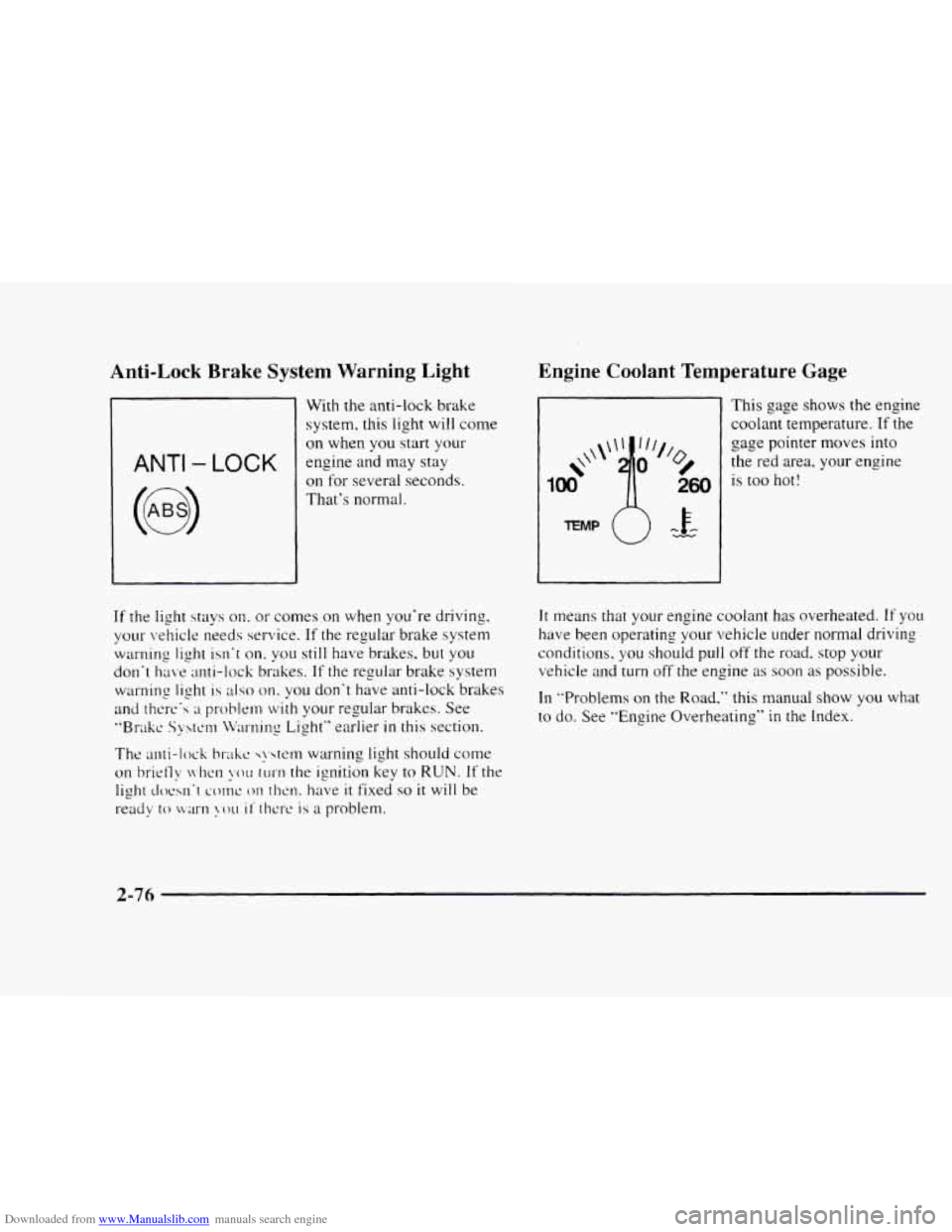
Downloaded from www.Manualslib.com manuals search engine Anti-Lock Brake System Warning Light
ANTI - LOCK
With the anti-lock brake
system, this light will come
on when you start your
engine and may stay
on for several seconds.
That's normal.
Engine Coolant Temperature Gage
This gage shows the engine
coolant temperature.
If the
gage pointer moves
into
is too hot!
the
red area, your engine 260
If the light stays on. or comes on when you're driving,
your irehick needs service.
If the regular brake system
warning
light isn't on. you still have brakes. but you
don't
have anti-lock brakes. If the regular brake system
warning light
is also on. you don't have anti-lock brakes
and there's
;I problern with your regular brakes. See
"B1-akc. Svstcm LVmling Light" earlier in this section.
The anti-lock brakc. s>.4tem warning light should come
on briet'ly n.hct1
~.ou turn the ignition key to RUN. If the
light doesn't co1nc3 011 111cn. have it fixed so it will be
ready
to w;m U)LI it' thew is a problem. lt means
that your engine coolant
have been operating your vehicle has
overheated.
If you
under normal driving
conditions. you should pull off the road.
stop your
vehicle and
turn off the engine as soon as possible.
In "Problems on the Road." this manual show you what
to
do. See "Engine Overheating" in the Index.
2-76
Page 140 of 402

Downloaded from www.Manualslib.com manuals search engine Section 3 Comfort Controls and Audio Systems
In this section, you'll find out how to operate the comfort control and audio systems offered with your vehicle. Be
sure to read about the particular systems supplied
with your vehicle.
3-2
3-2
3-3 3-3
3-4
3-5
3-5
3 -6
3-6
3-6
3-6
Comfort Controls
Climate Control System
Air Conditioning
Heating Ventilation System
Defogging and Defrosting
Rear Window Defogger (Option)
Audio Systems
Setting the Clock
Setting the Clock for AM-FM Stereo
with Compact Disc Player and Automatic
Tone Control
AM-FM Stereo 3-8
3- 10
3- 13
3-17
3- 19
3- 19
3-20
3-2 1
3-2 1
AM-FM Stereo with Cassette Tape Player
(If Equipped)
AM-FM Stereo
with Cassette Tape Player
and Equalizer
(If Equipped)
AM-FM Stereo
with Compact Disc Player
and Automatic Tone Control (If Equipped)
Theft-Deterrent Feature
Understanding Radio Reception
Tips About Your Audio System
Care of
Your Cassette Tape Player
Care
of Your Compact Discs
Fixed Mast Antenna
Page 141 of 402

Downloaded from www.Manualslib.com manuals search engine Temperature Knob Comfort Controls
With this system. you can control the heating. cooling
and ventilation in your vehicle.
Climate Control System
1
$8
hl
OF
Fan Control
The switch with the fan symbol changes the fan speed.
To increase the fiu1 speed. move the switch upward
toward
HI. To decrease the fan speed, move the switch
downward toward
LO.
The upper knob regulates the temperature of the air
coming through the system. Turn the knob clockwise
for
wrnw air, Turn the knob co~~nterclockwise for
cooler air.
Mode Knob
The lower knob allows you to choose the direction of
air delivery.
OFF: This setting turns the system off. Some outside air
will still enter the vehicle whenever the vehicle is
moving fot-w;lrd.
XlAX A/C: This setting provides maximuM cooling
with the least amount of work. MAX A/C recirculates
much
of the air inside your vehicle so it cools quickly.
NC: This settins cools the air entering your vehicle and
directs it 1111-ough the instrument panel outlets.
.)/J BI-LEVEL A/C: Air is delivered through the
heater 11oor outlets as well as the instrument panel outlets.
/J VENT: This setting directs airflow through the
instrument panel outlets. The air conditioning
conlpressor
is not working when VENT is selected.
+e
+e
3-2
Page 142 of 402

Downloaded from www.Manualslib.com manuals search engine 0
+’ HEATER: This setting directs warmed air through
the heater floor outlets and windshield defroster outlets.
‘H BLEND: Airflow is divided equally between the
heater floor outlet and the windshield defroster outlets.
DEFROST This setting directs most air through
w.
the windshield defroster outlets and some through the
heater outlets.
Air Conditioning
On hot days, open the windows long enough to let hot
inside air escape. This reduces the time it takes for your
vehicle to cool down. Then keep your windows closed
for the air conditioner
to work its best.
For quick cool-down
on very hot days, use MAX A/C
with the temperature knob turned counterclockwise.
This setting should be used to keep odors and/or dust
from entering the vehicle. For normal cooling on
hot days, use
A/C with the temperature knob
turned counterclockwise. On
cool but sunny days, use BI-LEVEL
A/C to deliver
warm
air to the floor and cooler air to the instrument
panel outlets.
When
the air conditioner is on, you may sometimes
notice slight changes in your vehicle‘s engine speed and
power. This is normal because the system is designed
to cycle
the compressor on and off to keep the
desired temperature.
Heating
The heater works best if you keep your windows closed
while using
it. On cold days, use HEATER with the
temperature knob turned clockwise. BLEND is useful
in
cool weather when you have fog or ice on the
windshield
or side windows.
If you use the optional engine coolant heater before
starting your engine, your heating system will produce
warmer
air faster to heat the passenger compartment in
cold weather. See “Engine Coolant Heater” in the Index.
3-3
Page 143 of 402
Downloaded from www.Manualslib.com manuals search engine Ventilation System
ror mild outside temperatures when little heating or
cooling is needed. use VENT to direct outside air
through your vehicle.
Airtlow is through the instrument
panel outlets.
Your vehicle's ventilation system supplies outside air- to
the inside
of yo11r vehicle when it is moving. When the
vehicle
is not moving. you can get outside air to flow
through
by selecting any mode and any fan speed.
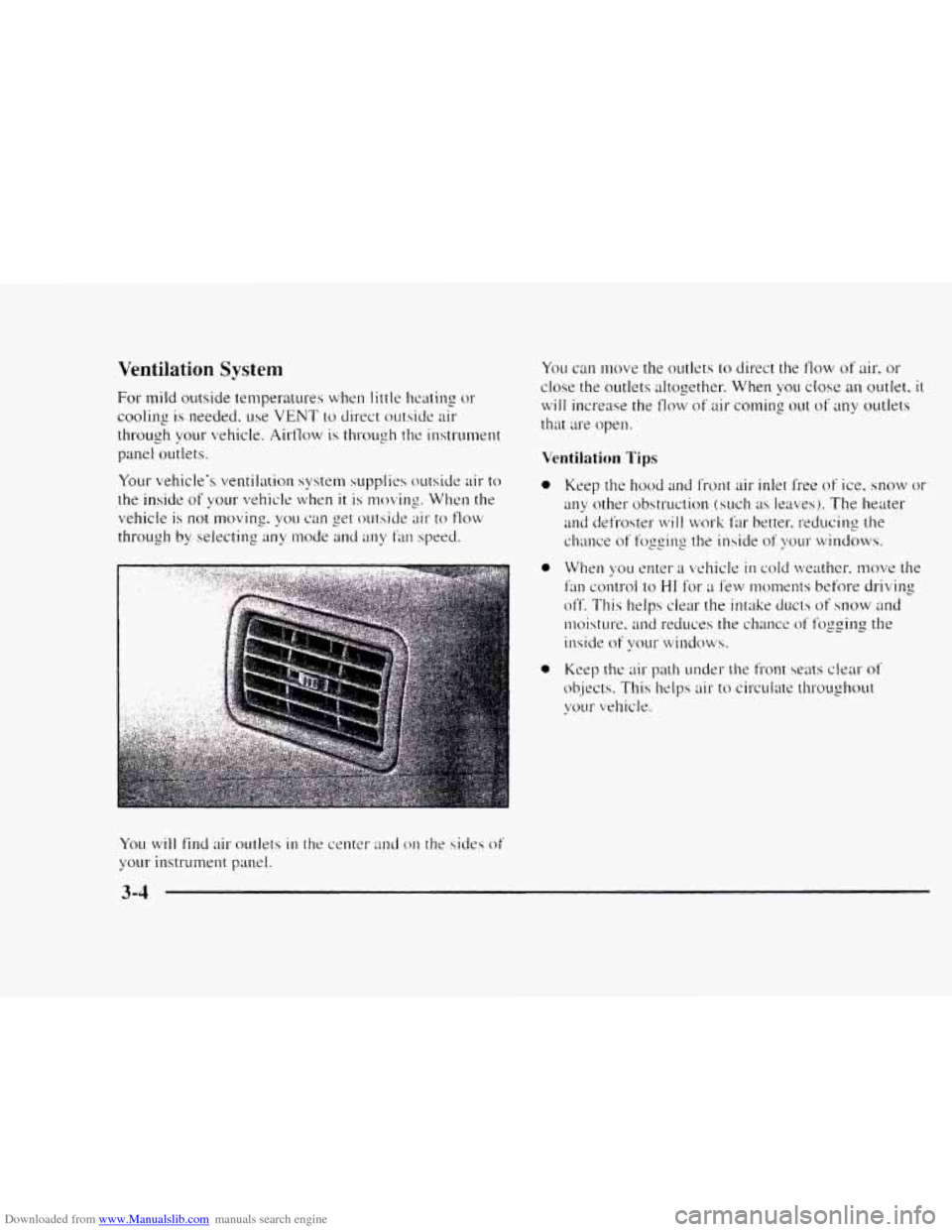
You
will find air outlets in the center and on the sides of
your instrument panel. You
can move the
outlets to direct the flow of air, or
close the outlets altogether. When you close an outlet. it
will increase the flow of air coming out of my outIets
that are open.
Ventilation Tips
0
0
0
Page 211 of 402
Downloaded from www.Manualslib.com manuals search engine Driving with a Trailer
If you have a rear-most window open and you
pull a trailer with your vehicle, carbon monoxide
(CO) could come into your vehicle. You can’t see
or smell
CO. It can cause unconsciousness or
death. (See “Engine Exhaust” in the Index.)
To
maximize your safety when towing a trailer:
Have your exhaust system inspected for
leaks, and make necessary repairs before
starting on your trip.
0 Keep the rear-most windows closed.
If exhaust does come into your vehicle
through
a window in the rear or another
opening, drive with your front, main heating or cooling system on and
with the
fan on
any speed. This will bring fresh,
outside
air into your vehicle. Do not use
MAX A/C because it only recirculates the
air inside your vehicle. (See b‘ Comfort
Controls”
in the Index.) Towing
a trailer requires a certain
amount of experience.
Before setting out for the open road. you‘ll want
to get
to know your rig. Acquaint yourself with the feel of
handling and braking with the added weight of the
trailer. And always keep in mind that the vehicle you are
driving
is now a good deal longer and not nearly as
responsive as your vehicle is by itself.
Before
you start, check the trailer hitch and platform
(and attachments). safety chains. electrical connector,
lamps, tires and mirror adjustment. If the trailer has
electric brakes. start your vehicle and trailer moving and
then apply the trailer brake controller by hand to be sure
the brakes are working. This lets
you check your
electrical connection at the same time.
During your trip. check occasionally to be sure that the
load is secure. and that the lamps and any trailer brakes
are still working.
4-50