1997 CHEVROLET BLAZER spare wheel
[x] Cancel search: spare wheelPage 251 of 402
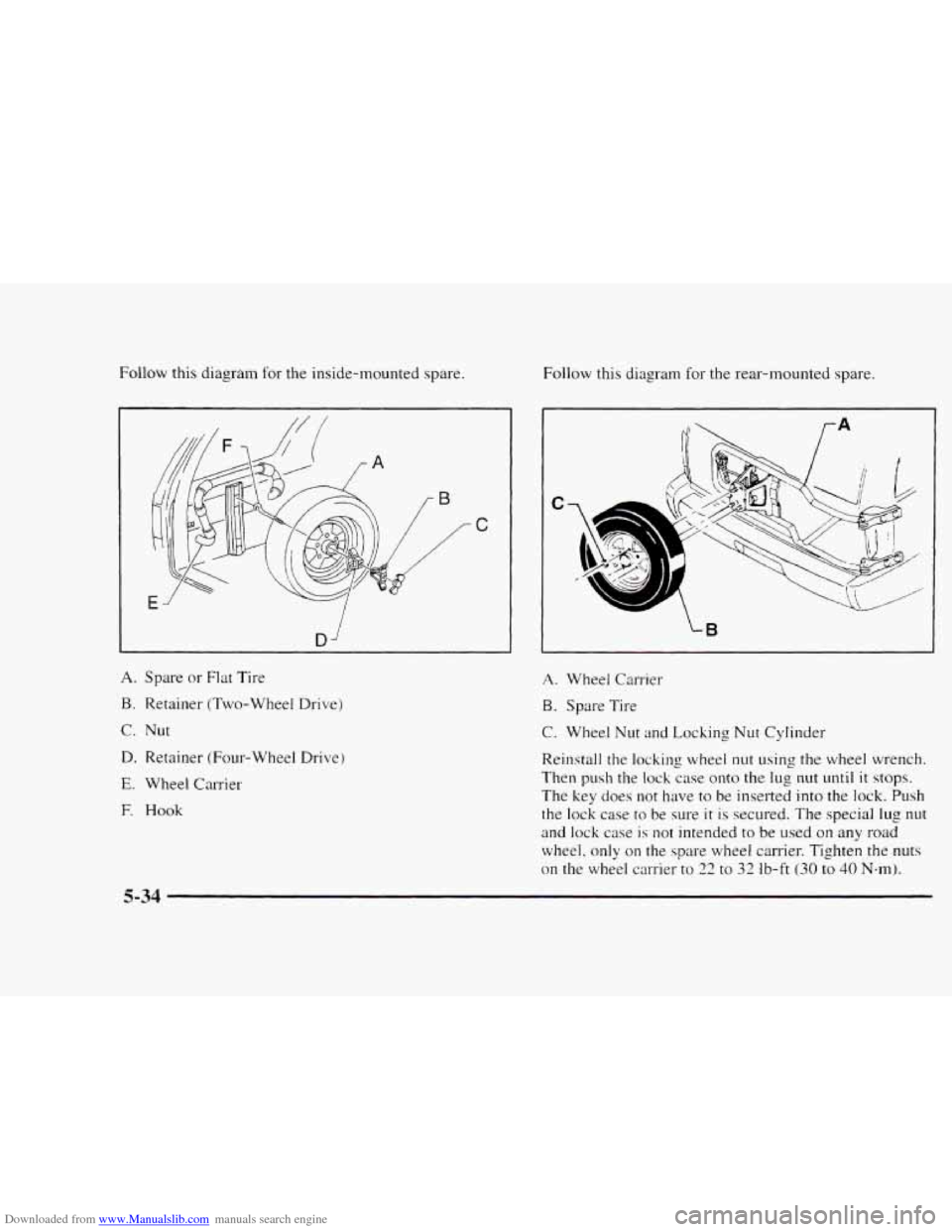
Downloaded from www.Manualslib.com manuals search engine Follow this diagram for the inside-mounted spare. Follow this diagram for the rear-mounted spare.
C
D i
C7
- i,
A. Spare or Flat Tire
B. Retainer (Two-Wheel Drive)
C. Nut
D. Retainer (Four-wheel Drive)
E. Wheel Carrier
E Hook
A. Wheel Carrier
B. Spare Tire
C. Wheel Nut and Locking Nut Cylinder
Reinstall the locking wheel
nut using the wheel wrench.
Then push the lock case onto
the lug nut until it stops.
The key does not have to be inserted into the lock. Push
the lock case to be sure
it is secured. The special lug nut
and lock case is not intended to be used on any road
wheel.
only on the spare wheel carrier. Tighten the nuts
on the wheel carrier to 22 to 32 Ib-ft (30 to 40 N-m).
Page 252 of 402
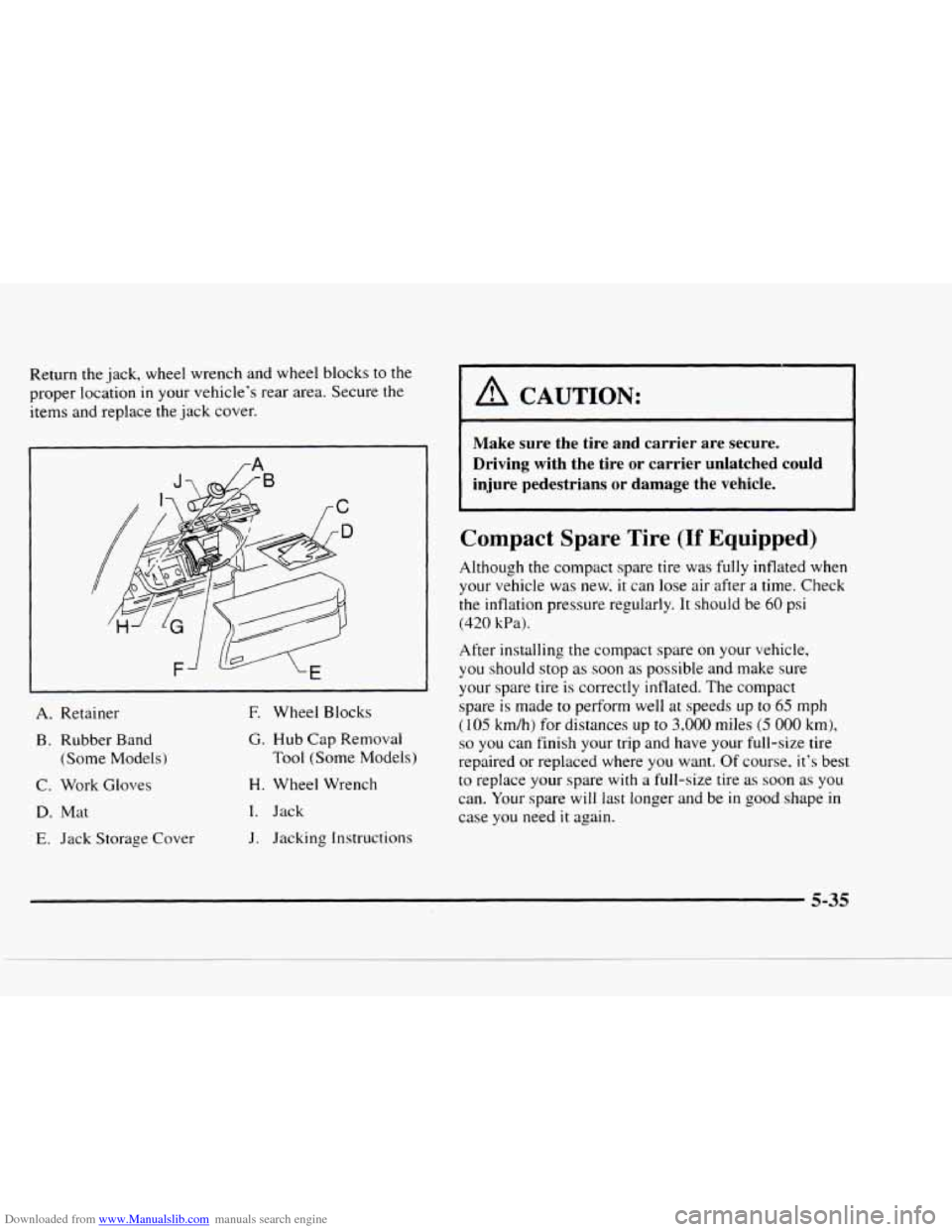
Downloaded from www.Manualslib.com manuals search engine Return the jack, wheel wrench and wheel blocks to the
proper location
in your vehicle’s rear area. Secure the
items and replace
the jack cover.
I
-
A. Retainer E Wheel Blocks
B. Rubber Band
(Some Models
j
C. Work Gloves
D. Mat
E. Jack Storage Cover
G. Hub Cap Removal
Tool (‘Some Models)
H. Wheel Wrench
I. Jack
J. Jacking Instructions
I A CAUTION:
I
Make sure the tire and carrier are secure.
Driving with the tire or carrier unlatched could
injure pedestrians
or damage the vehicle.
Compact Spare Tire (If Equipped)
Although the compact spare tire was fully inflated when
your vehicle was new,
it can lose air after a time. Check
the inflation pressure regularly. It should be 60 psi
(420 kPa).
After installing the compact spare on your vehicle,
you should stop as
soon as possible and make sure
your spare tire
is correctly inflated. The compact
spare
is made to perform well at speeds up to 65 mph
(105 km/h) for distances up to 3,000 miles (5 000 km),
so you can finish your trip and have your full-size tire
repaired or replaced where
you want. Of course, it’s best
to replace your spare with a full-size tire as soon as you
can. Your spare will last longer and be in good shape in
case you need
it again.
5-35
Page 253 of 402
Downloaded from www.Manualslib.com manuals search engine NOTICE:
When the compact spare is installed, don’t take
your vehicle through an automatic car wash with
guide rails. The compact spare can get caught on
the rails. That can damage the tire and wheel,
and maybe other parts
of your vehicle.
Don‘t use your compact spare on other vehicles
And
don’t mix your compact spare tire or wheel with
other wheels or tires. They won‘t fit. Keep your spare
tire and
its wheel together.
NOTICE:
Tire chains won’t tit your compact spare. Using
them can damage your vehicle and can damage
the chains too. Don’t use tire chains on your
compact spare.
If You’re Stuck: In Sand, Mud,
Ice or Snow
What you don‘t want to do when your vehicle is stuck is
to spin your wheels too fast. The method known as
“rocking“ can help you get out when you’re stuck, but
you must use caution.
A CAUTION:
If you let your tires spin at high speed, they can
explode, and you or others could be injured. And,
the transmission or other parts
of the vehicle can
overheat. That could cause an engine
compartment fire
or other damage. When you’re
stuck, spin the wheels as little as possible. Don’t
spin the wheels above
35 mph (55 kmh) as shown
on the speedometer.
5-36
Page 297 of 402

Downloaded from www.Manualslib.com manuals search engine I NOTICE: (Continued) I
If your tires have too much air (overinflation),
you can get the following:
Unusual wear
Bad handling
Rough ride
Needless damage from road hazards.
When to Check
Check your tires once a month or more. Also. check the
tire pressure
of the spare tire.
If you have a compact spare tire. it should be at 60 psi
(420 kPa).
How to Check
Use a good quality pocket-type gage to check tire
pressure.
You can't tell if your tires are properly inflated
simply by looking at them. Radial tires may look
properly inflated even when they're underinflated.
Be sure to
put the valve caps back on the valve stems.
They help prevent leaks by keeping out
dirt and moisture.
Tire Inspection and Rotation
Tires should be rotated every 6.000 to 8.000 miles
(10 000 to 13 000 km). Any time you notice unusual
wear. rotate your tires
as soon as possible and check
wheel alignment.
Also check for damaged tires or
wheels. See "When It's Time for New Tires" and
"Wheel Replacement'' later
in this section for
more information.
The purpose
of regular rotation is to achieve more
uniform wear for
all tires on the vehicle. The first
rotation is the most important. See "Scheduled
Maintenance Services"
in the Index for scheduled
rotation intervals.
6-42
Page 298 of 402
Downloaded from www.Manualslib.com manuals search engine i
I
LWA r I
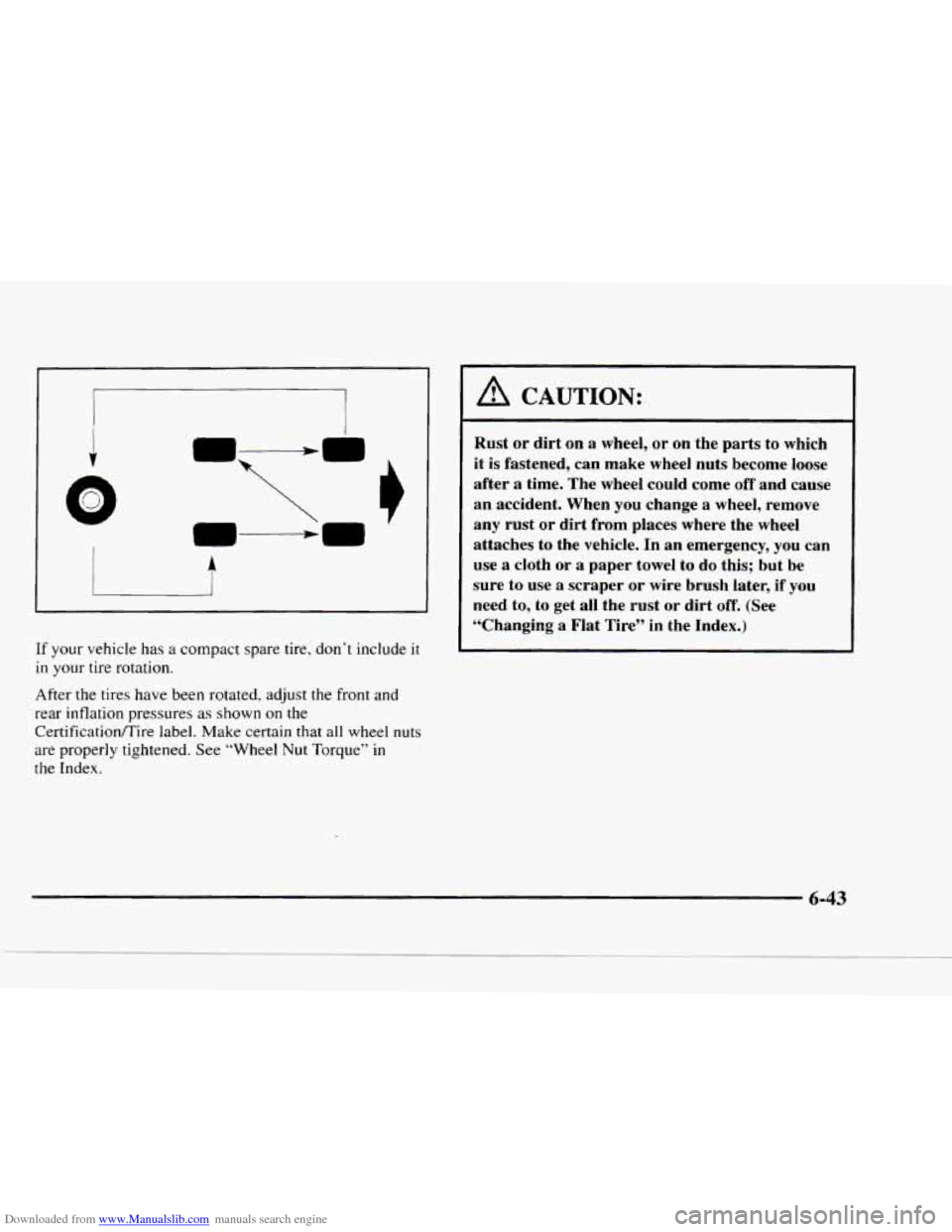
If your vehicle has a compact spare tire, don’t include it
in your tire rotation.
After the tires have been rotated, adjust the front and
rear inflation pressures as shown on the
CertificationRire label. Make certain that all wheel nuts
are properly tightened. See “Wheel
Nut Torque” in
the Index.
Rust or dirt on a wheel, or on the parts to which
it
is fastened, can make wheel nuts become loose
after a time. The wheel could come off and cause
an accident. When
you change a wheel, remove
any rust or dirt from places where the wheel
attaches to the vehicle.
In an emergency, you can
use a cloth or a paper towel to do this; but
be
sure to use a scraper or wire brush later, if you
need to, to get all the rust or dirt off. (See
“Changing a Flat Tire”
in the Index.)
6-43
Page 300 of 402
Downloaded from www.Manualslib.com manuals search engine I A CAUTION:
Mixing tires could cause you to lose control while
driving.
If you mix tires of different sizes or types
(radial and bias-belted tires), the vehicle may not
handle properly, and you could have a crash.
Using tires of different sizes may
also cause
damage to your vehicle. Be sure to use the same
size and type tires on all wheels.
It’s all right to drive with your compact spare
(if you have one). It was developed for use on
your vehicle.
Uniform Tire Quality Grading
The following information relates to the system
developed by
the United States National Highway
Traffic Safety Administration, which grades tires by
treadwear, traction and temperature performance. (This
applies only
to vehicles sold in the United States.) The
grades are molded on the sidewalls
of most passenger
car tires.
The Uniform Tire Quality Grading system does
not apply to deep tread, winter-type snow tires,
space-saver or temporary use spare tires, tires with
nominal rim diameters
of 10 to 12 inches (25 to 30 cm),
or
to some lirnited-production tires.
While the tires available
on General Motors passenger
cars and light trucks may vary with respect
to these
grades, they must also conform
to Federal safety
requirements and additional General Motors Tire
Performance Criteria (TPC) standards.
Treadwear
The treadwear grade is a comparative rating based on
the wear rate of the tire when tested under controlled
conditions on a specified government test course. For
example, a tire graded
150 would wear one and a half
(1 1/2) times as well on the government course as a tire
graded
100. The relative performance of tires depends
upon
the actual conditions of their use, however, and
may depart significantly from the norm due to variations
in driving habits, service practices and differences
in
road characteristics and climate.
6-45
Page 398 of 402
Downloaded from www.Manualslib.com manuals search engine Lap-Shoulder ........................... 1.13. 1.28
Questions and Answers ........................ 1 . I2
Rear Comfort Guides .......................... 1-3 1
Rear Seat Passengers .......................... 1-28
Replacing After a Crash ........................ 1-48
Right Front Passenger Position .................. 1-26
Use During Pregnancy ......................... 1-26
WhyThey Work ............................... 1-9
Safety Defects. Reporting ................... 8- 10. 8- I 1
Safety Warnings and Symbols ....................... III
Scheduled Maintenance Services .................... 7-4
Seatback
Latches
...................................... 1-6
Reclining Front ............................... 1-4
Seats and Restraint Systems ........................ 1-1
Second Gear
Automatic Transmission
....................... 2-20
Manual Transmission .......................... 2-2 1
Service and Appearance Care ...................... 6- 1
Service and Owner Publications .............. 8- 1 1. 8. 12
Service Engine Soon Light ....................... 2-77
Service Parts Identification Label .................. 6-58
Service Work. Doing Your Own .................... 6-2
Servicing Your Air Bag-Equipped Vehicle ........... 1-25
Sheet Metal Damage ............................ 6-55
Shift Light ............................... 2.22. 2.80
Shifting
.................................. 2-1 8. 2.21
Into Park ............................ ....... 2-30
OutofPark .................................. 2-33
Safety Chains .................................. 4-49
...
SignalingTurns ................................ 2-39
Skidding ...................................... 4-13
Specifications and Capacities ................. 6.63. 6.64
Speech Impaired. Customer Assistance ............... 8-4
Speedometer ................................... 2-71
Stains. Cleaning ................................ 6-51
Starter Switch Check ............................ 7-48
Starting Your Engine ............................ 2-15
Steam ........................................ 5-12
Steering
In Emergencies
............................... 4-10
Power ....................................... 4-9
Steering Column Park Lock Check ................. 7-49
Steering Wheel. Tilt ............................. 2-38
Storage Compartments ........................... 2-50
Storage. Vehicle ................................ 6-33
Storing a Flat or Spare Tire and Tools ............... 5-32
Stuck: In Sand. Mud. Ice or Snow .................. 5-36
SunVisors .................................... 2-62
Sunglasses Storage .............................. 2-56
Sunroof ....................................... 2-63
Supplemental Inflatable Restraint .................. 1-20
Symbols. Vehicle .................................. v
Tachometer .................................. 2-71
Taillamp Bulb Replacement ....................... 6-37
TapePlayerCare ............................... 3-20
Temperature and Compass Display ................. 2-53
SIR .......................................... 1-20
.. . 9-9