1997 CHEVROLET BLAZER brake fluid
[x] Cancel search: brake fluidPage 176 of 402
Downloaded from www.Manualslib.com manuals search engine Off-Road Driving with Your
Four-Wheel-Drive Vehicle
This off-road guide is for vehicles that have
four-wheel drive.
Also, see “Anti-Lock Brakes”
in the Index.
If your vehicle doesn‘t have four-wheel drive, you
shouldn‘t drive off-road unless you‘re on a level,
solid surface.
Off-road driving can be great
fun. But it does have some
definite hazards. The greatest
of these is the terrain itself.
“Off-roading” means
you’ve left the great North
American road
system behind. Traffic lanes aren‘t
marked. Curves aren’t banked. There are
no road signs.
Surfaces can be slippery. rough, uphill
or downhill. In
short. you’ve gone right back to nature.
Off-road driving involves some new skills. And that’s
why it’s very important that you read this guide. You’ll
find many driving tips and suggestions. These will help
make your off-road driving safer and more enjoyable.
Before You Go Off-Roading
There are sutfre things to do before you go out. For
example, be sure
to have all necessary maintenance and
service work done. Check
to make sure all underbody
shields
(if so equipped) are properly attached. Be sure
you read all the information about your
four-wheel-drive vehicle
in this manual. Is there enough
fuel?
Is the spare tire fully inflated? Are the fluid levels
up where they should be? What are
the local laws that
apply to off-roading where you’ll be driving? If
you
don’t know, you should check with law enforcement
people
in the area. Will you be on someone’s private
land?
If so, be sure to get the necessary permission.
Loading Your Vehicle for Off-Road Driving
There are some important things to remember about
how
to load your vehicle.
The heaviest things should be on the load floor and
forward of your rear axle. Put heavier items as far
forward
as you can.
Be sure the load is secured properly, so driving on
the off-road terrain doesn’t toss things around.
4- 15
Page 191 of 402
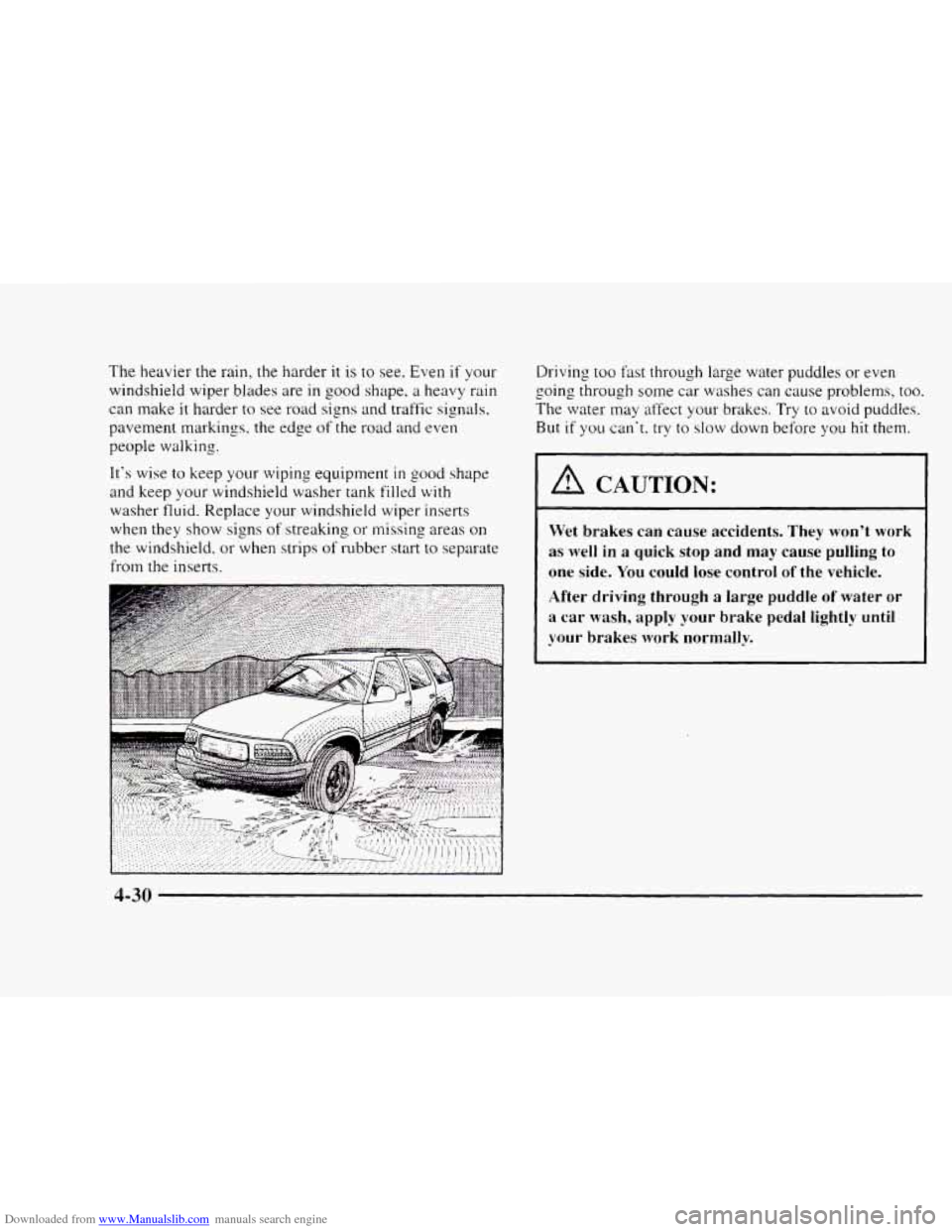
Downloaded from www.Manualslib.com manuals search engine The heavier the rain, the harder it is to see. Even if your
windshield wiper blades are
in good shape, a heavy rain
can make
it harder to see road signs and traffic sipals.
pavement markings. the edge
of the road and even
people walking.
It's wise to keep
your wiping equipment in good shape
and keep your windshield washer tank filled
with
washer fluid. Replace your windshield wiper inserts
when they show signs
of streaking or missing areas on
the windshield, or when strips of rubber start to separate
from the inserts. Driving
too
fast through large water puddles or even
going through
some car washes can cause problems, too.
The water may affect your brakes. Try to avoid puddles.
But if you can't. try to slow down before you hit them.
I A CAUTION:
Wet brakes can cause accidents. They won't work
as
well in a quick stop and may cause pulling to
one side. You could lose control
of the vehicle.
After driving through
a large puddle of water or
a car wash, apply your brake pedal lightly until
your brakes work normally.
4-30
Page 197 of 402
Downloaded from www.Manualslib.com manuals search engine Keep your vehicle in good shape. Check all fluid
levels and
also the brakes, tires. cooling system and
transmission. These parts can work hard
on
mountain roads.
Know how to go down hills. The most important
thing
to know is this: let your engine do some of the
slowing down. Shift
to a lower gear when you go
down a steep or long hill.
A CAUTION:
If you don’t shift down, your brakes could get so
hot that they wouldn’t work well. You would then
have poor braking or even none going down a
hill.
You could crash. Shift down to let your
engine assist your brakes on a steep
downhill slope.
I A CAUTION:
Coasting downhill in NEUTRAL (N) or with the
ignition
off is dangerous. Your brakes will have to
do all the work
of slowing down. They could get so
hot that they wouldn’t work well. You would then
have poor braking or even none going down a hill.
You could crash. Always have your engine running
and your vehicle in gear when you go downhill.
Know how to go uphill. You may want to shift down to a
lower gear. The lower gears help cool your engine and
transmission. and you can climb the
hill better.
Stay in your own lane when driving on two-lane
roads
in hills or mountains. Don‘t swing wide or cut
across the center
of the road. Drive at speeds that let
you stay in your own lane.
As you go over the top of a hill, be alert. There could be
something
in your lane. like a. stalled car or an accident.
You may see hishway signs on mountains that warn of
special problems. Examples are long grades, passing or
no-passing zones.
a falling rocks area or winding
roads.
Be alert to these and take appropriate action.
4-36
Page 210 of 402
Downloaded from www.Manualslib.com manuals search engine 0 Will you have to make any holes in the body of your
vehicle when you install a trailer hitch?
If you do, then be sure to seal the holes later when
you remove the hitch. If you don’t seal them, deadly
carbon monoxide
(CO) from your exhaust can get
into your
vehicle (see “Carbon Monoxide” in the
Index). Dirt and water can, too.
Safety Chains
You should always attach chains between your vehicle
and your trailer. Cross the safety chains under the tongue
of the trailer so that the tongue will not drop to the road
if it becomes separated from the hitch. instructions
about safety chains may be provided by the hitch
manufacturer or by
the trailer manufacturer. Follow the
manufacturer’s recommendation for attaching safety
chains and do not attach them to the bumper. Always
leave
just enough slack so you can turn with your rig.
And, never allow safety chains
to drag on the ground.
Trailer Brakes
If your trailer weighs more than 1,000 Ibs. (450 kg)
loaded, then it needs its own brakes -- and they must be
adequate. Be sure to read and follow the instructions
for
the trailer brakes so you’ll be able to install, adjust and
maintain them properly.
Your trailer’s brake system can tap
into the vehicle’s
hydraulic brake system
only if
The trailer parts can withstand 3,000 psi
(20 650 kPa) of pressure.
The trailer’s brake system will use less than
0.02 cubic inch (0.3 cc) of fluid from your vehicle’s
master cylinder. Otherwise, both braking systems
won’t work well. You could even lose your brakes.
If everything checks out this far, then make the brake
fluid tap at the port
on the master cylinder that sends
fluid to
the rear brakes. But don’t use copper tubing for
this.
if you do, it will bend and finally break off. Use
steel brake tubing.
Page 215 of 402
Downloaded from www.Manualslib.com manuals search engine When You Are Ready to Leave After
Parking
on a Hill
1. Apply your regular brakes and hold the pedal down
whiie you:
Start your engine:
Shift into a gear: and
Release the parking brake.
3,. Let up on the brake pedal.
3. Drive slowly until the trailer is clear of the chocks.
4. Stop and have someone pick up and store the chocks.
Maintenance When Trailer Towing
Your vehicle will need service more often when you’re
pulling
a trailer. See the Maintenance Schedule for more
on this. Things that are especially important in trailer
operation are automatic transmission fluid (don’t
overfill), engine
oil, axle lubricant, belt. cooling system
and brake adjustment. Each
of these is covered in this
manual. and
the Index will help you find them quickly.
If you’re trailering, it‘s a good idea to review these
sections before you start your
trip.
Check periodically to see that all hitch nuts and bolts
are tight.
4-54
Page 256 of 402
Downloaded from www.Manualslib.com manuals search engine Section 6 Service and Appearance Care
Here you will find information about the care of your vehicle. This section begins with service and fuel information,
and then
it shows how to check important fluid and lubricant levels. There is also technical information about your
vehicle, and a part devoted
to its appearance care.
6-3
6-4
6-5
6-6
6-9 6-
13
6- 14
6-18
6- 19
6-
20
6-2 1
6-23
6-26
6-26
6-26 6-27
Fuel
Fuels in Foreign Countries
Filling Your Tank
Checking Things Under the Hood
Engine Oil
Air Cleaner
Automatic Transmission Fluid
Manual Transmission Fluid
Hydraulic Clutch
Rear Axle
Four-wheel Drive and All-Wheel Drive
Engine Coolant Radiator Pressure Cap
Thermostat Power Steering Fluid
Windshield Washer Fluid 6-28
6-32
6-3 3 6-3 8
6-40 6-49
6-49
6-52
6-54
6-5
7
6-5 8
6-58
6-58
6-62
6-63
6-64
Brakes
Battery
Bulb Replacement
Windshield Wiper Blade Replacement
Tires
Appearance Care
Cleaning the Inside
of Your Vehicle
Care
of Safety Belts
Cleaning the Outside of Your Vehicle
Appearance Care Materials Chart
Vehicle Identification Number
(VIN)
Service Parts Identification Label
Electrical System
Replacement Bulbs
Capacities and Specifications
Air Conditioning Refrigerants
Page 262 of 402
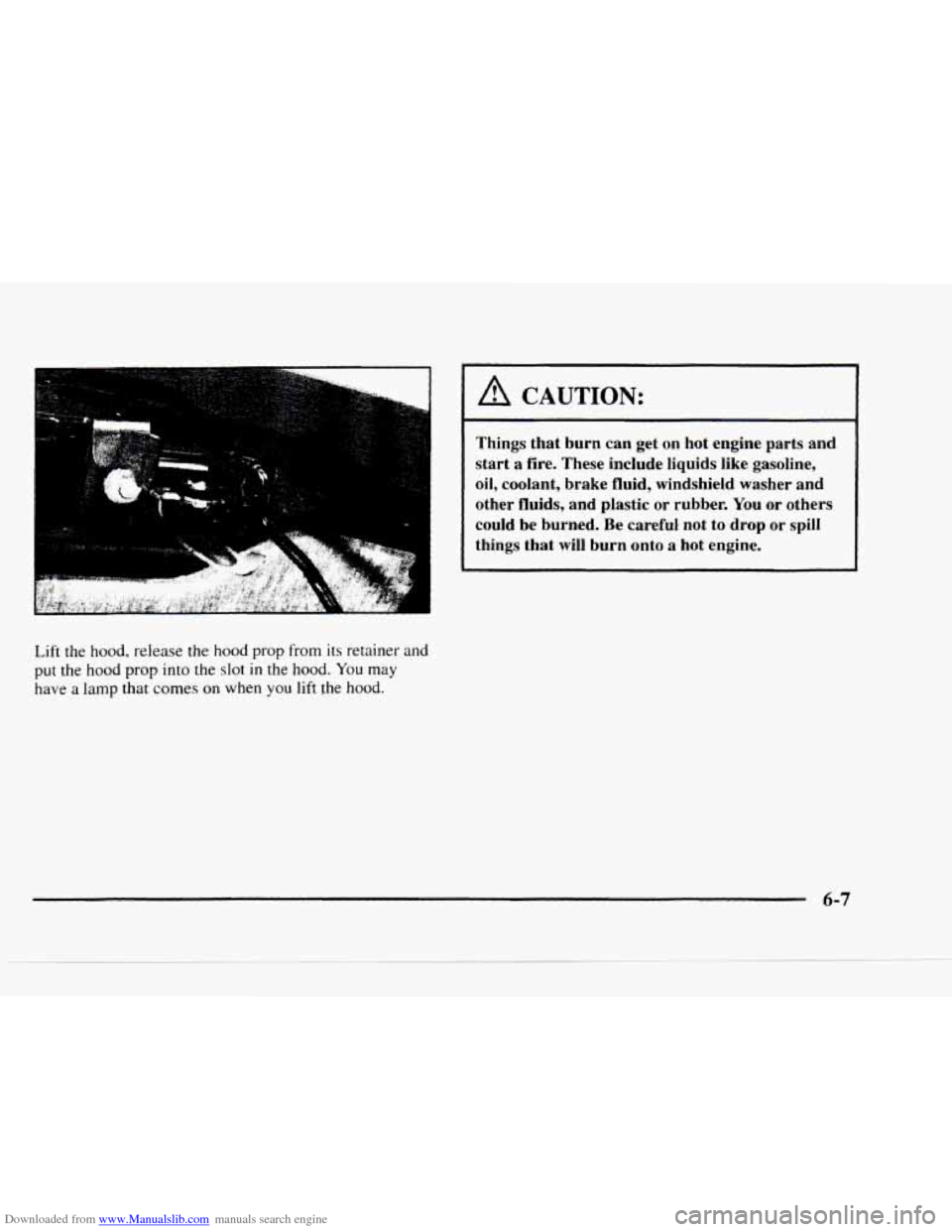
Downloaded from www.Manualslib.com manuals search engine Lift the hood, release the hood prop from its retainer and
put the hood prop into the slot in the hood. You may
have a lamp that comes on when you lift the hood.
I A CAUTION:
Things that burn can get on hot engine parts and
start a fire. These include liquids like gasoline,
oil, coolant, brake fluid, windshield washer and
other fluids, and plastic or rubber.
You or others
could be burned. Be careful not to drop or spill
things that
will burn onto a hot engine.
6-7
Page 263 of 402
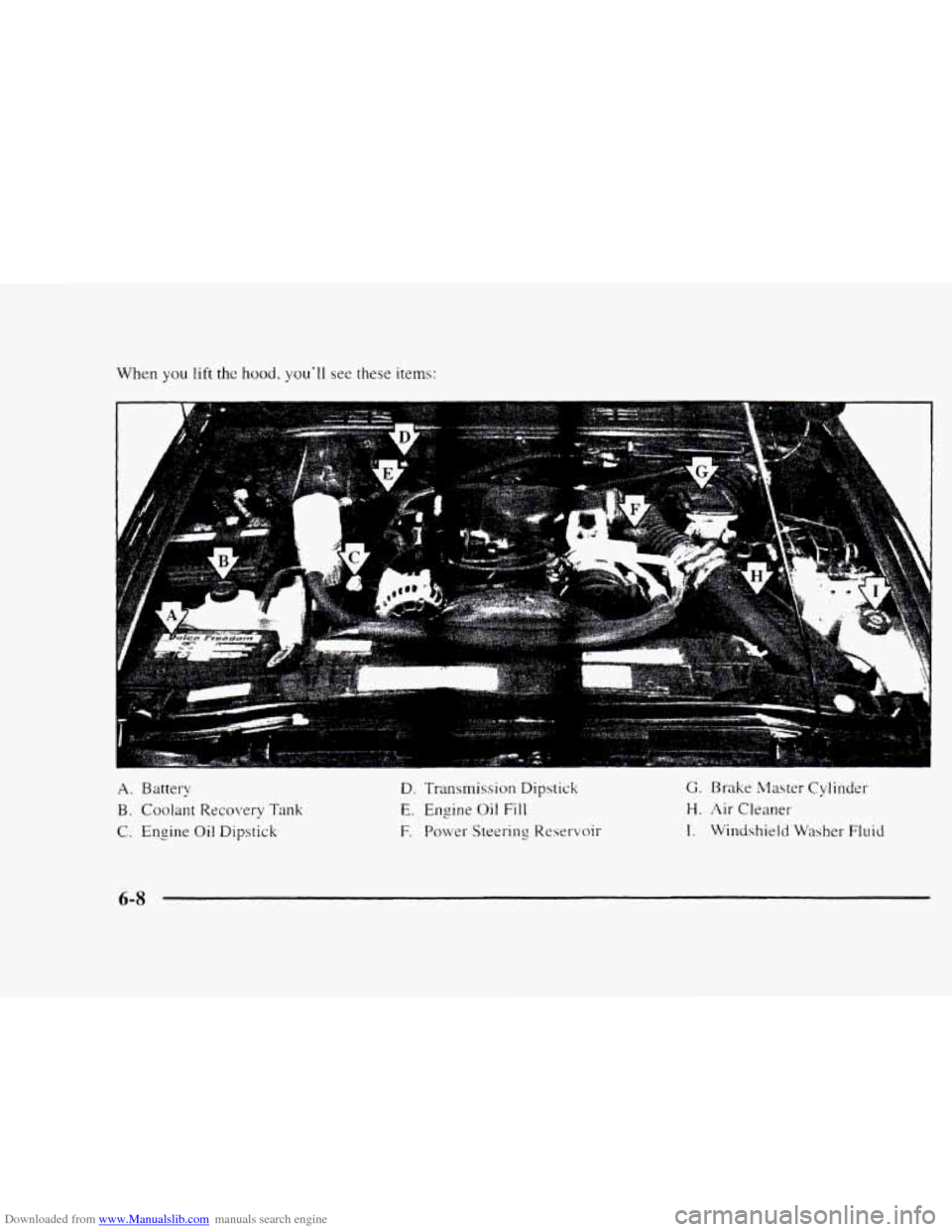
Downloaded from www.Manualslib.com manuals search engine When you lift the hood. you'll see these items:
B -- ."*f . ..
A. Battery
B. Coolant Recovery Tank
C. Engine Oil Dipstick
*
C
D. Transmission Dipstick
E. Engine Oil Fill
F. Power Steering Reservoir
G. Brake Master Cylinder
H. Air Cleaner
I. Windshield Washer Fluid
6-8