1997 CHEVROLET BLAZER coolant level
[x] Cancel search: coolant levelPage 142 of 402

Downloaded from www.Manualslib.com manuals search engine 0
+’ HEATER: This setting directs warmed air through
the heater floor outlets and windshield defroster outlets.
‘H BLEND: Airflow is divided equally between the
heater floor outlet and the windshield defroster outlets.
DEFROST This setting directs most air through
w.
the windshield defroster outlets and some through the
heater outlets.
Air Conditioning
On hot days, open the windows long enough to let hot
inside air escape. This reduces the time it takes for your
vehicle to cool down. Then keep your windows closed
for the air conditioner
to work its best.
For quick cool-down
on very hot days, use MAX A/C
with the temperature knob turned counterclockwise.
This setting should be used to keep odors and/or dust
from entering the vehicle. For normal cooling on
hot days, use
A/C with the temperature knob
turned counterclockwise. On
cool but sunny days, use BI-LEVEL
A/C to deliver
warm
air to the floor and cooler air to the instrument
panel outlets.
When
the air conditioner is on, you may sometimes
notice slight changes in your vehicle‘s engine speed and
power. This is normal because the system is designed
to cycle
the compressor on and off to keep the
desired temperature.
Heating
The heater works best if you keep your windows closed
while using
it. On cold days, use HEATER with the
temperature knob turned clockwise. BLEND is useful
in
cool weather when you have fog or ice on the
windshield
or side windows.
If you use the optional engine coolant heater before
starting your engine, your heating system will produce
warmer
air faster to heat the passenger compartment in
cold weather. See “Engine Coolant Heater” in the Index.
3-3
Page 213 of 402
Downloaded from www.Manualslib.com manuals search engine When towing a trailer, the arrows on your instrument
panel
will flash for turns even if the bulbs on the trailer
are burned out. Thus, you may
think drivers behind you
are seeing your signal when they are not. It's important
to check occasionally to be sure the trailer bulbs are
still working.
Driving On Grades
Reduce speed and shift to a lower gear byfilw you start
down
a long or steep downgrade. If you don't shift
down. you might have to use your brakes
so much that
they would get hot and no longer work well.
On
a long uphill grade. shift down and reduce your
speed
to around 45 mph (70 km/h) to reduce the
possibility of engine and transmission overheating.
if
you have an automatic transmission. you should use
DRIVE (D) when towing a trailer. Operating your
vehicle in DRIVE (D) when towing a trailer will
minimize heat buildup and extend the life
of your
transmission. Or.
if you have a manual transmission. it's
better not to use
FIFTH (5 j gear. just drive in
FOURTH (4) gear (or. as you need to. a lower gear). When
towing
at high altitude on steep uphill grades.
consider the following: Engine coolant will boil at a
lower temperature than at normal altitudes.
If you turn
your engine off immediately after towing at high altitude
on steep uphill grades, your vehicle may show signs
similar to engine overheating.
To avoid this. let the
engine
run while parked (preferably on level ground)
with the automatic transmission in PARK (P) (or the
rnanual transmission out of gear and the parking brake
applied) for a few minutes before turning the engine off.
If you do get the overheat warning, see "Engine
Overheating"
in the Index.
Parking on Hills
You really should not park your vehicle. with a trailer
attached.
on ;I hill. If something goes wrong, your ris
could start to move. People can be injured, and both
your vehicle and the trailer
can be damaged.
4-52
Page 232 of 402
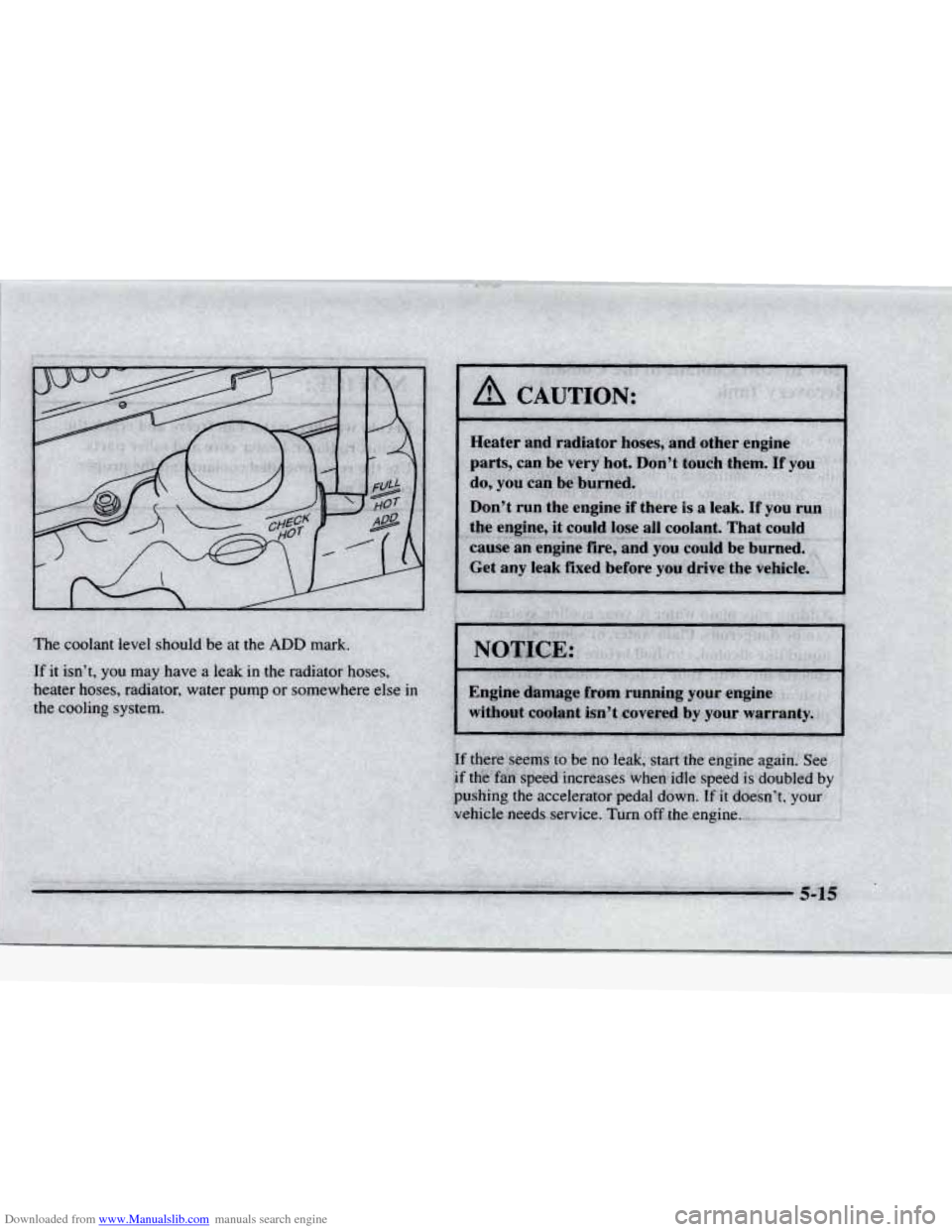
Downloaded from www.Manualslib.com manuals search engine The coolant level should be at the ADD mark.
If it isn’t, you may have a leak in the radiator h
heater hoses, radiator, water pump or somewhere else lr
wlw44l
A CAUTION:
Heater and radiator hoses, and other engine
parts, can be very hot. Don’t touch them.
If you
do, you can’be burned.
Don’t run the engine
if there is a leak. If you run
the engine,
it could lose all coolant. That could
cause
an engine fire, and you could be burned.
Get any leak fixed before you drive the vehicle.
Page 233 of 402
Downloaded from www.Manualslib.com manuals search engine How to Add Coolant to the Coolant
Recovery Tank
If you haven‘t found a problem yet, but the coolant level
isn‘t at the ADD mark, add a SO/SO mixture of clenrz
wter (preferably distilled) and DEX-COOL”
(silicate-free) antifreeze at the coolant recovery tank.
(See ”Engine Coolant”
in the Index for more
information.)
A CAUTION:
Adding only plain water to your cooling system
can be dangerous. Plain water, or some other
liquid like alcohol, can boil before the proper
coolant mix
will. Your vehicle’s coolant warning
system
is set for the proper coolant mix. With
plain water
or the wrong mix, your engine could
get too hot but >‘ou wouldn’t get the overheat
warning. k‘our
engine could catch fire and you or
others
could he hurned. Use a 50/50 mix of clean
water and DKX-CWOL” coolant.
NOTICE:
In cold weather, water can freeze and crack the
engine, radiator, heater core and other parts.
Use the recommended coolant and the proper
coolant
mix.
5-16
Page 238 of 402
Downloaded from www.Manualslib.com manuals search engine A
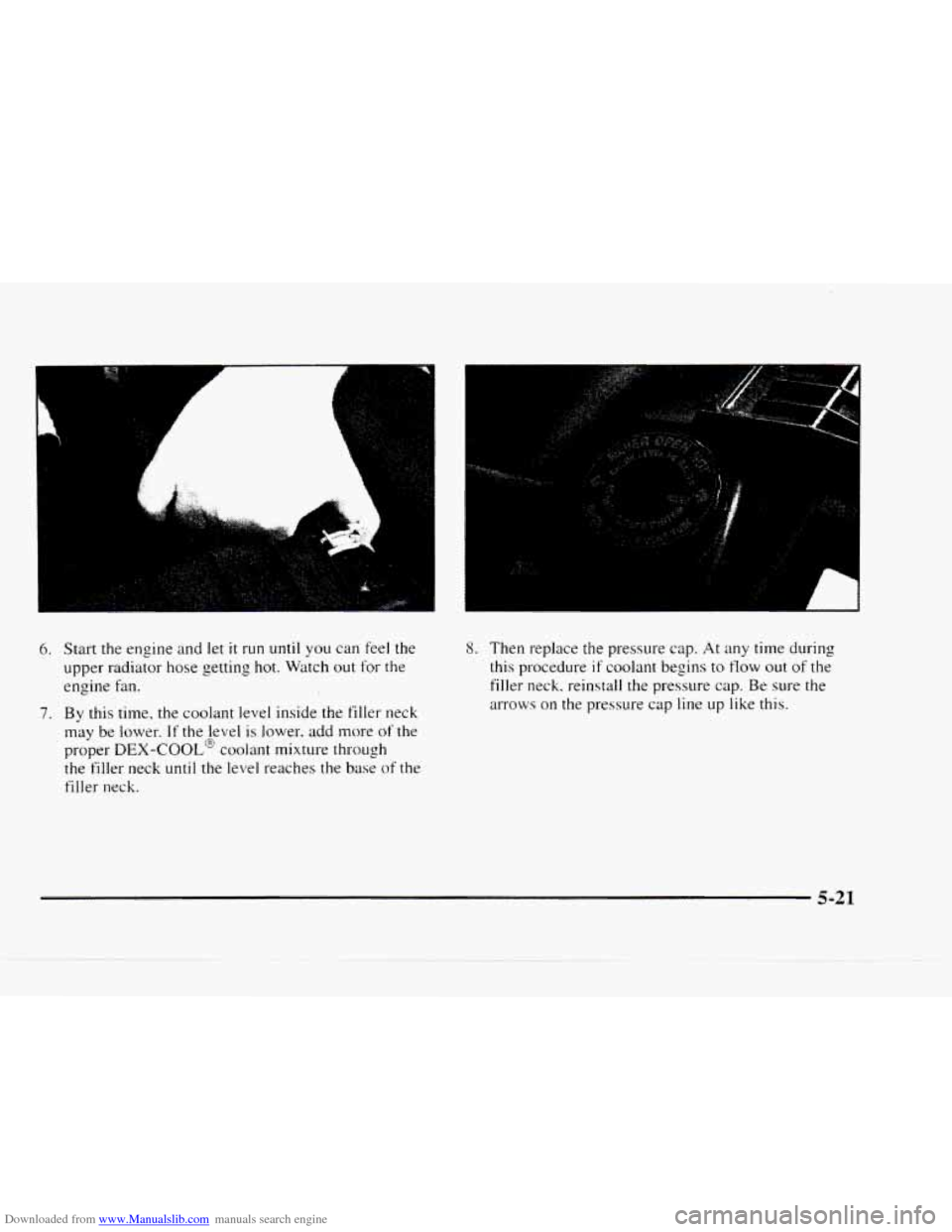
6. Start the engine and let it run until you can feel the
upper radiator hose getting
hot. Watch out for the
engine fan.
7. By this time, the coolant level inside the filler neck
may be lower. If the Ievel is lower. add more of the
proper
DEX-COOL@ coolant mixture through
the filler neck
until the level reaches the base of the
filler neck.
8. Then replace the pressure cap. At any time during
this procedure
if coolant begins to flow out of the
filler neck, reinstall the pressure cap.
Be sure the
arrows
on the pressure cap line up like this.
5-21
Page 256 of 402
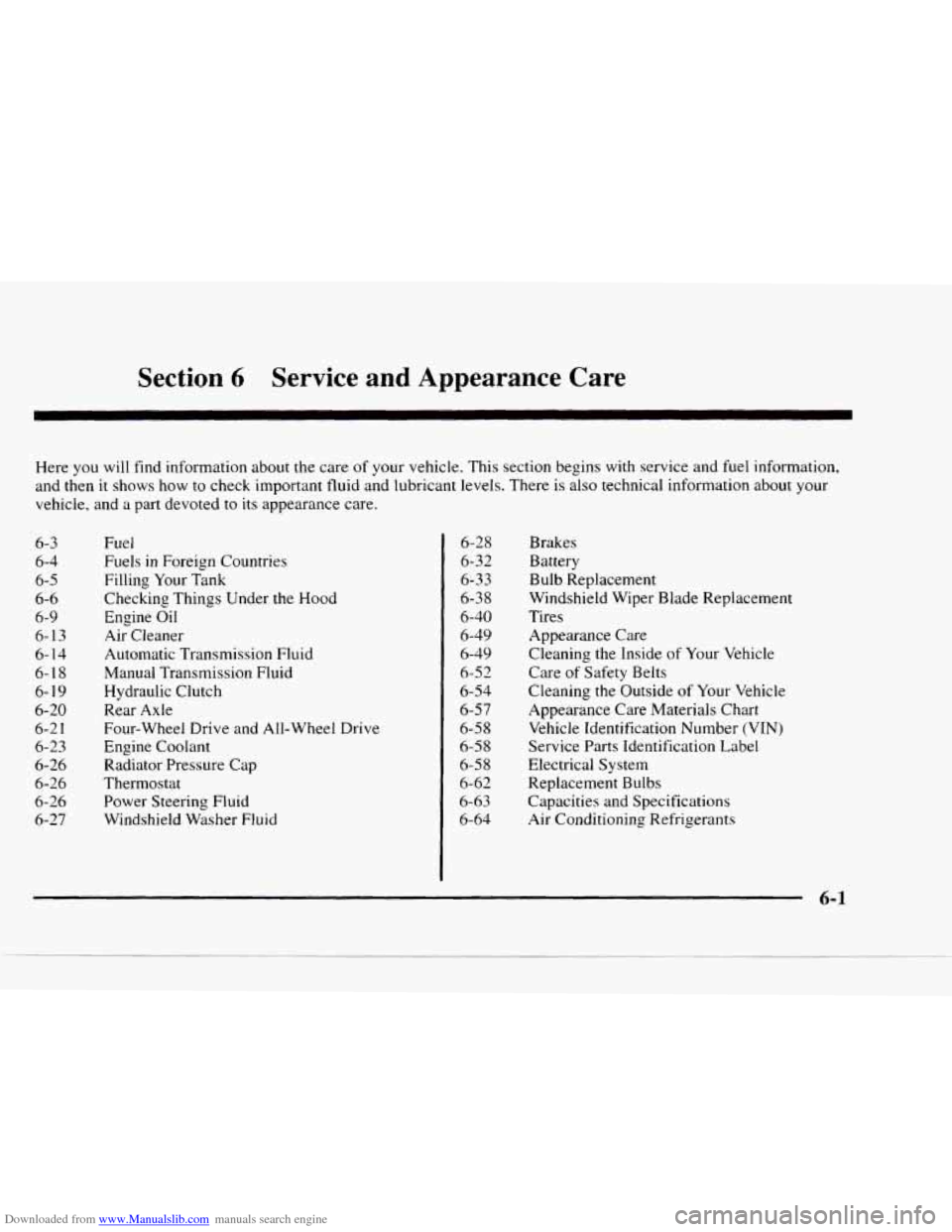
Downloaded from www.Manualslib.com manuals search engine Section 6 Service and Appearance Care
Here you will find information about the care of your vehicle. This section begins with service and fuel information,
and then
it shows how to check important fluid and lubricant levels. There is also technical information about your
vehicle, and a part devoted
to its appearance care.
6-3
6-4
6-5
6-6
6-9 6-
13
6- 14
6-18
6- 19
6-
20
6-2 1
6-23
6-26
6-26
6-26 6-27
Fuel
Fuels in Foreign Countries
Filling Your Tank
Checking Things Under the Hood
Engine Oil
Air Cleaner
Automatic Transmission Fluid
Manual Transmission Fluid
Hydraulic Clutch
Rear Axle
Four-wheel Drive and All-Wheel Drive
Engine Coolant Radiator Pressure Cap
Thermostat Power Steering Fluid
Windshield Washer Fluid 6-28
6-32
6-3 3 6-3 8
6-40 6-49
6-49
6-52
6-54
6-5
7
6-5 8
6-58
6-58
6-62
6-63
6-64
Brakes
Battery
Bulb Replacement
Windshield Wiper Blade Replacement
Tires
Appearance Care
Cleaning the Inside
of Your Vehicle
Care
of Safety Belts
Cleaning the Outside of Your Vehicle
Appearance Care Materials Chart
Vehicle Identification Number
(VIN)
Service Parts Identification Label
Electrical System
Replacement Bulbs
Capacities and Specifications
Air Conditioning Refrigerants
Page 365 of 402

Downloaded from www.Manualslib.com manuals search engine Part B: Owner Checks and Services
Listed below are owner checks and services which
should
be performed at the intervals specified to help
ensure the safety, dependability and emission control
performance of your vehicle.
Be sure
any necessary repairs are completed at once.
Whenever any fluids or lubricants are added to your
vehicle, make sure they are the proper ones. as shown
in
Part D.
At Each Fuel Fill
Engine Oil Level Check
Check the engine oil level and add the proper oil if
necessary. See "Engine Oil" in the Index for
further details.
Engine Coolant Level Check
Check the engine coolant level and add DEX-COOL@
coolant mix if necessary. See "Engine Coolant" in the
Index
for further details.
Windshield Washer Fluid Level Check
Check the windshield washer fluid level in the
windshield washer tank
and add the proper fluid if
necessarv. See "Windshield Washer Fluid"
in the Index
for
furthkr details.
At Least Once a Month
Tire Inflation Check
Make sure tires are inflated to the correct pressures. See
"Tires" in the Index for further details.
Cassette Deck Service
Clean cassette deck. Cleaning should be done every
50 hours of tape play. See "Audio Systems" in the
Index
for further details.
7-46
Page 393 of 402
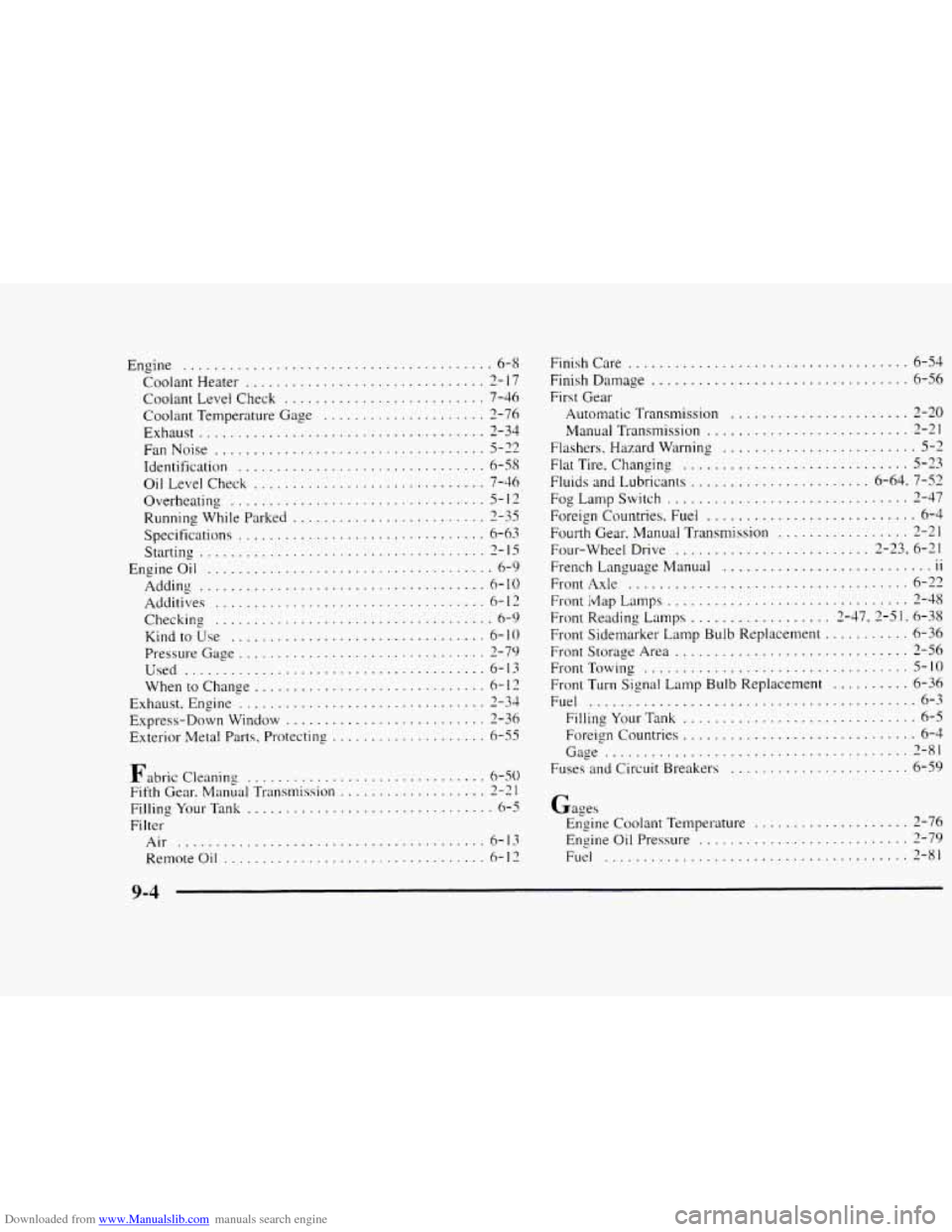
Downloaded from www.Manualslib.com manuals search engine Engine ........................................ 6-8
Coolant Heater
............................... 2- 17
Coolant Level Check
.......................... 7-46
Coolant Temperature Gage
..................... 3-76
Exhaust ..................................... 2-34
FanNoise
................................... 5-22
Identification ................................ 6-58
Oil Level Check .............................. 7-46
Running While Parked ......................... 2-35
Specifications ................................ 6-63
Overheating
................................. 5-12
Starting
..................................... 2-15
Engineoil
..................................... 6-9
Adding ..................................... 6-10
Additives ................................... 6- 12
Checking .................................... 6-9
Kind to Use ................................. 6-10
Pressure Gage ................................ 2-79
Used
....................................... 6-13
Whentochange .............................. 6-12
Exhaust.Engine
................................ 2-34
Express-Down Window .......................... 3-36
Exterior Metal Parts. Protecting
.................... 6-55
Fabric Cleaning
............................... 6-50
Fifth Gear
. Manual Transmission ................... 2-21
FillingYourTank ................................ 6-5
Fi 1 ter
Air
........................................ 6-13
Remote Oil .................................. 6- 12
Finish Care .................................... 6-54
Finish Damage
................................. 6-56
First Gear
Automatic Transmission
....................... 2-20
Manual Transmission .......................... 2-21
Flashers
. Hazard Warning ......................... 5-2
Flat Tire . Changing ............................. 5-23
Fluids and Lubricants ....................... 6-64. 7-52
FogLampSwitch ............................... 2-47
Foreign Countries. Fuel
........................... 6-4
Fourth Gear, Manual Transmission ................. 2-21
Four-wheel Drive ......................... 2-23, 6-21
French Language Manual 11
FrontAxle .................................... 6-22
.. ...........................
Front ivlap Lamps ............................... 2-48
Front Reading Lamps .................. 2-47. 2-5 1.6-38
Front Storage Area
.............................. 2-56
Front
Sidemarker Lamp Bulb Replacement
........... 6-36
FrontTowing
.................................. 5-10
Front Turn Signal Lamp Bulb Replacement .......... 6-36
Fuel .......................................... 6-3
Filling Your Tank .............................. 6-5
Foreign Countries
.............................. 6-4
Gage ....................................... 2-81
Fuses and Circuit Breakers ....................... 6-59
Gages Engine Coolant Temperature
.................... 2-76
Engine Oil Pressure ........................... 2-79
Fuel
....................................... 2-81
9-4