1997 CHEVROLET ASTRO light
[x] Cancel search: lightPage 126 of 404
Downloaded from www.Manualslib.com manuals search engine Visor Vanity Mirror (If Equipped)
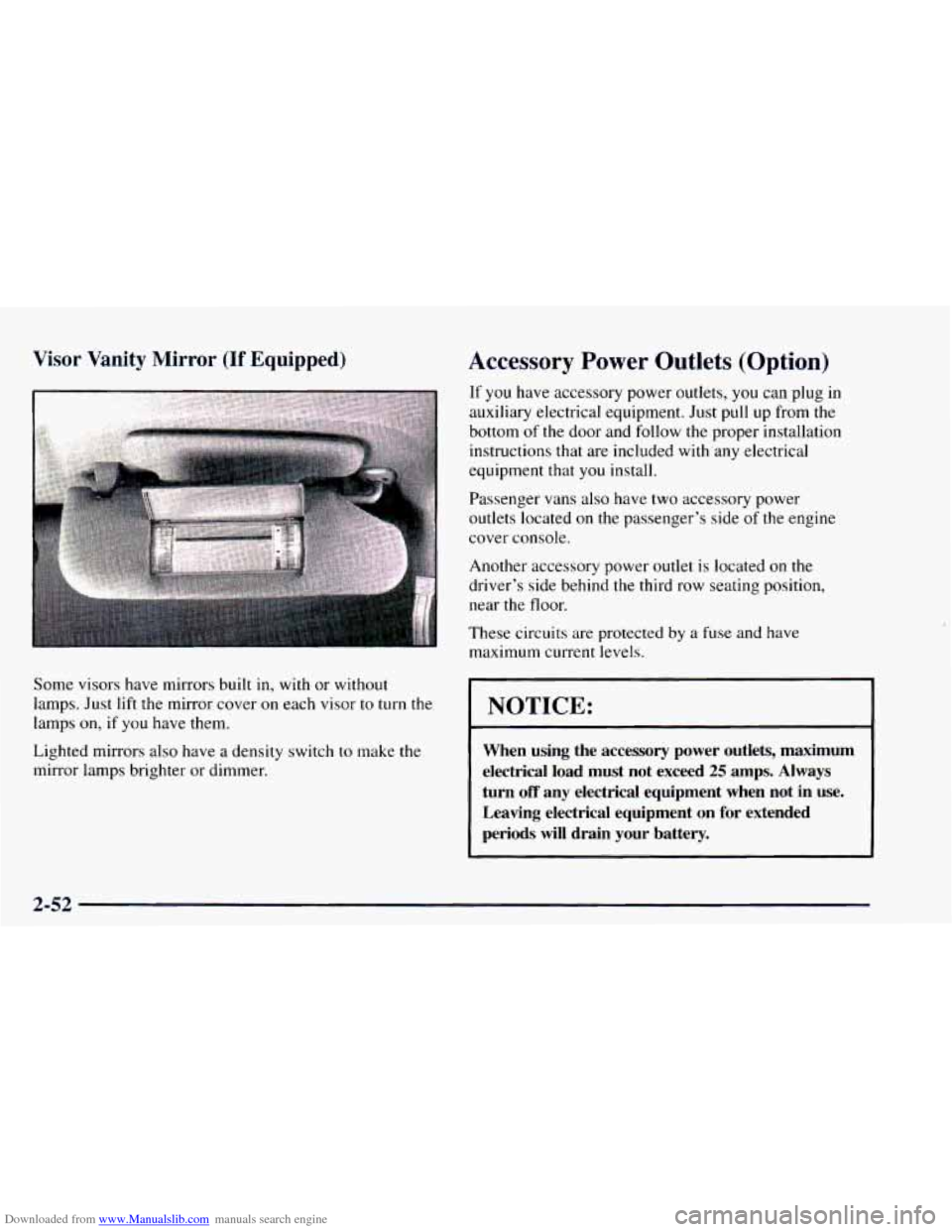
Some visors have mirrors built in, with or without
lamps. Just lift the mirror cover
on each visor to turn the
lamps on, if you have them.
Lighted mirrors also have a density switch
to make the
mirror lamps brighter or dimmer.
Accessory Power Outlets (Option)
If you have accessory power outlets, you can plug in
auxiliary electrical equipment. Just pull up from the
bottom of the door and follow the proper installation
instructions that are included with any electrical
equipment that you install.
Passenger vans also have
two accessory power
outlets located
on the passenger’s side of the engine
cover console.
Another accessory power outlet
is located on the
driver’s side behind the third row seating position,
near the floor.
These circuits are protected
by a fuse and have
maximum current levels.
NOTICE:
When using the accessory power outlets, maximum
electrical load must not exceed
25 amps. Always
turn
off any electrical equipment when not in use.
Leaving electrical equipment on
for extended
periods
will drain your battery.
2-52
Page 127 of 404
Downloaded from www.Manualslib.com manuals search engine Universal Transmitter (Option)
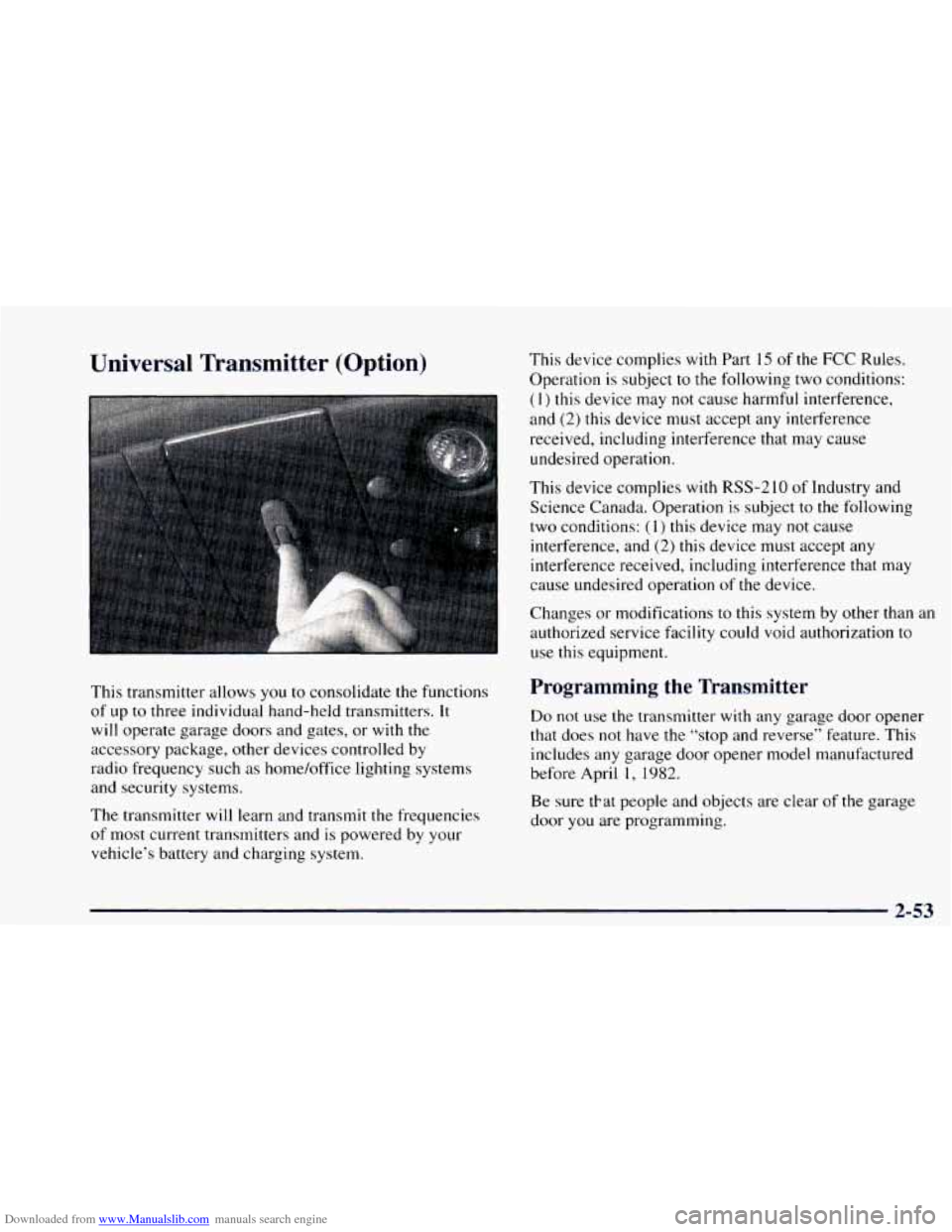
This transmitter allows you to consolidate the functions
of up to three individual hand-held transmitters.
It
will operate garage doors and gates, or with the
accessory package, other devices controlled by
radio frequency such as home/office lighting systems
and security systems.
The transmitter will learn and transmit the frequencies
of most current transmitters and is powered by your
vehicle’s battery and charging system. This device
complies with Part
15 of the FCC Rules.
Operation is subject to the following two conditions:
( 1) this device may not cause harmful interference,
and (2) this device must accept any interference
received, including interference that may cause
undesired operation.
This device complies with RSS-2
10 of Industry and
Science Canada. Operation is subject
to the following
two conditions:
(1) this device may not cause
interference, and
(2) this device must accept any
interference received, including interference that may
cause undesired operation
of the device.
Changes or modifications to this system by other than an
authorized service facility could void authorization
to
use this equipment.
Programming the Transmitter
Do not use the transmitter with any garage door opener
that does not have the “stop and reverse” feature. This
includes any garage door opener model manufactured
before April
1, 1982.
Be sure tkat people and objects are clear of the garage
door
you are programming.
2-53
Page 128 of 404
Downloaded from www.Manualslib.com manuals search engine Your vehicle’s engine should be turned off while
programming the transmitter. Follow these steps to
program up to three channels:
1.
2.
3.
4.
If you have previously programmed a universal
channel, proceed
to Step 2. Otherwise, hold down
the two outside buttons
on the universal transmitter
until the red light begins
to flash rapidly
(approximately
20 seconds). Then release the
buttons. This procedure initializes the memory and
erases any previous settings for all three channels.
Hold the end
of the hand-held transmitter against the
bottom surface of the universal transmitter
so that
you can still see the red light.
Decide which one of the three channels
you want to
program. Using both hands, press the hand-held
transmitter button and the desired button on
the
universal transmitter. Continue to hold both buttons
through Step
4.
Hold down both buttons until you see the red light
on the universal transmitter flash rapidly. The rapid
flashing, which could take up
to 90 seconds,
indicates that
the universal transmitter has been
programmed. Release both buttons once
the light
starts
to flash rapidly. If
you have trouble programming the universal
transmitter, make sure that
you have followed the
directions exactly as described and that the battery in
the hand-held transmitter is not dead. If
you still
cannot program
it, rotate the hand-held transmitter
end over end and try again. The universal transmitter
may
not work with older garage door openers that do
not meet current Federal Consumer Safety Standards.
If you cannot program the transmitter after repeated
attempts, consult your
GM dealer.
Be sure to keep the original hand-held transmitter
in case you need to erase and reprogram the
universal transmitter.
Operating the Transmitter
Press and hold the appropriate button on the universal
transmitter. The red light comes
on while the signal is
being transmitted.
Note that the effective transmission range
of the
universal transmitter may differ from the hand-held
transmitter and from one channel to another.
2-54
Page 129 of 404
Downloaded from www.Manualslib.com manuals search engine Erasing Channels
To erase all three programmed channels, hold down the
two outside buttons
until the red light begins to flash.
Individual channels cannot be erased, but can be
reprogrammed using the procedure for programming the
transmitter explained earlier.
Training a Garage Opener with a “Rolling
Code” Feature
If you programmed the universal transmitter, but the
garage door will
not open, and if your garage door opener
was manufactured after 1995, your garage door may have
a security feature that changes
the “code” of your garage
door opener every time it is opened or closed.
To determine if your garage door opener has this
“rolling code” feature, press the appropriate button on
the universal transmitter that was programmed. If the
red light flashes rapidly for
one to two seconds, then
turns solid, your garage door opener has this feature.
To program a garage door opener with the rolling code
feature, do
the following:
1. Program your hand-held transmitter to the universal
transmitter by following the steps provided under
“Programming
the Transmitter” earlier in this section.
2.
3.
4.
5.
6.
Remove the cover panel from the garage door opener
receiver.
It is located near the garage door opener motor.
Locate the training button
on the garage door opener
receiver. The exact location and color will vary
among brands.
Press the training button
on the garage door opener
receiver for one to two seconds.
Return to your vehicle and press the programmed
button on the universal transmitter until the red light
flashes rapidly (about two seconds).
Release the button, then press it again
to confirm it
was programmed
to the garage door opener receiver.
You may now use either the universal transmitter or the
hand-held transmitter to open your garage door.
If you
still have difficulty in programming and require
assistance, please call
1-800-355-35 15.
Accessories
Accessories for the universal transmitter are available
from
the manufacturer of the unit. If you would like
additional information, please call
1-800-355-35 15.
2-55
Page 131 of 404
Downloaded from www.Manualslib.com manuals search engine A.
B.
C.
D.
E.
E
G.
H.
I.
J.
Lamp Switches
Instrument Panel Dimmer
Multifunction Lever
Hazard Lamp Switch
Transmission Shift Lever
Ignition Switch
Rear Hatch Release
Rear Defogger
Comfort Controls Rear A/C Control K. Rear Heater Control
L. Rear WasherNiper
M. Front Ashtray
N. Accessory Power Outlets
0. Cupholders/Storage Tray
P. Front Storage Compartment
Q. Audio System
R. Cigarette Lighter
S. Hood Release
T. Dome Override Button
2-57
Page 134 of 404

Downloaded from www.Manualslib.com manuals search engine Warning Lights, Gages and Indicators
This part describes the warning lights and gages that
may be on your vehicle. The pictures will help you
locate them.
Warning lights and gages can signal that something is
wrong before it becomes serious enough to cause an
expensive repair or replacement. Paying attention
to
your warning lights and gages could also save you or
others from injury.
Warning lights come on when there may be or
is a
problem with one
of your vehicle’s functions. As you
will see in the details on the next few pages, some
warning lights come on briefly when you start the
engine just
to let you know they’re working. If you are
familiar with this section, you should not be alarmed
when this happens.
Gages can indicate
when there may be or is a problem
with one of your vehicle’s functions. Often gages and
warning lights work together to
let you know when
there’s a problem with your vehicle. When
one of the warning lights comes on and stays
on
when you are driving, or when one of the gages shows
there may be a problem, check the section that tells
you what to do about it. Please follow this manual’s
advice. Waiting to do repairs can be costly
-- and even
dangerous.
So please get to know your warning light
and gages. They’re a big help.
Safety Belt Reminder Light
When the key is turned to RUN or START, a tone wi
come
on for about eight seconds to remind people to
fasten their safety belts, unless
the driver’s safety bel
already buckled.
The safety belt light will
.t 1:
S
I
is
~ also come on and stay on
for about
20 seconds, then
it will flash for about
55 seconds. If the driver’s
belt is already buckled, neither the tone nor the
light will come
on.
2-60
Page 135 of 404

Downloaded from www.Manualslib.com manuals search engine Air Bag Readiness Light
There is an air bag readiness light on the instrument
panel, which shows
AIR BAG. The system checks the
air bag’s electrical system for malfunctions. The light
tells
you if there is an electrical problem. The system
check includes the air bag sensors, the air bag modules,
the wiring and the crash sensing and diagnostic module.
For more information on the air bag system, see “Air
Bag” in the Index.
AIR
BAG
This light will come on
when you start your engine,
and it will flash for a few
seconds. Then the light
should go out. This means
the system is ready.
If the air bag readiness light stays
on after you start the
engine or comes
on when you are driving, your air bag
system may not work properly. Have your vehicle
serviced right away.
The air bag readiness light should flash for a few
seconds when
you turn the ignition key to RUN. If the light doesn’t
come
on then, have it fixed so it will be
ready to warn
you if there is a problem.
Charging System Indicator Light
The charglng system light
will come on briefly when
you turn the ignition on, but
the engine is
not running, as
a check
to show you the
light is working.
Then it should go out once the engine is running. If it
stays on, or comes
on while you are driving, you may
have a problem with the electrical charging system.
It could indicate that
you have a loose accessory drive
belt, or another electrical problem. Have it checked
right away. Driving while this light
is on could drain
your battery.
If you must drive a short distance with the light on, be
certain to turn off all your accessories, such as the radio
and heatedair conditioner.
Page 137 of 404

Downloaded from www.Manualslib.com manuals search engine Brake System Warning Light
Your vehicle’s hydraulic brake system is divided into
two parts. If one part isn’t working,
the other part can
still work and stop
you, For good braking, though, you
need both parts working well.
If the warning light comes on, there could be a brake
problem. Have your brake system inspected right away.
BRAKE
This light should come
on briefly when you turn
the ignition key
to RUN.
If it doesn’t come on then,
have it fixed
so it will be
ready
to warn you if there’s
a problem.
If the light comes on while you are driving, pull off the
road and stop carefully. You may notice that the pedal is
harder to push. Or, the pedal may go closer to the floor.
It may take longer
to stop. If the light is still on, have the
vehicle towed for service. (See “Towing Your Vehicle”
in the Index.)
A CAUTION:
Your brake system may not be working properly
if the brake system warning light
is on. Driving
with the brake system warning light on can lead
to an accident. If the light is still on after you’ve
pulled
off the road and stopped carefully, have
the vehicle towed for service.
When the ignition is on, the brake system warning light
will also come
on when you set your parking brake. The
light will stay
on if your parking brake doesn’t release
fully. If it stays on after your parking brake is fully
released,
it means you have a brake problem.
2-63