Page 280 of 361
Downloaded from www.Manualslib.com manuals search engine 4.
5.
1.
2.
3.
Follow these steps to reinstall the air cleaner assembly:
Slide the air cleaner lid into the slots in the front
edge
of the air cleaner base.
Pivot the
air cleaner cover and the air duct assembly
downward. Make sure that both latches are secure
and fully engaged.
Reinstall the clean air duct over the mass airflow
sensor. Make sure that the duct
is secure around the
entire outer edge of the sensor.
Tighten the air duct clamp.
Reconnect the
LA% sensor.
Refer to the Maintenance Schedule to determine when to
replace the
air filter.
See “Scheduled Maintenance Services” in the
Maintenance Schedule booklet.
. ..
.. ..
Operating the engine with the air cleaner off
can cause you or others to be burned. The air
cleaner
not only cleans the air, it stops flames if
the engine backfires. If it isn’t there, and the
engine backfires, you could be burned. Don’t
drive with it off, and be careful working on the
engine
with the air cleaner off.
If the air cleaner is off, a backfire can cause a
damaging engine fire. And, dirt can easily get
into your engine, which will damage it. Always
have the air cleaner in place when you’re driving.
Page 281 of 361
Downloaded from www.Manualslib.com manuals search engine ic
ange
A good time to check your automatic transaxle fluid
level
is when the engine oil is changed.
Change both
the fluid and filter every 50,000 miles
(83
000 km) if the vehicle is mainly driven under one or
more
of these conditions:
In heavy city traffic where the outside temperature
regularly reaches
90°F (32 O C) or higher.
In hilly or mountainous terrain.
When doing frequent trailer towing.
Uses such
as found in taxi, police or delivery service.
If you do not use your vehicle under any of these
conditions, the fluid and filter do not require changing.
See “Scheduled Maintenance Services”
in the
Maintenance Schedule booklet. Because this
operation can be
a little difficult, you may
choose
to have this done at your Cadillac dealership
service department.
If’ you do it yourself, be sure to follow all the instructions
here, or you could get
a false reading on the dipstick.
ICE:
Page 283 of 361
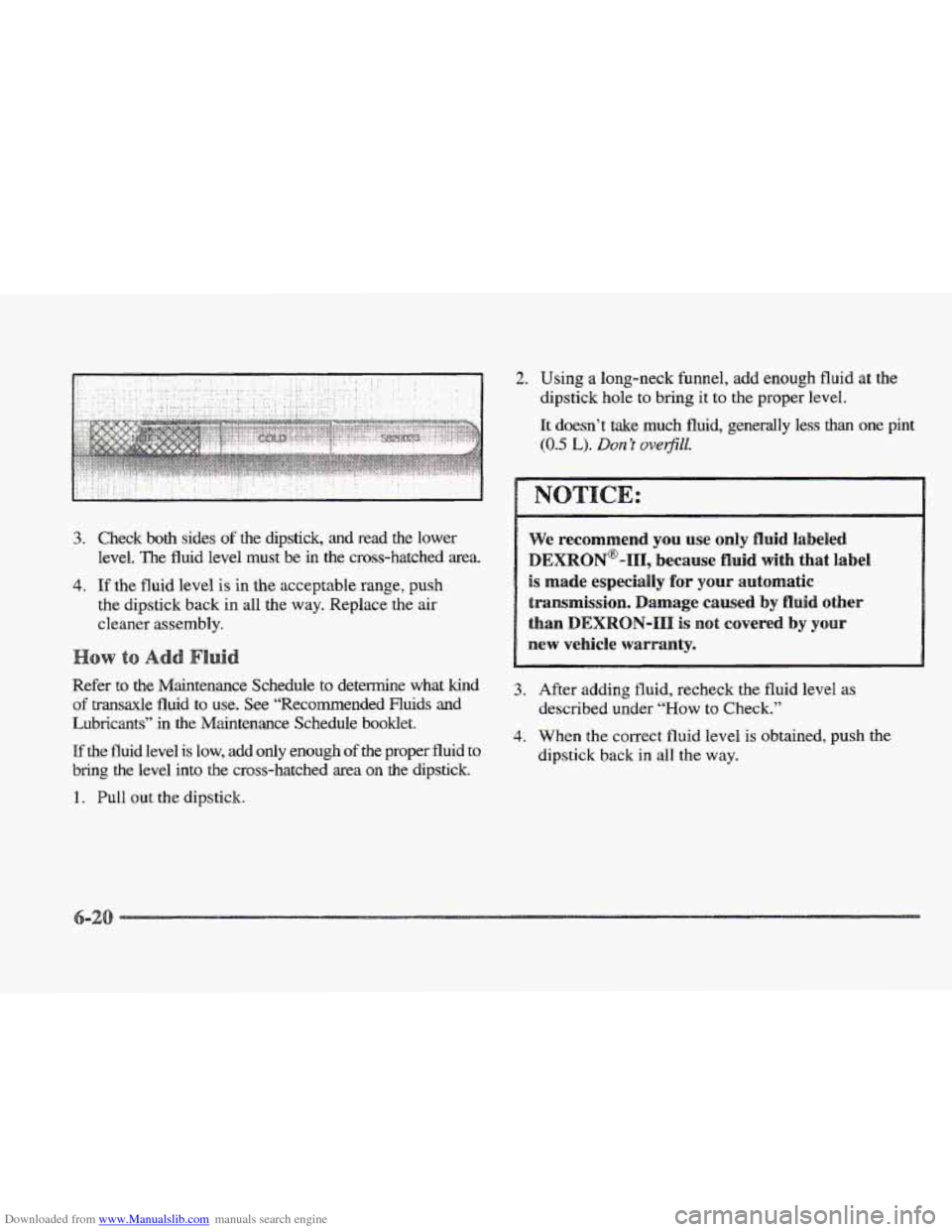
Downloaded from www.Manualslib.com manuals search engine 3. Check both sides of the dipstick, and read the lower
level.
”he fluid level must be in the cross-hatched area.
4. If the fluid level is in the acceptable range, push
the dipstick back in
a11 the way. Replace the air
cleaner assembly.
Refer
to the Maintenance Schedule to determine what kind
of transaxle fluid to use. See “Recommended Fluids and
Lubricants” in the Maintenance Schedule booklet.
If’ the fluid level is low, add only enough of the proper fluid to
bring the level into the cross-hatched area on the dipstick.
1. Pull OW the dipstick.
2. Using a long-neck funnel, add enough fluid at the
dipstick hole to bring it to the proper level.
It doesn’t take
much fluid, generally less than one pint
(0.5 L). Don’t oveflll.
3. After adding fluid, recheck the fluid level as
described under “How to Check.”
4. When the correct fluid level is obtained, push the
dipstick back
in all the way.
Page 284 of 361
Downloaded from www.Manualslib.com manuals search engine Your vehicle is equipped with a transaxle fluid change
indicator.
A CHANGE TRANS FLUID message will
display on
the Driver Information Center (DIC) when
the powertrain computer determines that the transaxle
fluid needs to be changed or at each
100,080 miles
(160 080 km) interval, whichever occurs first. See your
Maintenance Schedule booklet for more information.
When this message appears, change the transaxle fluid
and reset the transaxle fluid life indicator as follows:
I. Turn the ignition on but do not start the engine.
2. Press and hold the OFF and rear defog buttons on the
climate control at the same time until the
TRANS
FLUID RESET message appears on the DHC.
The cooling s stern in your vehicle is filled with
DEX-COOL engine coolant. This coolant is designed
to remain
in your vehicle for 5 years or 150,000 miles
(240 000 km) whichever occurs first, if you add only
DEX-COOL‘ extended life coolant.
2
The following explains your cooling system and how to
add coolant when
it is low. If YOU have a problem with
engine overheating, see “Engine Overheating”
in
the Index.
A 50/50 mixture of water and DEX-COOL@
coolant will:
@ Give freezing protection down to -34” F (-37°C).
Give boiling protection up to 265 OF (1 29°C).
Protect against rust and corrosion.
Help keep the proper engine temperature.
Let the warning lights and gages work as
they should.
When adding coolant, it is important that you use
only DEX-COOL~ (silicate-free) coolant.
If coolant other than DEX-COOL@is added t~
the system, premature engine, heater core or
radiator corrosion may result. In addition, the
engine coolant
will require change SOQWW 0- at
34b,8(Bo miles (50 000 km) or 24 months,
whichever CD~CUP’S first. Damage caused
of coolant other than
covered
by your new vehicle warranty.
Page 288 of 361
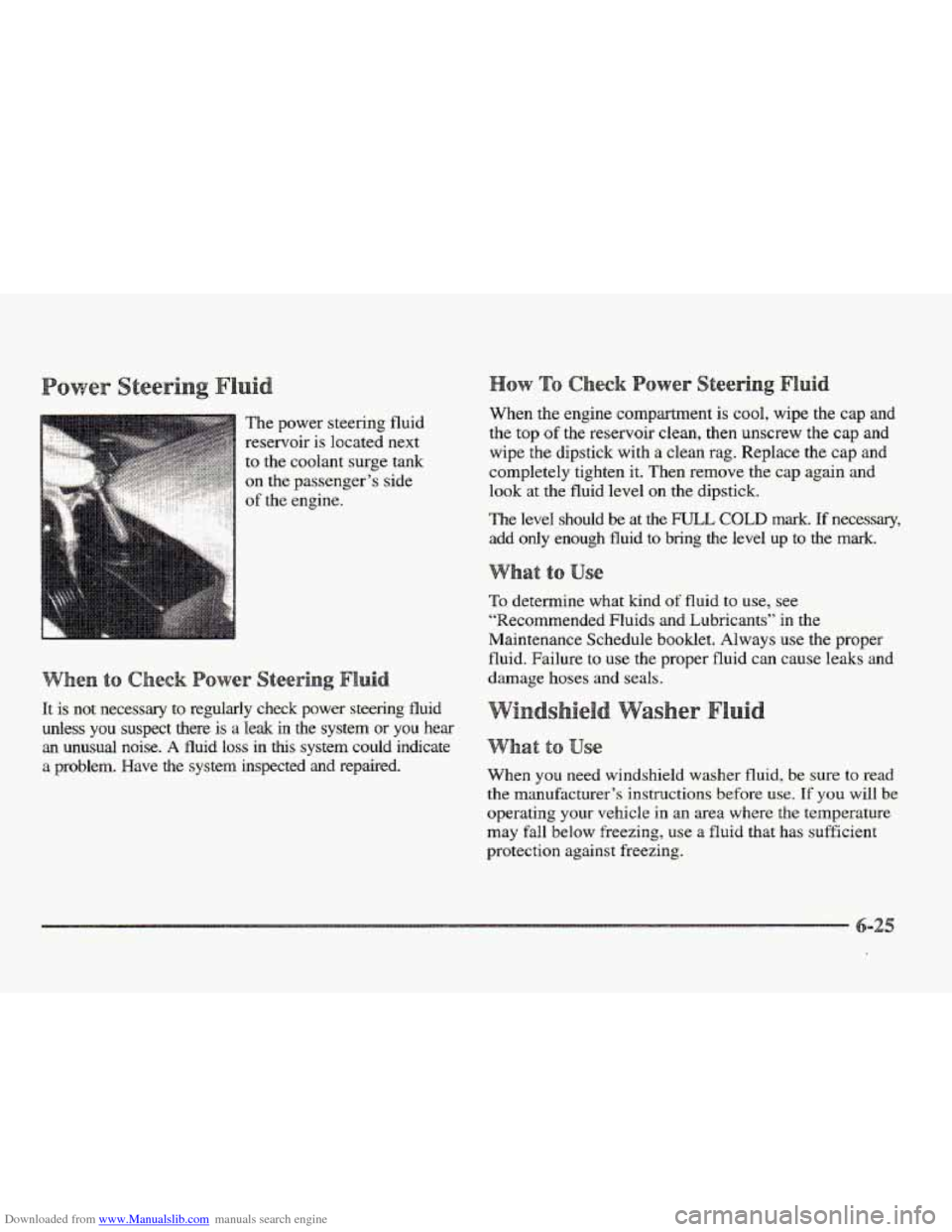
Downloaded from www.Manualslib.com manuals search engine The power steering fluid When the engine compartment is cool,
wipe the cap and
the top
of the reservoir clean, then unscrew the cap and
wipe
the dipstick with a clean rag. Replace the cap and
completely tighten
it. Then remove the cap again and
look
at the fluid level on the dipstick.
The level should be at
the FULL COLD mark. If necessary,
add only enough fluid to bring the level up to the mark.
ec
It is not necessary to regularly check power steering fluid
unless you suspect there is a leak
in the system or you hear
an unusual noise. A fluid loss in thls system could indicate
a problem. Have the system inspected and repaired.
To determine what lund of fluid to use, see
“Recommended Fluids
and Lubricants” in the
Maintenance Schedule booklet. Always use
the proper
fluid. Failure to use
the proper fluid can cause leaks and
damage hoses and seals.
When
YOU need windshield washer fluid, be sure to read
the manufacturer’s instructions before use. If you will be
operating your vehicle
in an area where the temperature
may fall
below freezing, use a fluid that has sufficient
protection against freezing.
Page 292 of 361
Downloaded from www.Manualslib.com manuals search engine Your Cadillac has four-wheel disc brakes.
Disc brake pads have built-in wear indicators that make a
high-pitched warning sound when the brake pads
are
worn and new pads are needed. The sound may come and
go or be heard all the time your vehicle is moving (except
when you are pushing on the brake pedal firmly).
The brake wear warning sound means that soon
your brakes won9$ work well. That could lead to
an accident. When you hear the brake wear
warning sound, have your vehicle serviced.
Some driving conditions or climates may cause a brake
squeal when the brakes are first applied or lightly
applied. This does
not mean something is wrong with
your brakes.
Properly torqued
wheel nuts are necessary to help
prevent brake pulsation. When tires are rotated, inspect
brake pads for wear and evenly torque wheel
nuts in the
proper sequence to GM specifications.
Brake linings should always be replaced
as complete
axle
sets.
See “Brake System Inspection” in the Maintenance
Schedule booklet under Part
C “Periodic Maintenance
Inspections”.
See your dealer
if the brake pedal does not return to
normal height, or if there is a rapid increase in pedal
travel. This could be a sign of brake trouble.
Every time you apply the brakes, with or without the
vehicle
moving, your brakes adjust for wear.
Page 300 of 361
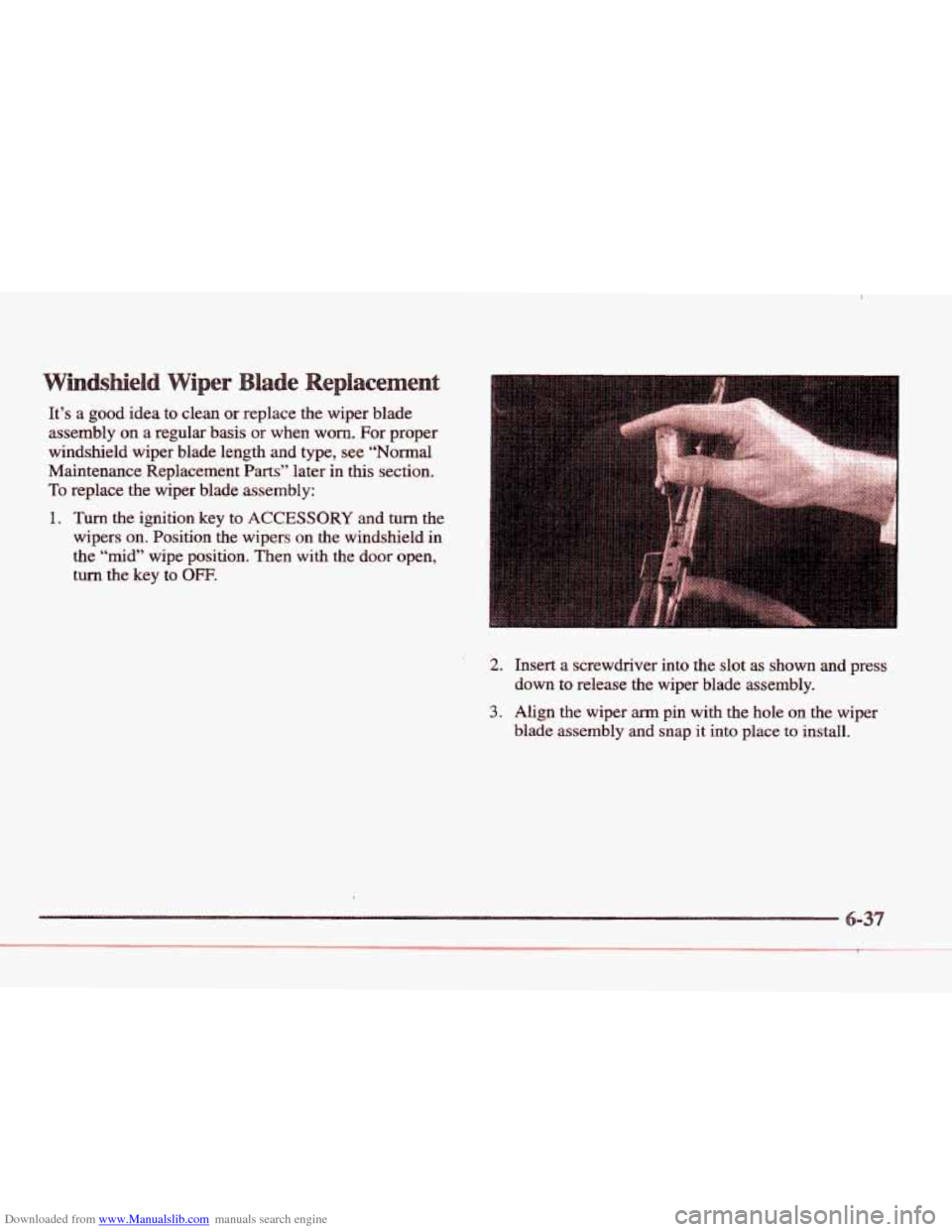
Downloaded from www.Manualslib.com manuals search engine It’s a good idea to clean ox replace the wiper blade
assembly on a regular basis
or when worn. For proper
windshield wiper blade length and type, see
“Normal
Maintenance Replacement Parts” later in this section.
To replace the wiper blade assembly:
I
1. Turn the ignition key to ACCESSORY and turn the
wipers on. Position the wipers on the windshield
in
the “mid” wipe position. Then with the door open,
turn the key
to OFF.
2. Insert a screwdriver into the slot as shown and press
down to release the wiper blade assembly.
3. Align the wiper arm pin with the hole on the wiper
blade assembly
and snap it into place to install.
Page 303 of 361
Downloaded from www.Manualslib.com manuals search engine Use a good quality pocket-type gage to check tire
pressure. You can’t tell if your tires
are properly inflated
simply by looking at them. Radial tires may look
properly inflated even when they’re underinflated.
Be
sure to put the valve caps back on the valve stems.
They help prevent leaks by keeping out dirt and moisture.
Tires should
be rotated every 6,000 to 8,000 miles
(10 000 to 13 000 km). Any time you notice unusual
wear, rotate your tires
as soon as possible and check
wheel alignment. Also check for damaged tires
or
wheels. See “When It’s Time for New Tires” and
“Wheel Replacement’’ later in this section for
more information.
The purpose of regular rotation is to achieve
more
uniform wear for all tires on the vehicle. The first
rotation is the most important. See “Scheduled
Maintenance Services” in the Maintenance Schedule
booklet for scheduled rotation intervals.
I
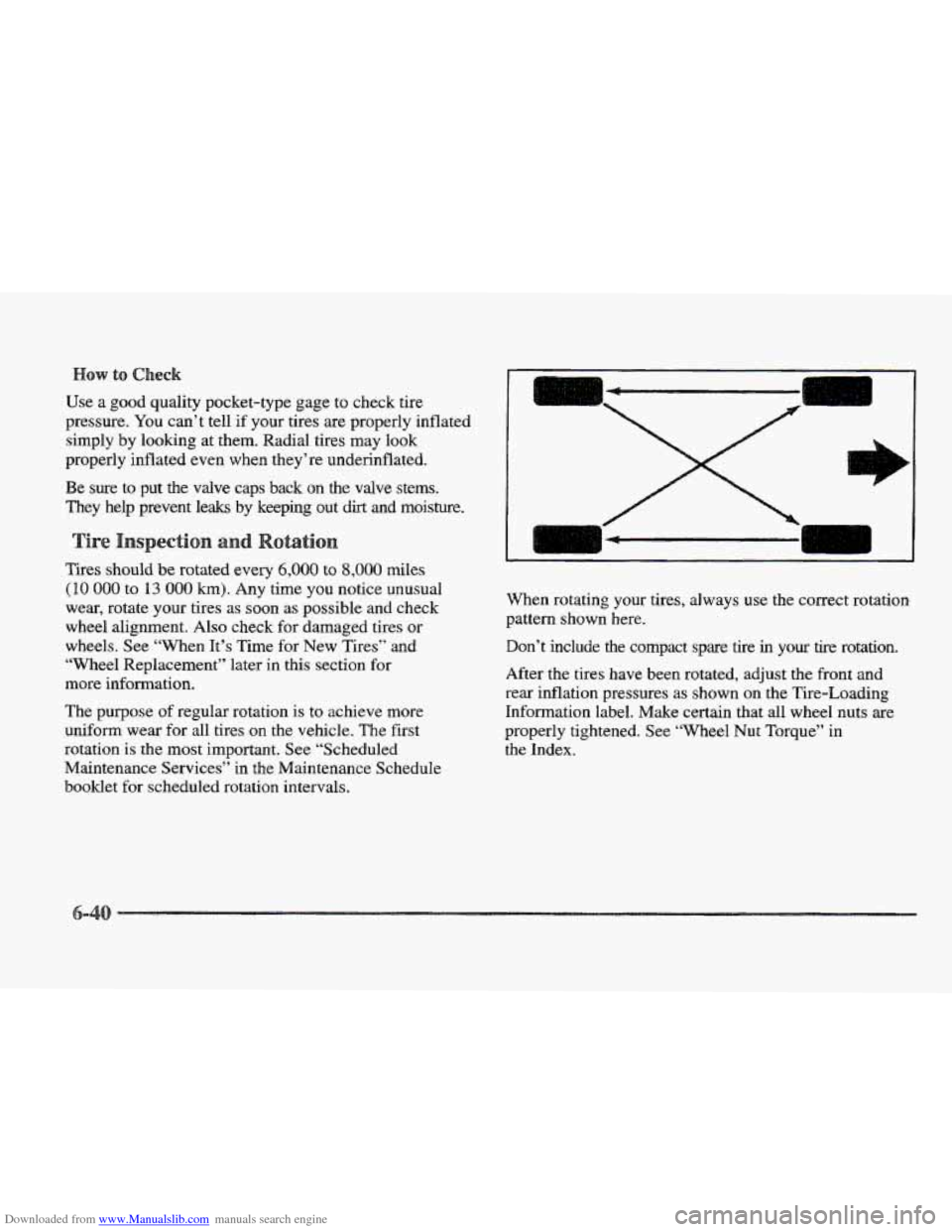
When rotating your tires, always use the correct rotation-
pattern shown here.
Don’t include the compact spare tire
in your tire rotation.
After the tires have been rotated, adjust the
front and
rear inflation pressures as shown on the Tire-Loading
Information label. Make certain that all wheel nuts are
properly tightened. See “Wheel
Nut Torque” in
the Index.