1997 BUICK REGAL ignition
[x] Cancel search: ignitionPage 222 of 422
If you drive regularly in steep country, or if you’re
planning to visit there, here are some tips that can
make
your trips safer and more enjoyable.
Keep your vehicle in good shape. Check all fluid
levels and also the brakes, tires, cooling system
and transaxle. These parts can work hard on
mountain roads.
0 Know how to go down hills. The most important
thing to know is this: let your engine do some of the
slowing down. Shift to a lower gear when you go
down a steep or long hill.
,A CAUTION:
If you don’t shift down, your brakes could
get
so hot that they wouldn’t work well. You
would then have poor braking or even none go
down a hill. You could crash. Shift down to let
your engine assist your brakes
on a steep
downhill slope.
m
ling Coasting downhill
in NEUTRAL (N) or
with the
ignition
off is dangerous. Your brakes will have to
do all the work of slowing down. They could get so
hot that they wouldn’t work well. You would then
have
poor braking or even none going down a hill.
You could crash. Always have your engine running
and your vehicle
in gear when you go downhill.
0
0
0
0
Know how to go uphill. You may want to shift down
to a lower gear. The lower gears help cool your engine
and transaxle, and you can climb
the hill better.
Stay in your own lane when driving on two-lane
roads in hills or mountains. Don’t swing wide or cut
across the center of
the road. Drive at speeds that let
you stay in your own lane.
As you go over the top of a hill, be alert. There could be
something in your lane, like a stalled car or
an accident.
You may
see highway signs on mountains that warn of
special problems. Examples
are long grades, passing or
no-passing zones, a falling rocks area or winding
roads. Be alert to these and take appropriate action.
4-26
ProCarManuals.com
Page 238 of 422
9 Hazard Warning Flashers
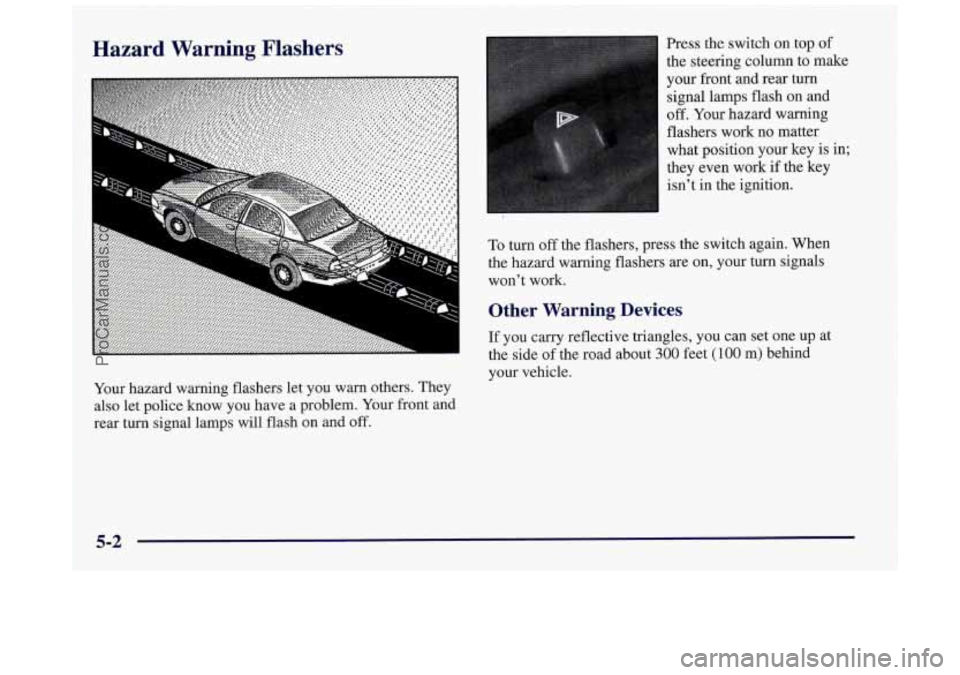
Your hazard warning flashers let you warn others. They
also let police know you have a problem. Your front and
rear turn signal lamps will flash on and off. Press
the switch
on top of
the steering column to make
your front and rear turn
signal lamps flash on and
off. Your hazard warning
flashers work no matter
what position your key is in;
they even work if the key
isn’t in the ignition.
To turn off the flashers, press the switch again. When
the hazard warning flashers are
on, your turn signals
won’t work.
Other Warning Devices
If you carry reflective triangles, you can set one up at
the side of the road about
300 feet (100 m) behind
your vehicle.
5-2
ProCarManuals.com
Page 240 of 422
2.
3.
Get the vehicles close enough so the jumper cables
can reach, but be
sure the vehicles aren’t touching
each other.
If they are, it could cause a ground
connection you don’t want.
You wouldn’t be able to
start your Buick, and the bad grounding could
damage the electrical systems.
To avoid the possibility of the vehicles rolling, set
the parking brake firmly on both vehicles involved
in
the jump start procedure. Put your automatic
transaxle in
PARK (P) before setting the
parking brake.
Turn
off the ignition on both vehicles. Unplug
unnecessary accessories plugged into the cigarette
lighter
or accessory power outlet. Turn off all lamps
that aren’t needed as well as radios. This will avoid
sparks and help save both batteries. In addition,
it
could save your radio!
I NOTICE:
If you leave your radio on, it could be badly
damaged. The repairs wouldn’t be covered by
your warranty.
4. Open the hoods and locate the batteries. (Your
vehicle’s battery is located under the windshield
washer fluid reservoir.)
An electric fan can start up even when the engine
is not running and can injure you. Keep hands,
clothing and tools away from any underhood
electric fan.
5-4
ProCarManuals.com
Page 246 of 422
A vehicle can fall from a car-carrier if it isn’t
adequately secured. This can cause a collision,
serious personal injury and vehicle damage. The
vehicle should be tightly secured with chains or
steel cables before it is transported.
Don’t use substitutes (ropes, leather straps,
canvas webbing, etc.) that can be cut by sharp
edges underneath the towed vehicle. Always use
T-hooks inserted in the T-hook slots. Never use
J-hooks. They will damage drivetrain and
suspension components.
When your vehicle is being towed, have the ignition key
in the
OFF position. The steering wheel should be
clamped in a straight-ahead position, with a clamping
device designed for towing service.
Do not use the
vehicle’s steering column lock for this. The transaxle
should be in NEUTRAL
(N) and the parking
brake released.
Don’t have your vehicle towed on the drive wheels,
unless you must.
If the vehicle must be towed on the
drive wheels, be sure to follow the speed and distance
restrictions later in this section or your transaxle will be
damaged,
If these limitations must be exceeded, then the
drive wheels have to be supported on a dolly.
5-10
ProCarManuals.com
Page 293 of 422
Passenger Compartment Air Filter
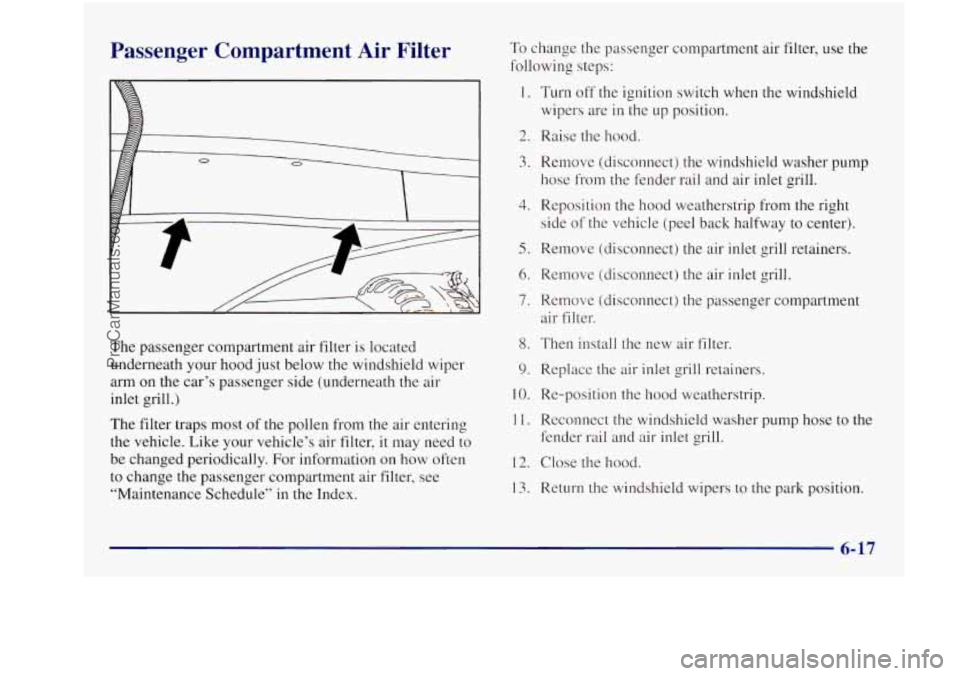
The passenger compartment air filter is located
underneath your hood just below the windshield wiper
arm on the car’s passenger side (underneath
the air
inlet grill.)
The filter traps most
of the pollen from the air entering
the vehicle. Like your vehicle’s air filter, it may need to
be changed periodically. For information on how often
to change the passenger compartment air
filter, see
“Maintenance Schedule”
in the Index.
To change the passenger compartment air filter, use the
following steps:
1.
2.
3.
4.
5.
6.
7.
8.
9.
10.
11.
12.
13.
Turn off the ignition switch when the windshield
wipers are
in the up position.
Raise the hood.
Remove (disconnect) the windshield washer pump
hose from the fender rail and air inlet grill.
Reposition the hood weatherstrip from the right
side of the vehicle (peel back halfway to center).
Remove (disconnect) the air inlet grill retainers.
Remove (disconnect) the air inlet grill.
Remove (disconnect) the passenger compartment
air filter.
Then install the new air filter.
Replace the air inlet grill retainers.
Re-position the hood weatherstrip.
Reconnect the windshield washer pump hose to the
fender rail and air inlet grill.
Close the hood.
Return the windshield wipers to the park position.
ProCarManuals.com
Page 315 of 422
2.
3.
4.
5.
Turn off the ignition while the wipers are at the
outer positions of the wiper pattern. The blades
are more accessible for removal/replacement while
in this position.
Pull the windshield wiper
arm 3 to 4 inches
(7.5 to 10 cm) away from the windshield.
While holding the wiper arm away from the glass,
push
the release clip from under the blade
connecting point and pull the blade assembly down
toward the glass to remove
it from the wiper arm.
Push the new wiper blade securely on the wiper arm
until
you hear the release clip “click” into place.
For wiper blade replacement length and type,
also see
“Capacities and Specifications”
in the Index.
Tires
Your new Buick comes with high-quality tires made by
a leading tire manufacturer. If you ever have questions
about your tire warranty and where to obtain service, see
your Buick Warranty booklet for details. Poorly maintained and improperly used tires
are dangerous.
0
Overloading your tires can cause
overheating as
a result of too much friction.
You could have an air-out and a serious
accident. See “Loading Your Vehicle” in
the Index.
Underinflated tires pose the same danger
as overloaded tires. The resulting accident
could cause serious injury. Check all tires
frequently to maintain the recommended
pressure. Tire pressure should be checked
when your tires are cold. Overinflated tires are more likely
to be
cut, punctured or broken by a sudden
impact
-- such as when you hit a pothole.
Keep tires at the recommended pressure.
Worn, old tires can cause accidents.
If your
tread is badly worn, or if your tires have
been damaged, replace them.
6-39
ProCarManuals.com
Page 336 of 422
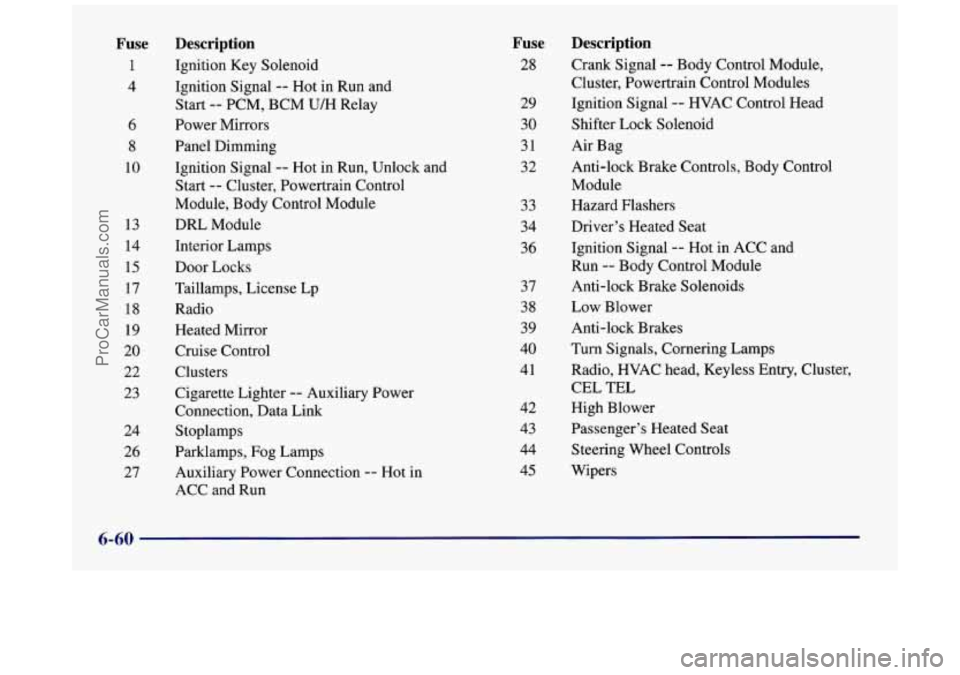
Fuse
1
4
6
8
10
13
14 15
17
18
19
20
22
23
24 26
27 Description
Ignition
Key Solenoid
Ignition Signal
-- Hot in Run and
Start
-- PCM, BCM U/H Relay
Power Mirrors
Panel Dimming Ignition Signal
-- Hot in Run, Unlock and
Start
-- Cluster, Powertrain Control
Module, Body Control Module
DRL Module
Interior Lamps
Door Locks
Taillamps, License Lp
Radio Heated Mirror
Cruise Control
Clusters
Cigarette Lighter
-- Auxiliary Power
Connection, Data Link
Stoplamps
Parklamps, Fog Lamps
Auxiliary Power Connection
-- Hot in
ACC and Run
Fuse
28
29
30
31
32
33
34
36
37
38
39
40
41
42
43
44
45
Description
Crank Signal -- Body Control Module,
Cluster, Powertrain Control Modules
Ignition Signal
-- HVAC Control Head
Shifter Lock Solenoid
Air Bag
Anti-lock Brake Controls, Body Control
Module
Hazard Flashers
Driver’s Heated Seat
Ignition Signal
-- Hot in ACC and
Run
-- Body Control Module
Anti-lock Brake Solenoids
Low Blower
Anti-lock Brakes
Turn Signals, Cornering Lamps
Radio, HVAC head, Keyless En
CEL
TEL
High Blower
Passenger’s Heated Seat
Steering Wheel Controls
Wipers ltry,
Clus
; ter,
6-60
ProCarManuals.com
Page 337 of 422
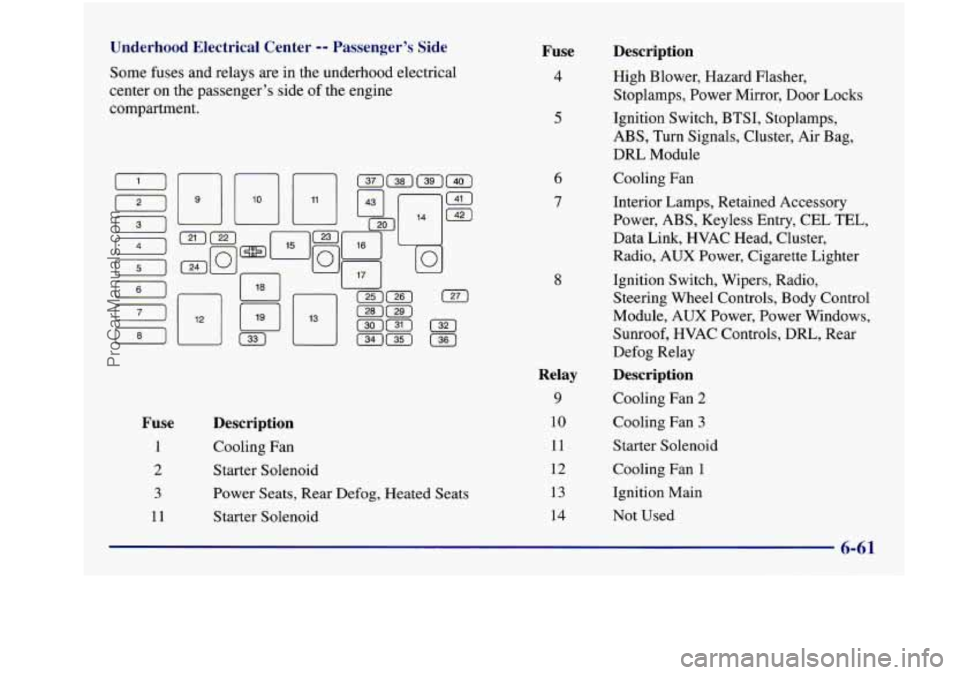
Underhood Electrical Center -- Passenger’s Side
Some fuses and relays are in the underhood electrical
center on the passenger’s side of the engine
compartment.
Fuse
1
2
3
11
Description
Cooling Fan
Starter Solenoid
Power Seats, Rear
Defog, Heated Seats
Starter Solenoid
Fuse
4
5
6
7
8
Relay
9
10
11
12
13
14
Description
High Blower, Hazard Flasher,
Stoplamps, Power Mirror, Door Locks
Ignition Switch, BTSI, Stoplamps,
ABS, Turn Signals, Cluster, Air Bag,
DRL Module
Cooling Fan
Interior Lamps, Retained Accessory
Power, ABS, Keyless Entry, CEL TEL,
Data Link,
HVAC Head, Cluster,
Radio, AUX Power, Cigarette Lighter
Ignition Switch, Wipers, Radio,
Steering Wheel Controls, Body Control
Module, AUX Power, Power Windows,
Sunroof, HVAC Controls, DRL, Rear
Defog Relay
Description
Cooling Fan 2
Cooling Fan
3
Starter Solenoid
Cooling Fan 1
Ignition Main
Not Used
6-61
ProCarManuals.com