1997 BUICK REGAL oil level
[x] Cancel search: oil levelPage 148 of 422
The oil light could also come on in the following situations:
The light will come on briefly when you turn on the
ignition to show you that it is working properly.
(If it
doesn’t come on with the ignition on, you may have
a
problem with the fuse or bulb. Have it fixed right away.)
0 Sometimes when the engine is idling at a stop, the
light may blink on and
off. This is normal.
Don’t keep driving if the oil pressure is low. If
you do, your engine can become so hot that it
catches fire. You
or others could be burned.
Check your oil as soon as possible and have
your vehicle serviced.
NOTICE:
Damage to your engine from neglected oil problems can be costly and is not covered by
your warranty.
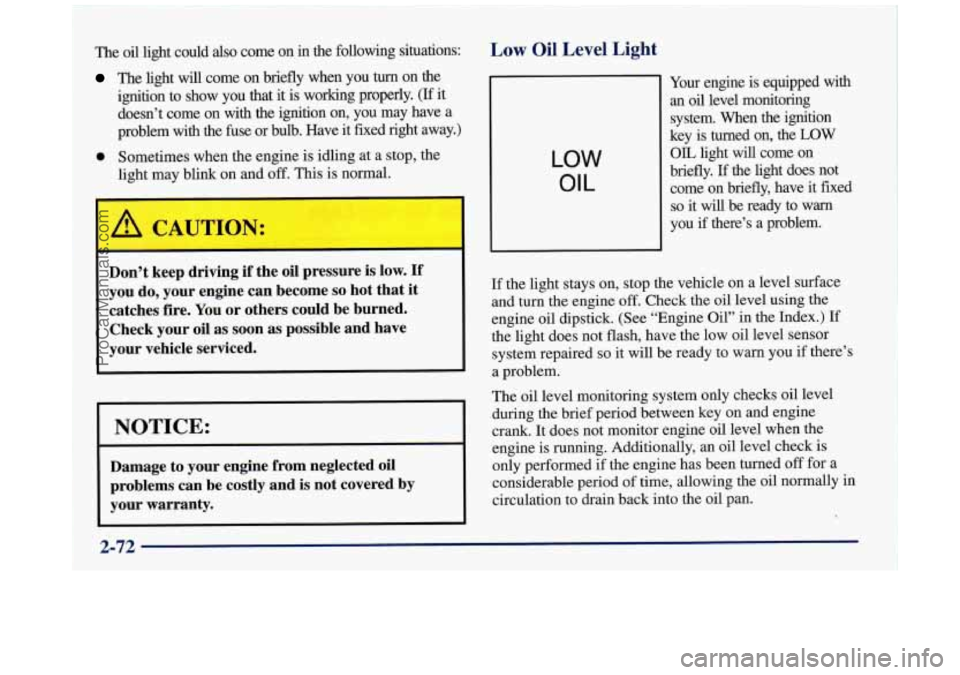
Low Oil Level Light
LOW
OIL
Your engine is equipped with
an oil level monitoring
system. When
the ignition
key is turned on, the
LOW
OIL light will come on
briefly.
If the light does not
come on briefly, have it fixed
so it will be ready to warn
you if there’s a problem.
If the light stays on, stop the vehicle on a level surface
and turn the engine
off. Check the oil level using the
engine oil dipstick. (See “Engine Oil” in the Index.)
If
the light does not flash, have the low oil level sensor
system repaired
so it will be ready to warn you if there’s
a problem.
The oil level monitoring system only checks oil level
during the brief period between key
on and engine
crank. It does not monitor engine oil level when the
engine is running. Additionally, an oil level check is
only performed if
the engine has been turned off for a
considerable period of time, allowing the oil normally in
circulation to drain back into the oil pan.
2-72
ProCarManuals.com
Page 220 of 422
The exit speed is usually posted.
Reduce your speed according to your speedometer, not
to your sense of motion. After driving for any distance
at higher speeds, you may tend to think you are going
slower than you actually are.
Before Leaving on a Long Trip
Make sure you’re ready. Try to be well rested. If you
must start when you’re not fresh
-- such as after a day’s
work
-- don’t plan to make too many miles that first part
of the journey. Wear comfortable clothing and shoes you
can easily drive in.
Is your vehicle ready for a long trip? If you keep it
serviced and maintained, it’s ready
to go. If it needs
service, have it done before starting out. Of course,
you’ll find experienced and able service experts in
Buick dealerships all across North America. They’ll be
ready and willing to help if you need it. Here
are some things
you can check before a trip:
0
0
0
0
0
0
0
Wirzdslzield Wusher Fluid: Is the reservoir full? Are
all windows clean inside and outside?
Wiper Blades: Are they in good shape?
Fuel, Engine
Oil, Other Fluids: Have you checked
all levels?
Lumps: Are they all working? Are the lenses clean?
Tires: They are vitally important to a safe,
trouble-free trip.
Is the tread good enough for
long-distance driving? Are the tires all inflated to the
recommended pressure?
Weather Forecasts: What’s the weather outlook
along your route? Should you delay your trip a short
time to avoid a major storm system?
Maps: Do you have up-to-date maps?
ProCarManuals.com
Page 255 of 422
How to Add Coolant to the Coolant
Recovery Tank
~~
NOTICE:
If you haven’t found a problem yet, but the coolant level I In cold weather, water can freeze and crack the I isn’t at the COLD mark, add a 50/50 mixture of clean
water (preferably distilled) and DEX-COOL@
(silicate-free) antifreeze at the coolant recovery tank.
(See “Engine Coolant” in the Index for
more information.)
/a CAUTION:
Adding only plain water to your cooling system
can be dangerous. Plain water, or some other
liquid like alcohol, can boil before the proper
coolant mix will. Your vehicle’s coolant warning
system is set for the proper coolant mix. With
plain water or the wrong mix, your engine could
get too hot but you wouldn’t get the overheat
warning. Your engine could catch fire and you or
others could be burned. Use a
50/50 mix of clean
water and
DEX-COOL@ coolant. engine,
radiator, heater core and other parts.
Use the recommended coolant and the proper
coolant
mix.
5-19
ProCarManuals.com
Page 277 of 422
Section 6 Service and Appearance Care
Here you will find information about the care of your Buick. This section begins with service and fuel information,
and then it shows how
to check important fluid and lubricant levels. There is also technical information about your
6-2
6-3
6-5
6-5
6-7
6-11
6-1
1
6-16
6-19
6-22
6-26
6-27
6-28
6-3
1
6-32 6-39
6-47
6-48
6-5
1
6-5 1
vehicle, and a part devoted to its appearance care.
Service
Fuel
Fuels in Foreign Countries
Filling Your Tank
Checking Things Under the Hood
3800 Supercharged (Code 1) Engine
Engine Oil
Air Cleaner
Automatic Transaxle Fluid
Engine Coolant
Power Steering Fluid
Windshield Washer Fluid
Brakes
Battery
Bulb Replacement
Tires
Appearance Care
Cleaning the Inside
of Your Buick
Cleaning the Built-in Child Restraint
Care
of Safety Belts and Built-in Child
Restraint Harness 6-5
1
6-52
6-52
6-52
6-53
6-54 6-54
6-54
6-55
6-55
6-5 6
6-57
6-57
6-58
6-63
6-63
6-64
6-65
6-65 Cleaning Glass Surfaces
Cleaning
the Outside of the Windshield and
Wiper Blades
Weatherstrips Cleaning the Outside of Your Buick
Cleaning Aluminum or Chrome Wheels
Cleaning Tires
Sheet Metal Damage
Finish Damage
Underbody Maintenance
Chemical Paint Spotting
Appearance Care Materials Chart
Vehicle Identification Number
(VIN)
Service Parts Identification Label
Electrical System Replacement Bulbs
Capacities and Specifications
Vehicle Dimensions
Normal Maintenance Replacement Parts
Air Conditioning Refrigerants
6-1
ProCarManuals.com
Page 287 of 422
Before closing the hood, be sure all the filler caps are
on properly. Then just pull the hood down and close
it firmly.
3800 Supercharged (Code 1) Engine
(If Equipped)
Your Buick may have a 3800 Supercharged engine.
The supercharger is a device which is designed to
pump more air into the engine than it would normally
use. This air is mixed with fuel, which creates increased
engine power. Since the supercharger is a pump and is
driven from an engine accessory drive belt, increased
pressure is available at all driving conditions.
The powertrain control module
(PCM), works with
a vacuum control to regulate the increased pressure
required during specific driving conditions. When
this
increased pressure or boost is not desired, such as during
idling and light throttle cruising, the excess air that the
supercharger
is pumping is routed through a bypass.
All of these controls working together provide high
performance character and fuel efficiency in the
3800 Supercharged L67 engine.
Engine
I --
LOW
OIL
If the LOW OIL light on
the instrument panel comes on, it means you need to
check your engine oil level right away. For more
information, see
“Low Oil
Level Light” in the Index.
You should check your
engine oil level regularly;
this is an added reminder.
It’s
a good idea to check your engine oil every time you
get fuel. In order to get an accurate reading, the oil must
be warm and the vehicle must be on level ground.
6-11
ProCarManuals.com
Page 288 of 422
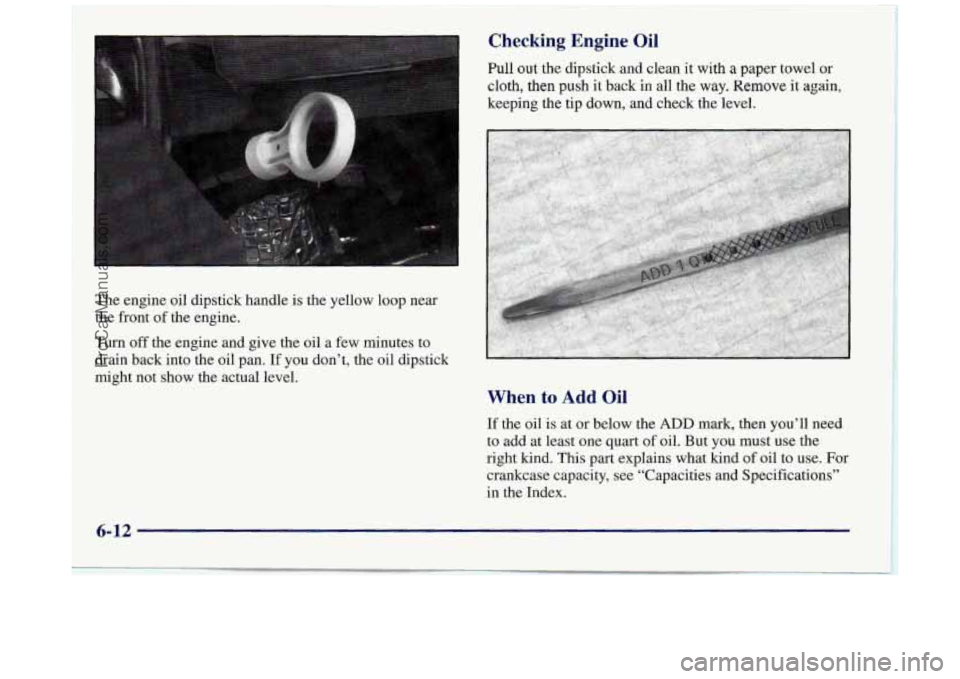
The engine oil dipstick handle is the yellow loop near
the front of
the engine.
Turn off the engine and give the oil a few minutes to
drain back into the oil pan. If you don’t, the oil dipstick
might not show the actual level.
Checking Engine Qil
Pull out the dipstiik and clean it with a paper tuwel or
cloth, then push it back iri all the way. Remove it again,
keeping the tip down, ;and check the level.
When to Add Oil
If the oil is at or below the ADD mark, then you’ll need
to add at least one quart of oil. But you must use the
right kind. This part explains what kind of oil to use. For
crankcase capacity, see “Capacities and Specifications”
in
the Index.
6-12
ProCarManuals.com
Page 289 of 422
NOTICE:
Don’t add too much oil. If your engine has so
much oil that the oil level gets above the
cross-hatched area that shows the proper
operating range, your engine could
be damaged.
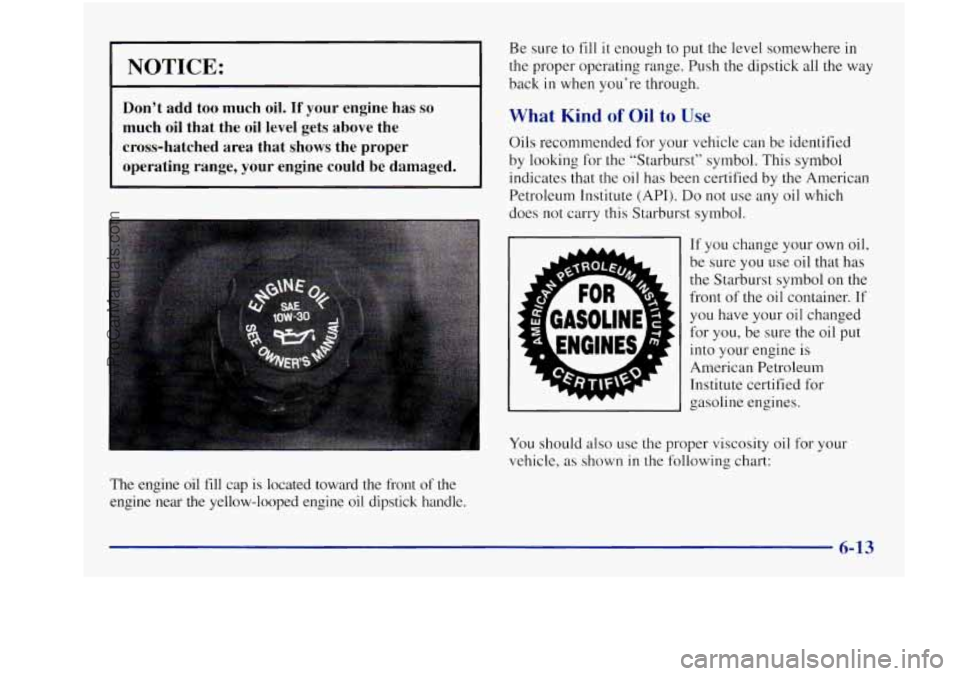
The engine oil fill cap is located toward the front of the
engine near the yellow-looped engine oil dipstick handle. Be
sure to fill
it enough to put the level somewhere in
the proper operating range. Push the dipstick all the way
back
in when you’re through.
What Kind of Oil to Use
Oils recommended for your vehicle can be identified
by looking for the “Starburst” symbol. This symbol
indicates that the oil has been certified by the American
Petroleum Institute (API).
Do not use any oil which
does not carry this Starburst symbol.
If you change your own oil,
be sure you use oil that has
the Starburst symbol on the
front of the oil container.
If
you have your oil changed
for you, be sure the oil put
into your engine is
American Petroleum
Tnstitute certified for
gasoline engines.
You should also use the proper viscosity oil for your
vehicle,
as shown in the following chart:
ProCarManuals.com
Page 294 of 422
Supercharger Oil
Unless you are technically qualified and have the proper
tools, you should let your dealer or a qualified service
center perform this maintenance.
When to Check
Check oil level every 30,000 miles (50 000 km) or every
36 months, whichever occurs first.
What Kind of Oil to Use
See “Recommended Fluids and Lubricants’’ in the Index
and use only the recommended oil.
How to Check and Add Oil
Check oil only when the engine is cold. Allow the
engine to cool two to three hours after running.
If you remove the supercharger oil fill plug while
the engine is hot, pressure may cause
hot oil to
blow out
of the oil fill hole. You may be burned.
Do not remove the plug until the engine cools.
1.
2.
3.
3.
Clean the area around the oil fill plug before
removing it.
Remove
the oil fill plug using a 3/16 inch Allen
wrench.
The oil level is correct when
it just reaches the
bottom
of the threads of the inspection hole.
Replace the oil plug with the O-ring
in place.
Torque to
88 lb-in (10 N-m).
6-18
ProCarManuals.com