Page 27 of 422
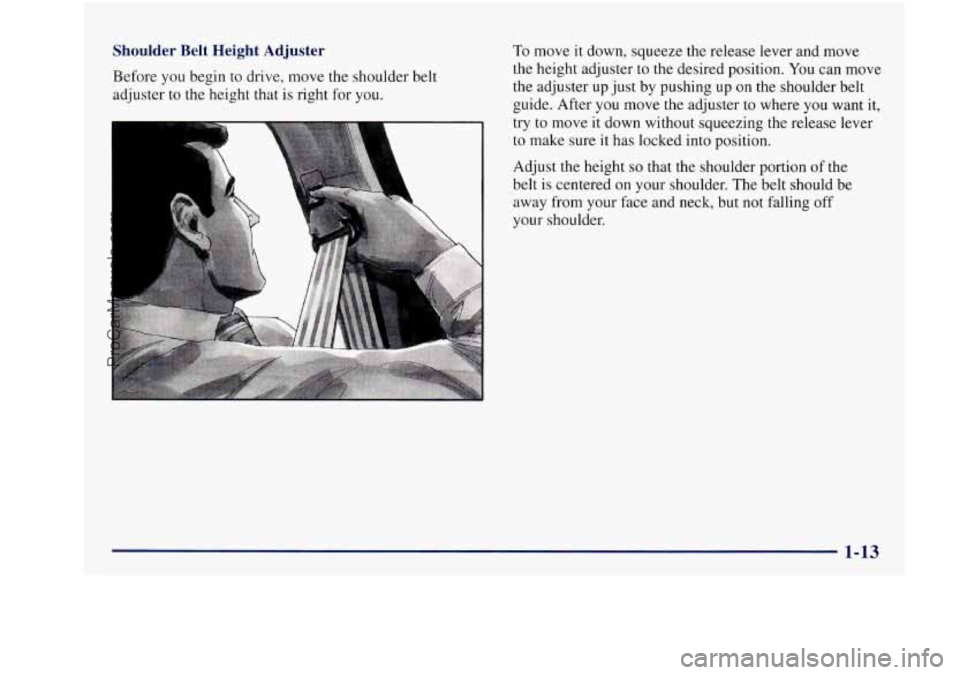
Shoulder Belt Height Adjuster
Before you begin to drive, move the shoulder belt
adjuster to the height that
is right for you.
To move it down, squeeze the release lever and move
the height adjuster to the desired position.
You can move
the adjuster up just by pushing up on the shoulder belt
guide. After
you move the adjuster to where you want it,
try to move it down without squeezing the release lever
to make sure it has locked into position.
Adjust the height
so that the shoulder portion of the
belt is centered on your shoulder. The belt should be
away from your face and neck, but
not falling off
your shoulder.
ProCarManuals.com
Page 48 of 422
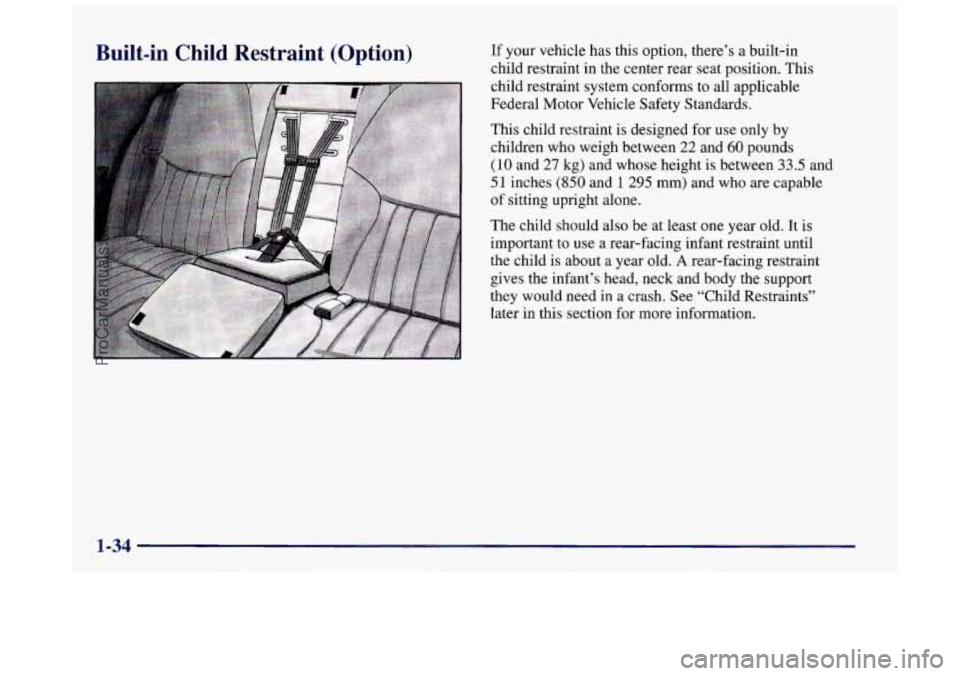
Built-in Child Restraint (Option) If your vehicle has this option, there’s a built-in
child restraint in the center rear seat position. This
child restraint system conforms to ali applicable
Federal Motor Vehicle Safety Standards.
This child restraint is designed for use only by
children who weigh between
22 and 60 pounds
(10 and 27 kg) and whose height is between 33.5 and
51 inches (850 and 1 295 mm) and who are capable
of sitting upright alone.
The child should also be at least one year old. It is
important
to use a rear-facing infant restraint until
the child is about a year old.
A rear-facing restraint
gives the infant’s head, neck and body the support
they would need in a crash. See “Child Restraints”
later in this section for more information.
ProCarManuals.com
Page 49 of 422
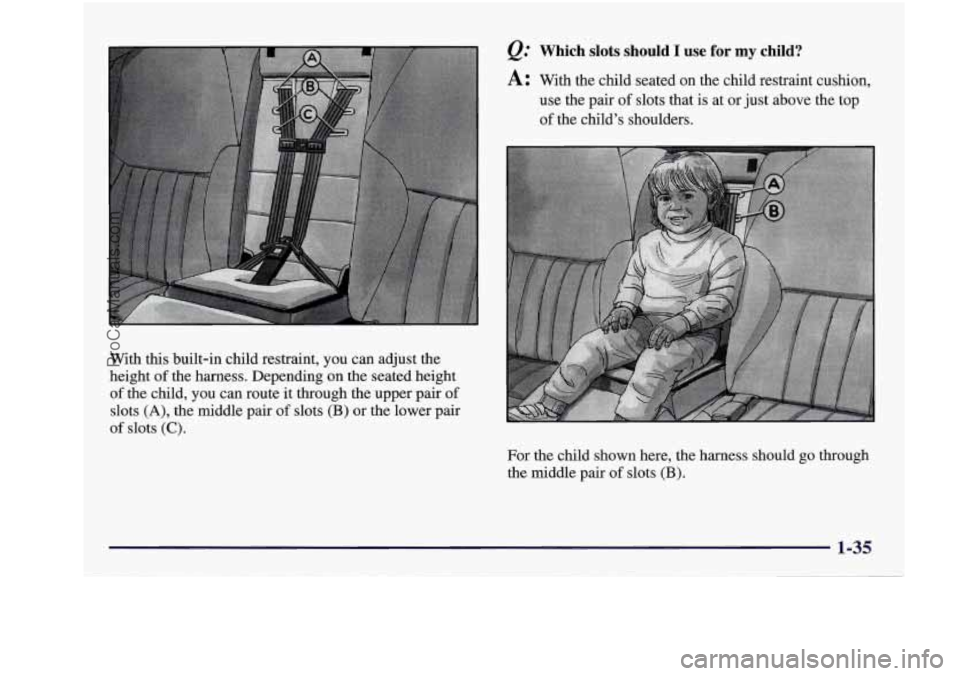
With this built-in child restraint, you can adjust the
height
of the harness. Depending on the seated height
of the child, you can route it through the upper pair of
slots (A), the middle pair of slots (B) or the lower pair
of slots (C).
&.' Which slots should I use for my child?
A: With the child seated on the child restraint cushion,
use the pair
of slots that is at or just above the top
of the child's shoulders.
For the child shown here, the harness should go through the middle pair
of slots (B).
1-35
ProCarManuals.com
Page 50 of 422
@ What if the top of my child’s shoulders is above
A: A child whose shoulders are above the highest slots
the highest pair of slots?
shouldn’t use this child restraint. Instead, the child
should sit on the vehicle’s seat cushion and use the
vehicle’s safety belts.
MAKE SURE THE TOP OF THE CHILD’S
SHOULDERS IS BELOW THE SLOTS THAT
THE HARNESS GOES THROUGH.
A CHILD
WHOSE SHOULDERS ARE ABOVE THOSE
SLOTS COULD BE
IN JURED DURING A
SUDDEN STOP OR CRASH. IF‘ THE TOP
OF THE CHILD’S SHOULDERS IS ABOVE
THE SLOTS, DON’T USE THIS CHILD
RESTRAINT. INSTEAD, THE CHILD SHOULD
SIT ON THE VEHICLE’S REGULAR SEAT
AND USE THE REGULAR SAFETY BELTS.
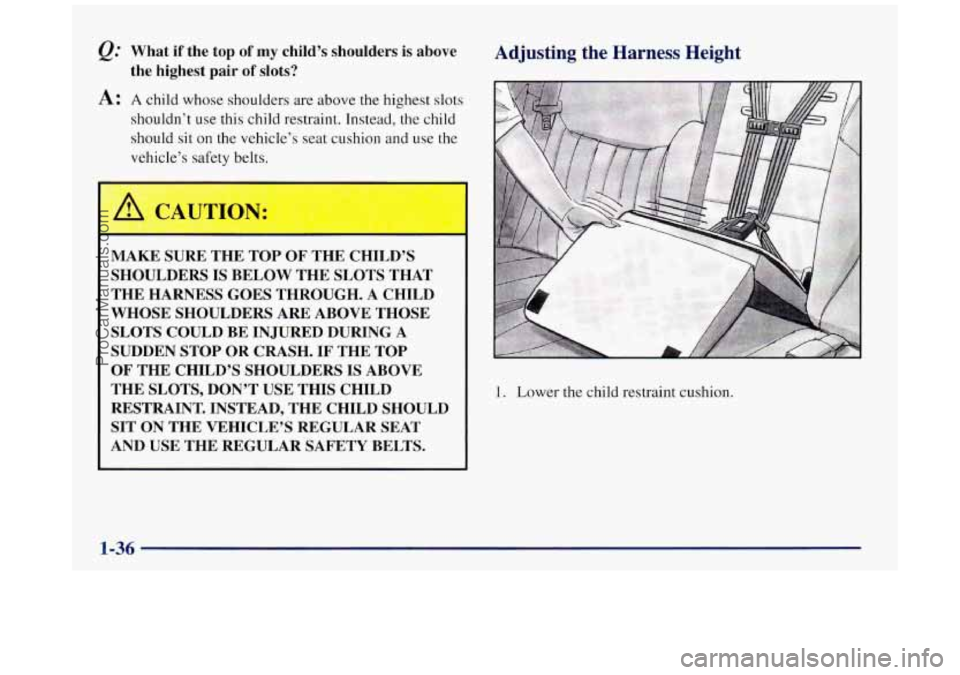
Adjusting the Harness Height
1. Lower the child restraint cushion.
ProCarManuals.com
Page 54 of 422
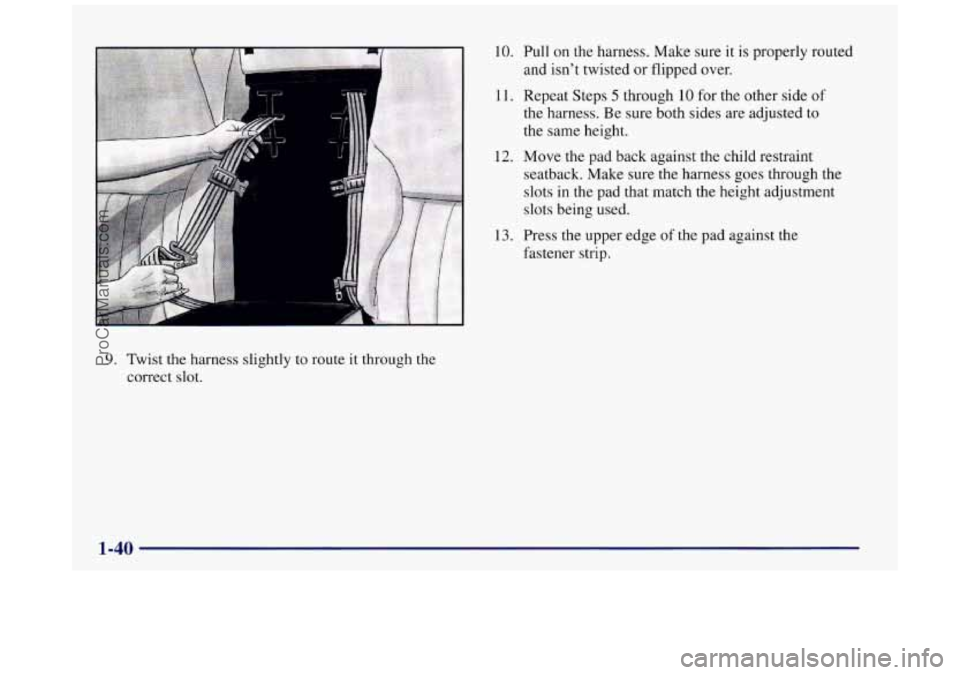
9. Twist the harness slightly to route it through the
correct
slot.
10. Pull on the harness. Make sure it is properly routed
and isn’t twisted or flipped over.
11. Repeat Steps 5 through 10 for the other side of
the harness. Be sure both sides are adjusted to
the same height.
12. Move the pad back against the child restraint
seatback. Make sure the harness
goes through the
slots in the pad that match the height adjustment
slots being used.
fastener strip.
13. Press the upper edge of the pad against the
1-40
-
ProCarManuals.com
Page 55 of 422
Securing a Child in the Built-in
Child Restraint
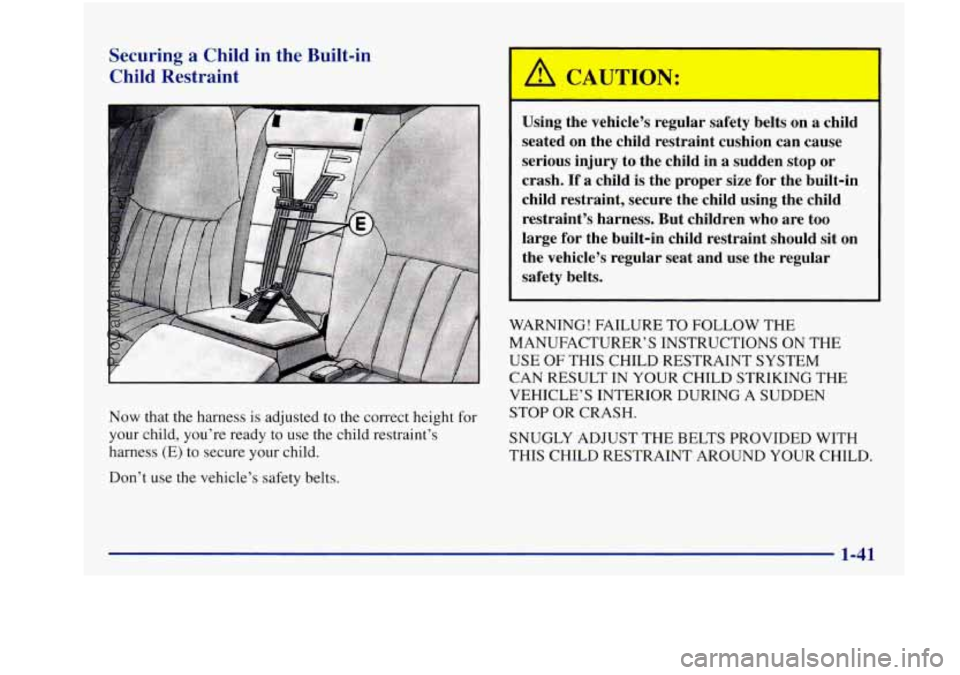
Now that the harness is adjusted to the correct height for
your child, you’re ready to use the child restraint’s
harness (E) to secure your child.
Don’t use the vehicle’s safety belts.
Using the vehicle’s regular safety belts on a child
seated on the child restraint cushion can cause
serious injury to the child in a sudden stop or
crash.
If a child is the proper size for the built-in
child restraint, secure the child using the child
restraint’s harness. But children who are too
large for the built-in child restraint should sit on
the vehicle’s regular seat and use the regular
safety belts.
WARNING! FAILURE TO FOLLOW THE
MANUFACTURER’S INSTRUCTIONS
ON THE
USE OF THIS CHILD RESTRAINT SYSTEM
CAN RESULT IN
YOUR CHILD STRIKING THE
VEHICLE’S INTERIOR DURING A SUDDEN
STOP
OR CRASH.
SNUGLY ADJUST THE BELTS PROVIDED WITH
THIS CHILD RESTRAINT AROUND YOUR CHILD.
ProCarManuals.com
Page 307 of 422
Some driving conditions or climates may cause a
brake squeal when the brakes are first applied or lightly
applied. This does
not mean something is wrong with
your brakes.
Properly torqued wheel nuts are necessary to help
prevent brake pulsation. When tires are rotated, inspect
brake pads for wear and evenly torque wheel nuts
in
the proper sequence to GM specifications.
Brake linings should always be replaced as complete
axle sets.
See “Brake System Inspection” in Section
7 of this
manual under Part
C “Periodic Maintenance
Inspections.”
Brake Pedal Travel
See your dealer if the brake pedal does not return to
normal height, or if there is a rapid increase
in pedal
travel. This could be a sign of brake trouble.
Brake Adjustment
Every time you apply the brakes, with or without the
vehicle moving, your brakes adjust for wear.
Replacing Brake System Parts
The braking system on a modern vehicle is complex.
Its many parts have to be of top quality and work well
together if the vehicle is to have really good braking.
Your vehicle was designed and tested with top-quality
GM brake parts. When you replace parts
of your braking
system
-- for example, when your brake linings wear
down and you have to have new ones put in
-- be sure
you get new approved GM replacement parts. If you
don’t, your brakes may no longer work properly. For
example,
if someone puts in brake linings that are wrong
for your vehicle, the balance between your front and
rear brakes can change
-- for the worse. The braking
performance you’ve come
to expect can change in many
other ways if someone puts in the wrong replacement
brake parts.
Battery
Every new Buick has a Delco Freedom@ battery. You
never have to add water to one of these. When it’s time
for a new battery, we recommend a Delco Freedom
battery. Get one that has the replacement number shown
on the original battery’s label.
~ 6-31
ProCarManuals.com
Page 322 of 422
1 Used Replacement Wheels
Using the wrong replacement wheels, wheel
bolts or wheel nuts on your vehicle can be
dangerous. It could affect the braking and
handling
of your vehicle, make your tires lose
air and make you lose control. You could have
a
collision in which you or others could be injured.
Always use the correct wheel, wheel bolts and
wheel nuts for replacement.
NOTICE:
The wrong wheel can also cause problems with
bearing life, brake cooling, speedometer or
odometer calibration, headlamp aim, bumper height, vehicle ground clearance and tire or tire
chain clearance
to the body and chassis.
See “Changing a Flat Tire”
in the Index for more
information. Putting
a used wheel
on your vehicle is
dangerous. You can’t know how it’s been used or
how far it’s been driven. It could fail suddenly
and cause an accident.
If you have to replace a
wheel, use a new
GM original equipment wheel.
Tire Chains
NOTICE:
If your Buick has P225/60R16 size tires, don’t use
tire chains. They can damage your vehicle
because there’s not enough clearance.
NOTICE: (Continued)
6-46
ProCarManuals.com