Page 199 of 422
Drunken Driving
Death and injury associated with drinking and driving is
a national tragedy. It’s the number one contributor to
the highway death toll, claiming thousands of victims
every year. Alcohol affects four things that anyone needs to dnve
a vehicle:
0 Judgment
0 Muscular Coordination
0 Vision
0 Attentiveness.
Police records show that almost half of all motor
vehicle-related deaths involve alcohol.
In most cases,
these deaths are the result of someone who was drinking
and driving.
In recent years, some 17,000 annual motor
vehicle-related deaths have been associated with the use
of alcohol, with more than
300,000 people injured.
Many adults
-- by some estimates, nearly half the
adult population
-- choose never to drink alcohol, so
they never drive after drinking. For persons under 21,
it’s against the law in every
U.S. state to drink alcohol.
There are good medical, psychological and
developmental reasons for these laws. The obvious
way to solve this highway safety problem
is for people never to drink alcohol and then drive. But
what if people do?
How much is “too much” if the
driver plans to drive? It’s a lot less than many might
think. Although it depends on each person and situation,
here is some general information on the problem.
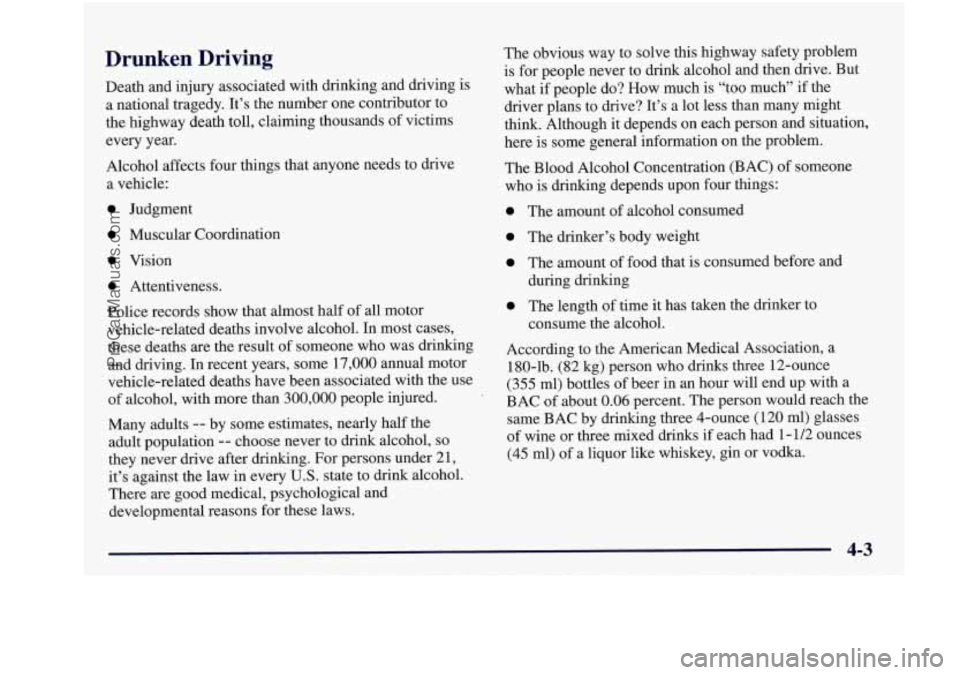
The Blood Alcohol Concentration (BAC) of someone
who is drinking depends upon four things:
0 The amount of alcohol consumed
0 The drinker’s body weight
0 The amount of food that is consumed before and
during drinking
0 The length of time it has taken the drinker to
consume the alcohol.
According to the American Medical Association, a 180-lb. (82 kg) person who drinks three 12-ounce
(355 ml) bottles of beer in an hour will end up with a
BAC of about
0.06 percent. The person would reach the
same BAC by drinking three 4-ounce (120
ml) glasses
of wine or three mixed drinks if each had 1-1/2 ounces
(45
ml) of a liquor like whiskey, gin or vodka.
4-3
ProCarManuals.com
Page 314 of 422
2. Lift the plastic locking tab on the electrical
connector and pull the connector from the dome
lamp assembly.
3. Grasp the bulb housing located in the center of the
assembly and pull straight up.
4. Pull the bulb out of the socket.
5. Push in a new bulb.
6. Replace the socket into the dome lamp assembly.
7. Reconnect the dome lamp assembly to the wiring
harness, making sure the connector tab snaps into
place.
8. Reposition the dome lamp assembly to the roof, and
gently push the assembly into the base plate.
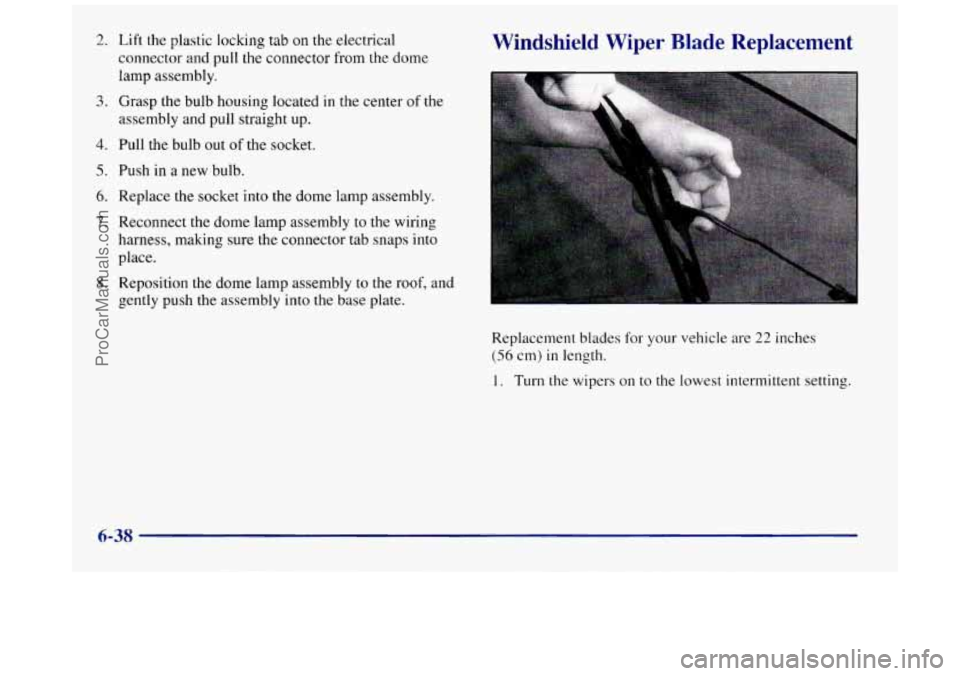
Windshield Wiper Blade Replacement
teplacement blades for your vehicle are 22 inches
56 cm) in length.
. Turn the wipers on to the lowest intermittent setting.
6-38
ProCarManuals.com
Page 315 of 422
2.
3.
4.
5.
Turn off the ignition while the wipers are at the
outer positions of the wiper pattern. The blades
are more accessible for removal/replacement while
in this position.
Pull the windshield wiper
arm 3 to 4 inches
(7.5 to 10 cm) away from the windshield.
While holding the wiper arm away from the glass,
push
the release clip from under the blade
connecting point and pull the blade assembly down
toward the glass to remove
it from the wiper arm.
Push the new wiper blade securely on the wiper arm
until
you hear the release clip “click” into place.
For wiper blade replacement length and type,
also see
“Capacities and Specifications”
in the Index.
Tires
Your new Buick comes with high-quality tires made by
a leading tire manufacturer. If you ever have questions
about your tire warranty and where to obtain service, see
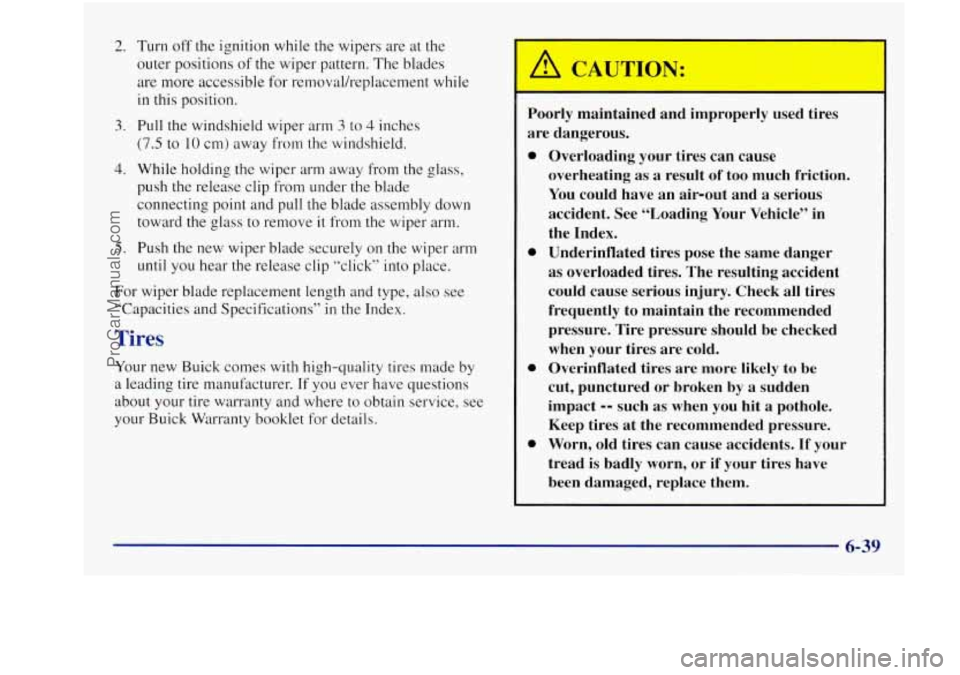
your Buick Warranty booklet for details. Poorly maintained and improperly used tires
are dangerous.
0
Overloading your tires can cause
overheating as
a result of too much friction.
You could have an air-out and a serious
accident. See “Loading Your Vehicle” in
the Index.
Underinflated tires pose the same danger
as overloaded tires. The resulting accident
could cause serious injury. Check all tires
frequently to maintain the recommended
pressure. Tire pressure should be checked
when your tires are cold. Overinflated tires are more likely
to be
cut, punctured or broken by a sudden
impact
-- such as when you hit a pothole.
Keep tires at the recommended pressure.
Worn, old tires can cause accidents.
If your
tread is badly worn, or if your tires have
been damaged, replace them.
6-39
ProCarManuals.com
Page 339 of 422
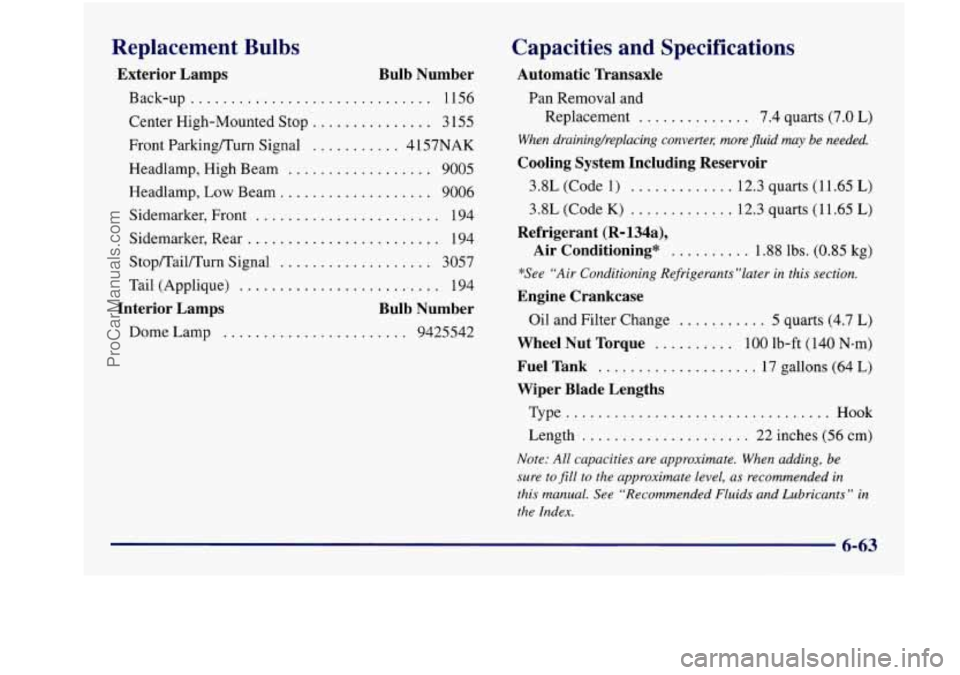
Replacement Bulbs
Exterior Lamps Bulb Number
Back-up .............................. 1156
Center High-Mounted Stop
............... 3 155
Front Parking/Turn Signal
........... 4 157NAK
Headlamp, High Beam
.................. 9005
Headlamp,
Low Beam. .................. 9006
Sidemarker, Front
....................... 194
Sidemarker, Rear
........................ 194
Stop/Tail/Turn Signal
................... 3057
Tail (Applique)
......................... 194
Interior Lamps Bulb Number
Dome Lamp ....................... 9425542
Capacities and Specifications
Automatic nansaxle
Pan Removal and
Replacement
.............. 7.4 quarts (7.0 L)
When drainingheplacing converter; more fluid my be needed.
Cooling System Including Reservoir
3.8L (Code 1) ............. 12.3 quarts (1 1.65 L)
3.8L (Code K) ............. 12.3 quarts (1 1.65 L)
Air Conditioning* .......... 1.88 lbs. (0.85 kg)
Refrigerant (R=134a),
*See “Air Conditioning Refrigerants”1ater in this section.
Engine Crankcase
Oil and Filter Change ........... 5 quarts (4.7 L)
Wheel Nut Torque .......... 100 lb-ft (140 N-m)
Fuel Tank .................... 17 gallons (64 L)
Wiper Blade Lengths
Type ................................. Hook
Length ..................... 22 inches (56 cm)
Note: All capacities are approximate. When adding, be
sure to
fill to the approximate level, as recommended in
this manual. See “Recommended Fluids and Lubricants
” in
the Index.
6-63
ProCarManuals.com
Page 340 of 422
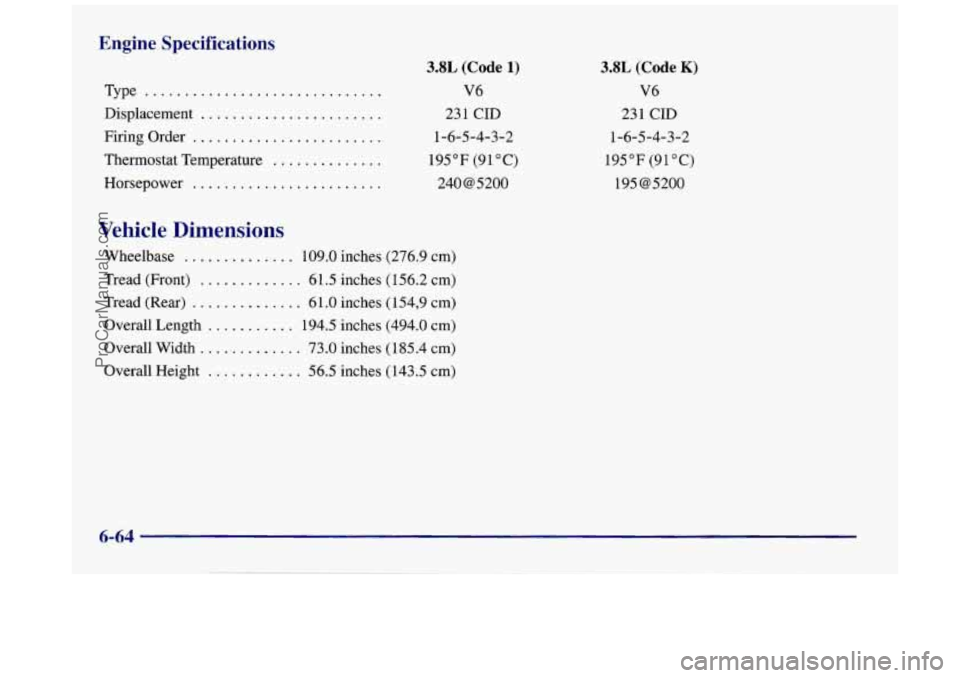
Engine Specifications
Type ..............................
Displacement .......................
Firing Order ........................
Horsepower ........................
Thermostat Temperature ..............
3.8L (Code 1)
V6
231
CID
1-6-5-4-3-2
195°F (91°C) 240
@ 5200
3.8L (Code K)
V6
231 CID
1-6-5-4-3-2
195°F (91°C) 195@5200
Vehicle Dimensions
Wheelbase .............. 109.0 inches (276.9 cm)
Tread (Front)
............. 6 1.5 inches ( 156.2 cm)
Tread (Rear)
.............. 61.0 inches (154,9 cm)
Overall Length
........... 194.5 inches (494.0 cm)
Overall Width
............. 73.0 inches (185.4 cm)
Overall Height
............ 56.5 inches (143.5 cm)
6-64
ProCarManuals.com