1997 BUICK REGAL brake
[x] Cancel search: brakePage 343 of 422
Section 7 Maintenance Schedule
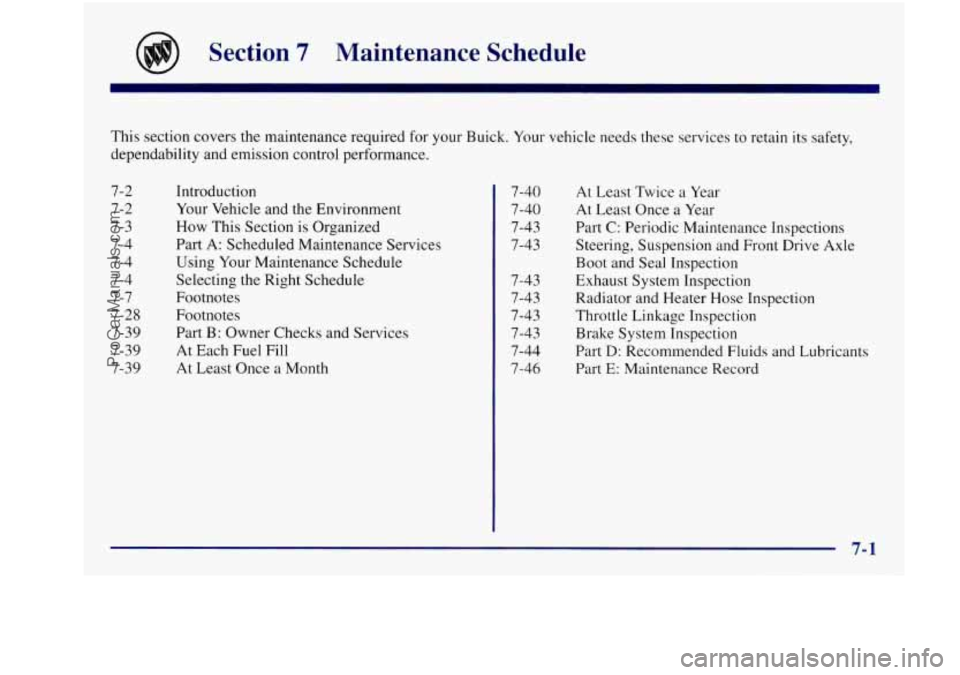
This section covers the maintenance required for your Buick. Your vehicle needs these services to retain its safety,
dependability and emission control performance.
7-2
7-2
7-3 7-4
7-4
7-4
7-7
7-28
7-39
7-39
7-39 Introduction
Your Vehicle
and the Environment
How This Section is Organized
Part A: Scheduled Maintenance Services
Using Your Maintenance Schedule
Selecting the Right Schedule
Footnotes
Footnotes
Part
B: Owner Checks and Services
At Each Fuel Fill
At Least Once a Month 7-40
7-40
7-43
7-43
7-43 7-43
7-43
7-43
7-44
7-46 At Least Twice
a Year
At Least Once a Year
Part
C: Periodic Maintenance Inspections
Steering, Suspension and Front Drive Axle
Boot and Seal Inspection
Exhaust System Inspection
Radiator and Heater Hose Inspection
Throttle Linkage Inspection
Brake System Inspection
Part
D: Recommended Fluids and Lubricants
Part E: Maintenance Record
ProCarManuals.com
Page 349 of 422
* Your vehicle has an Engine Oil L’
Short TripKity Maintenance Schedule
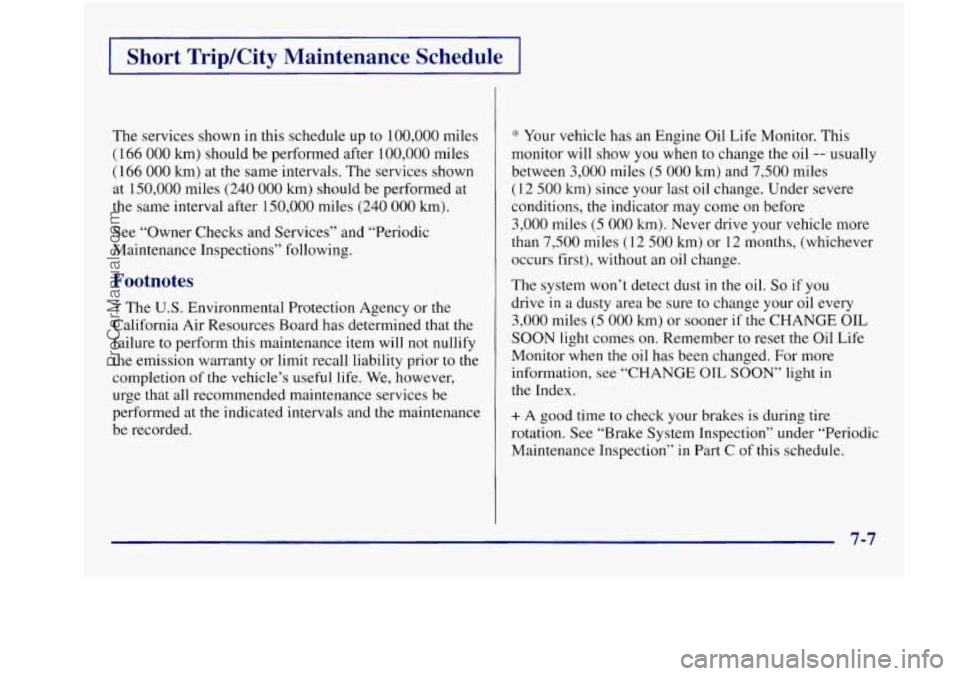
The services shown in this schedule up to 100,000 miles
(166 000 km) should be performed after 100,000 miles
(166 000 km) at the same intervals. The services shown
at
150,000 miles (240 000 km) should be performed at
the same interval after
150,000 miles (240 000 km).
See “Owner Checks and Services” and “Periodic
Maintenance Inspections” following.
Footnotes
-f The U.S. Environmental Protection Agency or the
California Air Resources Board has determined that the
failure to perform this maintenance item will not nullify
the emission warranty or limit recall liability prior to the
completion of the vehicle’s useful life. We, however,
urge that all recommended maintenance services be
performed at
the indicated intervals and the maintenance
be recorded. ~fe
Monitor. Thi
.s
monitor will show you when to change the oil -- usually
between
3,000 miles (5 000 km) and 7,500 miles
(1 2 500 km) since your last oil change. Under severe
conditions,
the indicator may come on before
3,000 miles (5 000 km). Never drive your vehicle more
than
7,500 miles (1 2 500 km) or 12 months, (whichever
occurs first), without an oil change.
The system won’t detect dust in the oil.
So if you
drive in
a dusty area be sure to change your oil every
3,000 miles (5 000 km) or sooner if the CHANGE OIL
SOON light comes on. Remember to reset the Oil Life
Monitor when the oil has been changed. For more
information, see
“CHANGE OIL SOON” light in
the Index.
+ A good time to check your brakes is during tire
rotation.
See “Brake System Inspection” under “Periodic
Maintenance Inspection” in Part C
of this schedule.
7-7
ProCarManuals.com
Page 370 of 422
I Long Tripmighway Maintenance Schedule 1
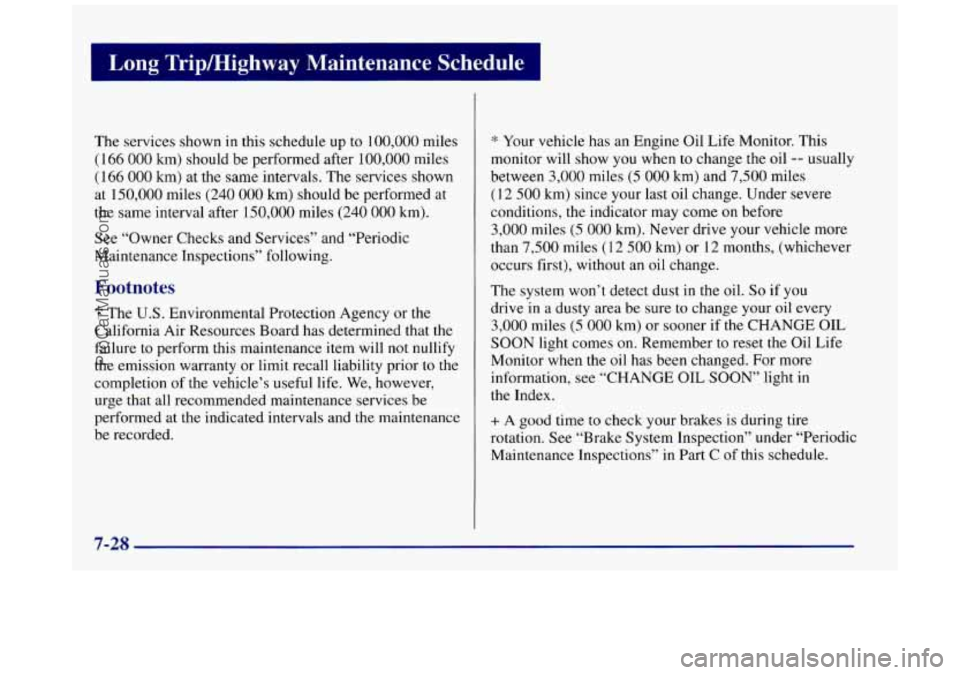
The services shown in this schedule up to 100,000 miles
( 166 000 km) should be performed after 100,000 miles
(166 000 km) at the same intervals. The services shown
at
150,000 miles (240 000 km) should be performed at
the same interval after 150,000 miles
(240 000 km).
See “Owner Checks and Services” and “Periodic
Maintenance Inspections” following.
Footnotes
The U.S. Environmental Protection Agency or the
California Air Resources Board has determined that the
failure to perform this maintenance item will not nullify
the emission warranty or limit recall liability prior to the
completion of the vehicle’s useful life.
We, however,
urge that all recommended maintenance services be
performed at the indicated intervals and the maintenance
be recorded.
* Your vehicle has an Engine Oil Life Monitor. This
monitor will show you when to change the oil
-- usually
between
3,000 miles (5 000 km) and 7,500 miles
(1 2 500 km) since your last oil change. Under severe
conditions, the indicator may come on before
3,000 miles (5 000 km). Never drive your vehicle more
than
7,500 miles (1 2 500 km) or 12 months, (whichever
occurs first), without an oil change.
The system won’t detect dust in the oil.
So if you
drive in a dusty area be sure to change your oil every
3,000 miles (5 000 km) or sooner if the CHANGE OIL
SOON light comes on. Remember to reset the Oil Life
Monitor when the
oil has been changed. For more
information, see “CHANGE OIL
SOON’ light in
the Index.
+ A good time to check your brakes is during tire
rotation.
See “Brake System Inspection” under “Periodic
Maintenance Inspections” in Part
C of this schedule.
7-28
ProCarManuals.com
Page 383 of 422
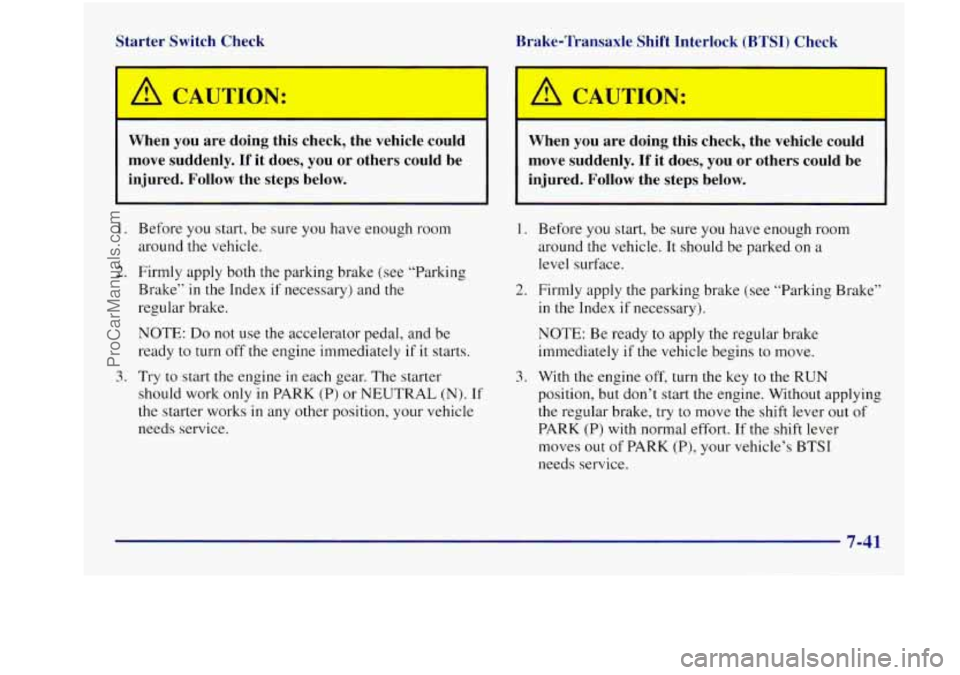
Starter Switch Check Brake-Transaxle Shift Interlock (BTSI) Check
When you are doing this check, the vehicle could
move suddenly. If it does, you or others could be
injured. Follow the steps below.
I A CAUTION:
When you are doing this check, the vehicle could
move suddenly. If it does, you or others could be
injured. Follow the steps below.
1.
2.
3.
Before you start, be sure you have enough room
around the vehicle.
Firmly apply both the parking brake (see “Parking
Brake”
in the Index if necessary) and the
regular brake.
NOTE: Do not use the accelerator pedal, and be
ready to turn off
the engine immediately if it starts.
Try to start the engine
in each gear. The starter
should work only
in PARK (P) or NEUTRAL (N). If
the starter works in any other position, your vehicle
needs service.
1.
2.
3.
Before you start, be sure you have enough room
around the vehicle. It should be parked on
a
level surface.
Firmly apply the parking brake (see “Parking Brake”
in the Index if necessary).
NOTE: Be ready to apply the regular brake
immediately if
the vehicle begins to move.
With the engine off, turn
the key to the RUN
position, but don’t start the engine. Without applying
the regular brake, try to move
the shift lever out of
PARK (P) with normal effort. If the shift lever
moves out
of PARK (P), your vehicle’s BTSI
needs service.
7-41
ProCarManuals.com
Page 384 of 422
Ignition Transaxle Lock Check
While parked, and with the parking brake
set, try to turn
the ignition key to LOCK in each shift lever position.
0 The key should turn to LOCK only when the shift
lever is in PARK
(P).
0 The key should come out only in LOCK.
Parking Brake and Automatic Transaxle PARK
(P)
Mechanism Check
When you are doing this check, your vehicle
could begin to move. You or others could be
injured and property could be damaged. Make
sure there is room in front
of your vehicle in case
it begins to roll. Be ready to apply the regular
brake at once should the vehicle begin to move. Park on
a fairly steep hill, with the vehicle facing
downhill. Keeping your foot on the regular brake, set the
parking brake.
0
0
To check the parking brake’s holding ability: With
the engine running and transaxle in NEUTRAL
(N),
slowly remove foot pressure from the regular brake
pedal.
Do this until the vehicle is held by the parking
brake only.
To check the PARK (P) mechanism’s holding ability:
With the engine running, shift to PARK (P). Then
release all brakes.
Underbody Flushing Service
At least every spring, use plain water
to flush any
corrosive materials from
the underbody. Take care to
clean thoroughly any areas where mud and other debris
can collect.
7-42
ProCarManuals.com
Page 385 of 422
Part C: Periodic Maintenance
Inspections
Listed below are inspections and services which should
be performed at least twice a year (for instance, each
spring and fall). You should let your GM dealer’s
service department or other qualified service center do
these jobs. Make sure any necessary repairs are
completed at once.
Proper procedures to perform these services may be
found in a GM service manual. See “Service and Owner
Publications” in the Index.
Steering, Suspension and Front Drive Axle
Boot and Seal Inspection
Inspect the front and rear suspension and steering
system for damaged, loose or missing parts, signs of
wear or lack of lubrication. Inspect the power steering
lines and hoses for proper hook-up, binding, leaks,
cracks, chafing, etc. Clean and then inspect the drive
axle boot seals for damage, tears or leakage. Replace
seals if necessary.
Exhaust System Inspection
Inspect the complete exhaust system. Inspect the body
near the exhaust system. Look for broken, damaged, missing
or out-of-position parts as well as open seams,
holes, loose connections or other conditions which could
cause a heat build-up in the floor pan or could let
exhaust fumes into the vehicle. See “Engine Exhaust” in
the Index.
Radiator and Heater Hose Inspection
Inspect the hoses and have them replaced if they are
cracked, swollen or deteriorated. Inspect all pipes,
fittings and clamps; replace as needed.
Throttle Linkage Inspection
Inspect the throttle linkage for interference or binding,
and for damaged or missing parts. Replace parts as
needed. Replace any cables that have high effort or
excessive wear.
Do not lubricate accelerator and cruise
control cables.
Brake System Inspection
Inspect the complete system. Inspect brake lines and
hoses for proper hook-up, binding, leaks, cracks,
chafing, etc. Inspect disc brake pads for wear and rotors
for surface condition. Inspect other brake parts,
including calipers, parking brake, etc. Check parking
brake adjustment. You may need to have your brakes
inspected more often
if your driving habits or conditions
result
in frequent braking.
7-43
ProCarManuals.com
Page 386 of 422

Part D: Recommended Fluids
and Lubricants
NOTE: Fluids and lubricants identified below by name,
part number or specification may be obtained from your
GM dealer.
USAGE
Engine Oil
Engine Coolant
FLUIDLUBRICANT
Engine oil with the American
Petroleum Institute Certified For
Gasoline Engines “Starburst”
symbol
of the proper viscosity. To
determine the preferred viscosity
for your vehicle’s engine, see
“Engine Oil”
in the Index.
50/50 mixture of clean water
(preferably distilled) and use only
GM Goodwrench’ DEX-COOL@
or Havoline@ DEX-COOL’
coolant. See “Engine Coolant”
in
the Index.
USAGE
Hydraulic Brake
System
Power Steering
System
Automatic
Transaxle
Key Lock
Cylinders
Supercharger
FLUIDLUBRICANT
Delco Supreme 11 ’ Brake Fluid
(GM Part
No. 12377967 or
equivalent DOT-3 brake fluid).
GM Power Steering Fluid (GM
Part
No. 1052884 - 1 pint,
1050017
- 1 quart, or equivalent).
DEXR0N’-I11 Automatic
Transmission Fluid.
Multi-Pur ose lubricant,
Superlube (GM Part
No. 1234624 1 or equivalent).
Supercharger
Oil (GM Part
No. 12345982). See “Supercharger
Oil” in the Index.
b
7-44
ProCarManuals.com
Page 404 of 422
1997 BUICK SERVICE PUBLICATIONS ORDERING INFORMATION
The following publications covering the operation and servicing of your vehicle can be purchased by filling out
the Service Publication Order Form in this book and mailing
it in with your check, money order,
or credit card information to Helm, Incorporated (address below.)
CURRENT PUBLICATIONS FOR 1997 BUCK
SERVICE MANUALS
Service Manuals have the diagnosis and repair information
on engines, transmission, axle, suspension, brakes,
electrical, steering, body, etc. RETAIL SELL PRICE: $90.00
TRANSMISSION, TRANSAXLE, TRANSFER CASE
UNIT REPAIR MANUAL
This manual provides information on unit repair service
procedures, adjustments and specifications for the
1997 GM transmissions, transaxles and transfer cases.
RETAIL SELL
PRICE: $40.00
SERVICE BULLETINS
Service Bulletins give technical service information needed
to knowledgeably service General Motors cars and trucks.
Each bulletin contains instructions to assist in the
diagnosis and service
of your vehicle.
PLEASE COMPLETE THE ORDER FORM SHOWN ON
THE FOLLOWING PAGE AND MAIL TO:
Helm, Incorporated P.O. Box 07130 Detroit, MI 48207
OWNER’S INFORMATION
Owner publications are written directly for Owners and
intended to provide basic operational information about the
vehicle. The owner’s manual will include the Maintenance
Schedule for all models.
In-Porffolio: Includes a Portfolio, Owner’s Manual and
Warranty Booklet.
RETAIL SELL PRICE: $15.00
Without Portfolio: Owner’s Manual only.
RETAIL SELL PRICE: $10.00
CURRENT & PAST MODEL ORDER FORMS
Service Publications are available for current and past
model GM vehicles. To request an order form, please
specify year and model name of the vehicle.
OR ORDER TOLL FREE: 1-800-782-4356
Monday-Friday 8:OO AM - 6:OO PM Eastern Time
For Credit Card Orders Only (VISA-Mastercard-Discover)
ProCarManuals.com