Page 246 of 422
A vehicle can fall from a car-carrier if it isn’t
adequately secured. This can cause a collision,
serious personal injury and vehicle damage. The
vehicle should be tightly secured with chains or
steel cables before it is transported.
Don’t use substitutes (ropes, leather straps,
canvas webbing, etc.) that can be cut by sharp
edges underneath the towed vehicle. Always use
T-hooks inserted in the T-hook slots. Never use
J-hooks. They will damage drivetrain and
suspension components.
When your vehicle is being towed, have the ignition key
in the
OFF position. The steering wheel should be
clamped in a straight-ahead position, with a clamping
device designed for towing service.
Do not use the
vehicle’s steering column lock for this. The transaxle
should be in NEUTRAL
(N) and the parking
brake released.
Don’t have your vehicle towed on the drive wheels,
unless you must.
If the vehicle must be towed on the
drive wheels, be sure to follow the speed and distance
restrictions later in this section or your transaxle will be
damaged,
If these limitations must be exceeded, then the
drive wheels have to be supported on a dolly.
5-10
ProCarManuals.com
Page 248 of 422
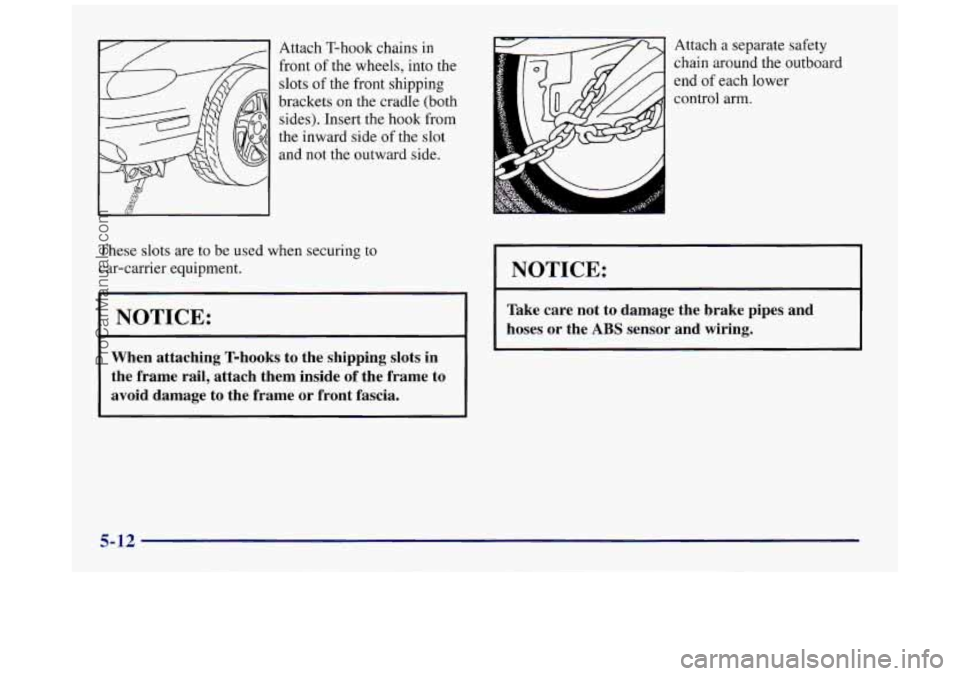
Attach T-hook chains in
front of the wheels, into the
slots of the front shipping
brackets on the cradle (both
sides). Insert the hook from
the inward side
of the slot
and not the outward side.
I
These slots are to be used when securing to
car-carrier equipment.
NOTICE:
When attaching T-hooks to the shipping slots in
the frame rail, attach them inside
of the frame to
avoid damage to the frame or front fascia.
Attach a separate safety
chain around the outboard
end of each lower
control arm.
/A
NOTICE:
Take care not to damage the brake pipes and
hoses or the
ABS sensor and wiring.
5-12
ProCarManuals.com
Page 250 of 422
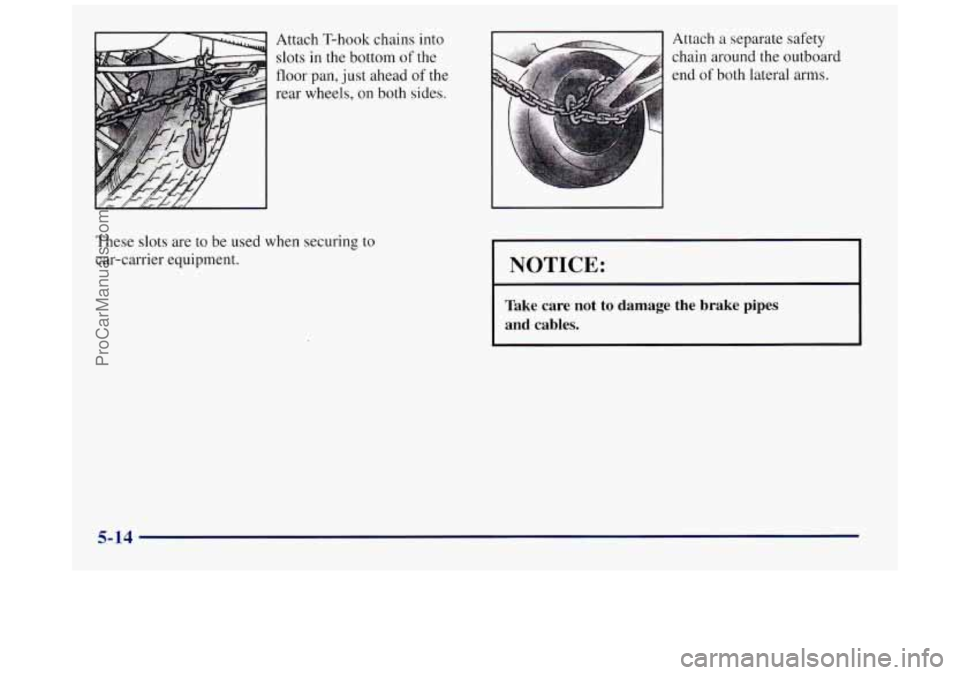
Attach T-hook chains into
slots in
the bottom of the
floor pan,
just ahead of the
rear wheels, on both sides.
These
slots are to be used when securing to
car-carrier equipment. Attach
a separate safety
chain around the outboard
end
of both lateral arms.
I
NOTICE:
Take care not to damage the brake pipes
and cables.
5-14
ProCarManuals.com
Page 261 of 422
If a Tire Goes Flat
It’s unusual for a tire to “blow out” while you’re driving,
especially
if you maintain your tires properly. If air goes
out of a tire, it’s much more likely to leak out slowly.
But if you should ever have a “blowout,’’ here are
a few
tips about what to expect and what to do:
If a front tire fails, the flat tire will create a drag that
pulls the vehicle toward that side. Take your foot off the
accelerator pedal and grip the steering wheel firmly.
Steer to maintain lane position, and then gently brake to
a stop well out
of the traffic lane.
A rear blowout, particularly on a curve, acts much like a
skid and may require the same correction you’d use
in a
skid. In any rear blowout, remove your foot from the
accelerator pedal. Get the vehicle under control by
steering the way you want the vehicle to go. It may be
very bumpy and noisy, but you can still steer. Gently
brake
to a stop -- well off the road if possible.
If
a tire goes flat, the next part shows how to use your
jacking equipment to change
a flat tire safely.
Changing a Flat Tire
If a tire goes flat, avoid further tire and wheel damage
by driving slowly to a level place. Turn on your hazard
warning flashers.
I
Changing a tire can cause an injury. The vehicle
can slip off the jack and roll over you or other
people. You and they could be badly injured.
Find
a level place to change your tire. To help
prevent the vehicle from moving:
1. Set the parking brake firmly.
2. Put the shift lever in PARK (P).
3. Turn off the engine.
To be even more certain the vehicle won’t move,
you can put blocks at the front and rear
of the
tire farthest
away from the one being changed.
That would be the tire on the other side of the
vehicle,
at the opposite end.
ProCarManuals.com
Page 270 of 422
-
Incorrect wheel nuts or improperly tightened
wheel nuts can cause the wheel to become loose
and even come
off. This could lead to an accident.
Be sure to use the correct wheel nuts.
If you have
to replace them, be sure to get new GM original
equipment wheel nuts.
Stop somewhere
as soon as you can and have the
nuts tightened with
a torque wrench to 100 lb-ft
(140 Nom).
5-34
I NOTICE:
Improperly tightened wheel nuts can lead to
brake pulsation and rotor damage. To avoid
expensive brake repairs, evenly tighten the wheel
nuts in the proper sequence and to the proper
torque specification.
Don’t try to put the wheel cover on your compact spare
tire. It won’t fit. Store the wheel cover
in the trunk until
you have the flat tire repaired or replaced.
NOTICE:
Wheel covers won’t fit on your compact spare. If
you try to put a wheel cover on your compact
spare, you could damage the cover or the spare.
ProCarManuals.com
Page 277 of 422
Section 6 Service and Appearance Care
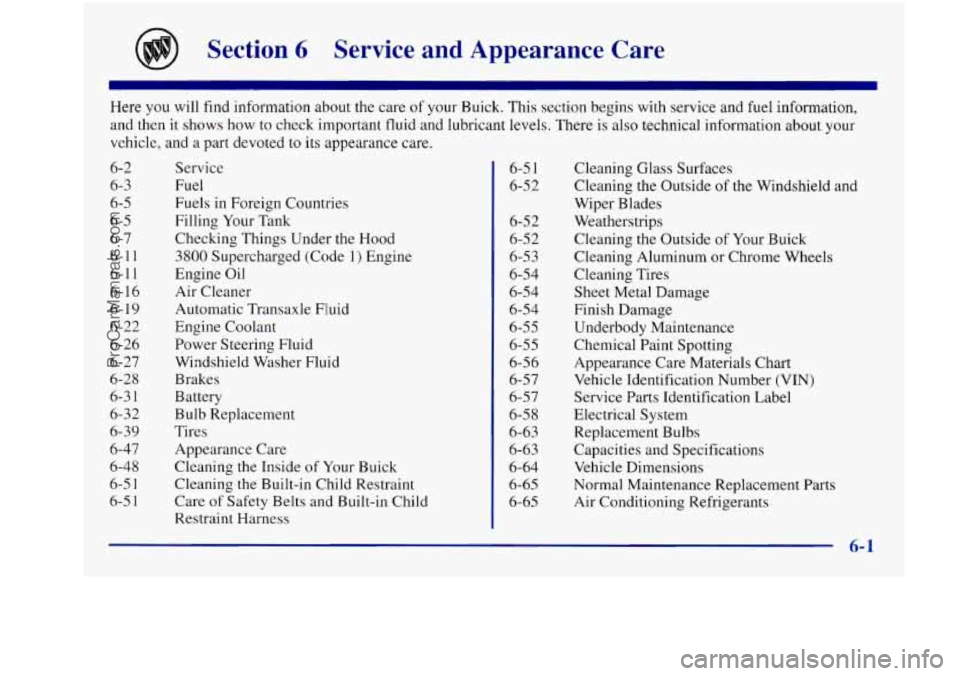
Here you will find information about the care of your Buick. This section begins with service and fuel information,
and then it shows how
to check important fluid and lubricant levels. There is also technical information about your
6-2
6-3
6-5
6-5
6-7
6-11
6-1
1
6-16
6-19
6-22
6-26
6-27
6-28
6-3
1
6-32 6-39
6-47
6-48
6-5
1
6-5 1
vehicle, and a part devoted to its appearance care.
Service
Fuel
Fuels in Foreign Countries
Filling Your Tank
Checking Things Under the Hood
3800 Supercharged (Code 1) Engine
Engine Oil
Air Cleaner
Automatic Transaxle Fluid
Engine Coolant
Power Steering Fluid
Windshield Washer Fluid
Brakes
Battery
Bulb Replacement
Tires
Appearance Care
Cleaning the Inside
of Your Buick
Cleaning the Built-in Child Restraint
Care
of Safety Belts and Built-in Child
Restraint Harness 6-5
1
6-52
6-52
6-52
6-53
6-54 6-54
6-54
6-55
6-55
6-5 6
6-57
6-57
6-58
6-63
6-63
6-64
6-65
6-65 Cleaning Glass Surfaces
Cleaning
the Outside of the Windshield and
Wiper Blades
Weatherstrips Cleaning the Outside of Your Buick
Cleaning Aluminum or Chrome Wheels
Cleaning Tires
Sheet Metal Damage
Finish Damage
Underbody Maintenance
Chemical Paint Spotting
Appearance Care Materials Chart
Vehicle Identification Number
(VIN)
Service Parts Identification Label
Electrical System Replacement Bulbs
Capacities and Specifications
Vehicle Dimensions
Normal Maintenance Replacement Parts
Air Conditioning Refrigerants
6-1
ProCarManuals.com
Page 283 of 422
When you put the cap back on, turn it to the right
(clockwise) until
you hear a clicking sound. Make
sure
you fully install the cap. The diagnostic system
can determine
if the fuel cap has been left off or
improperly installed. This would allow fuel to
evaporate into the atmosphere. See “Malfunction
Indicator Lamp” in the Index.
NOTICE:
If you need a new cap, be sure to get the right
type. Your dealer can get one
for you. If you get
the wrong type, it may not
fit properly. This may
cause your malfunction indicator lamp to light
and your
fuel tank and emissions system may be
damaged. See “Malfunction Indicator Lamp” in
the Index.
Checking Things Under the Yood
An electric fan under the hood can start up and
injure you even when the engine is not running.
Keep hands, clothing and tools away from any
underhood electric fan.
Things that burn can get
on hot engine parts and
start a fire. These include liquids like gasoline,
oil, coolant, brake fluid, windshield washer and
other fluids, and plastic or rubber. You or others
could be burned. Be careful not to drop
or spill
things that will burn onto a hot engine.
ProCarManuals.com
Page 285 of 422
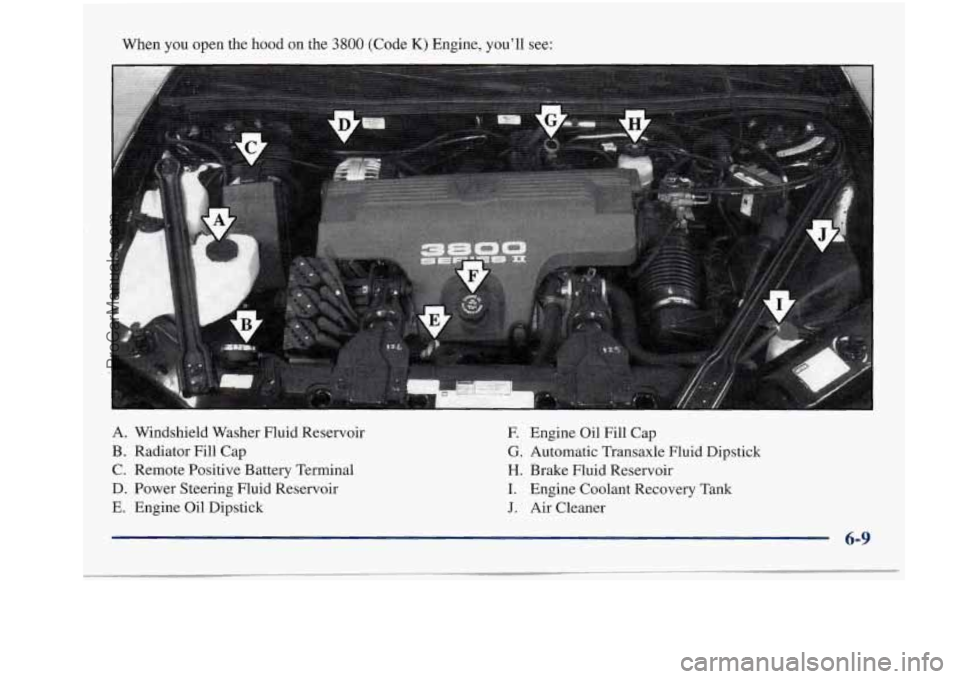
When you open the hood on the 3800 (Code K) Engine, you’ll see:
A. Windshield Washer Fluid Reservoir
F. Engine Oil Fill Cap
B. Radiator Fill Cap
G. Automatic Transaxle Fluid Dipstick
C. Remote Positive Battery Terminal H. Brake Fluid Reservoir
D. Power Steering Fluid Reservoir
I. Engine Coolant Recovery Tank
E. Engine Oil Dipstick J. Air Cleaner
6-9
ProCarManuals.com