Page 282 of 422
If you get gasoline on yourself and then
something ignites it, you could be badly burned.
Gasoline can spray out on you if you open the
fuel filler cap too quickly. This spray can happen
if your tank is nearly full, and is more likely in
hot weather. Open the fuel filler cap slowly and
wait for any “hiss” noise
to stop. Then unscrew
the cap all the
way.
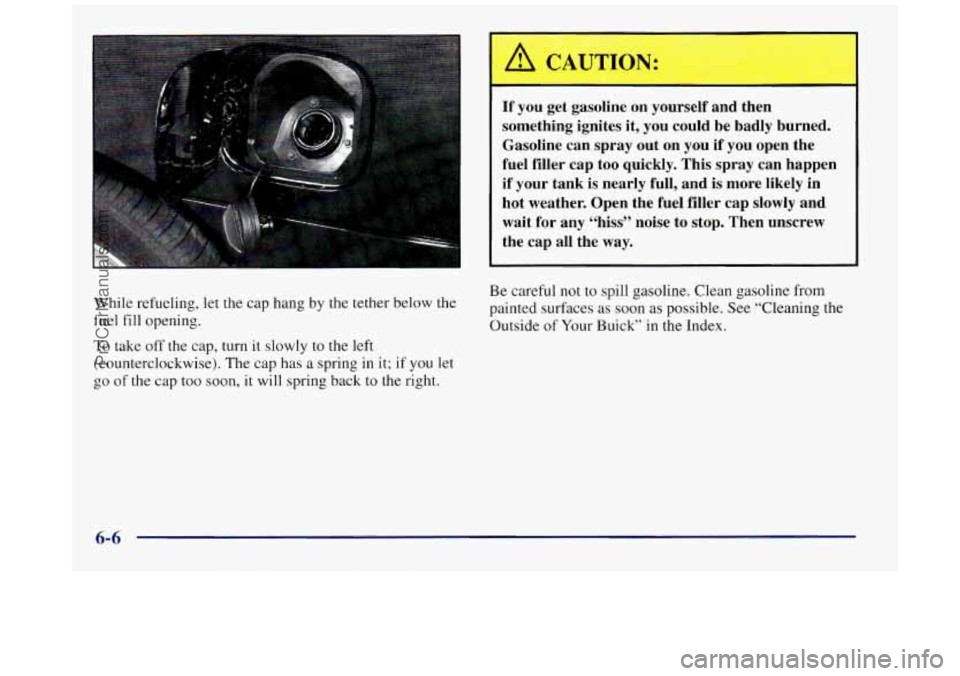
While refueling, let the cap hang by the tether below the
fuel fill opening.
To take off the cap, turn it slowly to the left
(counterclockwise). The cap has a spring
in it; if you let
go of the cap too soon,
it will spring back to the right. Be
careful
not to spill gasoline. Clean gasoline from
painted surfaces as soon as possible. See “Cleaning the
Outside of Your Buick” in the Index.
6-6
ProCarManuals.com
Page 283 of 422
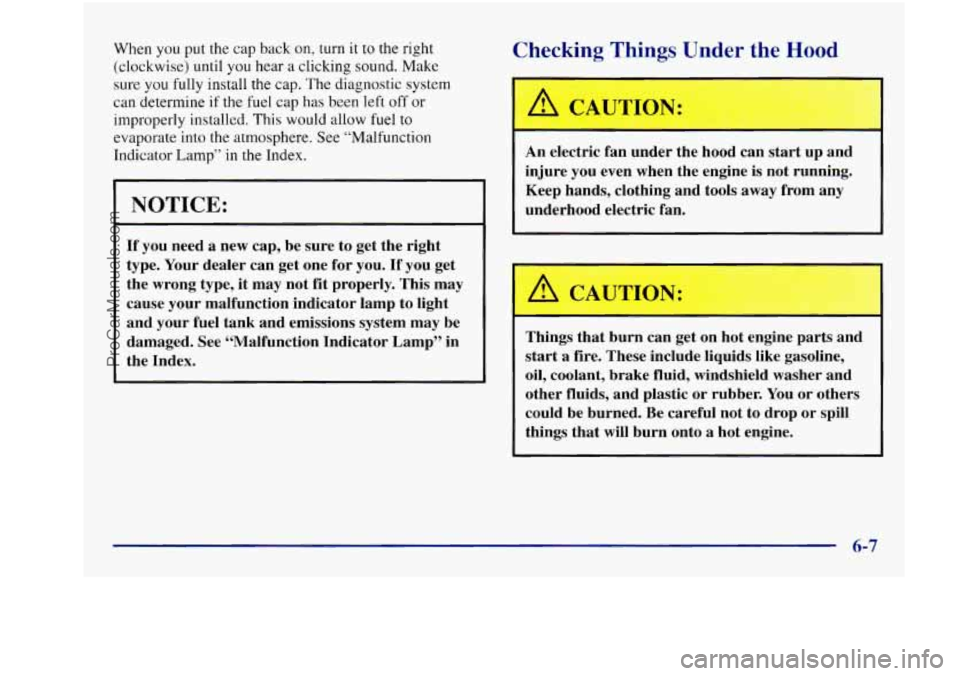
When you put the cap back on, turn it to the right
(clockwise) until
you hear a clicking sound. Make
sure
you fully install the cap. The diagnostic system
can determine
if the fuel cap has been left off or
improperly installed. This would allow fuel to
evaporate into the atmosphere. See “Malfunction
Indicator Lamp” in the Index.
NOTICE:
If you need a new cap, be sure to get the right
type. Your dealer can get one
for you. If you get
the wrong type, it may not
fit properly. This may
cause your malfunction indicator lamp to light
and your
fuel tank and emissions system may be
damaged. See “Malfunction Indicator Lamp” in
the Index.
Checking Things Under the Yood
An electric fan under the hood can start up and
injure you even when the engine is not running.
Keep hands, clothing and tools away from any
underhood electric fan.
Things that burn can get
on hot engine parts and
start a fire. These include liquids like gasoline,
oil, coolant, brake fluid, windshield washer and
other fluids, and plastic or rubber. You or others
could be burned. Be careful not to drop
or spill
things that will burn onto a hot engine.
ProCarManuals.com
Page 287 of 422
Before closing the hood, be sure all the filler caps are
on properly. Then just pull the hood down and close
it firmly.
3800 Supercharged (Code 1) Engine
(If Equipped)
Your Buick may have a 3800 Supercharged engine.
The supercharger is a device which is designed to
pump more air into the engine than it would normally
use. This air is mixed with fuel, which creates increased
engine power. Since the supercharger is a pump and is
driven from an engine accessory drive belt, increased
pressure is available at all driving conditions.
The powertrain control module
(PCM), works with
a vacuum control to regulate the increased pressure
required during specific driving conditions. When
this
increased pressure or boost is not desired, such as during
idling and light throttle cruising, the excess air that the
supercharger
is pumping is routed through a bypass.
All of these controls working together provide high
performance character and fuel efficiency in the
3800 Supercharged L67 engine.
Engine
I --
LOW
OIL
If the LOW OIL light on
the instrument panel comes on, it means you need to
check your engine oil level right away. For more
information, see
“Low Oil
Level Light” in the Index.
You should check your
engine oil level regularly;
this is an added reminder.
It’s
a good idea to check your engine oil every time you
get fuel. In order to get an accurate reading, the oil must
be warm and the vehicle must be on level ground.
6-11
ProCarManuals.com
Page 339 of 422
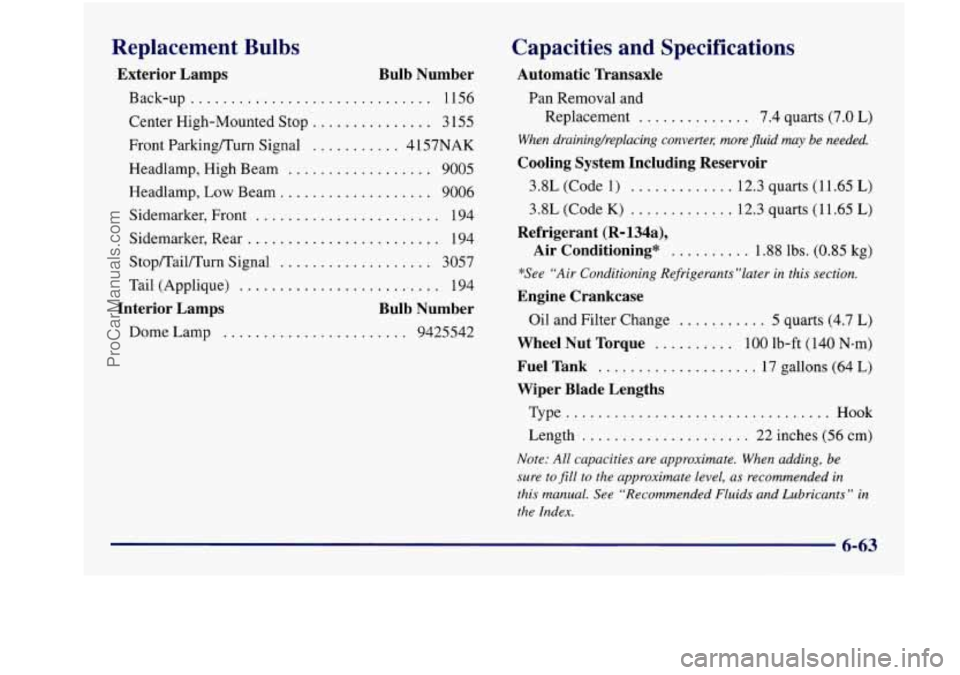
Replacement Bulbs
Exterior Lamps Bulb Number
Back-up .............................. 1156
Center High-Mounted Stop
............... 3 155
Front Parking/Turn Signal
........... 4 157NAK
Headlamp, High Beam
.................. 9005
Headlamp,
Low Beam. .................. 9006
Sidemarker, Front
....................... 194
Sidemarker, Rear
........................ 194
Stop/Tail/Turn Signal
................... 3057
Tail (Applique)
......................... 194
Interior Lamps Bulb Number
Dome Lamp ....................... 9425542
Capacities and Specifications
Automatic nansaxle
Pan Removal and
Replacement
.............. 7.4 quarts (7.0 L)
When drainingheplacing converter; more fluid my be needed.
Cooling System Including Reservoir
3.8L (Code 1) ............. 12.3 quarts (1 1.65 L)
3.8L (Code K) ............. 12.3 quarts (1 1.65 L)
Air Conditioning* .......... 1.88 lbs. (0.85 kg)
Refrigerant (R=134a),
*See “Air Conditioning Refrigerants”1ater in this section.
Engine Crankcase
Oil and Filter Change ........... 5 quarts (4.7 L)
Wheel Nut Torque .......... 100 lb-ft (140 N-m)
Fuel Tank .................... 17 gallons (64 L)
Wiper Blade Lengths
Type ................................. Hook
Length ..................... 22 inches (56 cm)
Note: All capacities are approximate. When adding, be
sure to
fill to the approximate level, as recommended in
this manual. See “Recommended Fluids and Lubricants
” in
the Index.
6-63
ProCarManuals.com
Page 347 of 422
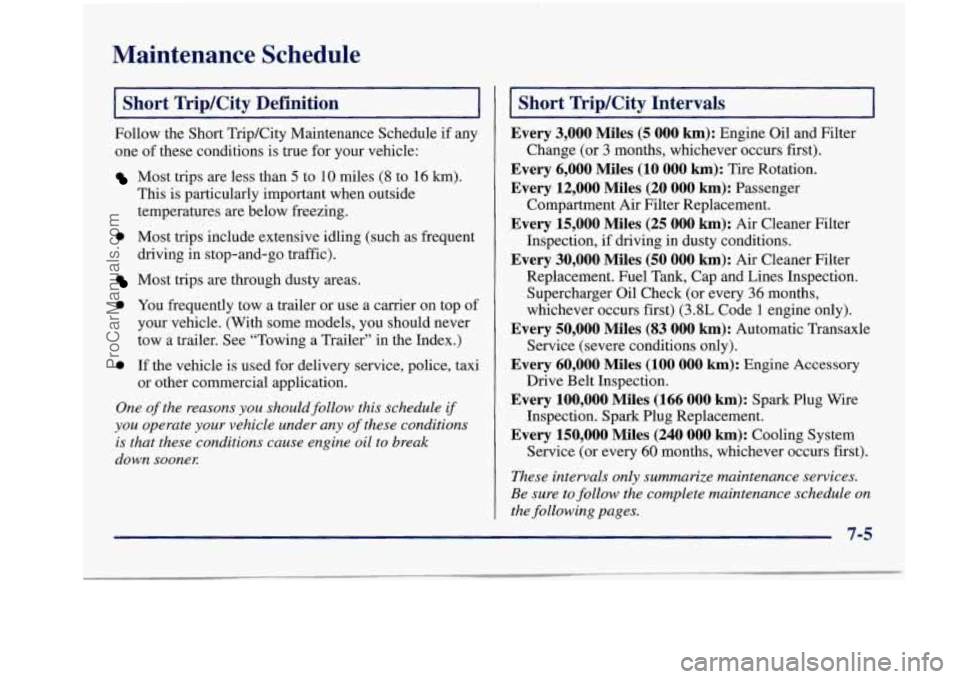
Maintenance Schedule
Short TripKity Definition
Follow the Short TripKity Maintenance Schedule if any
one of these conditions is true for your vehicle:
Most trips are less than 5 to 10 miles (8 to 16 km).
This is particularly important when outside
temperatures are below freezing.
0 Most trips include extensive idling (such as frequent
driving in stop-and-go traffic).
Most trips are through dusty areas.
0 You frequently tow a trailer or use a carrier on top of
your vehicle. (With some models, you should never
tow
a trailer. See “Towing a Trailer” in the Index.)
0 If the vehicle is used for delivery service, police, taxi
or other commercial application.
One
of the reasons you should follow this schedule if
you operate your vehicle under any of these conditions
is that these conditions cause engine oil to break
down soonel:
Short Trip/City Intervals
Every 3,000 Miles (5 000 km): Engine Oil and Filter
Change
(or 3 months, whichever occurs first).
Every 6,000 Miles (10 000 km): Tire Rotation.
Every 12,000 Miles (20 000 km): Passenger
Every 15,000 Miles (25 000 km): Air Cleaner Filter
Every 30,000 Miles (50 000 km): Air Cleaner Filter
Compartment Air Filter Replacement.
Inspection, if driving
in dusty conditions.
Replacement. Fuel Tank, Cap and Lines Inspection.
Supercharger Oil Check (or every 36 months,
whichever occurs first)
(3.8L Code 1 engine only).
Every 50,000 Miles (83 000 km): Automatic Transaxle
Service (severe conditions only).
Every 60,000 Miles (100 000 km): Engine Accessory
Drive Belt Inspection.
Every 100,000 Miles (166 000 km): Spark Plug Wire
Inspection. Spark Plug Replacement.
Every 150,000 Miles (240 000 km): Cooling System
Service (or every
60 months, whichever occurs first).
These intervals only summarize maintenance services.
Be sure to follow the complete maintenance schedule
on
the following pages.
I- 7-5
ProCarManuals.com
Page 348 of 422
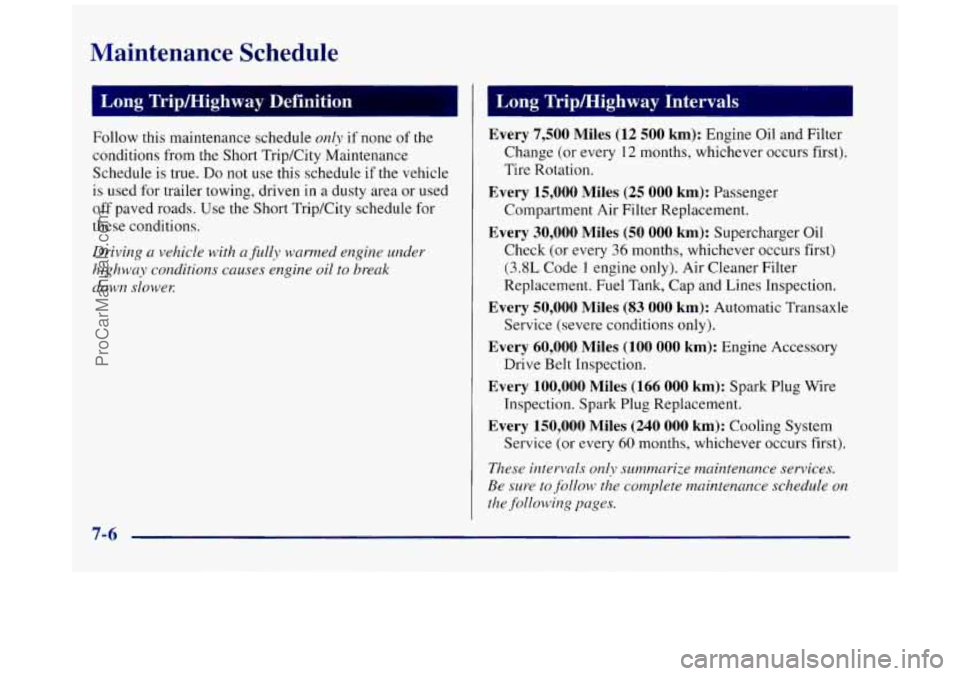
Maintenance Schedule
Follow this maintenance schedule only if none of the
conditions from
the Short TripKity Maintenance
Schedule is true.
Do not use this schedule if the vehicle
is used for trailer towing, driven in a dusty area or used
off paved roads. Use the Short Trip/City schedule for
these conditions.
Driving a vehicle with a fidly warmed engine under
highway conditions causes engine oil to break
down
slowex
Every 7,500 Miles (12 500 km): Engine Oil and Filter
Change (or every 12 months, whichever occurs first).
Tire Rotation.
Every 15,000 Miles (25 000 km): Passenger
Compartment Air Filter Replacement.
Every 30,000 Miles (50 000 km): Supercharger Oil
Check (or every
36 months, whichever occurs first)
(3.8L Code 1 engine only). Air Cleaner Filter
Replacement. Fuel Tank, Cap and Lines Inspection.
Every 50,000 Miles (83 000 km): Automatic Transaxle
Service (severe conditions only).
Every 60,000 Miles (100 000 km): Engine Accessory
Drive Belt Inspection.
Every 100,000 Miles (166 000 krn): Spark Plug Wire
Inspection. Spark Plug Replacement.
Every 150,000 Miles (240 000 km): Cooling System
Service (or every
60 months, whichever occurs first).
These intervals only summarize maintenance services.
Be sure to follow the complete nzaintenance schedule on
the following pages.
7-6
ProCarManuals.com
Page 354 of 422
I Short TripKity Maintenance Schedule I
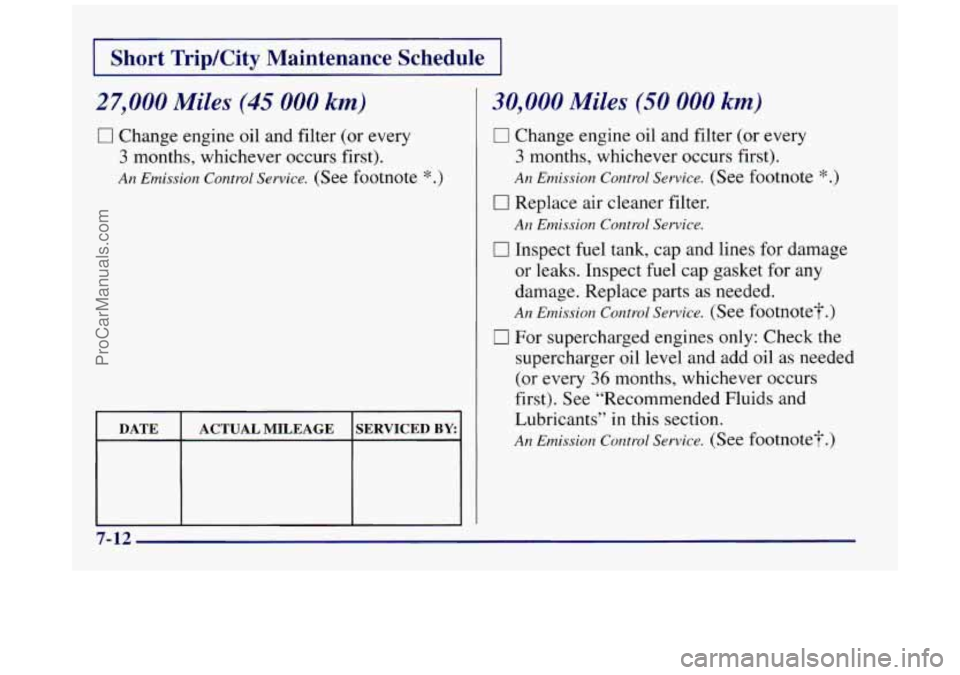
27,000 Miles (45 000 km)
0 Change engine oil and filter (or every
3 months, whichever occurs first).
An Emission Control Service. (See footnote *.)
DATE SERVICED BY: ACTUAL MILEAGE
30,000 Miles (50 000 km)
0 Change engine oil and filter (or every
3 months, whichever occurs first).
An Emission Control Service. (See footnote *.)
0 Replace air cleaner filter.
0 Inspect fuel tank, cap and lines for damage
or leaks. Inspect fuel cap gasket for any
damage. Replace parts as needed.
An Emission Control Service. (See footnote?.)
0 For supercharged engines only: Check the
supercharger oil level and add oil as needed
(or every
36 months, whichever occurs
first). See “Recommended Fluids and
Lubricants” in this section.
An Emission Control Service. (See footnote?.)
An Emission Control Service.
7-12
ProCarManuals.com
Page 360 of 422
I Short TripKity Maintenance Schedule I
~~~
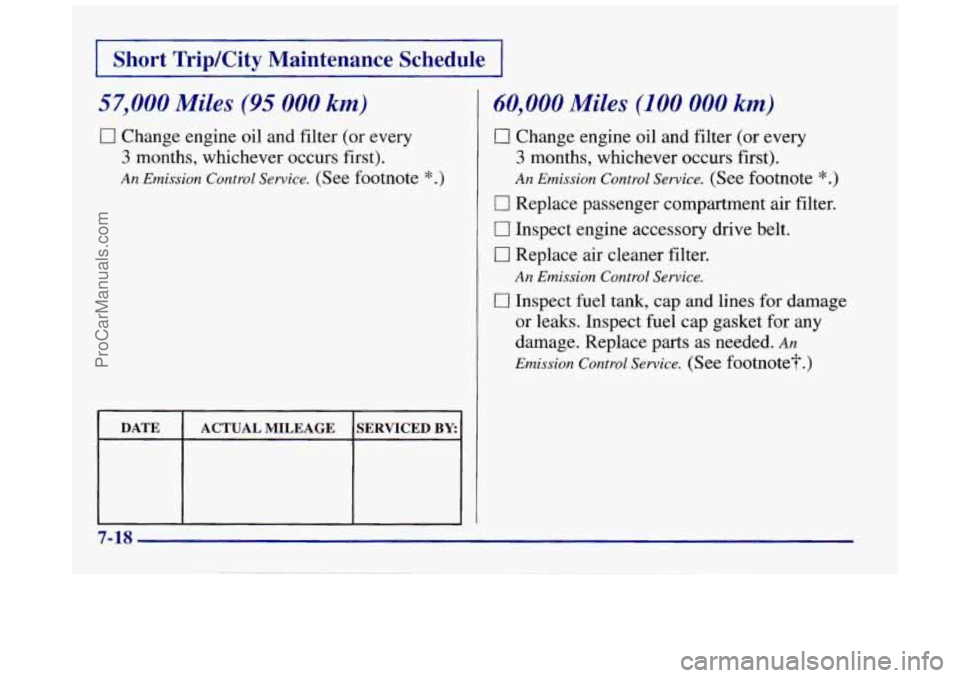
57,000 Miles (95 000 km)
0 Change engine oil and filter (or every
3 months, whichever occurs first).
An Emission Control Service. (See footnote *.)
DATE
SERVICED BY: ACTUAL MILEAGE
60,000 Miles (100 000 km)
0 Change engine oil and filter (or every
3 months, whichever occurs first).
An Emission Control Service. (See footnote *.)
[7 Replace passenger compartment air filter.
0 Inspect engine accessory drive belt.
0 Replace air cleaner filter.
An Emission Control Service.
[7 Inspect fuel tank, cap and lines for damage
or leaks. Inspect fuel cap gasket for any
damage. Replace parts as needed.
An
Emission Control Service.
(See footnote"f )
7-18
ProCarManuals.com