Page 99 of 420
Windshield Washer
At the top of the multifunction lever there’s a paddle
with the word
PUSH on it. To spray washer fluid on the
windshield, push the paddle for less than a second. The
wipers will clear the window and then either stop or
return
to your preset speed. For more washer cycles,
push and hold the paddle.
In freezing weather, don’t use your washer until
the windshield is warmed. Otherwise the washer
fluid can form ice
on the windshield, blocking
your vision.
If your vehicle is equipped with a DIC, a
WINDSHIELD WASHER FLUID LOW message will
appear on the display when you are low on washer fluid.
Cruise Control
With cruise control, you can
maintain a speed
of about
25 mph (40 kmh) or more
without keeping your foot
on the accelerator.
This can
really help on long
trips.
Cruise control does not work at speeds below about
25 mph (40 km/h).
When you apply your brakes, the cruise control
shuts
off.
2-39
ProCarManuals.com
Page 213 of 420
If you drive regularly in steep country, or if you’re
planning to visit there, here are some tips that can make
your trips safer and more enjoyable.
0 Keep your vehicle in good shape. Check all fluid levels
and
also the brakes, tires, cooling system and transaxle.
These parts can work hard on mountain roads.
0 Know how to go down hills. The most important
thing to know is this: let your engine do some of the
slowing down. Shift to a lower gear when you go
down a steep or long hill.
If you don’t shift down, your brakes could get
so hot that they wouldn’t work well. You would
then have poor braking or even none going
down
a hill. You could crash. Shift down to let
your engine assist your brakes on
a steep
downhill slope.
-_ 1
Coasting downhill in NEUTRAL (N) or with the
ignition
off is dangerous. Your brakes will have to
do all the work of slowing down. They could get
so hot that they wouldn’t work well. You would
then have poor braking or even none going down
a hill. You could crash. Always have your engine
running and your vehicle in gear when you
go downhill.
0 Know how to go uphill. Drive in the highest
gear possible.
0 Stay in your own lane when driving on two-lane
roads in hills or mountains. Don’t swing wide or cut
across the center of the road. Drive at speeds that let
you stay in your own lane.
As you go over the top of a hill, be alert. There could be
something
in your lane, like a stalled car or an accident.
You may see highway signs on mountains that warn of
special problems. Examples are long grades, passing or
no-passing zones, a falling rocks area or winding
roads. Be alert to these and take appropriate action.
4-25
ProCarManuals.com
Page 226 of 420
Driving On Grades
Reduce speed and shift to a lower gear before you start
down a long or steep downgrade.
If you don’t shift
down, you might have to use your brakes
so much that
they would get hot and no longer work well.
On a long uphill grade, shift down to
THIRD (3) and
reduce your speed to around
45 mph (70 km/h) to reduce
the possibility of engine and transaxle overheating.
Parking on Hills
You really should not park your vehicle, with a trailer
attached, on a hill. If something goes wrong, your rig
could start to move. People can be injured, and both
your vehicle and the trailer can be damaged.
But if you ever have to park your rig on a hill, here’s
how to do it:
1. Apply your regular brakes, but don’t shift into
2. Have someone place chocks under the trailer wheels.
3. When the wheel chocks are in place, release the
regular brakes until the chocks absorb the load.
4. Reapply the regular brakes. Then apply your parking
brake, and then shift to PARK (P).
5. Release the regular brakes.
PARK (P) yet.
When You Are Ready to Leave After
Parking
on a Hill
1. Apply your regular brakes and hold the pedal down
while you:
Start your engine;
Shift into a gear; and
0 Release the parking brake.
2. Let up on the brake pedal.
3. Drive slowly until the trailer is clear of the chocks.
4. Stop and have someone pick up and store the chocks.
Maintenance When Trailer Towing
Your vehicle will need service more often when you’re
pulling a trailer. See the Maintenance Schedule for more
on this. Things that
are especially important in trailer
operation are automatic transaxle fluid (don’t overfill),
engine oil, belts, cooling system and brake adjustment.
Each of these is covered in this manual, and the Index
will help you find them quickly. If you’re trailering, it’\
s
a good idea to review these sections before you start
your trip.
Check periodically to see that all hitch nuts and bolts
are tight.
ProCarManuals.com
Page 265 of 420
Section 6 Service and Appearance Care
Here you will find information about the care of your Buick. This section begins with service and fuel information,
and then it shows how to check important fluid and lubricant levels. There is also technical information about your
vehicle, and a part devoted to its appearance care.
6-2
6-3
6-9
6-12
6- 17
6-20
6-2
1
6-24
6-28
6-29
6-30
6-34
6-34
6-46
6-47 Service
Fuel Checking Things Under the
Hood
Engine Oil
Air Cleaner Supercharger Oil
Automatic Transaxle Fluid
Engine Coolant Radiator Pressure Cap
Windshield Washer Fluid
Brakes
Battery
Bulb Replacement
Windshield Wiper Blade Replacement
Tires 6-56
6-57
6-6
1
6-64
6-64
6-65
6-66
6-67
6-73
6-75 6-76
6-77
6-77
6-78
6-78 Appearance
Care
Cleaning the Inside
of Your Buick
Cleaning the Outside of Your Buick
Underbody Maintenance
Chemical Paint Spotting
Appearance Care Materials Chart
Vehicle Identification Number (VIN)
Electrical System
Removing the Rear Seat Cushion
Replacement Bulbs Capacities and Specifications
Air Conditioning Refrigerants
Engine Specifications Vehicle Dimensions
Normal Maintenance Replacement Parts
ProCarManuals.com
Page 273 of 420
Checking Things Under the Hood Hood Release
A CAUTION:
An electric fan under the hood can start up and
injure you even when the engine is not running.
Keep hands, clothing and tools away from any
underhood electric fan.
A CAUTION: I I
Things that burn can get on hot engine parts and
start a fire. These include liquids like gasoline,
oil, coolant, brake fluid, windshield washer and
other fluids, and plastic or rubber. You or others
could be burned. Be careful not
to drop or spill
things that will burn onto a hot engine.
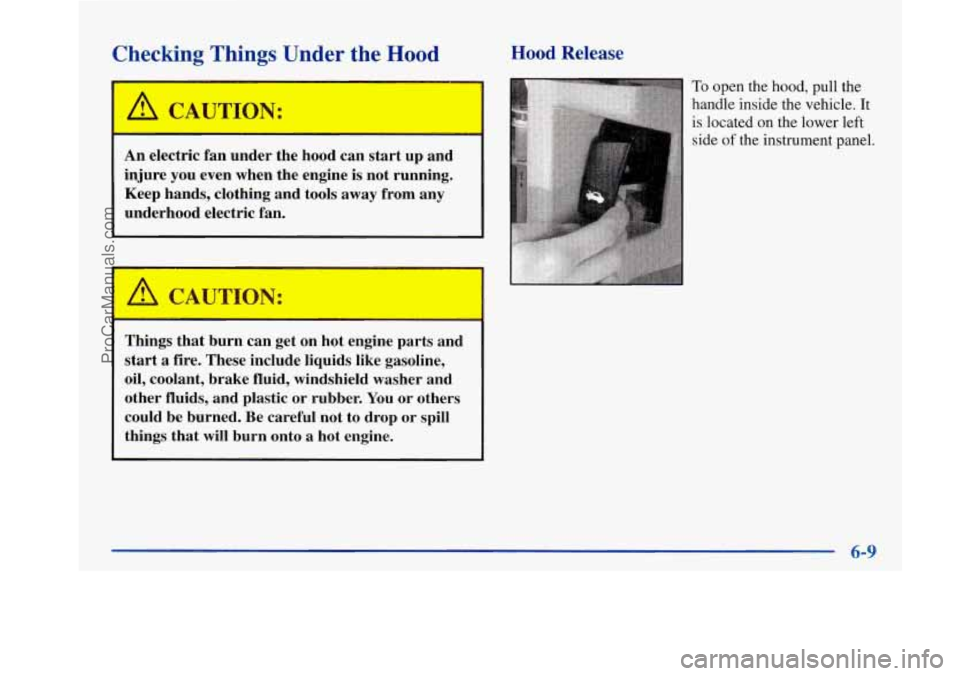
To open the hood, pull the
handle inside the vehicle. It
is located on the lower left
side
of the instrument panel.
6-9
ProCarManuals.com
Page 275 of 420
3800 Series I1 (Code K) Engine (L36)
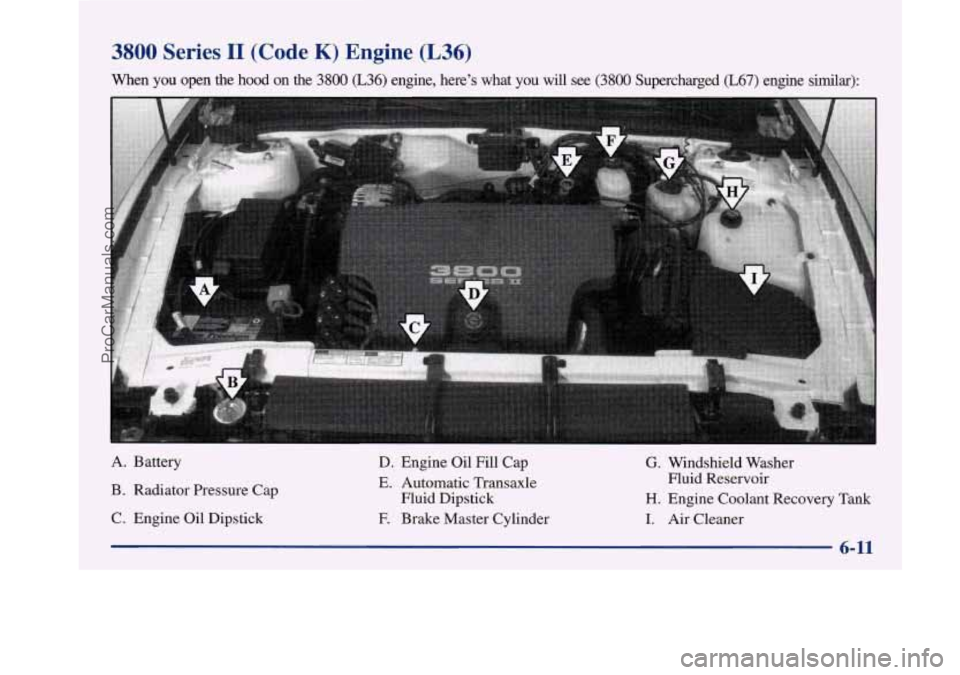
When you open the hood on the 3800 (L36) engine, here’s what you will see (3800 Supercharged (L67) engine similar):
“14 ,....
A. Battcry
D. Engine Oil Fill Cap G. Windshield Washer
B
. Radiator Pressure Cap
C. Engine Oil Dipstick E.
Automatic Transaxle
Fluid Dipstick
F. Brake Master Cylinder Fluid Reservoir
H. Engine Coolant Recovery
Tank
I. Air Cleaner
6-11
ProCarManuals.com
Page 286 of 420
Checking the Fluid Level
Park your vehicle on a level place. Keep the engine
running.
With the parking brake applied, place the shift lever
in PARK (P).
With your foot on the brake pedal, move the shift
lever through each gear range, pausing for about
three seconds
in each range. Then, position the shift
lever
in PARK (P).
0 Let the engine run at idle for three to five minutes. Then,
without shutting
off the engine, follow
these steps:
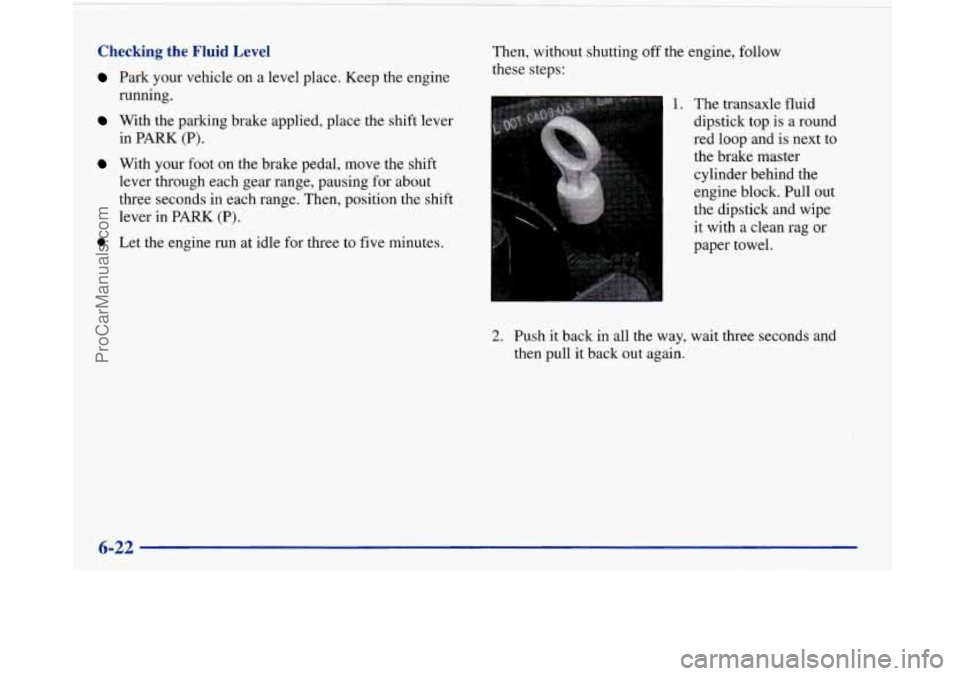
1. The transaxle fluid
dipstick top is a round
red loop and is next
to
the brake master
cylinder behind the
engine block. Pull out
the dipstick and wipe
it with a clean rag or
paper towel.
2. Push it back in all the way,
then pull it back out again. wait
three seconds and
6-2’
ProCarManuals.com
Page 294 of 420
NOTICE:
0
0
When using concentrated washer fluid,
follow the manufacturer’s instructions for
adding water.
Don’t mix water with ready-to-use washer
fluid. Water can cause the solution to freeze
and damage your washer fluid tank and
other parts of the washer system. Also,
water doesn’t clean as well as washer fluid.
Fill your washer fluid tank only
three-quarters full when
it’s very cold. This
allows for expansion
if freezing occurs,
which could damage the tank if it is
completely full.
Don’t use radiator antifreeze in your
windshield washer. It can damage your
washer system and paint.
Brakes
Brake Fluid
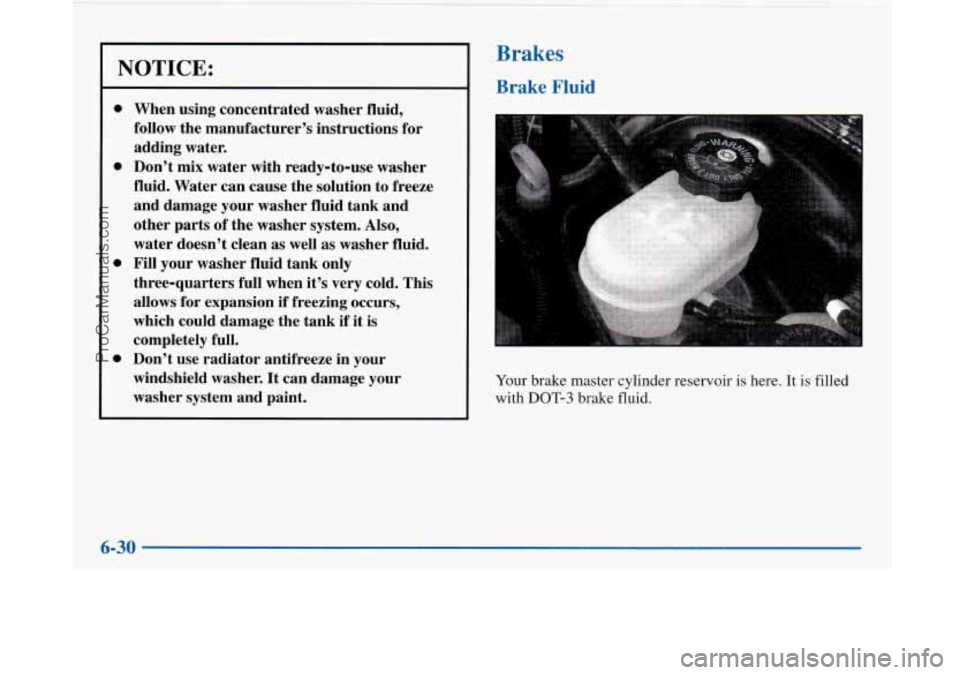
Your brake master cylinder reservoir is here. It is filled
with
DOT-3 brake fluid.
ProCarManuals.com