1997 BUICK PARK AVENUE lock
[x] Cancel search: lockPage 78 of 420

This device complies with Part 15 of the FCC Rules.
Operation
is subject to the following two conditions:
(1) ths device may not cause harmful interference,
and
(2) this device must accept any interference
received, including interference that may cause
undesired operation.
This device complies with
RSS-210 of Industry and
Science Canada. Operation is subject to the following
two conditions:
(1) this device may not cause
interference, and
(2) this device must accept any
interference received, including interference that may cause undesired operation of the device.
Changes or modifications to this system by other than
an authorized service facility could void authorization
to use this equipment.
When the PASS-Key
III system senses that someone is
using the wrong key, it shuts down the vehicle’s starter
and fuel systems. The starter will not work and fuel
will stop being delivered to the engine. Anyone using
a trial-and-error method to start the vehicle will be
discouraged because of the high number of electrical
key codes. If
when trying to start the vehicle, the engine does not
start and the
SECURITY light comes on, the key may
have a damaged transponder. Turn the ignition off
and
try again.
If the engine still does not start, and the key appears to
be undamaged, try another ignition key. At this time,
you may also want to check the fuse (see “Fuses and
Circuit Breakers” in the Index). If the engine still does
not start with the other key, your vehicle needs service.
If your vehicle does start, the first key may be faulty.
See your Buick dealer or a locksmith who can service
the PASS-Key I11 to have a new key made.
It is possible for the PASS-Key
111 decoder to learn the
transponder value of
a new or replacement key. Up to
ten additional keys may be programmed for the vehicle.
This procedure is for learning additional keys only. If all
the currently programmed keys are lost or do not
operate, you must see your Buick dealer or a locksmith
who can service PASS-Key
I11 to have keys made and
programmed to the system.
See your dealer or a locksmith who can service
PASS-Key
I11 to get a new key blank that is a cut
exactly as a current black colored driver’s key that
operates the system.
Do not use a gray colored valet
key for this procedure.
2-18
~
ProCarManuals.com
Page 80 of 420
Ignition Positions
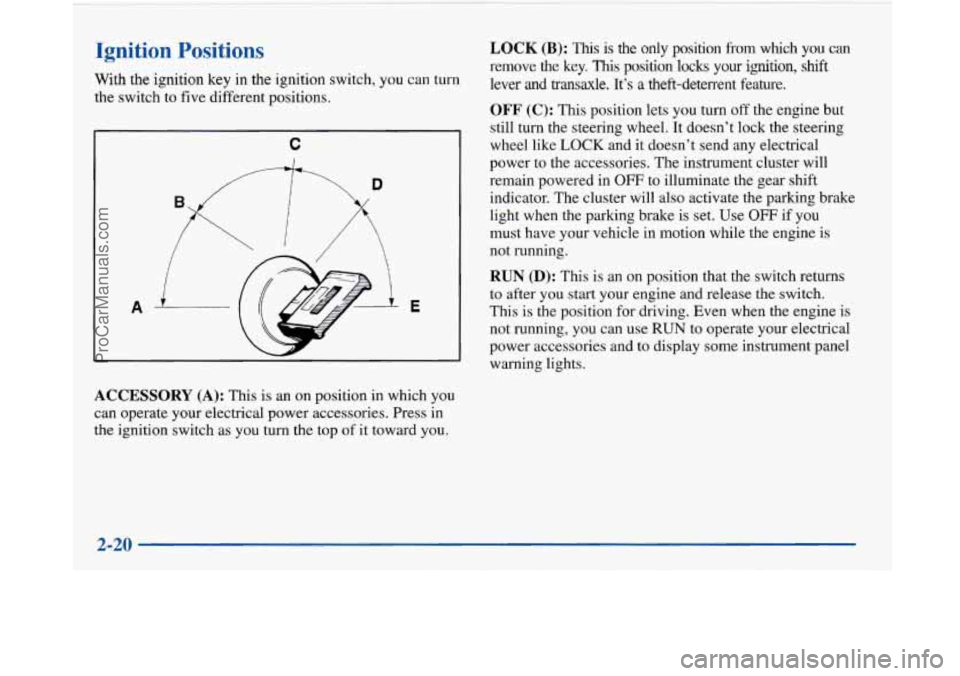
With the ignition key in the ignition switch, you can turn
the switch to five different positions.
C
I
D
-E 1
ACCESSORY (A): This is an on position in which you
can operate your electrical power accessories. Press in
the ignition switch as you turn the top of it toward you.
LOCK (B): This is the only position Erom which you can
remove the key.
This position locks your ignition, shift
lever and transaxle. It’s a theft-detewent feature.
OFF (C): This position lets you turn off the engine but
still turn the steering wheel. It doesn’t lock the steering
wheel like
LOCK and it doesn’t send any electrical
power to the accessories. The instrument cluster will
remain powered in
OFF to illuminate the gear shift
indicator. The cluster will also activate the parking brake
light when the parking brake is set. Use
OFF if you
must have your vehicle in motion while the engine is
not running.
RUN (D): This is an on position that the switch returns
to after you start your engine and release the switch.
This is the position for driving. Even when the engine is
not running, you can use
RUN to operate your electrical
power accessories and to display some instrument panel
warning lights.
2-20
I
ProCarManuals.com
Page 81 of 420
START (E): This position starts your engine. When the
engine starts, release the key. The ignition switch will
return to
RUN for normal driving.
NOTICE:
If your key seems stuck in LOCK and you can’t
turn it, be sure you are using the correct key; if
so, is it all the way in? If it is, then turn the
steering wheel left and right while you turn the
key hard. But turn the key only with your hand.
Using
a tool to force it could break the key or the
ignition switch.
If none of this works, then your
vehicle needs service.
Key Reminder Warning
If you leave your key in the ignition, in the OFF
position, you will hear a warning chime when you open
the driver’s door.
Retained Accessory Power
After you turn your ignition off and even remove the
key, you will still have electrical power to such
accessories as the radio and power windows for up to
10 minutes. But if you open a door, power is shut off.
Starting Your Engine
Move your shift lever to PARK (P) or NEUTRAL (N).
Your engine won’t start in any other position -- that’s a
safety feature. To restart when you’re already moving,
use NEUTRAL (N) only.
NOTICE:
Don’t try to shift to PARK (P) if your Buick is
moving.
If you do, you could damage the
transaxle. Shift to
PARK (P) only when your
vehicle is stopped.
1. Without pushing the accelerator pedal, turn your
ignition key to START. When the engine starts, let
go of the key. The idle speed will go down as your
engine gets warm.
2-21
ProCarManuals.com
Page 84 of 420
PARK (P): This locks your front wheels. It’s the best
position to use when you start your engine because your
vehicle can’t move easily.
It is dangerous to get out of your vehicle if the
shift lever is not fully in
PARK (P) with the
~ parking brake firmly set. Your vehicle can roll.
Don’t leave your vehicle when the engine
is
running unless you have to. If you have left the
engine running, the vehicle can move suddenly.
You or others could be injured.
To be sure your
vehicle won’t move, even when you’re on fairly
level ground, always set your parking brake and
move the shift lever to
PARK (P).
See “Shifting Into PARK (P)” in the Index. If
you’re pulling a trailer, see “Towin9: a Trailer” in
I theIndex* I
Ensure the shift lever is fully in PARK (P) range before
starting
the engine. Your Buick has a brake-transaxle
shift interlock.
You have to fully apply your regular
brakes
before you can shift from PARK (P) when the
ignition key is in the
RUN position. If you cannot shift
out of PARK
(P), ease pressure on the shift lever -- push
the shift lever all the way into PARK (P) as you
maintain brake application. Then move the shift lever
into the gear you wish. See “Shifting Out of PARK
(P)”
in the Index.
REVERSE (R): Use this gear to back up.
NOTICE:
Shifting to REVERSE (R) while your vehicle is
moving forward could damage your transaxle. Shift to
REVERSE (R) only after your vehicle
is stopped.
To rock your vehicle back and forth to get out of snow,
ice or sand without damaging your transaxle, see “If
You’re Stuck:
In Sand, Mud, Ice or Snow” in the Index.
2-24
ProCarManuals.com
Page 87 of 420
Parking Brake
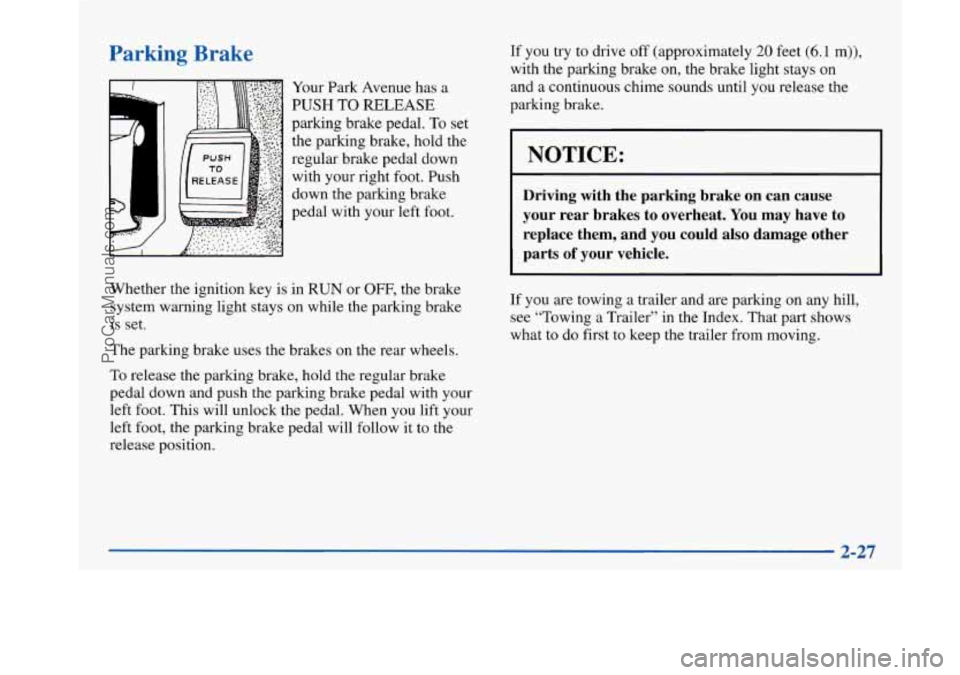
Your Park Avenue has a
PUSH TO RELEASE
parking brake pedal. To set
the parking brake, hold the
regular brake pedal down
with your right foot. Push
down the parking brake
pedal with your left foot.
~___
Whether the ignition key is
in RUN or OFF, the brake
system warning light stays on while the parking brake
is set.
The parking brake uses the brakes on the rear wheels.
To release the parking brake, hold the regular brake
pedal down and push the parking brake pedal with your
left foot. This will unlock the pedal. When you lift your
left foot, the parking brake pedal will follow it to the
release position. If you
try to drive
off (approximately 20 feet (6.1 m)),
with the parking brake on, the brake light stays on and a continuous chime sounds until you release the
parking brake.
I NOTICE:
Driving with the parking brake on can cause
your rear brakes to overheat.
You may have to
replace them, and you could also damage other
parts
of your vehicle.
If you are towing a trailer and are parking on any hill,
see “Towing a Trailer” in the Index. That part shows
what to do first to keep the trailer from moving.
2-27
ProCarManuals.com
Page 89 of 420
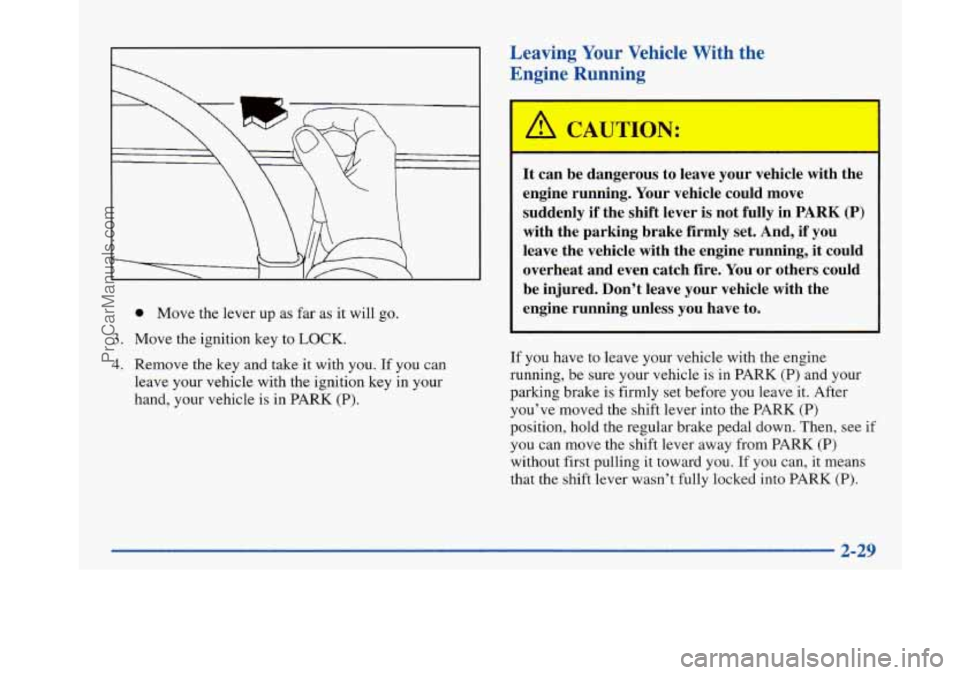
0 Move the lever up as far as it will go.
3. Move the ignition key to LOCK.
4. Remove the key and take it with you. If you can
leave your vehicle with the ignition key in your
hand, your vehicle is in PARK (P).
Leaving Your Vehicle With the
Engine Running
I
It can be dangerous to leave your vehicle with the
engine running. Your vehicle could move
suddenly if the shift lever
is not fully in PARK (P)
with the parking brake firmly set. And, if you
leave the vehicle with the engine running, it could
overheat and even catch fire. You or others could
be injured. Don’t leave your vehicle with the
engine running unless you have to.
If you have to leave your vehicle with the engine
running, be sure your vehicle is in PARK
(P) and your
parking brake is firmly set before you leave it. After
you’ve moved the shift lever into the PARK (P)
position, hold the regular brake pedal down. Then, see
if
you can move the shift lever away from PARK (P)
without first pulling it toward you.
If you can, it means
that the shift lever wasn’t fully locked into PARK (P).
2-29
ProCarManuals.com
Page 90 of 420

Torque Lock
If you are parking on a hill and you don’t shift your
transaxle into PARK
(P) properly, the weight of the
vehicle may put too much force on the parking pawl in
the transaxle. You may find it difficult to pull the shift
lever out of PARK (P). This is called “torque lock.”
To
prevent torque lock, set the parking brake and then shift
into PARK
(P) properly before you leave the driver’s
seat. To find out how, see “Shifting Into
PARK (P)” in
the Index.
When you are ready
to drive, move the shift lever out of
PARK
(P) before you release the parking brake.
If torque lock does occur, you may need to have another
vehicle push yours a little uphill to take some of the
pressure from the parking pawl in the transaxle,
so you
can pull the shift lever out
of PARK (P).
Shifting Out of PARK (P)
Your Buick has a brake-transaxle shift interlock. You
have to fully
apply your regular brake before you can
shift from PARK (P) when the ignition
is in the RUN
position. See “Automatic Transaxle” in the Index.
If you cannot shift out of PARK (P), ease pressure on
the shift lever
-- push the shift lever all the way into
PARK (P) as you maintain brake application. Then
move the shift lever into the gear you want.
If you ever hold the brake pedal down but still can’t
shift out
of PARK (P), try this:
1. Turn the key to OFF. Open and close the driver’s
2. Apply and hold the brake until the end of Step 4.
door to turn off the retained accessory power feature.
3. Shift to NEUTRAL (N).
4. Start the vehicle and then shift to the drive gear
you want.
5. Have the vehicle fixed as soon as you can.
2-30
ProCarManuals.com
Page 93 of 420
Windows
Power Windows
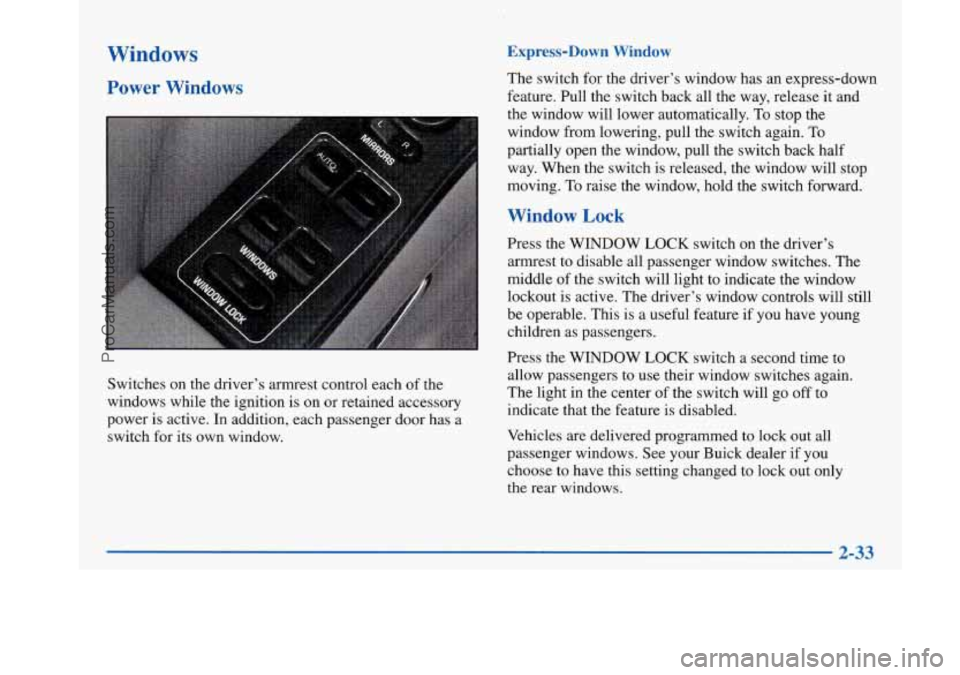
Switches on the driver’s armrest control each of the
windows while the ignition is on or retained accessory
power is active. In addition, each passenger door has a
switch for its own window.
Express-Down Window
The switch for the driver’s window has an express-down
feature. Pull the switch back all the way, release it and
the window will lower automatically. To stop the
window from lowering, pull the switch again. To
partially open the window, pull the switch back half
way. When the switch is released, the window will stop
moving. To raise the window, hold the switch forward.
Window Lock
Press the WINDOW LOCK switch on the driver’s
armrest to disable all passenger window switches. The
middle of the switch will light
to indicate the window
lockout is active. The driver’s window controls will still
be operable. This is a useful feature if you have young
children as passengers.
Press the WINDOW
LOCK switch a second time to
allow passengers to use their window switches again.
The light in the center of the switch will go off to
indicate that the feature is disabled.
Vehicles are delivered programmed to lock out all
passenger windows. See your Buick dealer if you
choose
to have this setting changed to lock out only
the rear windows.
ProCarManuals.com