Page 1083 of 2062
Downloaded from www.Manualslib.com manuals search engine CO – COOLING (3RZ-FE)
COOLANT CO-1
WATER PUMP CO-3
THERMOSTAT CO-7
RADIATOR CO-11
Page 1084 of 2062
Downloaded from www.Manualslib.com manuals search engine CO056−02
− COOLING (3RZ−FE)COOLANT
CO−1
1070 Author�: Date�:
1996 TOYOTA T100 (RM449U)
COOLANT
INSPECTION
1. CHECK ENGINE COOLANT LEVEL AT RESERVOIR TANK
The coolant level should be between the ”LOW” and ”FULL” lines.
If low, check for leaks and add coolant up to the ”FULL” line.
2. CHECK ENGINE COOLANT QUALITY
(a) Remove the radiator cap.
CAUTION:
To avoid the danger of being burned, do not remove the radiator cap while the engine and radiator
are still hot, as fluid and steam can be blown out under pressure.
(b) There should not be any excessive deposits of rust or scale around the radiator cap or radiator filler
hole, and the coolant should be free from oil.
If excessively dirty, replace the coolant.
(c) Reinstall the radiator cap.
Page 1085 of 2062

Downloaded from www.Manualslib.com manuals search engine CO057−03
P14901Drain Plug
Drain Plug CO−2
− COOLING (3RZ−FE)COOLANT
1996 TOYOTA T100 (RM449U)
REPLACEMENT
1. REPLACE ENGINE COOLANT
(a) Remove the radiator cap.
CAUTION:
To avoid the danger of being burned, do not remove it while
the engine and radiator are still hot, as fluid and steam can
be blown out under pressure.
(b) Drain the coolant from the radiator drain plug and engine
drain plug. (Engine drain plug at the right of engine block.)
(c) Close the drain cock plug.
Torque:Torque (Engine drain plug):
24 N·m (250 kgf·cm, 18 ft·lbf)
2. FILL ENGINE COOLANT
(a) Slowly fill the system with coolant.
�Use a good brand of ethylene−glycol base coolant
and mix it according to the manufacturer’s direc-
tions.
�Using coolant which includes more than 50 % ethyl-
ene−glycol (but not more than 70 %) is recom-
mended.
NOTICE:
Do not use an alcohol type coolant. The coolant should be
mixed with demineralized water or distilled water.
Capacity (w/ Heater):
8.7 liters (9.2 US qts, 7.7 lmp. qts)
(b) Reinstall the radiator cap.
(c) Warm up the engine and check for leaks.
(d) Recheck the coolant level and refill as necessary.
Page 1087 of 2062

Downloaded from www.Manualslib.com manuals search engine CO059−03
P14842
Adjusting Bolt
Lock Bolt
Pivot Bolt
P14838
A CO−4
− COOLING (3RZ−FE)WATER PUMP
1996 TOYOTA T100 (RM449U)
REMOVAL
1. DRAIN ENGINE COOLANT
2. DISCONNECT RADIATOR INLET HOSE
3. REMOVE PS DRIVE BELT
Loosen the lock bolt and adjusting bolt, and remove the drive
belt.
4. w/ A/C:
REMOVE A/C DRIVE BELT
Loosen the idler pulley nut and adjusting bolt, and remove the
drive belt.
5. REMOVE DRIVE BELT, FAN WITH FLUID
COUPLING, WATER PUMP PULLEY AND FAN
SHROUD
(a) Stretch the belt and loosen the water pump pulley nuts.
(b) Loosen the lock, pivot and adjusting bolts of the genera-
tor, and remove the drive belt.
(c) Remove the 4 water pump pulley nuts.
Torque: 21 N·m (210 kgf·cm, 16 ft·lbf)
(d) Pull out the fan with fluid coupling and water pump pulley.
(e) Remove the No.2 fan shroud.
(f) Remove the 4 bolts and No.1 fan shroud.
6. REMOVE WATER PUMP
Remove the 10 bolts, water pump and gasket.
Torque:
8.9 N·m (90 kgf·cm, 78 in.·lbf) except bolt A
24.5 N·m (250 kgf·cm, 18 ft·lbf) for bolt A
HINT:
Use a new gasket.
Page 1091 of 2062
Downloaded from www.Manualslib.com manuals search engine CO05D−01
P14832
CO−8
− COOLING (3RZ−FE)THERMOSTAT
1996 TOYOTA T100 (RM449U)
REMOVAL
HINT:
Removal of the thermostat would have an adverse effect, caus-
ing a lowering of cooling efficiency. Do not remove the thermo-
stat, even if the engine tends to overheat.
1. DRAIN ENGINE COOLANT
2. DISCONNECT RADIATOR OUTLET HOSE
3. REMOVE WATER INLET AND THERMOSTAT
(a) Remove the 2 nuts holding the water inlet to the inlet
housing, and disconnect the water inlet from the inlet
housing.
(b) Remove the thermostat.
(c) Remove the gasket from the thermostat.
Page 1093 of 2062
Downloaded from www.Manualslib.com manuals search engine CO05F−01
P14834
P14833
15°15° CO−10
− COOLING (3RZ−FE)THERMOSTAT
1996 TOYOTA T100 (RM449U)
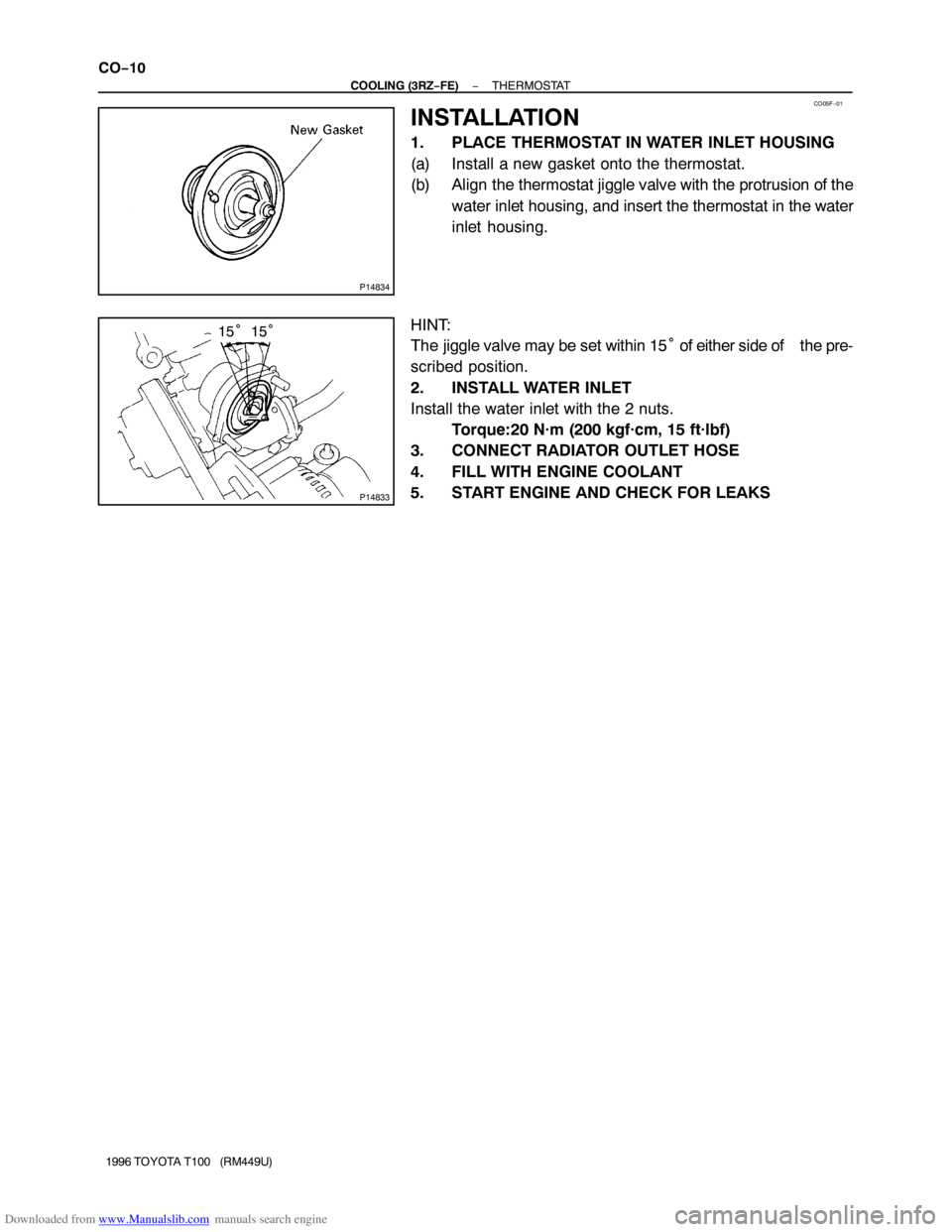
INSTALLATION
1. PLACE THERMOSTAT IN WATER INLET HOUSING
(a) Install a new gasket onto the thermostat.
(b) Align the thermostat jiggle valve with the protrusion of the
water inlet housing, and insert the thermostat in the water
inlet housing.
HINT:
The jiggle valve may be set within 15° of either side of the pre-
scribed position.
2. INSTALL WATER INLET
Install the water inlet with the 2 nuts.
Torque:20 N·m (200 kgf·cm, 15 ft·lbf)
3. CONNECT RADIATOR OUTLET HOSE
4. FILL WITH ENGINE COOLANT
5. START ENGINE AND CHECK FOR LEAKS
Page 1094 of 2062
Downloaded from www.Manualslib.com manuals search engine CO05G−02
− COOLING (3RZ−FE)RADIATOR
CO−11
1080 Author�: Date�:
1996 TOYOTA T100 (RM449U)
RADIATOR
ON−VEHICLE CLEANING
Using water or a steam cleaner, remove any mud or dirt from the radiator core.
NOTICE:
If using a high pressure type cleaner, be careful not to deform the fins of the radiator core (i.e. Main-
tain a distance between the cleaner nozzle and radiator core).
Page 1095 of 2062

Downloaded from www.Manualslib.com manuals search engine CO05H−02
Z02362
Radiator Cap Tester
Radiator Cap
P14849Radiator Cap Tester
CO−12
− COOLING (3RZ−FE)RADIATOR
1996 TOYOTA T100 (RM449U)
ON−VEHICLE INSPECTION
1. REMOVE RADIATOR CAP
CAUTION:
To avoid the danger of being burned, do not remove the ra-
diator cap while the engine and radiator are still hot, as fluid
and steam can be blown out under pressure.
2. INSPECT RADIATOR CAP
NOTICE:
If the radiator cap has contaminations,always rinse it with
water.
Using a radiator cap tester, pump the tester and measure the
relief valve opening pressure.
Standard opening pressure:
74 − 103 kPa (0.75 − 1.05 kgf/cm
2, 10.7 − 14.9 psi)
HINT:
Use the tester’s maximum reading as the opening pressure.
If the opening pressure is less than standard, replace the radia-
tor cap.
3. INSPECT COOLING SYSTEM FOR LEAKS
(a) Fill the radiator with coolant and attach a radiator cap tes-
ter.
(b) Warm up the engine.
(c) Pump it to 118 kPa (1.2 kgf/cm
2, 17.1 psi), and check that
the pressure does not drop.
If the pressure drops, check the hoses, radiator or water pump
for leaks. If no external leaks are found, check the heater core,
cylinder block and head.
4. REINSTALL RADIATOR CAP