1996 TOYOTA PASEO engine
[x] Cancel search: enginePage 94 of 165

91
FUNCTIONS OF ENGINE OIL
Engine oil has the primary functions of lu-
bricating and cooling the inside of the en-
gine,
and plays a major role in maintaining
the engine in proper working order. ENGINE OIL CONSUMPTION
It is normal that an engine should con-
sume some engine oil during normal
engine operation. The causes of oil
consumption in a normal engine are
as follows. Oil is used to lubricate pistons, piston
rings and cylinders. A thin film of oil isleft on the cylinder wall when a piston
moves downwards in the cylinder.
High negative pressure generated
when the vehicle is decelerating sucks
some of this oil into the combustion
chamber. This oil as well as some part
of the oil film left on the cylinder wall is
burned by the high temperature com-
bustion gases during the combustionprocess.
Oil is also used to lubricate the stems
of the intake valves. Some of this oil is
sucked into the combustion chamber
together with the intake air and is
burned along with the fuel. High tem-perature exhaust gases also burn the
oil used to lubricate the exhaust valve stems.
The amount of engine oil consumed
depends on the viscosity of the oil, the
quality of the oil and the conditions
the vehicle is driven under. More oil is consumed by high-speed driv-
ing and frequent acceleration and decel- eration.
A new engine consumes more oil, since
its pistons, piston rings and cylinder walls
have not become conditioned.
When judging the amount of oil con-
sumption, note that the oil may be-come diluted and make it difficult to
judge the true level accurately.
As an example, if a vehicle is used for re-
peated short trips, and consumes a nor- mal amount of oil, the dipstick may not
show any drop in the oil level at all, even after 1000 km (600 miles) or more. This is because the oil is gradually becoming
diluted with fuel or moisture, making it ap-
pear that the oil level has not changed. The diluting ingredients evaporate out
when the vehicle is then driven at high
speeds, as on an expressway, making itappear that oil is excessively consumed
after driving at high speeds.
IMPORTANCE OF ENGINE OIL LEVEL CHECK
One of the most important points in proper vehicle maintenance is to keep the engine
oil at the optimum level so that oil function
will
not be impaired. Therefore, it is essen-
tial that the oil level be checked regularly.
Toyota recommends that the oil level bechecked every time you refuel the vehicle.
Failure to check the oil level
regularly could lead to serious
engine trouble due to insuf ficient oil.
NOTICE
For detailed information on oil level check,
see Checking the engine oil levelº in Chapter 7-2.
Facts about engine oil consumption
Page 95 of 165
92
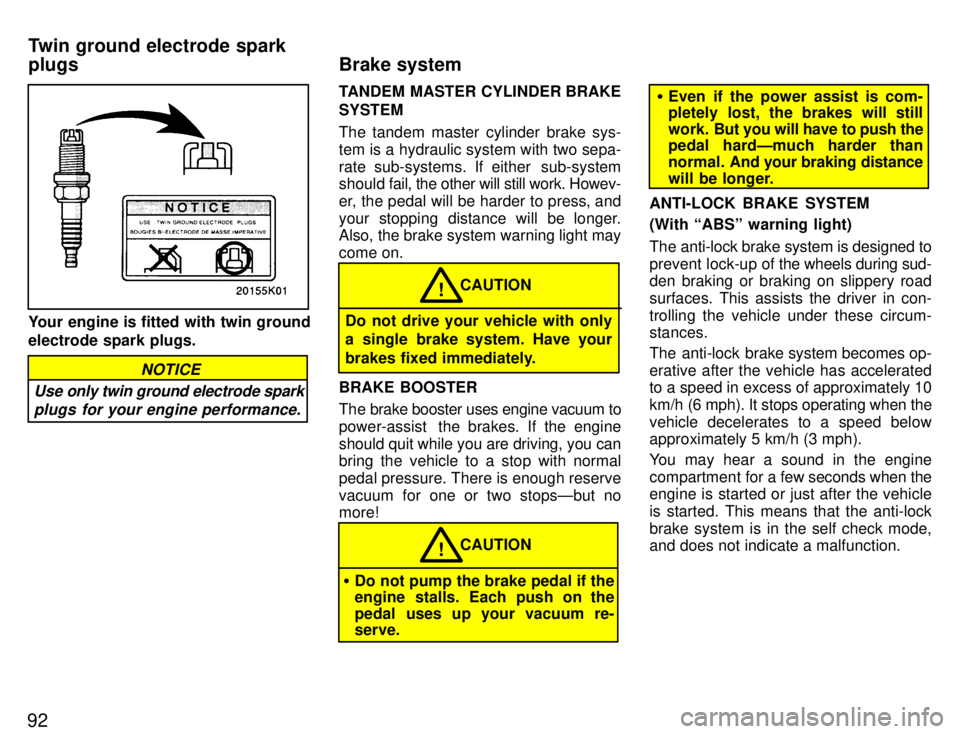
Your engine is fitted with twin ground electrode spark plugs.
Use only twin ground electrode sparkplugs for your engine performance.
NOTICE
TANDEM MASTER CYLINDER BRAKE SYSTEM
The tandem master cylinder brake sys-
tem is a hydraulic system with two sepa-
rate sub-systems. If either sub-system
should fa il, the other will still work. Howev-
er, the pedal will be harder to press, and
your stopping distance will be longer.
Also, the brake system warning light may come on.
CAUTION!
Do not drive your vehicle with only
a single brake system. Have your
brakes fixed immediately.
BRAKE BOOSTER
The brake booster uses engine vacuum to
power-assist the brakes. If the engine
should quit while you are driving, you can
bring the vehicle to a stop with normal
pedal pressure. There is enough reservevacuum for one or two stopsÐbut no more!
CAUTION!
Do not pump the brake pedal if the
engine stalls. Each push on the
pedal uses up your vacuum re- serve.
Even if the power assist is com-
pletely lost, the brakes will still
work. But you will have to push the
pedal hardÐmuch harder than
normal. And your braking distance
will be longer.
ANTI-LOCK BRAKE SYSTEM (With ABSº warning light)
The anti-lock brake system is designed to prevent lock-up of the wheels during sud-
den braking or braking on slippery roadsurfaces. This assists the driver in con-
trolling the vehicle under these circum- stances.
The anti-lock brake system becomes op- erative after the vehicle has accelerated
to a speed in excess of approximately 10
km/h (6 mph). It stops operating when the
vehicle decelerates to a speed below
approximately 5 km/h (3 mph).
You may hear a sound in the engine
compartment for a few seconds when the
engine is started or just after the vehicleis started. This means that the anti-lock
brake system is in the self check mode,
and does not indicate a malfunction.
Brake system
Twin ground electrode spark plugs
Page 99 of 165
96
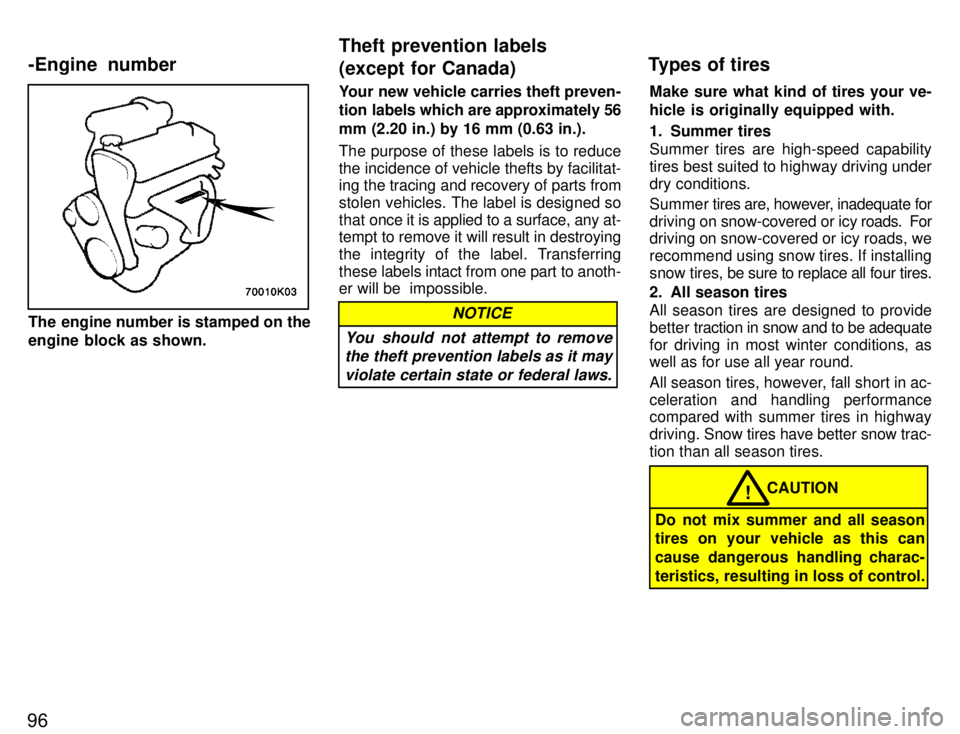
The engine number is stamped on the
engine block as shown.Your new vehicle carries theft preven-
tion labels which are approximately 56 mm (2.20 in.) by 16 mm (0.63 in.). The purpose of these labels is to reduce
the incidence of vehicle thefts by facilitat- ing the tracing and recovery of parts from
stolen vehicles. The label is designed so
that
once it is applied to a surface, any at-
tempt to remove it will result in destroying
the integrity of the label. Transferringthese labels intact from one part to anoth-
er will be impossible.
You should not attempt to remove
the theft prevention labels as it may
violate certain state or federal laws.
NOTICE
Make sure what kind of tires your ve-
hicle is originally equipped with.
1. Summer tires
Summer tires are high-speed capability
tires best suited to highway driving underdry conditions.
Summer tires are, however, inadequate for
driving on snow-covered or icy roads. For
driving on snow-covered or icy roads, we recommend using snow tires. If installing
snow tires, be sure to replace all four tires.
2. All season tires
All season tires are designed to provide
better traction in snow and to be adequate
for driving in most winter conditions, as
well as for use all year round.
All season tires, however, fall short in ac-
celeration and handling performance
compared with summer tires in highway
driving. Snow tires have better snow trac-
tion than all season tires.
CAUTION!
Do not mix summer and all season tires on your vehicle as this can
cause dangerous handling charac-
teristics, resulting in loss of control.
Types of tires
Theft prevention labels (except for Canada)
-Engine number
Page 100 of 165
Part 3How to start the engineÐ
(a) Before cranking
Before starting the engine
97
STARTING AND DRIVING
Before starting the engine
How to start the engine
Tips for driving in various conditions
Winter driving tips
Trailer towing
How to save fuel and make
your vehicle last longer, too
1. Check the area around the vehicle be-
fore entering it.
2. Adjust seat position and seatback angle.
3. Adjust inside and outside rear view mirrors.
4. Lock both side doors.
5. Fasten seat belts.
1. Apply the parking brake firmly.
2. Turn off unnecessary lights and acces- sories. 3.
Manual transmission: Press the
clutch pedal to the floor and shift the trans-
mission into neutral. Hold the clutch pedal
to the floor until the engine is started. A
starter safety device will prevent the start-
er from operating if the clutch pedal is not fully depressed.
Automatic transmission: Put the selec-
tor lever in Pº. If you need to restart the
engine while the vehicle is moving, put the
selector lever in Nº. A starter safety de-vice will prevent the starter from operating
if the selector lever is in any drive position. 4. Automatic transmission only: De-
press the brake pedal and hold it to the
floor until driving off.
Page 101 of 165

98
Before starting the engine, be sure to fol-
low the instructions in (a) Before crank- ingº.
Normal starting procedure
The multiport fuel injection system/se-
quential multiport fuel injection system in
your engine automatically controls the
proper air-fuel mixture for starting. You can start a cold or hot engine as follows:
1. With your foot off the accelerator ped- al, crank the engine by turning the key to
STARTº. Release it when the enginestarts.
2. After
the engine runs for about 10 sec-
onds, you are ready to drive.
If the weather is below freezing, let the en-
gine warm up for a few minutes before driving.
If the engine stalls...
Simply restart it, using the correct proce- dure given in normal starting. If the engine will not startÐ
See If your vehicle will not startº in Part 4.
Do not crank for more than 15 sec-
onds at a time. This may overheat
the starter and wiring systems.
Do not race a cold engine.
If the engine becomes difficult tostart or stalls frequently, have theengine checked immediately.
NOTICE Always slow down in gusty cross- winds. This will allow you much better control.
Drive slowly onto curbs and, if pos-
sible, at a right angle. Avoid drivingonto high, sharp-edged objects and
other road hazards. Failure to do so
can lead to severe tire damage result-
ing in tire bursts.
When parking on a hill, turn the front
wheels until they touch the curb so that
the vehicle will not roll. Apply the park-
ing brake, and place the transmission in Pº (automatic) or in first or reverse
(manual). If necessary, block thewheels.
Washing your vehicle or driving
through deep water may get the
brakes wet. To see whether they are
wet, check that there is no traffic near
you, and then press the pedal lightly. If
you do not feel a normal braking force,
the brakes are probably wet. To dry
them, drive the vehicle cautiously
while lightly pressing the brake pedal
with the parking brake pulled. If they
still do not work safely, pull to the side
of the road and call a T oyota dealer for
assistance.
(b) Starting the engine
Tips for driving in various conditions
Page 102 of 165
99
CAUTION
Before driving off, make sure that the parking brake if fully released
and the parking brake reminder
light is off.
Do not leave your vehicle unat-
tended while the engine is running.
Do not rest your foot on the brake
pedal while driving. It can cause dangerous overheating, needless
wear, and poor fuel economy.
To drive down a long or steep hill,reduce your speed and downshift.
Remember, if you ride the brakes
excessively, they may overheat
and not work properly.
Be careful when accelerating, up-
shifting, downshifting or braking
on a slippery surface. Sudden ac-
celeration or engine braking, could
cause the vehicle to spin or skid.!
Do not drive in excess of the speed
limit. Even if the legal speed limit
permits it, do not drive over 140
km/h (85 mph) unless your vehicle
has high-speed capability tires.
Driving over 140 km/h (85 mph)
may result in tire failure, loss of
control and possible injury. Be sure to consult a tire dealer to de-
termine whether the tires on your
vehicle are high-speed capability tires or not before driving at suchspeeds.
Do not continue normal driving
when the brakes are wet. If they are
wet, your vehicle will require a lon-
ger stopping distance, and it may
pull to one side when the brakes
are applied. Also, the parking brake will not hold the vehicle se-
curely. Make sure you have ethylene-glycol
antifreeze in the radiator.
Do not use alcohol type antifreeze.
NOTICE
Check the condition of the battery and cables. Cold temperatures reduce the capacity of
any battery, so it must be in top shape to provide enough power for winter starting.Chapter 7-3 tells you how to visually in-
spect the battery. Your Toyota dealer and
most service stations will be pleased tocheck the level of charge.
Make sure the engine oil viscosity is
suitable for the cold weather. See Chapter 7-2 for recommended
viscosity. Leaving a heavy summer oil in
your vehicle during winter months may cause harder starting. If you are not sure
about which oil to use, call your Toyota
dealerÐhe will be pleased to help. Keep the door locks from freezing. Squirt lock de-icer or glycerine into the
locks to
keep them from freezing. To open
a frozen lock, try heating the key before in-serting it.
Winter driving tips
Page 103 of 165

100
Use a washer fluid containing an anti-
freeze solution.
This product is available at your Toyota
dealer and most auto parts stores. Follow
the manufacturer's directions for how
much to mix with water.
Do not use engine antifreeze or any
other substitute because it may
damage your vehicle's paint.
NOTICE
Do not use your parking brake when there is a possibility it could freeze. When parking, put the transmission into
Pº (automatic) or into first or reverse
(manual) and block the rear wheels. Do
not use the parking brake, or snow or wa-
ter accumulated in and around the parkingbrake mechanism may freeze, making it
hard to release. Keep ice and snow from accumulating
under the fenders.
Ice and snow built up under your fenders
can make steering difficult. During bad winter driving, stop and check under the
fenders occasionally. Depending on where you are driving,
we recommend you carry some emer- gency equipment.
Some of the things you might put in the ve-
hicle are tire chains, window scraper, bag of sand or salt, flares, small shovel, jump- er cables, etc.
Toyota does not recommend towing a
trailer with your Paseo. It is not designed for trailer towing.
Trailer towing
Page 104 of 165
101
Getting
more kilometers/mileage from a li-
ter/gallon of fuel is easyÐjust take it easy.
It will help make your vehicle last longer,
too. Here are some specific tips on how to
save money on both fuel and repairs: Keep your tires inflated at the cor- rect pressure. Underinflation causes
tire wear and wastes fuel. See Chapter
7-2 for instructions.
Do not carry unneeded weight in
your vehicle. Excess weight puts a
heavier load on the engine, causinggreater fuel consumption.
Avoid lengthy warm-up idling.
Once the engine is running smoothly,
begin drivingÐbut gently. Remember,
however, that on cold winter days this
may take a little longer.
Accelerate slowly and smoothly.
Avoid jackrabbit starts. Get into high
gear as quickly as possible.
Avoid long engine idling. If you have
a long wait and you are not in traffic, it
is better to turn off the engine and start
again later.
Avoid engine lug or overrevving.
Use a gear position suitable for the
road on which you are travelling.
Avoid continuous speeding up and
slowing down. Stop-and-go driving
wastes fuel.
Avoid unnecessary stopping and
braking. Maintain a steady pace. Try
to time the traffic signals so you only
need to stop as little as possible or take
advantage of through streets to avoid
traffic lights. Keep a proper distance
from other vehicles to avoid suddenbraking. This will also reduce wear onyour brakes.
Avoid heavy traffic or traffic jams
whenever possible.
Do not rest your foot on the clutch
or brake pedal. This causes needless
wear, overheating and poor fuel econ-
omy.
Maintain a moderate speed on highways. The faster you drive, the
greater the fuel consumption. By re-
ducing your speed, you will cut down
on fuel consumption.
Keep the front wheels in properalignment. Avoid hitting the curb and
slow down on rough roads. Improper
alignment not only causes faster tire
wear but also puts an extra load on the
engine, which, in turn, wastes fuel.
Keep the bottom of your vehicle
free from mud, etc. This not only
lessens weight but also helps prevent corrosion.
Keep your vehicle tuned-up and in
top shape. A dirty air cleaner, improp-
er valve clearance, dirty plugs, dirty oil
and grease, brakes not adjusted, etc.
all lower engine performance and con-
tribute to poor fuel economy. For lon-
ger life of all parts and lower operating
costs, keep all maintenance work on
schedule, and if you often drive under severe conditions, see that your ve-
hicle receives more frequent mainte-
nance (For schedule maintenance in-
formation, please refer to the separate
Owner 's Manual Supplement/Main-
tenance Scheduleº).
CAUTION
Never turn off the engine to coast
down hills. Your power steering and
brake booster will not function with-
out the engine running. Also, theemission control system operates
properly only when the engine isrunning.!
How to save fuel and make
your vehicle last longer, too