Page 515 of 1399
DI−78
−
DIAGNOSTICS ENGINE
1996 LAND CRUISER (RM451U)
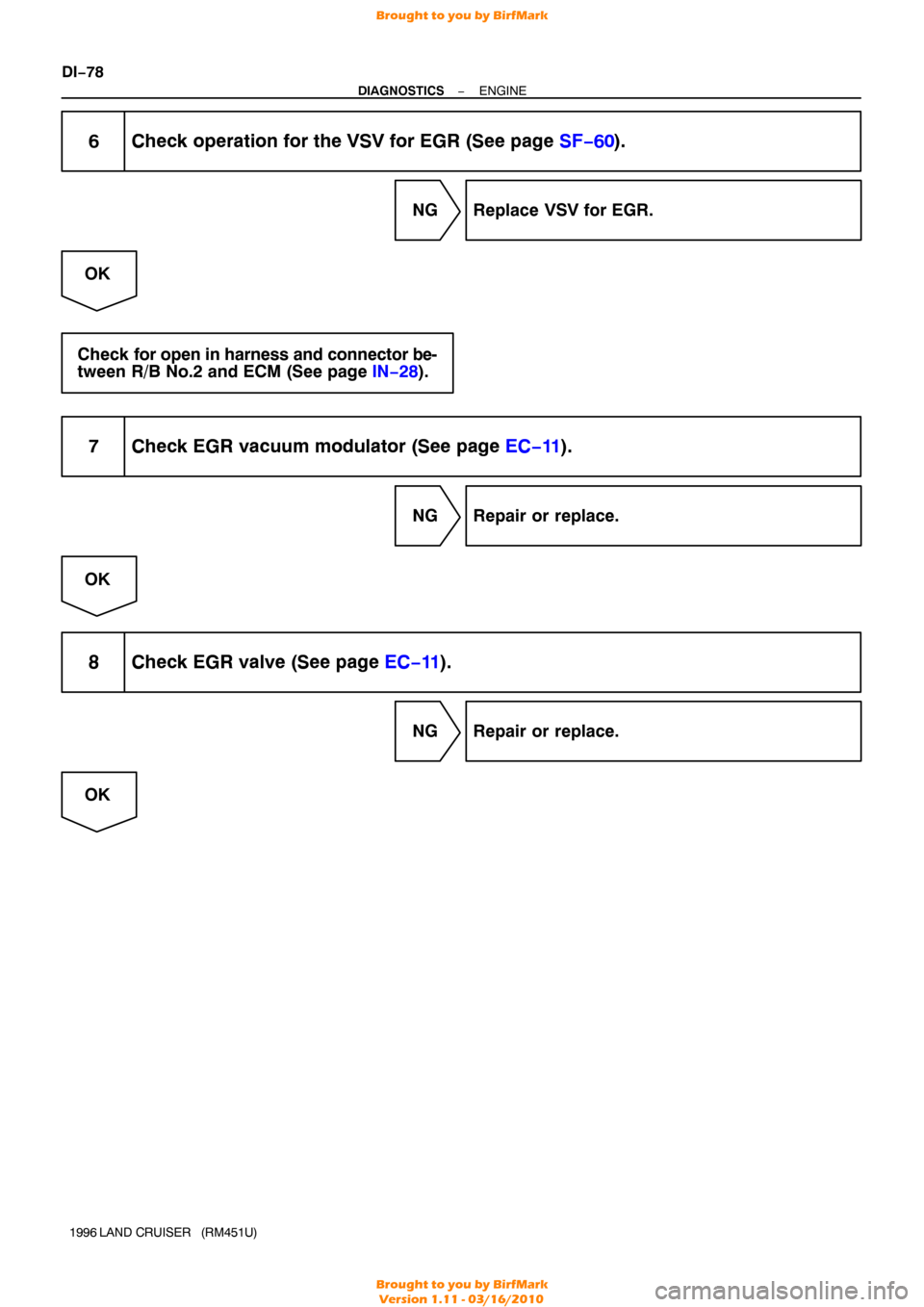
6 Check operation for the VSV for EGR (See page SF−60).
NG Replace VSV for EGR.
OK
Check for open in harness and connector be-
tween R/B No.2 and ECM (See page IN−28).
7 Check EGR vacuum modulator (See page EC−11 ).
NG Repair or replace.
OK
8 Check EGR valve (See page EC−11 ).
NG Repair or replace.
OK
Brought to you by BirfMark
Brought to you by BirfMark
Version 1.11 - 03/16/2010
Page 517 of 1399

DI−80
−
DIAGNOSTICS ENGINE
1996 LAND CRUISER (RM451U)
DTC P0402 Exhaust Gas Recirculation Flow Excessive Detected
CIRCUIT DESCRIPTION
Refer to DTC P0401 (Exhaust Gas Recirculation Flow Insufficient Detected) on page DI−69.
DTC No.DTC Detecting ConditionTrouble Area
P0402
EGR gas temp. sensor value is high during EGR cut −off when
engine is cold (Race engine at about 4,000 rpm without load so
that vacuum is applied to port E)
(2 trip detection logic)� EGR valve stuck open
� EGR VSV open malfunction
� Open in VSV circuit for EGR
� Short in EGR gas temp. sensor circuit
� ECM
EGR valve is always open (2 trip detection logic)
Refer to DTC P0401 (Exhaust Gas Recirculation Flow Insufficient Detected) for the System Check Driving
Pattern and Wiring Diagram.
INSPECTION PROCEDURE
TOYOTA hand −held tester
1 Connect the TOYOTA hand −held tester and read EGR gas temp. value.
PREPARATION:
(a) Remove the fuse cover on the instrument panel.
(b) Connect the TOYOTA hand−held tester to the DLC3.
(c) Turn ignition switch ON and push the TOYOTA hand −held tester main switch ON.
CHECK:
Read EGR gas temp. on the TOYOTA hand−held tester.
OK:
EGR gas temp.: 150° C (302°F) or less (Not immediately after driving)
HINT:
If there is a short circuit, the TOYOTA hand−held tester indicates Approx. 157.5°C (315.5°F).
OK Go to step 4.
NG
DI5PL−02
Brought to you by BirfMark
Brought to you by BirfMark
Version 1.11 - 03/16/2010
Page 519 of 1399
P24665
DI−82
−
DIAGNOSTICS ENGINE
1996 LAND CRUISER (RM451U)
4 Check the VSV for EGR (See page DI−69 ).
OK Check EGR valve (See page EC−11).
NG
5 Check operation of the VSV for EGR (See page SF−60).
NG Replace VSV for EGR.
OK
Check for short in harness and connector
between VSV and ECM (See page IN−28).
OBD II scan tool (excluding TOYOTA hand −held tester)
1 Check resistance of EGR gas temp. sensor (See page DI−105).
PREPARATION:
Disconnect EGR gas temp. sensor connector.
CHECK:
Measure resistance between terminals of EGR gas temp. sen-
sor connector.
OK:
Resistance: 2.5 k Ω or more
(Not immediately after driving)
HINT:
If there is short circuit, ohmmeter indicates 200 Ω or less.
NG Replace EGR gas temp. sensor.
OK
Brought to you by BirfMark
Brought to you by BirfMark
Version 1.11 - 03/16/2010
Page 520 of 1399
−
DIAGNOSTICS ENGINE
DI−83
1996 LAND CRUISER (RM451U)
2 Check for short in harness and connector between EGR gas temp. sensor and
ECM (See page IN−28 ).
NG Repair or replace harness or connector.
OK
3 Check the VSV for EGR (See page DI−69 , step 5).
OK Check EGR valve (See page EC−11).
NG
4 Check operation of the VSV for EGR (See page SF−60).
NG Replace VSV for EGR.
OK
5 Check for short in harness and connector between VSV and ECM (See page IN−28 ).
NG Repair or replace harness or connector.
OK
Check and replace ECM (See page IN−28 ).
Brought to you by BirfMark
Brought to you by BirfMark
Version 1.11 - 03/16/2010
Page 781 of 1399

EC0JT−01
−
EMISSION CONTROL EXHAUST GAS RECIRCULATION (EGR) SYSTEM
EC−11
1996 LAND CRUISER (RM451U)
INSPECTION
1. INSPECT AND CLEAN FILTER IN EGR V ACUUM MOD-
ULATOR
(a) Remove the cap and filter.
(b) Check the filter for contamination or damage.
(c) Using compressed air, clean the filter.
(d) Reinstall the filter and cap.
HINT:
Install the filter with the coarser surface facing the atmospheric
side (outward).
2. INSTALL VACUUM GAUGE
Using a 3 −way connector, connect a vacuum gauge to the hose
between the EGR valve and EGR vacuum modulator.
3. INSPECT SEATING OF EGR VALVE
Start the engine and check that the engine starts and runs at
idle.
4. CONNECT TOYOTA HAND− HELD TESTER OR OBD II
SCAN TOOL (See page EM−10)
5. INSPECT VSV OPERATION WITH COLD ENGINE
(a) The engine coolant temperature should be below 47 °C
(117 °F).
(b) Check that the vacuum gauge indicates zero at 2,500 rpm.
(c) Check that the EGR pipe is not hot.
6. INSPECT OPERATION OF VSV AND EGR VACUUM
MODULATOR WITH HOT ENGINE
(a) Warm up the engine to above 53° C (127°F).
(b) Check that the vacuum gauge indicates low vacuum at 2,500 rpm.
(c) Disconnect the vacuum hose port R of the EGR vacuum modulator and connect port R directly to the air intake
chamber with another hose.
(d) Check that the vacuum gauge indicates high vacuum at 2,500 rpm.
Brought to you by BirfMark
Brought to you by BirfMark
Version 1.11 - 03/16/2010
Page 782 of 1399

EC−12
−
EMISSION CONTROL EXHAUST GAS RECIRCULATION (EGR) SYSTEM
1996 LAND CRUISER (RM451U)
HINT:
As a large amount of exhaust gas enters, the engine will misfire
slightly.
7. DISCONNECT TOYOTA HAND −HELD TESTER OR
OBD II SCAN TOOL
8. REMOVE VACUUM GAUGE
Remove the vacuum gauge, and reconnect the vacuum hoses
to the proper locations.
9. INSPECT EGR VALVE
(a) Apply vacuum directly to the EGR valve with the engine idle.
(b) Check that the engine runs rough or dies.
(c) Reconnect the vacuum hoses to the proper locations.
If no problem is found with this inspection, system is normal;
otherwise inspect each part.
10. CANCEL DIAGNOSTIC TROUBLE CODE
11. REMOVE AIR INTAKE CHAMBER (See page EM−28)
12. DISCONNECT VACUUM HOSES AND CONNECTOR
13. INSPECT VSV FOR OPEN CIRCUIT
Using an ohmmeter, check that there is continuity between the
terminals. Resistance: 30 − 34 Ω at 20° C (68°F)
If there is no continuity, replace the VSV.
14. INSPECT VSV FOR GROUND
Using an ohmmeter, check that there is no continuity between
each terminal and the body.
If there is continuity, replace the VSV.
Brought to you by BirfMark
Brought to you by BirfMark
Version 1.11 - 03/16/2010
Page 784 of 1399

EC−14
−
EMISSION CONTROL EXHAUST GAS RECIRCULATION (EGR) SYSTEM
1996 LAND CRUISER (RM451U)
21. REMOVE EGR VACUUM MODULATOR
22. REMOVE EGR VALVE
(a) Disconnect the vacuum hose from the EGR valve.
(b) Disconnect the engine wire from the clamp.
(c) Loosen the EGR pipe union nut.
(d) Remove the 2 nuts holding the EGR valve to the air intake
chamber.
(e) Using 2 nuts, remove the 2 stud bolts, EGR valve and gasket.
23. INSPECT EGR VALVE
Check for sticking and heavy carbon deposits.
If a problem is found, replace the valve.
24. REINSTALL EGR VALVE
(a) Using 2 nuts, temporarily install a new gasket, and EGR valve with the 2 stud bolts.
Torque: 9 N·m (90 kgf·cm, 78 in.·lbf)
(b) Install the 2 nuts holding the EGR valve to the air intake
chamber.
Torque: 18 N·m (180 kgf·cm, 13 ft·lbf)
(c) Tighten the union nut of the EGR pipe. Torque: 64 N·m (650 kgf·cm, 47 ft·lbf)
(d) Connect the engine wire to the clamp.
(e) Connect the vacuum hose to the EGR valve.
25. REINSTALL EGR VACUUM MODULATOR
Torque: 18 N·m (185 kgf·cm, 13 ft·lbf)
Brought to you by BirfMark
Brought to you by BirfMark
Version 1.11 - 03/16/2010
Page 787 of 1399

EM−2
−
ENGINE MECHANICAL CO/HC
505
Author�: Date�:
1996 LAND CRUISER (RM451U)
6. TROUBLESHOOTING
If the CO/HC concentration does not comply with regulations,
troubleshoot in the order given below.
See the table below for possible causes, and then inspect and
correct the applicable causes if necessary.
COHCProblemsCauses
NormalHighRough idle
3. Faulty ignitions:
�Incorrect timing
� Fouled, shorted or improperly gapped plugs
� Open or crossed high −tension cords
� Cracked distributor cap
4. Incorrect valve clearance
5. Leaky EGR valve
6. Leaky intake and exhaust valves
7. Leaky cylinders
LowHighRough idle
(Fluctuating HC reading)
1. Vacuum leaks:
� PCV hose
� EGR valve
� Intake manifold
� Air intake chamber
� Throttle body
� IAC valve
� Brake booster line
2. Lean mixture causing misfire
HighHighRough idle
(Black smoke from exhaust)
1. Restricted air filter
2. Faulty SFI systems:
� Faulty pressure regulator
� Clogged fuel return line
� Defective ECT sensor
� Faulty ECM
� Faulty injector
� Faulty throttle position sensor
� Faulty MAF meter
Brought to you by BirfMark
Brought to you by BirfMark
Version 1.11 - 03/16/2010