182If you perform maintenance by your-
self, be sure to follow the correct pro-
cedure given in this part.
You should be aware that improper or in-
complete servicing may result in operat-
ing problems.
Performing do-it-yourself maintenance
during the warranty period may affect
your warranty coverage. Read the sepa-
rate Toyota Warranty statement for details
and suggestions.
This part gives instructions only for those
items that are relatively easy for an owner
to perform. As explained in Part 6, there
are still a number of items that must be
done by a qualified technician with special
tools.
For information on tools and parts for do-
it-yourself maintenance, see Parts and
toolsº.
Utmost care should be taken when work-
ing on your vehicle to prevent accidental
injury. Here are a few precautions that you
should be especially careful to observe:
�When the engine is running, keep
hands, clothing, and tools away
from the moving fan and engine
drive belts. (Removing rings,
watches, and ties is advisable.)
�Right after driving, the engine
compartmentÐthe engine, radia-
tor, exhaust manifold and spark
plug boots, etc.Ðwill be hot. So
be careful not to touch them. Oil,
fluids and spark plugs may also be
hot.
�If the engine is hot, do not remove
the radiator cap or loosen the
drain plugs to prevent burning
yourself.
�Do not smoke, cause sparks or al-
low open flames around fuel or the
battery. Their fumes are flam-
mable.
�Be extremely cautious when work-
ing on the battery. It contains poi-
sonous and corrosive sulfuric
acid.
�Do not get under your vehicle with
just the body jack supporting it.
Always use automotive jack
stands or other solid supports.CAUTION
!�Be sure that the ignition is off if
you work near the electric cooling
fans or radiator grille. With the
ignition on, the electric cooling
fans will automatically start to run
if the engine coolant temperature
is high and/or the air conditioning
is on.
�Use eye protection whenever you
work on or under your vehicle
where you may be exposed to fly-
ing or falling material, fluid spray,
etc.
�Used engine oil contains poten-
tially harmful contaminants which
may cause skin disorders such as
inflammation or skin cancer, so
care should be taken to avoid pro-
longed and repeated contact with
it. To remove used engine oil from
your skin, wash thoroughly with
soap and water.
�Do not leave used oil within the
reach of children.
�Dispose of used oil and filter only
in a safe and acceptable manner.
Do not dispose of used oil and fil-
ter in household trash, in sewers
or onto the ground. Call your deal-
er or a service station for informa-
tion concerning recycling or dis-
posal.
Do-it-yourself service
precautions
ProCarManuals.com
187
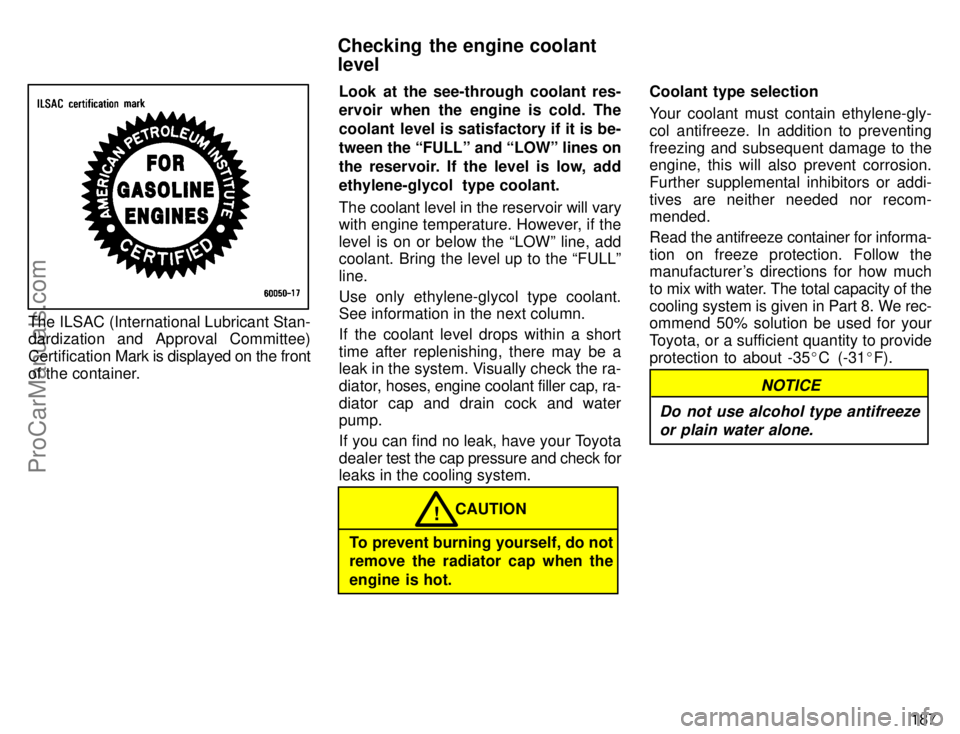
The ILSAC (International Lubricant Stan-
dardization and Approval Committee)
Certification Mark is displayed on the front
of the container.Look at the see-through coolant res-
ervoir when the engine is cold. The
coolant level is satisfactory if it is be-
tween the FULLº and LOWº lines on
the reservoir. If the level is low, add
ethylene-glycol type coolant.
The coolant level in the reservoir will vary
with engine temperature. However, if the
level is on or below the LOWº line, add
coolant. Bring the level up to the FULLº
line.
Use only ethylene-glycol type coolant.
See information in the next column.
If the coolant level drops within a short
time after replenishing, there may be a
leak in the system. Visually check the ra-
diator, hoses, engine coolant filler cap, ra-
diator cap and drain cock and water
pump.
If you can find no leak, have your Toyota
dealer test the cap pressure and check for
leaks in the cooling system.
CAUTION!
To prevent burning yourself, do not
remove the radiator cap when the
engine is hot.Coolant type selection
Your coolant must contain ethylene-gly-
col antifreeze. In addition to preventing
freezing and subsequent damage to the
engine, this will also prevent corrosion.
Further supplemental inhibitors or addi-
tives are neither needed nor recom-
mended.
Read the antifreeze container for informa-
tion on freeze protection. Follow the
manufacturer 's directions for how much
to mix with water. The total capacity of the
cooling system is given in Part 8. We rec-
ommend 50% solution be used for your
Toyota, or a sufficient quantity to provide
protection to about -35�C (-31�F).
NOTICE
Do not use alcohol type antifreeze
or plain water alone.
Checking the engine coolant
level
ProCarManuals.com