Page 38 of 217

36In a severe frontal impact, sensors detect
deceleration and the system triggers the
airbag inflators. Then a chemical reaction
in the inflators momentarily fills the air-
bags with non-toxic nitrogen gas to help
restrain the forward motion of the occu-pants. When the airbags inflate, they produce a fairly
loud noise and release some smoke
along with the nitrogen gas. This is not harmful and does not indicate a fire. Be
sure to wash off any residue as soon as
possible to prevent minor skin irritation.
Deployment of the airbags happens in a
fraction of a second, so the airbags must
inflate with considerable force. While the
system is designed to reduce serious inju-
ries, it may also cause minor burns or
abrasions and swellings.
Parts of the airbag module (steering
wheel hub, dashboard) may be hot forseveral minutes, but the airbags them- selves w ill not be hot. The airbags are de-
signed to inflate only once.
A crash severe enough to inflate the air-
bags may break the windshield as the ve-
hicle buckles. In vehicles with a passen- ger airbag the windshield may also be
damaged by absorbing some of the force
of the inflating airbag.
CAUTION!
The SRS airbag system is de-
signed only as a supplement to
the primary protection of the seat
belt systems of the driver and
front passenger. The front seat oc-
cupants are particularly suscepti-
ble to injury if they do not wear
their seat belts; when sudden
braking or a collision occurs, they
may be thrown forward. To obtain
further protection in an accident,
the driver and all passengers in
the vehicle should always wear
their seat belts when driving. For
instructions and precautions con-
cerning the seat belt system, see
Seat beltsº in this chapter.
A baby or small child who is too
small to use a seat belt should be
properly secured in a rear seat us-
ing a child restraint system.
Do not use a rear-facing child re-
straint system in the front seat be- cause the force of the rapid infla-
tion of the passenger airbag may cause severe injury to the child.
Vehicles with a passenger airbag
display a caution label on the pas-
senger side instrument panel as
shown above to remind you not to install a rear-facing child restraint
system on the front seat.
Page 43 of 217
40
CAUTION!
After installing the child restraint system, make sure it is secured in
place. If it is not restrained securely,
it can cause injury to the child in theevent of a sudden stop or accident.
When not using the child restraint system, keep it secured with the seat belt or place
it somewhere other than in passenger
compartment. This will prevent it injuring passengers in the event of a sudden stop or accident.
Your vehicle has anchors for securing the
top strap of a child restraint system. The
anchor nuts are welded beneath the sheet
metal to permit installation of an anchor
bracket for a child restraint system.
To install an anchor bracket, use an 8mm
X 30 mm X 1.25 mm coarse thread metric
bolt and a 10 mm (0.4 in.) spacer. Note that the bolts accompanying many child
restraint systems are not metric. You can
damage the anchor nuts on your vehicle
if you force bolts with different thread intothe anchor nuts.
For instructions about how to install the
anchor bracket, see (C) TOP STRAP
ANCHORS AND LOCATIONSº. If your child restraint system
does not pro-
vide any of the necessary parts, you can
purchase the following items from your
Toyota dealer.
* CRS installation kit
(Part No. 04731-22012) Ðcontains 1 bolt, 3 types of spacers and 1 locking clip.
* Bolt (Part No. 91511-60830)
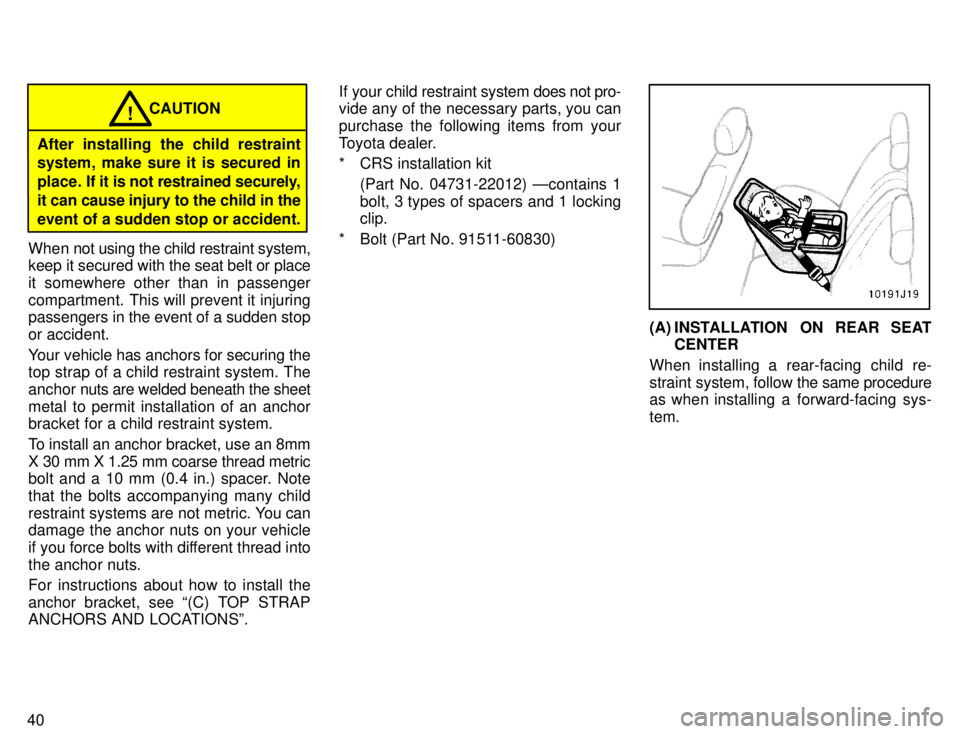
(A) INSTALLATION ON REAR SEAT CENTER
When installing a rear-facing child re-
straint system, follow the same procedure
as when installing a forward-facing sys-tem.
Page 45 of 217
42
CAUTION!
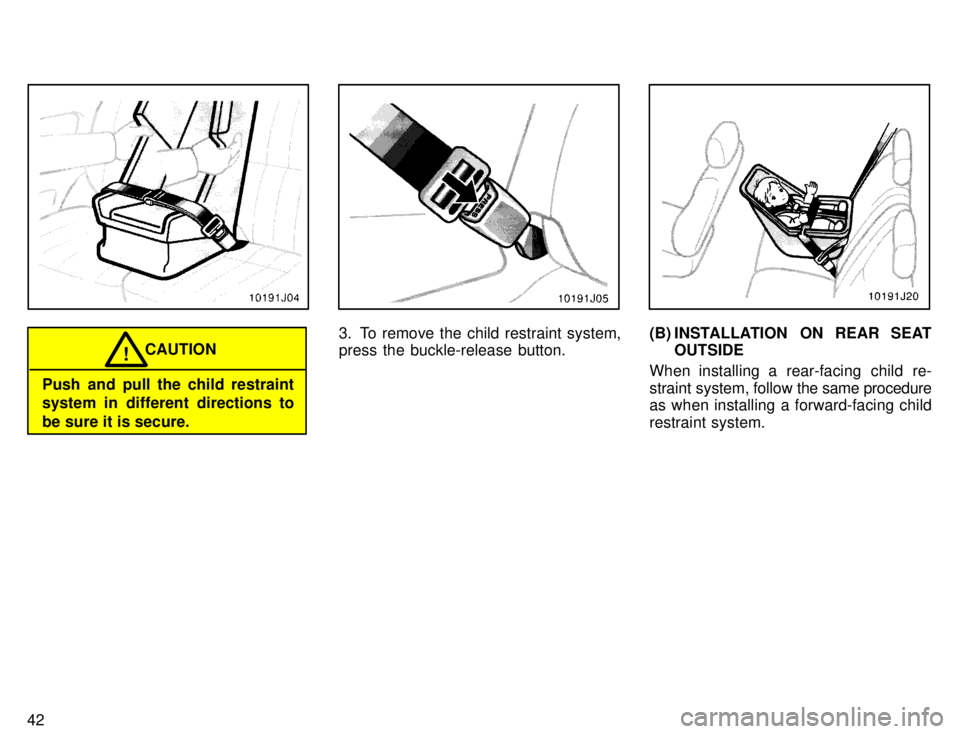
Push and pull the child restraint
system in different directions to
be sure it is secure.
3. To remove the child restraint system, press the buckle-release button.(B) INSTALLATION ON REAR SEAT OUTSIDE
When installing a rear-facing child re-
straint system, follow the same procedure
as when installing a forward-facing child
restraint system.
Page 47 of 217
44
2. Fully extend the shoulder belt to put it in the lock mode.3. Place the shoulder belt between the vehicle seatback and the child restraint
system and allow it to retract. To hold the
child restraint system securely, let the
shoulder belt retract as far as it will go
while firmly pushing down the child re-
straint system.4. If your child restraint system requires
the use of a top strap, latch the hook onto
the anchor bracket and tighten the topstrap.
Page 48 of 217
45
CAUTION!
Make sure the seat belt is securely
locked. Also make sure the child re- straint system is secure by pushingand pulling it in different directions.
5. To remove the child restraint system, press the buckle-release button and al-
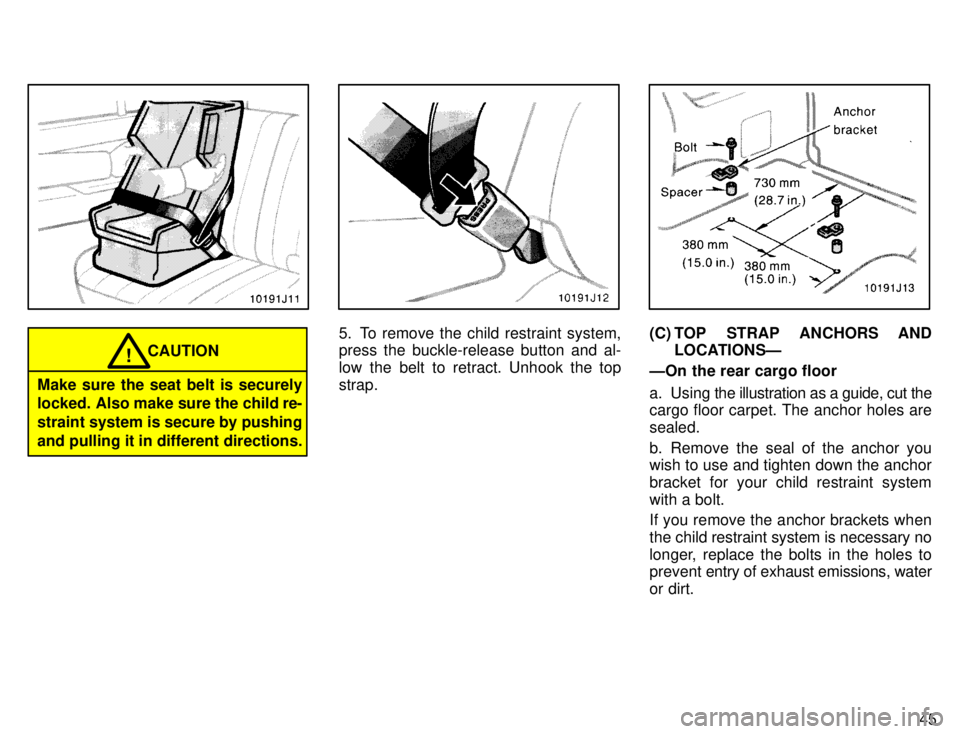
low the belt to retract. Unhook the topstrap.(C) TOP STRAP ANCHORS AND LOCATIONSÐ
ÐOn the rear cargo floor
a. Using the illustration as a guide, cut the
cargo floor carpet. The anchor holes are sealed.
b. Remove the seal of the anchor you
wish to use and tighten down the anchor
bracket for your child restraint systemwith a bolt. If you remove the anchor brackets when
the child restraint system is necessary no
longer, replace the bolts in the holes to
prevent en try of exhaust emissions, water
or dirt.
Page 51 of 217
48
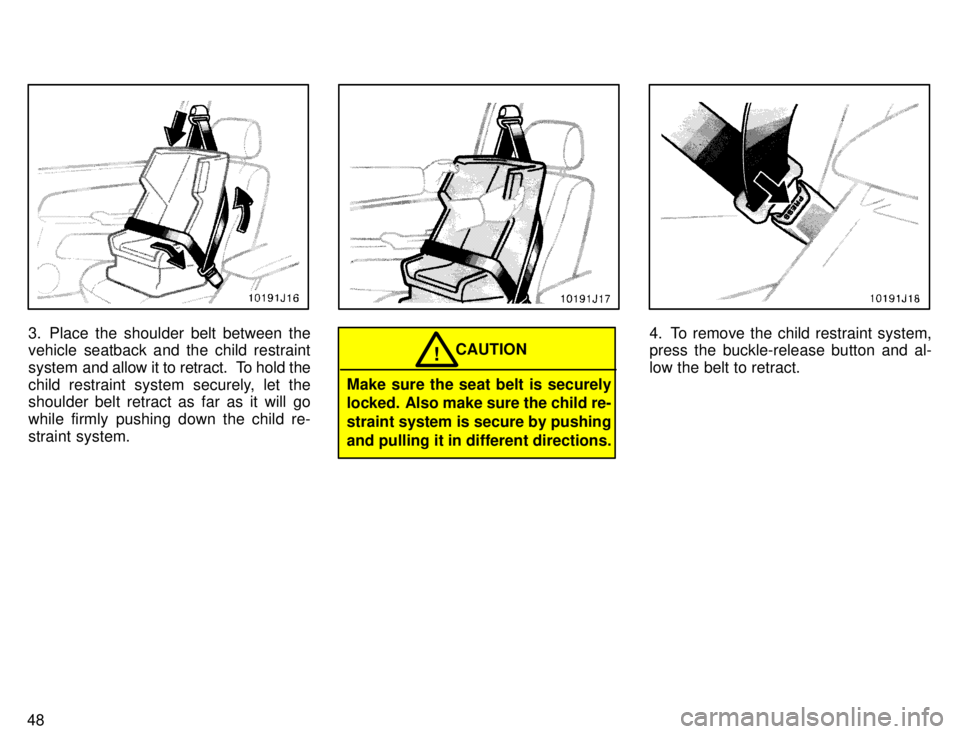
3. Place the shoulder belt between the vehicle seatback and the child restraint
system and allow it to retract. To hold the
child restraint system securely, let the
shoulder belt retract as far as it will go
while firmly pushing down the child re-
straint system.
CAUTION!
Make sure the seat belt is securely
locked. Also make sure the child re- straint system is secure by pushingand pulling it in different directions.
4. To remove the child restraint system, press the buckle-release button and al-
low the belt to retract.
Page 71 of 217
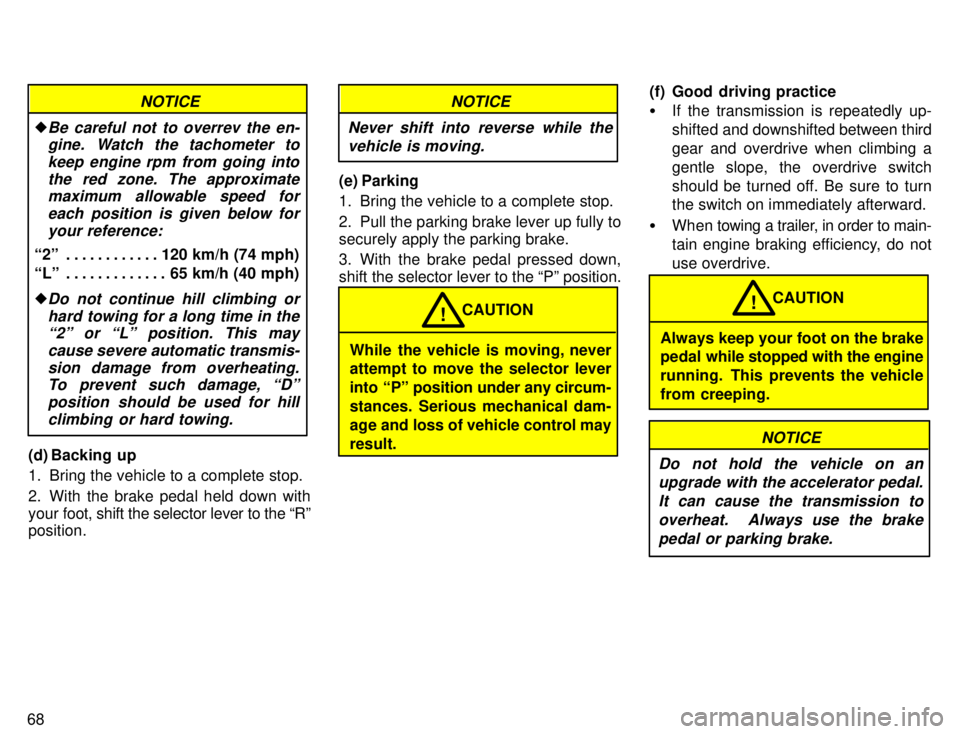
68
NOTICE
Be careful not to overrev the en-gine. Watch the tachometer to
keep engine rpm from going into the red zone. The approximatemaximum allowable speed for
each position is given below for
your reference:
2º 120 km/h (74 mph) . . . . . . . . . . . .
Lº 65 km/h (40 mph) . . . . . . . . . . . . .
Do not continue hill climbing or hard towing for a long time in the2º or Lº position. This may
cause severe automatic transmis-sion damage from overheating.To prevent such damage, Dº
position should be used for hill climbing or hard towing.
(d) Backing up
1. Bring the vehicle to a complete stop.
2. With the brake pedal held down with your foot, shift the selector lever to the Rº
position.
NOTICE
Never shift into reverse while the vehicle is moving.
(e) Parking
1. Bring the vehicle to a complete stop.
2. Pull the parking brake lever up fully to securely apply the parking brake.
3. With the brake pedal pressed down,
shift the selector lever to the Pº position.
While the vehicle is moving, never
attempt to move the selector lever
into Pº position under any circum-
stances. Serious mechanical dam-
age and loss of vehicle control mayresult. CAUTION
! (f) Good driving practice
If the transmission is repeatedly up-
shifted and downshifted between third
gear and overdrive when climbing a
gentle slope, the overdrive switch
should be turned off. Be sure to turn the switch on immediately afterward.
When towing a trailer, in order to main-
tain engine braking efficiency, do notuse overdrive.
Always keep your foot on the brake
pedal w hile stopped with the engine
running. This prevents the vehicle
from creeping. CAUTION
!
NOTICE
Do not hold the vehicle on an upgrade with the accelerator pedal.
It can cause the transmission tooverheat. Always use the brake pedal or parking brake.
Page 106 of 217

103
Push SKIPº. SKIPº will appear on the
display. The cassette player will keep
track of how much blank space it plays.
Any time it has played about 10 seconds
of blank tape, it will automatically fast for-
ward to the next track and begin to play.
Push the button a second time to turn off the skip feature. ST (Stereo reception) display
Your radio automatically changes to ste- reo reception when a stereo broadcast is
received. STº appears on the display. Ifthe signal becomes weak, the radio re-
duces the amount of channel separation to prevent the weak signal from creating
noise. If the signal becomes extremely weak, the radio switches from stereo to mono reception.
TAPE
Push T
APEº to switch from radio or com-
pact disc operation to cassette operation.
If the audio system is off, you can turn on
the cassette player by pushing TAPEº. In both cases, a cassette must already be
loaded in the player. TREB (Treble)
This knob lets you adjust the treble level.
Push TREB/FADEº so that it pops out of
its retracted position. Turn the
knob to ad-
just the treble. Push the knob back into its
retracted position. TUNE
Tuning
Your Toyota has an electronic tuning radio
(ETR). Push and release the ~º (up) or
! º (down) side of TUNEº to step up or
down the station band. (If you hear a
beep, you held the button too long and the
radio will go into the seek mode.) Seeking
In the seek mode, the radio finds and plays the next station up or down the sta- tion band.
To seek a station, push and hold the ~º or
vº side of TUNEº until you hear a beep. Do this again to find another station. The anti-theft system prevents the audio
system f
rom working after it has been dis-
connected. To activate the system, you
must set a three-digit security code. After the system is set, SECº will appear in the
display each time the ignition is turned
form LOCKº to ACCº or ONº. Also, the
anti-theft light flashes every few seconds
while the ignition key is in the LOCKºposition.
You will need to know your security code
to reactivate your radio after electrical ser-vice is performed on your vehicle.
Choose a security code that is easy to re-
member and keep a copy of it (not in your
Toyota).
NOTICE
If you pushed any wrong buttons on the anti-theft system, the following
messages will appear on the display.
ErrºÐYou have pushed wrongbuttons.
ÐAnti-theft system
(Type 2-2 and 3 only)