Page 179 of 217

176Automatic transmission Parkº
mech-
anism
Check the lock release button of the se-
lector lever for proper and smooth opera-
tion. On a safe incline, check that your ve-
hicle is held securely with the selectorlever in ºPº position and all brakes re-leased.
IN THE ENGINE COMPARTMENT Items listed below should be checked
from time to time , e.g. each time when
refueling.
Washer fluid
Make sure there is sufficient fluid in the
tank. See Chapter 7-3 for additional infor-
mation.
Engine coolant level Make sure the coolant level is between
the FULLº and LOWº lines on the see-
through reservoir. See Chapter 7-2 for
additional information. Battery electrolyte level Make sure the electrolyte level of all bat-
tery cells is between upper and lower level
lines on the case. Add only distilled water
when replenishing. See Chapter 7-3 for
additional information. Brake fluid level
Make sure the brake fluid level is correct. See Chapter 7-2 for additional informa-tion.
Engine oil level
Check the l
evel on the dipstick with the en-
gine turned off and the vehicle parked on
a level spot. See Chapter 7-2 for addition-
al information. Power steering fluid level Check the level through the reservoir. The
level should be in the HOTº or COLDº
range depending on the fluid t emperature.
See Chapter 7-2 for additional informa- tion.
Exhaust system
If you notice any change in the sound of
the exhaust or smell exhaust fumes, have the cause located and corrected immedi-
ately. (See engine exhaust cautions in
Part 2.) Be on the alert for changes in perfor-
mance, sounds, and visual tip-offs
that in-
dicate service is needed. Some important
clues are as follows: Engine missing, stumbling, or pinging
Appreciable loss of power
Strange engine noises
A leak under the vehicle (however, wa-
ter dripping from the air conditioning
after use is normal.)
Change in exhaust sound (This may
indicate a dangerous carbon monox-
ide leak. Drive with the windows open
and have the exhaust system checked
immediately.)
Flat-looking tire; excessive tire squeal
when cornering; uneven tire wear
Vehicle pulls to one side when driving straight on a level road
Strange noises related to suspensionmovement
Loss of brake effectiveness; spongy
feeling brake or clutch pedal; pedal al-
most touches floor; vehicle pulls to one
side when braking
Engine coolant temperature continual-
ly higher than normal
Does your vehicle needrepairing?
Page 201 of 217
198
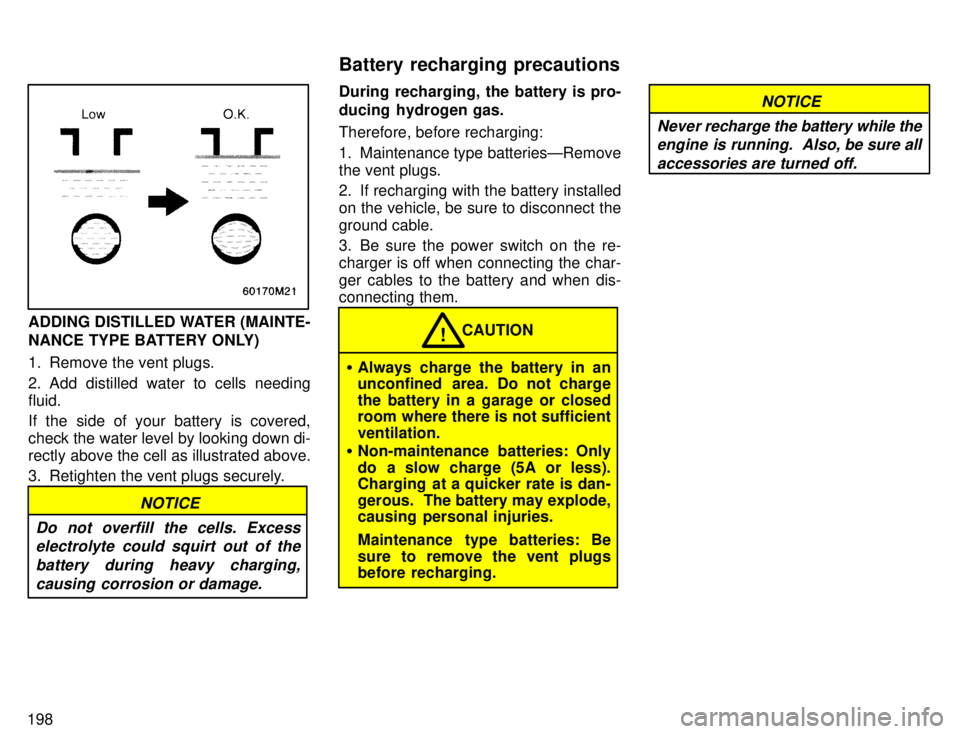
ADDING DISTILLED WATER (MAINTE-
NANCE TYPE BATTERY ONLY)
1. Remove the vent plugs.
2. Add distilled water to cells needing fluid.
If the side of your battery is covered,
check the water level by looking down di-
rectly above the cell as illustrated above.
3. Retighten the vent plugs securely.
NOTICE
Do not overfill the cells. Excess electrolyte could squirt out of the
battery during heavy charging,causing corrosion or damage.
During recharging, the battery is pro-
ducing hydrogen gas. Therefore, before recharging:
1. Maintenance type batteriesÐRemove the vent plugs.
2. If recharging with the battery installed on the vehicle, be sure to disconnect theground cable.
3. Be sure the power switch on the re-
charger is off when connecting the char-ger cables to the battery and when dis-
connecting them.
Always charge the battery in an
unconfined area. Do not charge
the battery in a garage or closed
room where there is not sufficient ventilation.
Non-maintenance batteries: Only
do a slow charge (5A or less).
Charging at a quicker rate is dan-
gerous. The battery may explode,
causing personal injuries.
Maintenance type batteries: Be sure to remove the vent plugs
before recharging.
CAUTION!
NOTICE
Never recharge the battery while the
engine is running. Also, be sure all
accessories are turned off.
Battery recharging precautions
Page 214 of 217
211
19. ECU-B 7.5 A:
SRS airbag warning
light
20. 4WD 20 A: A.D.D. control system,
four-wheel drive control system, rear dif- ferential lock system
21. TURN 10 A: Turn signals lights, emer-
gency flashers
22. GAUGE 10 A: Gauges and meters,
back window defogger, daytime running
light system, air conditioning system, electric moon roof
23. ECU-IG 10 A: Cruise control system,
anti-lock brake system, electronically
controlled automatic transmission sys-
tem, power antenna
24. WIPER 20 A: Windshield wipers and
washer, back window wiper
25. IGN 7.5 A: SRS airbag system, multi-
port fuel injection system / sequential mul-
tiport fuel injection system, discharge
warning light Fuses (type B)
26. HEATER 50 A:
Air conditioning sys-
tem, A.Cº fuse
27. AM1 40 A: Starting system
28. AM2 30 A: Starting system, IGNº
fuse
29. POWER 30 A: Power window, power
back window, electric moon roofFuses (type C)
30. ABS 60 A: Anti-lock brake system
31. ALT 100 A: Charging system