1996 NISSAN MAXIMA brake light
[x] Cancel search: brake lightPage 138 of 197
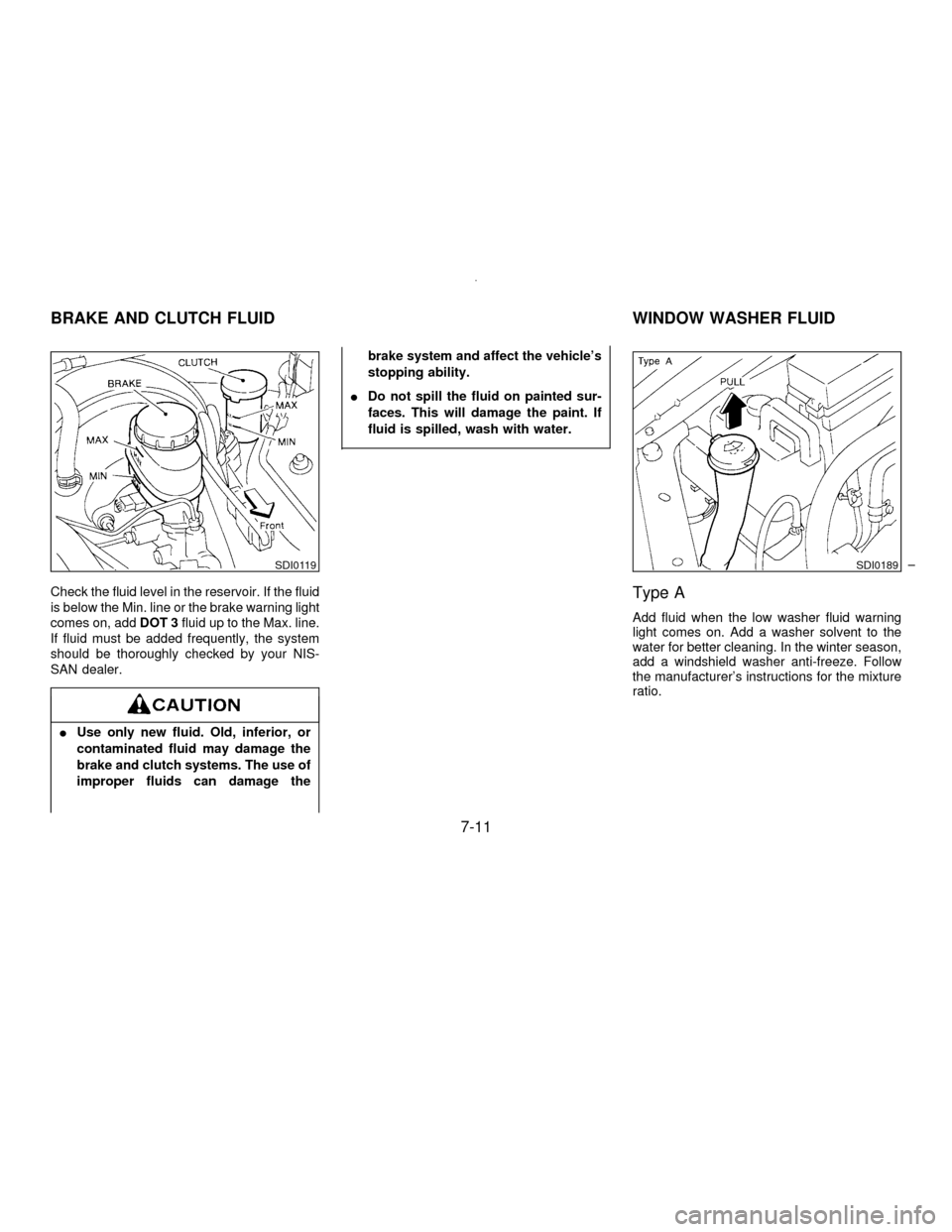
Check the fluid level in the reservoir. If the fluid
is below the Min. line or the brake warning light
comes on, addDOT 3fluid up to the Max. line.
If fluid must be added frequently, the system
should be thoroughly checked by your NIS-
SAN dealer.
IUse only new fluid. Old, inferior, or
contaminated fluid may damage the
brake and clutch systems. The use of
improper fluids can damage thebrake system and affect the vehicle's
stopping ability.
IDo not spill the fluid on painted sur-
faces. This will damage the paint. If
fluid is spilled, wash with water.
Type A
Add fluid when the low washer fluid warning
light comes on. Add a washer solvent to the
water for better cleaning. In the winter season,
add a windshield washer anti-freeze. Follow
the manufacturer's instructions for the mixture
ratio.
SDI0119SDI0189
BRAKE AND CLUTCH FLUID WINDOW WASHER FLUID
7-11
Z01.2.1/A32-DX
Page 146 of 197
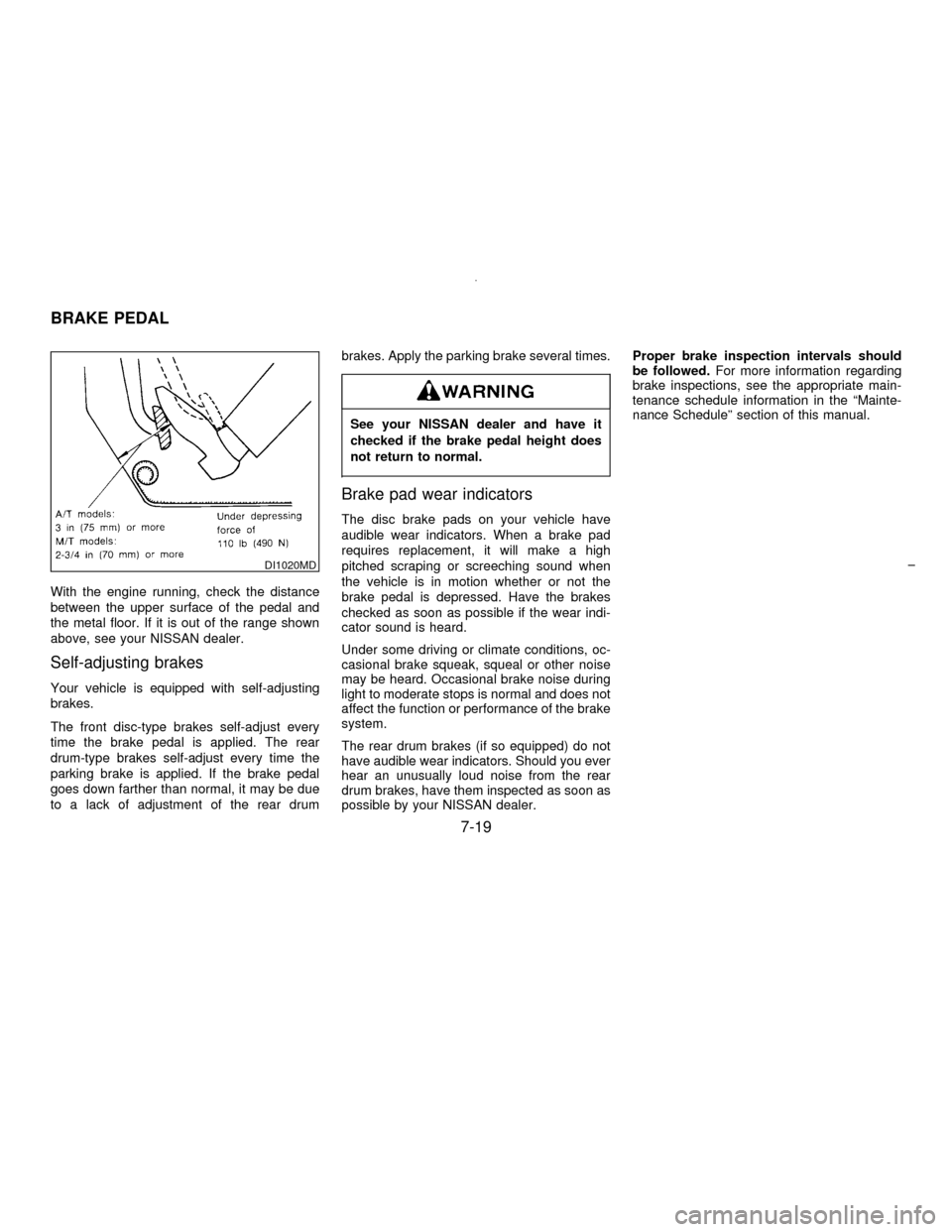
With the engine running, check the distance
between the upper surface of the pedal and
the metal floor. If it is out of the range shown
above, see your NISSAN dealer.
Self-adjusting brakes
Your vehicle is equipped with self-adjusting
brakes.
The front disc-type brakes self-adjust every
time the brake pedal is applied. The rear
drum-type brakes self-adjust every time the
parking brake is applied. If the brake pedal
goes down farther than normal, it may be due
to a lack of adjustment of the rear drumbrakes. Apply the parking brake several times.
See your NISSAN dealer and have it
checked if the brake pedal height does
not return to normal.
Brake pad wear indicators
The disc brake pads on your vehicle have
audible wear indicators. When a brake pad
requires replacement, it will make a high
pitched scraping or screeching sound when
the vehicle is in motion whether or not the
brake pedal is depressed. Have the brakes
checked as soon as possible if the wear indi-
cator sound is heard.
Under some driving or climate conditions, oc-
casional brake squeak, squeal or other noise
may be heard. Occasional brake noise during
light to moderate stops is normal and does not
affect the function or performance of the brake
system.
The rear drum brakes (if so equipped) do not
have audible wear indicators. Should you ever
hear an unusually loud noise from the rear
drum brakes, have them inspected as soon as
possible by your NISSAN dealer.Proper brake inspection intervals should
be followed.For more information regarding
brake inspections, see the appropriate main-
tenance schedule information in the ªMainte-
nance Scheduleº section of this manual.
DI1020MD
BRAKE PEDAL
7-19
Z01.2.1/A32-DX
Page 147 of 197
Check the brake booster function as follows:
1. With the engine off, press and release the
brake pedal several times. When brake
pedal movement (distance of travel) re-
mains the same from one pedal application
to the next, continue on to the next step.
2. While depressing the brake pedal, start the
engine. The pedal height should drop a
little.
3. With the brake pedal depressed, stop the
engine. Keeping the pedal depressed for
about 30 seconds, the pedal height should
not change.
4. Run the engine for one minute without
depressing the brake pedal, then turn it off.
Depress the brake pedal several times. The
pedal travel distance will decrease gradu-
ally with each depression as the vacuum is
released from the booster.
If the brakes do not operate properly, see your
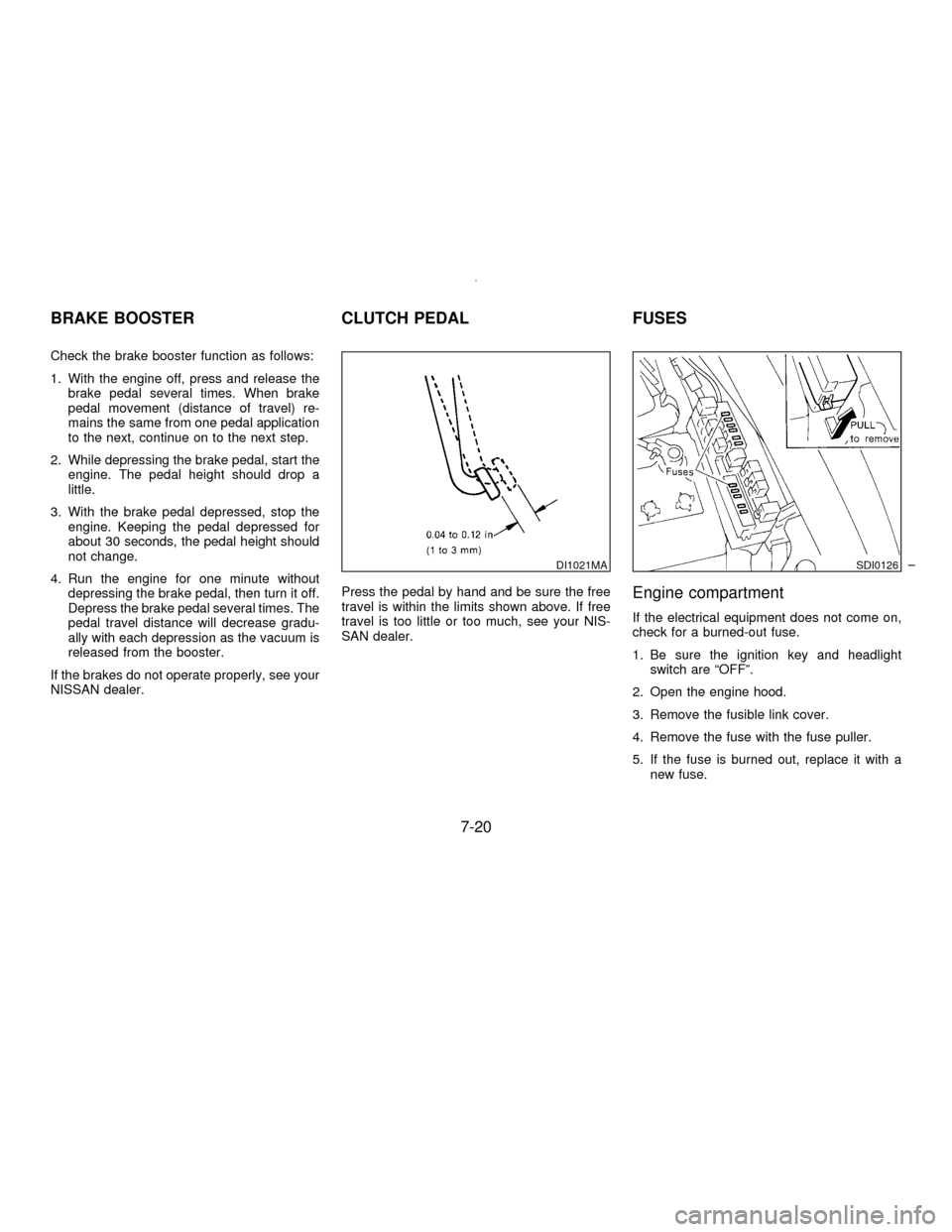
NISSAN dealer.Press the pedal by hand and be sure the free
travel is within the limits shown above. If free
travel is too little or too much, see your NIS-
SAN dealer.
Engine compartment
If the electrical equipment does not come on,
check for a burned-out fuse.
1. Be sure the ignition key and headlight
switch are ªOFFº.
2. Open the engine hood.
3. Remove the fusible link cover.
4. Remove the fuse with the fuse puller.
5. If the fuse is burned out, replace it with a
new fuse.
DI1021MASDI0126
BRAKE BOOSTER CLUTCH PEDAL FUSES
7-20
Z01.2.1/A32-DX
Page 158 of 197
IAfter rotating the tires, adjust the tire
pressure.
IRetighten the wheel nuts after the
aluminum wheels have been run for
the first 600 miles (1,000 km) (also in
cases of a flat tire, etc.).
IDo not include the T-type spare tire or
any other small size spare tire in the
tire rotation.
Tire wear and damage
Tires should be periodically inspected
for wear, cracking, bulging, or objects
caught in the tread. If excessive wear,
cracks, bulging, or deep cuts are found,
the tire should be replaced.
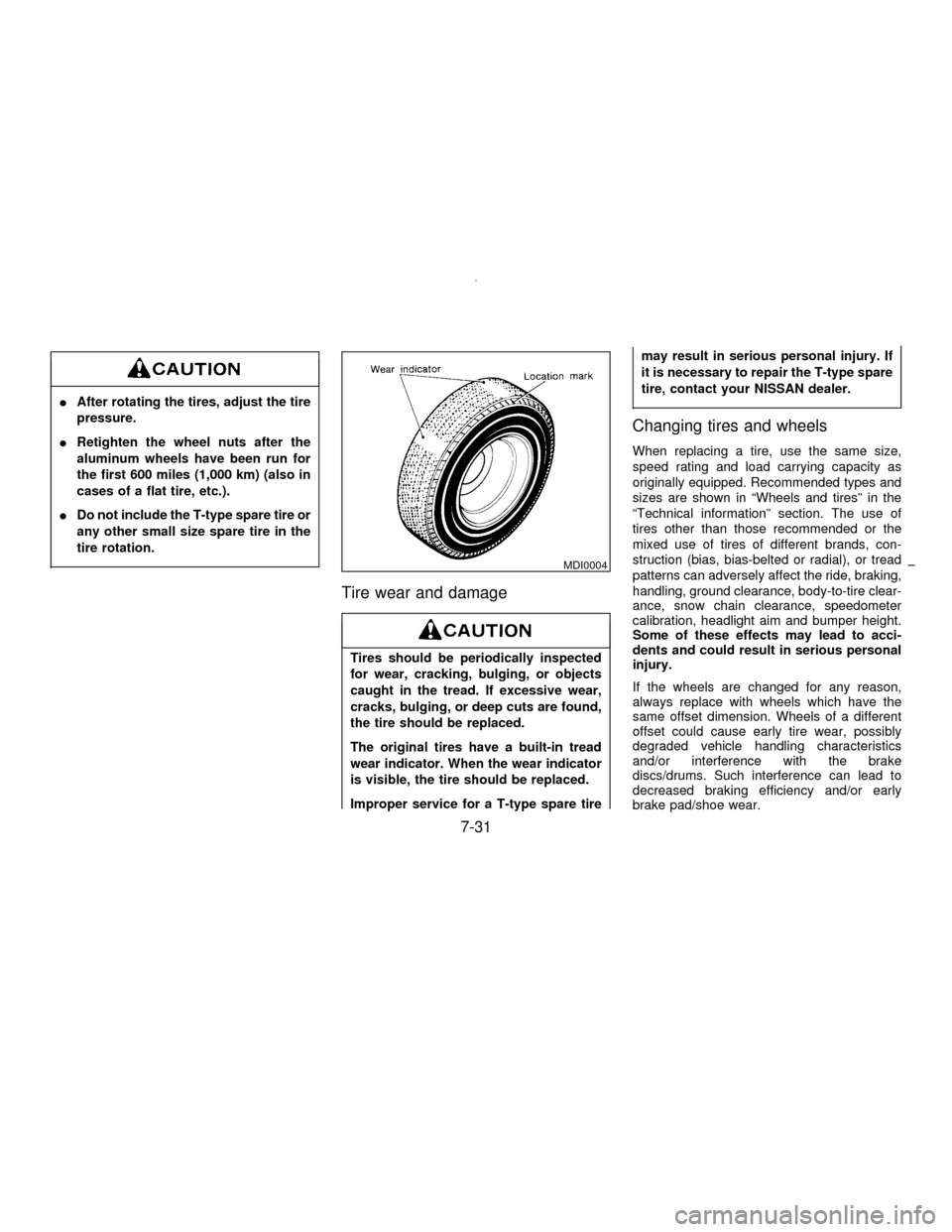
The original tires have a built-in tread
wear indicator. When the wear indicator
is visible, the tire should be replaced.
Improper service for a T-type spare tiremay result in serious personal injury. If
it is necessary to repair the T-type spare
tire, contact your NISSAN dealer.
Changing tires and wheels
When replacing a tire, use the same size,
speed rating and load carrying capacity as
originally equipped. Recommended types and
sizes are shown in ªWheels and tiresº in the
ªTechnical informationº section. The use of
tires other than those recommended or the
mixed use of tires of different brands, con-
struction (bias, bias-belted or radial), or tread
patterns can adversely affect the ride, braking,
handling, ground clearance, body-to-tire clear-
ance, snow chain clearance, speedometer
calibration, headlight aim and bumper height.
Some of these effects may lead to acci-
dents and could result in serious personal
injury.
If the wheels are changed for any reason,
always replace with wheels which have the
same offset dimension. Wheels of a different
offset could cause early tire wear, possibly
degraded vehicle handling characteristics
and/or interference with the brake
discs/drums. Such interference can lead to
decreased braking efficiency and/or early
brake pad/shoe wear.
MDI0004
7-31
Z01.2.1/A32-DX
Page 186 of 197
IRegularly check that all hitch mounting
bolts are securely mounted.
Tire pressures
IWhen towing a trailer, inflate the vehicle
tires to the recommended cold tire pressure
indicated on the tire placard (located on the
inside of the center console lid.)
ITrailer tire condition, size, load rating and
proper inflation pressure should be in ac-
cordance with the trailer and tire manufac-
turers' specifications.
Safety chain
Always use a suitable chain between your
vehicle and the trailer. The chain should be
crossed and should be attached to the hitch,
not to the vehicle bumper or axle. Be sure to
leave enough slack in the chain to permit
turning corners.
Trailer lights
Trailer lights should comply with Federal
and/or local regulations. When wiring the ve-
hicle for towing, connect the stop and tail light
pickup into the vehicle electrical circuit at a
point between the sensor and stop light or light
switch.
Trailer brakes
If your trailer is equipped with a braking sys-
tem, make sure it conforms to Federal and/or
local regulations and that it is properly in-
stalled.
Never connect a trailer brake system
directly to the vehicle brake system.
Pre-towing tips
IBe certain your vehicle maintains a level
position when a loaded and/or unloaded
trailer is hitched. Do not drive the vehicle if
it has an abnormal nose-up or nose-down
condition; check for improper tongue load,
overload, worn suspension or other pos-
sible causes of either condition.
IAlways secure items in the trailer to prevent
load shifts while driving.
IBe certain your rear view mirrors conform to
all federal, state or local regulations. If not,
install any mirrors required for towing be-
fore driving the vehicle.
Trailer towing tips
In order to gain skill and an understanding of
the vehicle's behavior, you should practice
turning, stopping and backing up in an area
which is free from traffic. Steering stability, and
braking performance will be somewhat differ-
ent than under normal driving conditions.
IAlways secure items in the trailer to prevent
load shift while driving.
IAvoid abrupt starts, acceleration or stops.
IAvoid sharp turns or lane changes.
IAlways drive your vehicle at a moderate
speed.
IAlways block the wheels on both vehicle
and trailer when parking. Parking on a
slope is not recommended; however, if you
must do so, and if your vehicle is equipped
with automatic transmission, first block the
wheels and apply the parking brake, and
then move the transmission shift lever into
the ªPº position. If you move the shift lever
to the ªPº position before blocking the
wheels and applying the parking brake,
transmission damage could occur.
IWhen going down a hill, shift into a lower
gear and use the engine braking effect.
When ascending a long grade, downshift
9-15
Z01.2.1/A32-DX
Page 192 of 197

10 Index
A
Air bag warning light ....................................... 2-21
Air cleaner filter ............................................... 7-16
Air conditioner
Air conditioner operation ............................. 3-5
Air conditioner specification label.............. 9-11
Automatic air conditioner............................. 3-9
Air flow chart ..................................................... 3-6
AM-FM radio with cassette player .................. 3-12
AM-FM radio with cassette player and compact
disc player (Bose audio system) .................... 3-16
Antenna........................................................... 3-22
Anti-lock brake system ................................... 4-17
Automatic
Automatic air conditioner............................. 3-9
Automatic transmission fluid ....................... 7-9
Driving with automatic transmission............ 4-6
Avoiding collision and rollover .......................... 4-3
B
Battery............................................................. 7-12
Battery replacement.......................................... 2-7
Before starting the engine ................................ 4-6
Brake
Anti-lock brake system .............................. 4-17
Brake and clutch fluid................................ 7-11
Brake booster ............................................ 7-20Brake pedal ............................................... 7-19
Brake wear indicators ........................ 1-8, 7-19
Parking brake ................................... 4-11, 7-18
Break-in schedule ........................................... 4-13
C
Capacities and recommended fuel/lubricants... 9-2
Caution and warning labels ............................ 2-21
CB radio or car phone .................................... 3-23
Changing
Changing engine coolant ............................ 7-5
Changing engine oil .................................... 7-7
Changing oil filter ........................................ 7-8
Checking engine coolant level .......................... 7-4
Checking engine oil level .................................. 7-6
Child restraints for infants and small children .... 2-
29
Child safety ..................................................... 2-23
Child safety rear door lock................................ 2-3
Cigarette lighter and ash trays ....................... 1-17
Cleaning exterior and interior ........................... 6-2
Clock ............................................................... 1-21
Clutch pedal .................................................... 7-20
Cold weather driving cautions ........................ 4-18
Compact disc (CD) player operation .............. 3-21
Controls............................................................. 3-3
Coolant
Changing engine coolant ............................ 7-5
Checking engine coolant level .................... 7-4Engine coolant temperature gauge ............. 1-4
Cornering light ................................................ 1-14
Corrosion protection ......................................... 6-5
Cruise control.................................................. 4-12
Cup and card holders ..................................... 1-18
DDefogger switch
Rear window and outside mirror defogger
switch......................................................... 1-12
Dimensions and weights ................................... 9-8
Door lock operation .......................................... 2-6
Door locks ......................................................... 2-2
Door unlock operation ...................................... 2-6
Drinking alcohol/drugs and driving ................... 4-4
Drive belts ....................................................... 7-13
Driving
Cold weather driving cautions ................... 4-18
Drinking alcohol/drugs and driving .............. 4-4
Driving with automatic transmission............ 4-6
Driving with manual transmission ............... 4-9
Precautions when driving .......................... 4-16
Precautions when starting and driving ........ 4-2
E
Economy hints ................................................ 4-14
Emission control information label .................. 9-10
Emission control system warranty .................. 9-18
Z01.2.1/A32-DX
Page 193 of 197
Engine ............................................................... 9-7
Before starting the engine ........................... 4-6
Changing engine coolant ............................ 7-5
Changing engine oil .................................... 7-7
Checking engine coolant level .................... 7-4
Checking engine oil level ............................ 7-6
Engine coolant temperature gauge ............. 1-4
Engine cooling system ................................ 7-4
Engine oil..................................................... 7-6
Engine oil and oil filter
recommendation .......................................... 9-4
Engine serial number ................................ 9-10
Starting the engine .................................... 4-10
Exhaust gas (Carbon monoxide) ...................... 4-2
Explanation of maintenance items.................. 8-10
F
Flat tire .............................................................. 5-2
Fluid
Automatic transmission fluid ....................... 7-9
Brake and clutch fluid................................ 7-11
Power steering fluid................................... 7-10
Window washer fluid ................................. 7-11
F.M.V.S.S. certification label........................... 9-10
Foldable outside mirrors ................................. 2-36
Front fog light switch ...................................... 1-15
Front personal light ......................................... 1-22
Fuel
Capacities and recommended
fuel/lubricants .............................................. 9-2
Fuel filler cap ............................................. 2-10
Fuel filler lid lock ....................................... 2-10
Fuel gauge .................................................. 1-5Fuel recommendation.................................. 9-2
Fuses .............................................................. 7-20
Fusible links .................................................... 7-22
G
Gauge
Engine coolant temperature gauge ............. 1-4
Fuel gauge .................................................. 1-5
Meters and gauges ..................................... 1-3
General maintenance ....................................... 8-3
Glove box lock .................................................. 2-8
H
Hazard warning flasher switch........................ 1-15
Head restraint ................................................. 2-15
Headlight and turn signal switch..................... 1-13
Headlights ....................................................... 7-22
Heated seat .................................................... 1-16
Heater operation ............................................... 3-4
Hood release .................................................... 2-8
I
If your vehicle overheats .................................. 5-8
Ignition switch ................................................... 4-4
Inside mirror .................................................... 2-36
Installing license plate .................................... 9-11
Instrument brightness control ......................... 1-14
Interior light ..................................................... 1-21J
Jump starting ........................................... 5-6, 7-13
K
Key .................................................................... 2-2
L
License plate
Installing license plate ............................... 9-11
Light
Air bag warning light ................................. 2-21
Cigarette lighter and ash trays .................. 1-17
Cornering light ........................................... 1-14
Front fog light switch ................................. 1-15
Front personal light ................................... 1-22
Headlight and turn signal switch ............... 1-13
Headlights.................................................. 7-22
Interior light................................................ 1-21
Light bulbs ................................................. 7-22
Trunk light.................................................. 1-23
Vanity mirror light ...................................... 1-22
Warning/indicator light and buzzer.............. 1-6
Lock
Anti-lock brake system .............................. 4-17
Child safety rear door lock .......................... 2-3
Clock.......................................................... 1-21
Door lock operation ..................................... 2-6
Door locks ................................................... 2-2
Door unlock operation ................................. 2-6
Fuel filler lid lock ....................................... 2-10
Glove box lock............................................. 2-8
10-2
Z01.2.1/A32-DX
Page 194 of 197
Power door lock .......................................... 2-4
Trunk lid lock ............................................... 2-9
M
Maintenance
Explanation of maintenance items ............ 8-10
General maintenance .................................. 8-3
Periodic maintenance .................................. 8-5
Seat belt maintenance .............................. 2-29
Meters and gauges ........................................... 1-3
Mirror
Foldable outside mirrors............................ 2-36
Inside mirror .............................................. 2-36
Outside mirror remote control ................... 2-36
Rear window and outside mirror defogger
switch......................................................... 1-12
Vanity mirror light ...................................... 1-22
Multi-remote control system.............................. 2-5
O
Odometer .......................................................... 1-4
Oil
Changing engine oil .................................... 7-7
Changing oil filter ........................................ 7-8
Checking engine oil level ............................ 7-6
Engine oil..................................................... 7-6
Engine oil and oil filter
recommendation .......................................... 9-4
Opener cancel lever for trunk lid .................... 2-10
Opening the driver's and front passenger's
window .............................................................. 2-6
Outside mirror remote control ......................... 2-36Overheat
If your vehicle overheats ............................. 5-8
P
Panic alarm operation ....................................... 2-6
Parking
Parking brake ................................... 4-11, 7-18
Parking/parking on hills ............................. 4-15
Periodic maintenance ....................................... 8-5
Pocket ............................................................. 1-17
Power
Power antenna .......................................... 3-22
Power door lock .......................................... 2-4
Power steering fluid................................... 7-10
Power window ........................................... 1-19
Precautions ....................................................... 7-2
Precautions on seat belt usage ................ 2-23
Precautions when driving .......................... 4-16
Precautions when starting and driving ........ 4-2
Push starting ..................................................... 5-8
R
Radio............................................................... 3-11
AM-FM radio with cassette player ............ 3-12
AM-FM radio with cassette player and compact
disc player (Bose audio system) ............... 3-16
CB radio or car phone............................... 3-23
Radio operation ......................................... 3-17
Rear seat ........................................................ 2-16
Rear window and outside mirror defogger
switch .............................................................. 1-12
Recommended SAE viscosity number ............. 9-5Refrigerant recommendation ............................ 9-6
Reporting safety defects (For U.S.A.) ............ 9-18
S
Safety
Child safety................................................ 2-23
Child safety rear door lock .......................... 2-3
Reporting safety defects (For U.S.A.) ....... 9-18
Seat belt
2-point type without ................................... 2-27
3-point type seat belt with retractor .......... 2-25
Precautions on seat belt usage ................ 2-23
Seat belt extenders ................................... 2-28
Seat belt maintenance .............................. 2-29
Seat belts .................................................. 2-23
Seats ............................................................... 2-12
Spark plug replacement .................................. 7-14
Speedometer .................................................... 1-4
Starting
Before starting the engine ........................... 4-6
Jump starting ..................................... 5-6, 7-13
Precautions when starting and driving ........ 4-2
Push starting ............................................... 5-8
Starting the engine .................................... 4-10
Steering
Power steering fluid................................... 7-10
Tilting steering wheel ................................ 2-35
Sunroof ........................................................... 1-20
Supplemental restraint system (Air bag
system) ........................................................... 2-17
Switch
Front fog light switch ................................. 1-15
Hazard warning flasher switch .................. 1-15
10-3
Z01.2.1/A32-DX