Page 160 of 198
![NISSAN FRONTIER 1996 D22 / 1.G Owners Manual SCHEDULE 1
Abbreviations: R = Replace I = Inspect. Correct or replace if necessary. [ ]: At the mileage intervals only
MAINTENANCE OPERATIONMAINTENANCE INTERVAL
Perform at number of miles, kilometers](/manual-img/5/595/w960_595-159.png "NISSAN FRONTIER 1996 D22 / 1.G Owners Manual SCHEDULE 1
Abbreviations: R = Replace I = Inspect. Correct or replace if necessary. [ ]: At the mileage intervals only
MAINTENANCE OPERATIONMAINTENANCE INTERVAL
Perform at number of miles, kilometers")
SCHEDULE 1
Abbreviations: R = Replace I = Inspect. Correct or replace if necessary. [ ]: At the mileage intervals only
MAINTENANCE OPERATIONMAINTENANCE INTERVAL
Perform at number of miles, kilometers
or months, whichever comes first.Miles ý 1,000 3.75 7.5 11.25 15 18.75 22.5 26.25 30 33.75 37.5 41.25 45 48.75 52.5 56.25 60
(km ý 1,000) (6) (12) (18) (24) (30) (36) (42) (48) (54) (60) (66) (72) (78) (84) (90) (96)
Months 3 6 9 12 15 18 21 24 27 30 33 36 39 42 45 48
Chassis and body maintenance
Brake lines & cablesIIII
Brake pads, discs, drums & liningsIIIIIIII
Manual & automatic transmission, transfer
& differential gear oil (exc. LSD)See NOTE (1)IIII
Limited-slip differential (LSD) gear oil See NOTE (1)IRIR
Steering gear (box) & linkage, axle & suspension partsIIIIIIII
Drive shaft boots & propeller shaft (
) IIIIIIII
Steering linkage ball joints & front suspension ball jointsIIIIIIII
Front wheel bearing grease (4x2)II
Front wheel bearing grease & free-running
hub grease (
)See NOTE (2)IRIR
Exhaust systemIIIIIIII
Supplemental air bag system See NOTE (3)
NOTE: (1) If towing a trailer, using a camper or a car-top carrier, or driving on rough or muddy roads, change (not just inspect) oil at every 30,000
miles (48,000 km) or 24 months except for LSD Change LSD gear oil every 15,000 miles (24,000 km) or 12 months.
(2) If operating frequently in water, replace grease every 3,750 miles (6,000 km) or 3 months.
(3) Inspect the supplemental air bag system 10 years after the date of manufacture noted on the F.M.V.S.S. certification label.
8-7
ZX
Page 162 of 198
![NISSAN FRONTIER 1996 D22 / 1.G Owners Manual SCHEDULE 2
Abbreviations: R = Replace I = Inspect. Correct or replace if necessary. [ ]: At the mileage intervals only
MAINTENANCE OPERATIONMAINTENANCE INTERVAL
Perform at number of miles, kilometers](/manual-img/5/595/w960_595-161.png "NISSAN FRONTIER 1996 D22 / 1.G Owners Manual SCHEDULE 2
Abbreviations: R = Replace I = Inspect. Correct or replace if necessary. [ ]: At the mileage intervals only
MAINTENANCE OPERATIONMAINTENANCE INTERVAL
Perform at number of miles, kilometers")
SCHEDULE 2
Abbreviations: R = Replace I = Inspect. Correct or replace if necessary. [ ]: At the mileage intervals only
MAINTENANCE OPERATIONMAINTENANCE INTERVAL
Perform at number of miles, kilometers or
months, whichever comes first.Miles ý 1,000 7.5 15 22.5 30 37.5 45 52.5 60
(km ý 1,000) (12) (24) (36) (48) (60) (72) (84) (96)
Months 6 12 18 24 30 36 42 48
Chassis and body maintenance
Brake lines & cablesIIII
Brake pads, discs, drums & liningsIIII
Manual & automatic transmission, transfer & differential gear
oil (exc. LSD)IIII
Limited-slip differential (LSD) gear oil I R I R
Steering gear (box) & linkage, axle & suspension parts I I
Drive shaft boots (
) IIII
Steering linkage ball joints & front suspension ball jointsI
Front wheel bearing grease (4x2) I I
Front wheel bearing grease & free-running hub grease (
)I R I R
Exhaust systemII
Supplemental air bag system See NOTE (1)
NOTE: (1) Inspect the supplemental air bag system 10 years after the date of manufacture noted on the F.M.V.S.S. certification label.
8-9
ZX
Page 164 of 198

damage, looseness and grease leakage.
Under severe driving conditions, more fre-
quent inspection should be performed.
Propeller shaft(s)Check the propeller
shaft(s) for damage, looseness and grease
leakage under severe driving conditions
(
only).
Front wheel bearing grease & free-
running hub greaseCheck the wheel
bearing for grease leakage around grease
seals, axial end play and smooth turning.
Repack these in accordance with the main-
tenance schedule (4x2).
Check the wheel bearing and free running
hub for grease leakage around grease
seals, axial end play and smooth turning.
Repack these in accordance with the main-
tenance schedule. In case of frequent driv-
ing in muddy water, the bearing grease and
free-running hub grease inspection should
be performed more frequently (
).
Exhaust systemVisually check the ex-
haust pipes, muffler, and hangers for proper
attachment, leaks, cracks, chafing, abra-
sion, deterioration, etc. Under severe driv-
ing conditions, inspection should be per-
formed more frequently.Supplemental air bag systemCheck the
supplemental air bag system components
for proper attachment, damage, deformities,
cracks, rust, etc. Work around and on the
supplemental air bag system should be
done by an authorized NISSAN dealer.
8-11
ZX
Page 166 of 198
9 Technical and consumer information
Capacities and recommended fuel/lubricants .... 9-2
Engine ................................................................ 9-9
Wheel/tire size .................................................. 9-10
Dimensions and weights .................................. 9-11
Registering your vehicle in another country .... 9-12
Vehicle identification ......................................... 9-12
Trailer towing .................................................... 9-16
Towing load/specification chart ........................ 9-18
Uniform tire quality grading .............................. 9-21
Emission control system warranty ................... 9-22
Truck-camper loading ....................................... 9-23
Reporting safety defects (USA) ....................... 9-25
NISSAN Service/Owner's Manual Order Form . 9-26
ZX
Page 175 of 198
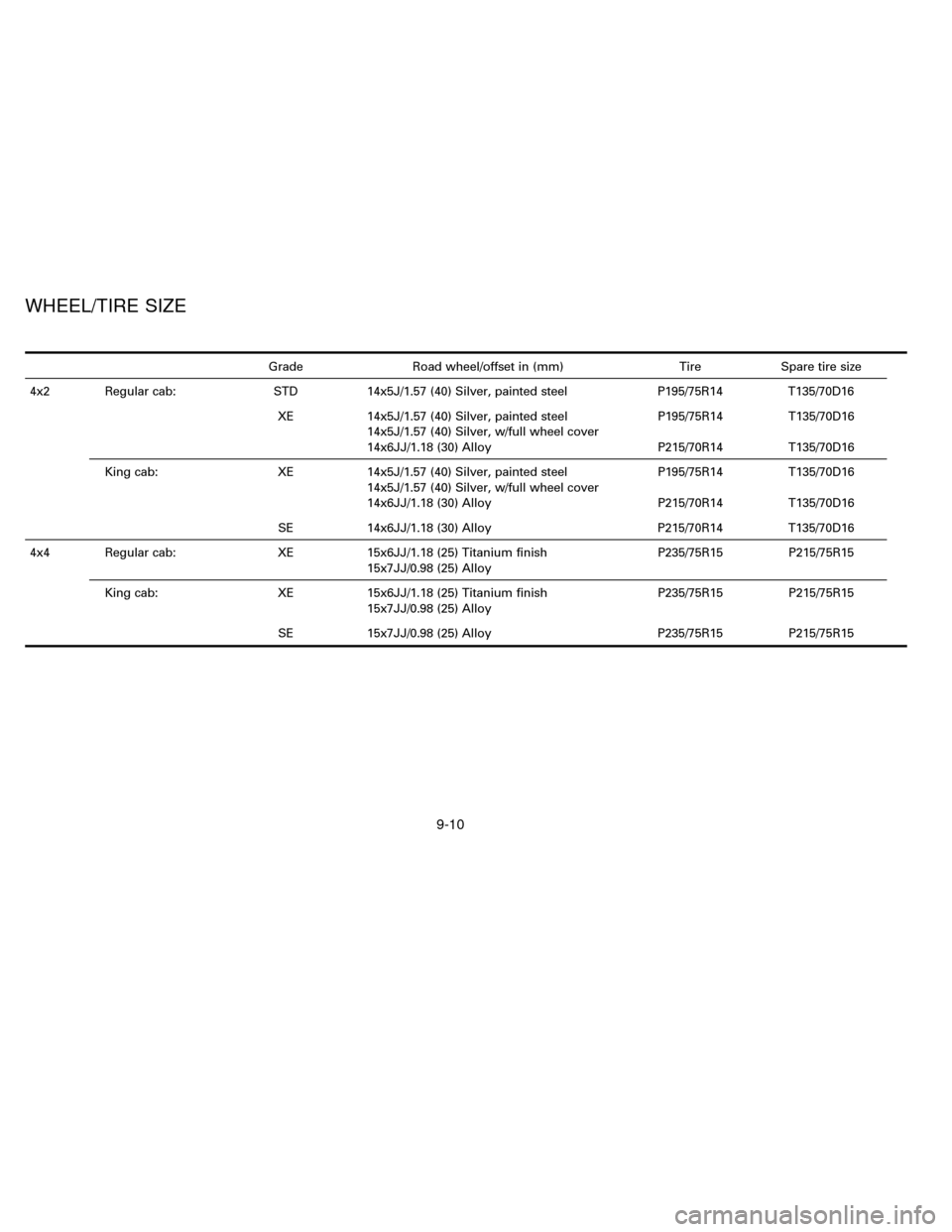
Grade Road wheel/offset in (mm) Tire Spare tire size
4x2 Regular cab: STD 14x5J/1.57 (40) Silver, painted steel P195/75R14 T135/70D16
XE 14x5J/1.57 (40) Silver, painted steel
14x5J/1.57 (40) Silver, w/full wheel cover
14x6JJ/1.18 (30) AlloyP195/75R14
P215/70R14T135/70D16
T135/70D16
King cab: XE 14x5J/1.57 (40) Silver, painted steel
14x5J/1.57 (40) Silver, w/full wheel cover
14x6JJ/1.18 (30) AlloyP195/75R14
P215/70R14T135/70D16
T135/70D16
SE 14x6JJ/1.18 (30) Alloy P215/70R14 T135/70D16
4x4 Regular cab: XE 15x6JJ/1.18 (25) Titanium finish
15x7JJ/0.98 (25) AlloyP235/75R15 P215/75R15
King cab: XE 15x6JJ/1.18 (25) Titanium finish
15x7JJ/0.98 (25) AlloyP235/75R15 P215/75R15
SE 15x7JJ/0.98 (25) Alloy P235/75R15 P215/75R15
WHEEL/TIRE SIZE
9-10
ZX
Page 176 of 198
Unit: in (mm)
4x2 4x4
Regular Cab King Cab Regular Cab King Cab
Overall length*1 174.6 (4,435) 190.0 (4,825) 174.6 (4,435) 190.0 (4,825)
Overall width 65.0 (1,650) 65.0 (1,650) 66.5 (1,690) 66.5 (1,690)
Overall height 62.0 (1,575) 62.0 (1,575) 67.1 (1,705) 67.1 (1,705)
Front tread 54.9 (1,395) 54.9 (1,395) 58.5 (1,486) 58.5 (1,486)
Rear tread 54.5 (1,385) 54.5 (1,385) 57.9 (1,471) 57.9 (1,471)
Wheelbase 104.3 (2,650) 116.1 (2,950) 104.3 (2,650) 116.1 (2,950)
Gross vehicle weight rating
lb (kg)
See the ``F.M.V.S.S. certification label'' on the driver side lock pillar. Gross axle weight rating
Front lb (kg)
Rear lb (kg)
*1: On step bumper equipped models, the bumper adds 5.5 in (140 mm) to the overall length.
DIMENSIONS AND WEIGHTS
9-11
ZX
Page 183 of 198
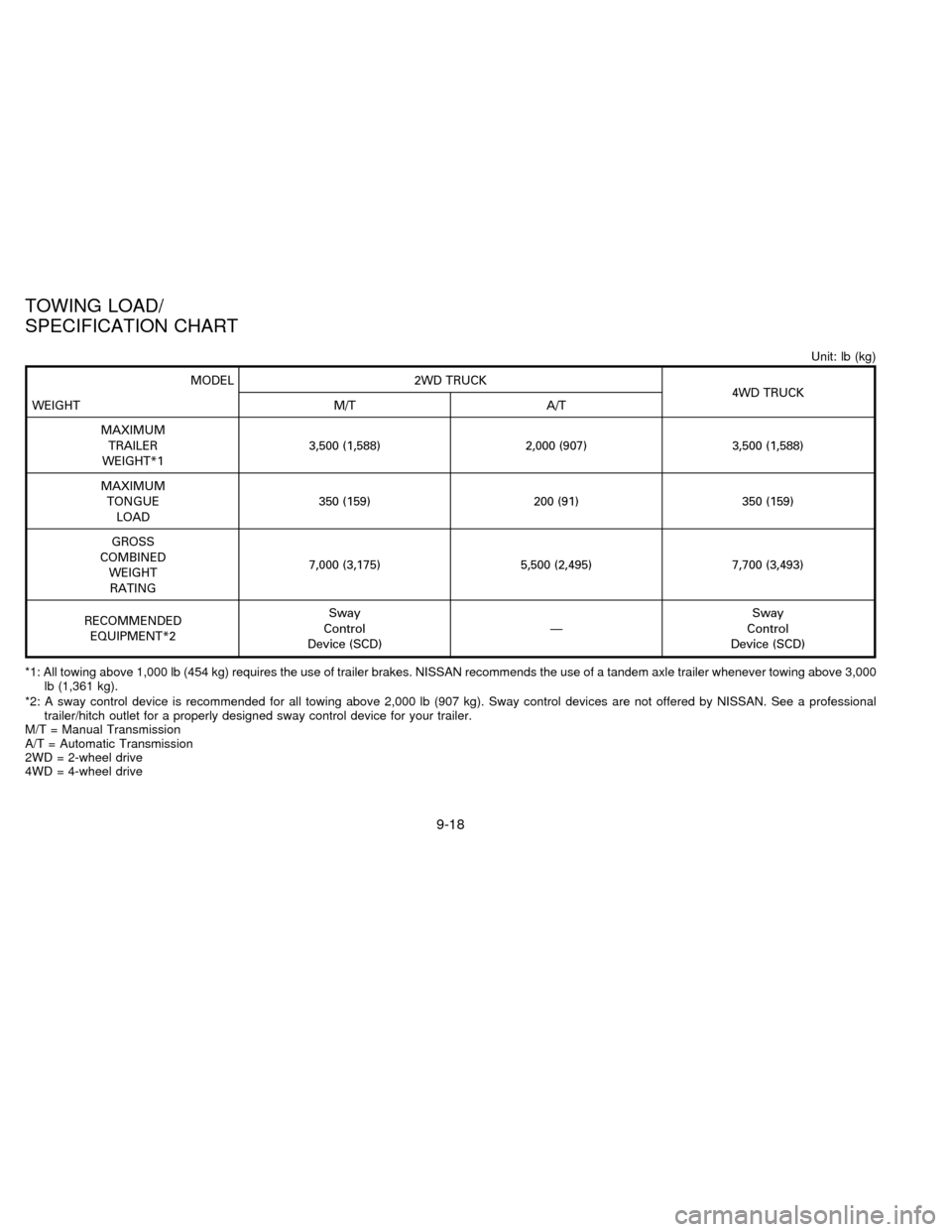
Unit: lb (kg)
MODEL
WEIGHT2WD TRUCK
4WD TRUCK
M/T A/T
MAXIMUM
TRAILER
WEIGHT*13,500 (1,588) 2,000 (907) 3,500 (1,588)
MAXIMUM
TONGUE
LOAD350 (159) 200 (91) 350 (159)
GROSS
COMBINED
WEIGHT
RATING7,000 (3,175) 5,500 (2,495) 7,700 (3,493)
RECOMMENDED
EQUIPMENT*2Sway
Control
Device (SCD)ÐSway
Control
Device (SCD)
*1: All towing above 1,000 lb (454 kg) requires the use of trailer brakes. NISSAN recommends the use of a tandem axle trailer whenever towing above 3,000
lb (1,361 kg).
*2: A sway control device is recommended for all towing above 2,000 lb (907 kg). Sway control devices are not offered by NISSAN. See a professional
trailer/hitch outlet for a properly designed sway control device for your trailer.
M/T = Manual Transmission
A/T = Automatic Transmission
2WD = 2-wheel drive
4WD = 4-wheel drive
TOWING LOAD/
SPECIFICATION CHART
9-18
ZX
Page 185 of 198

Trailer towing tips
In order to gain skill and an understanding
of the vehicle's behavior, you should prac-
tice turning, stopping and backing up in an
area which is free from traffic. Steering,
stability and braking performance will be
somewhat different than under normal driv-
ing conditions.
cAlways secure items in the trailer to
prevent load shift while driving.
c
Avoid abrupt starts, acceleration or stops.
cAvoid sharp turns or lane changes.
cAlways drive your vehicle at a moderate
speed.
cAlways block the wheels on both vehicle
and trailer when parking. Parking on a
slope is not recommended; however, if
you must do so, and if your vehicle is
equipped with automatic transmission,
first block the wheels and apply the park-
ing brake, and then move the transmis-
sion shift lever into the P position. If you
move the shift lever to the P position
before blocking the wheels and applying
the parking brake, transmission damage
could occur.cWhen going down a hill, shift into a lower
gear and use the engine braking effect.
When ascending a long grade, downshift
the transmission to a lower gear and
reduce speed to reduce chances of en-
gine overloading and/or overheating.
However, for long steep grades, do not
stay in 1st or 2nd gear when driving
above 35 MPH (56 km/h).
cIf the engine coolant rises to an ex-
tremely high temperature when the air
conditioning system is on, turn off the air
conditioner. Coolant heat can be addi-
tionally vented by opening the windows,
switching the fan control to high and
setting the temperature control to the
HOT position.
cTrailer towing requires more fuel than
normal circumstances.
cAvoid towing a trailer for your vehicle's
first 500 miles (800 km).
cHave your vehicle serviced more often
than at intervals specified in the recom-
mended Maintenance Schedule.
cWhen making a turn, your trailer wheels
will be closer to the inside of the turn than
your vehicle wheels. To compensate forthis, make a larger than normal turning
radius during the turn.
cCrosswinds and rough roads adversely
affect vehicle/trailer handling, possibly
causing vehicle sway. When being
passed by larger vehicles, be prepared
for possible changes in crosswinds that
could affect vehicle handling. If swaying
does occur, firmly grip the steering
wheel, steer straight ahead, and immedi-
ately (but gradually) reduce vehicle
speed. This combination helps to stabi-
lize the vehicle. Never increase speed.
cBe careful when passing other vehicles.
Passing while towing a trailer requires
considerably more distance than normal
passing. Remember the length of the
trailer must also pass the other vehicle
before you can safely change lanes.
cTo maintain engine braking efficiency
and electrical charging performance, do
not use fifth gear (manual transmission)
or overdrive (automatic transmission).
cAvoid holding the brake pedal down too
long or too frequently. This could cause
the brakes to overheat, resulting in re-
duced braking efficiency.
9-20
ZX