Selecting the correct oil filter
Your new vehicle is equipped with a high-
quality genuine NISSAN oil filter. When
replacing, use the genuine oil filter or its
equivalent for the reason described in
``Change intervals''.
Change intervals
The oil and oil filter change intervals for your
engine are based on the use of the specified
quality oils and filters. Oil and filter other
than the specified quality, or oil and filter
change intervals longer than recommended
could reduce engine life. Damage to en-
gines caused by improper maintenance or
use of incorrect oil and filter quality and/or
viscosity is not covered by the new NISSAN
vehicle warranties.
Your engine was filled with a high quality
engine oil when it was built. You do not have
to change the oil before the first recom-
mended change interval. Oil and filter
change intervals depend upon how you use
your vehicle. Operation under the following
conditions may require more frequent oil
and filter changes:
Ð repeated short distance driving at cold
outside temperatures,Ð driving in dusty conditions,
Ð extensive idling,
Ð towing a trailer.
RECOMMENDED SAE
VISCOSITY NUMBER
cSAE 5W-30 viscosity oil is preferred
for all temperatures. SAE 10W-30 vis-
cosity oil may be used if the ambient
temperature is above 0ÉF (-18ÉC).
ATI0509
9-7
ZX
When towing a trailer, change oil in the
transmission more frequently. See the
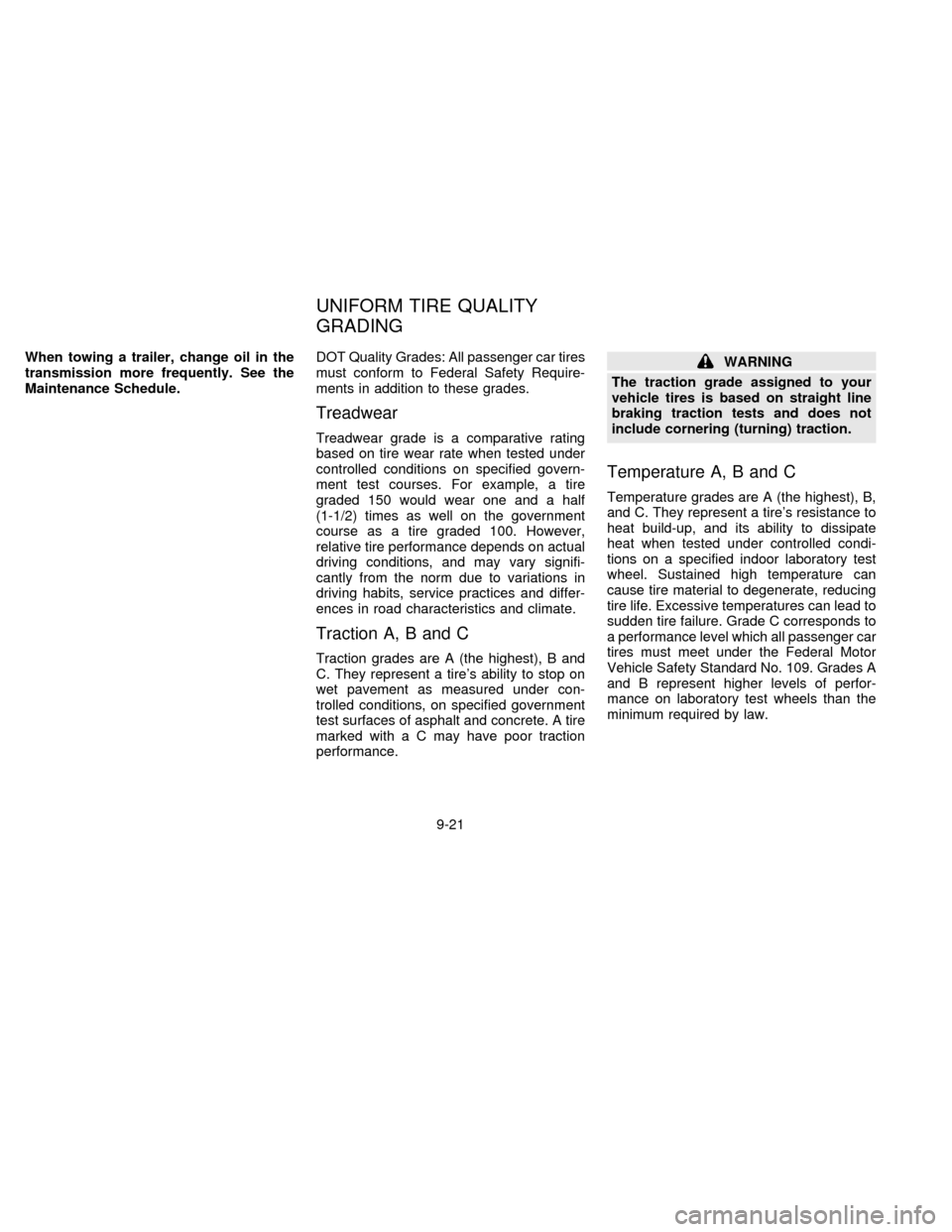
Maintenance Schedule.DOT Quality Grades: All passenger car tires
must conform to Federal Safety Require-
ments in addition to these grades.
Treadwear
Treadwear grade is a comparative rating
based on tire wear rate when tested under
controlled conditions on specified govern-
ment test courses. For example, a tire
graded 150 would wear one and a half
(1-1/2) times as well on the government
course as a tire graded 100. However,
relative tire performance depends on actual
driving conditions, and may vary signifi-
cantly from the norm due to variations in
driving habits, service practices and differ-
ences in road characteristics and climate.
Traction A, B and C
Traction grades are A (the highest), B and
C. They represent a tire's ability to stop on
wet pavement as measured under con-
trolled conditions, on specified government
test surfaces of asphalt and concrete. A tire
marked with a C may have poor traction
performance.
WARNING
The traction grade assigned to your
vehicle tires is based on straight line
braking traction tests and does not
include cornering (turning) traction.
Temperature A, B and C
Temperature grades are A (the highest), B,
and C. They represent a tire's resistance to
heat build-up, and its ability to dissipate
heat when tested under controlled condi-
tions on a specified indoor laboratory test
wheel. Sustained high temperature can
cause tire material to degenerate, reducing
tire life. Excessive temperatures can lead to
sudden tire failure. Grade C corresponds to
a performance level which all passenger car
tires must meet under the Federal Motor
Vehicle Safety Standard No. 109. Grades A
and B represent higher levels of perfor-
mance on laboratory test wheels than the
minimum required by law.
UNIFORM TIRE QUALITY
GRADING
9-21
ZX
Driving
Auto-lock free-running hubs ................. 4-15
Cold weather driving cautions .............. 4-27
Driving with automatic transmission ....... 4-6
Driving with manual transmission ........... 4-9
Driving your 4-wheel drive safely ......... 4-22
Manual-lock free-running hubs ............. 4-19
Precautions when driving ..................... 4-25
Precautions when starting and driving ... 4-2
E
Economy, fuel ............................................ 4-13
Emission control information label............. 9-14
Emission control system warranty ............. 9-22
Engine
Before starting the engine ...................... 4-5
Capacities and recommended
fuel/lubricants.......................................... 9-2
Changing engine coolant........................ 7-5
Changing engine oil................................ 7-7
Changing engine oil filter........................ 7-8
Checking engine coolant level ............... 7-4
Checking engine oil level ....................... 7-6
Engine compartment check locations .... 7-3
Engine coolant temperature gauge ........ 1-4
Engine cooling system ........................... 7-4
Engine oil ................................................ 7-6
Engine oil and oil filter
recommendation ..................................... 9-6
Engine oil viscosity ................................. 9-7
Engine serial number ........................... 9-13Engine specifications .............................. 9-9
Starting the engine ............................... 4-10
Exhaust gas (Carbon monoxide) ................. 4-2
F
Flashers (See hazard warning flasher switch)
Flat tire ......................................................... 5-2
Floor mat positioning aid ............................. 6-4
Fluid (Checking)
Automatic transmission fluid ................... 7-9
Brake and clutch fluid ........................... 7-11
Engine coolant ........................................ 7-4
Engine oil ................................................ 7-6
Power steering fluid .............................. 7-11
Window washer fluid ............................ 7-12
F.M.V.S.S. certification label ..................... 9-13
Front seats
Bench.................................................... 2-10
Separate ................................................. 2-8
Fuel
Capacities and recommended
fuel/lubricants.......................................... 9-2
Fuel economy ....................................... 4-13
Fuel filler cap .......................................... 2-5
Fuel gauge.............................................. 1-4
Fuel octane rating................................... 9-5
Fuel recommendation ............................. 9-4
Fuses ......................................................... 7-20G
Gas station information............................ 10-11
Gauge
Engine coolant temperature gauge ........ 1-4
Fuel gauge.............................................. 1-4
Odometer ................................................ 1-3
Speedometer .......................................... 1-3
Tachometer............................................. 1-3
Trip odometer ......................................... 1-3
Gear selection (See shifting)
General maintenance .................................. 8-2
Glove box lock ............................................. 2-4
H
Hazard warning flasher switch .................. 1-12
Head restraints ............................................ 2-9
Headlight and turn signal switch ............... 1-10
Headlights .................................................. 7-20
Heater
Heater and air conditioner controls ........ 3-3
Heater operation ..................................... 3-4
Hood release ............................................... 2-4
Hubs
Auto-lock free-running hubs ................. 4-15
Manual-lock free-running hubs ............. 4-19
I
Ignition switch .............................................. 4-4
10-2
ZX