Page 35 of 198
SEAT ADJUSTMENT
WARNING
cDo not adjust the bench seat while
driving. The seat may move sud-
denly and could cause loss of con-
trol of the vehicle.
cAfter adjustment, gently rock in the
seat to make sure it is securely
locked.
Forward and Backward
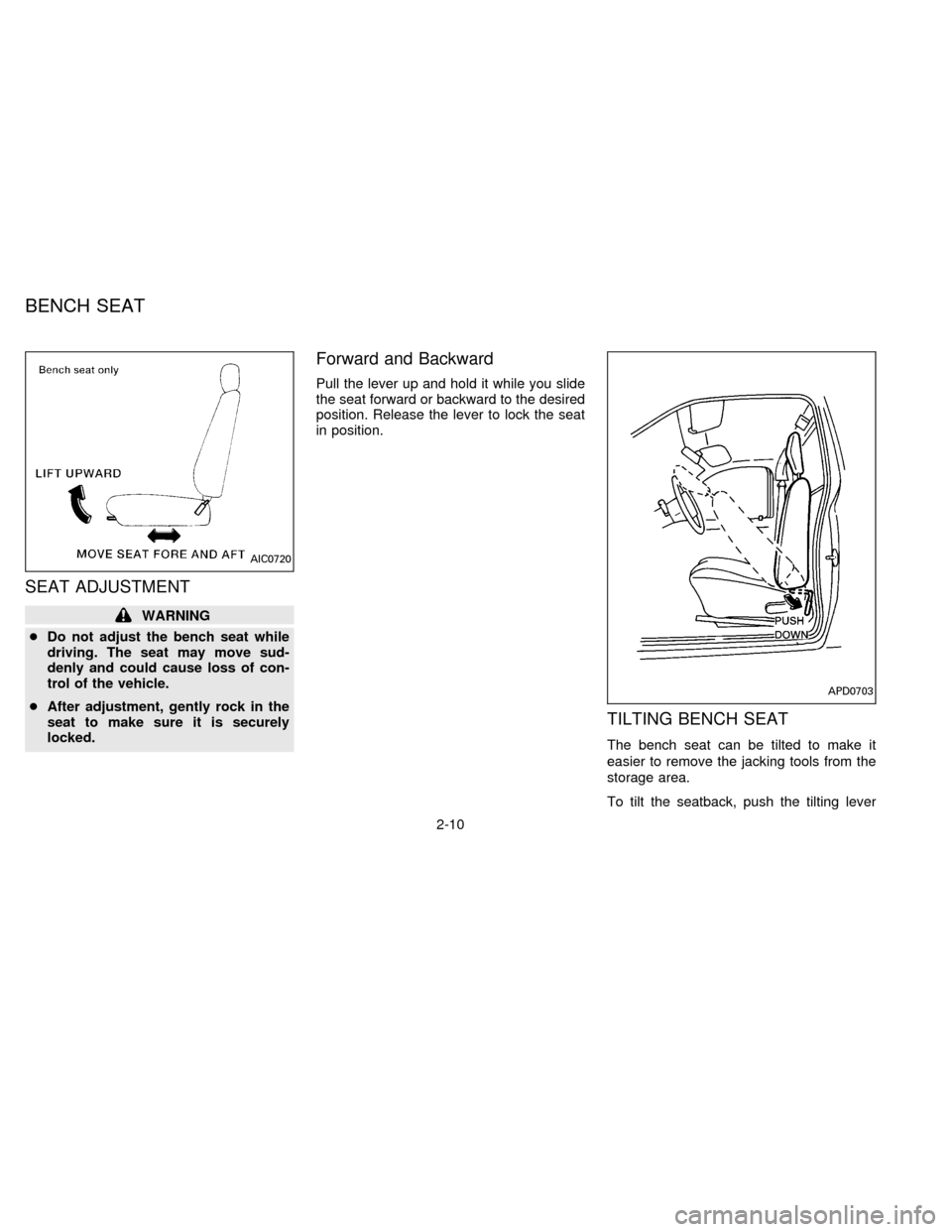
Pull the lever up and hold it while you slide
the seat forward or backward to the desired
position. Release the lever to lock the seat
in position.
TILTING BENCH SEAT
The bench seat can be tilted to make it
easier to remove the jacking tools from the
storage area.
To tilt the seatback, push the tilting lever
AIC0720
APD0703
BENCH SEAT
2-10
ZX
Page 110 of 198

Jacking up the vehicle and remov-
ing the wheel
Identify the type of jack supplied with
your truck.
You will find one of two types of jacks
installed in your vehicle, a pantograph (scis-
sor) type jack or a screw (bottle) type jack.
Always refer to the proper illustrations for
the correct placement and jack-up points for
your specific vehicle model and jack type.
To help avoid personal injury, carefully
read the following instructions.1. On 4-wheel drive models with a screw
type jack, put the adapter stored in the
tool bag on the jack when jacking up the
front side.
Do not use the jack adapter for the
rear.
2. Place the jack directly under the jack-up
point.
The jack should be used on level, firm
ground.
3. Loosen each wheel nut on the flat tire
one or two turns by turning counterclock-
wise with the wheel nut wrench.Do not remove the wheel nuts until the
tire is off the ground.
4. Carefully raise the vehicle until the flat
tire clears the ground. Remove the wheel
nuts, and then remove the wheel. Do not
remove the brake drum with the wheel.
ACE0700
PANTOGRAPH TYPE JACK
5-5
ZX
Page 112 of 198
Installing wheel
The spare tire is designed for emergency
use. See specific instructions under the
heading ``Wheels and tires'' in the ``Do-
it-yourself operations'' section.
1. Clean any mud or dirt from the surface
between the wheel and hub.
2. Carefully put the spare tire on and tighten
the wheel nuts finger tight.
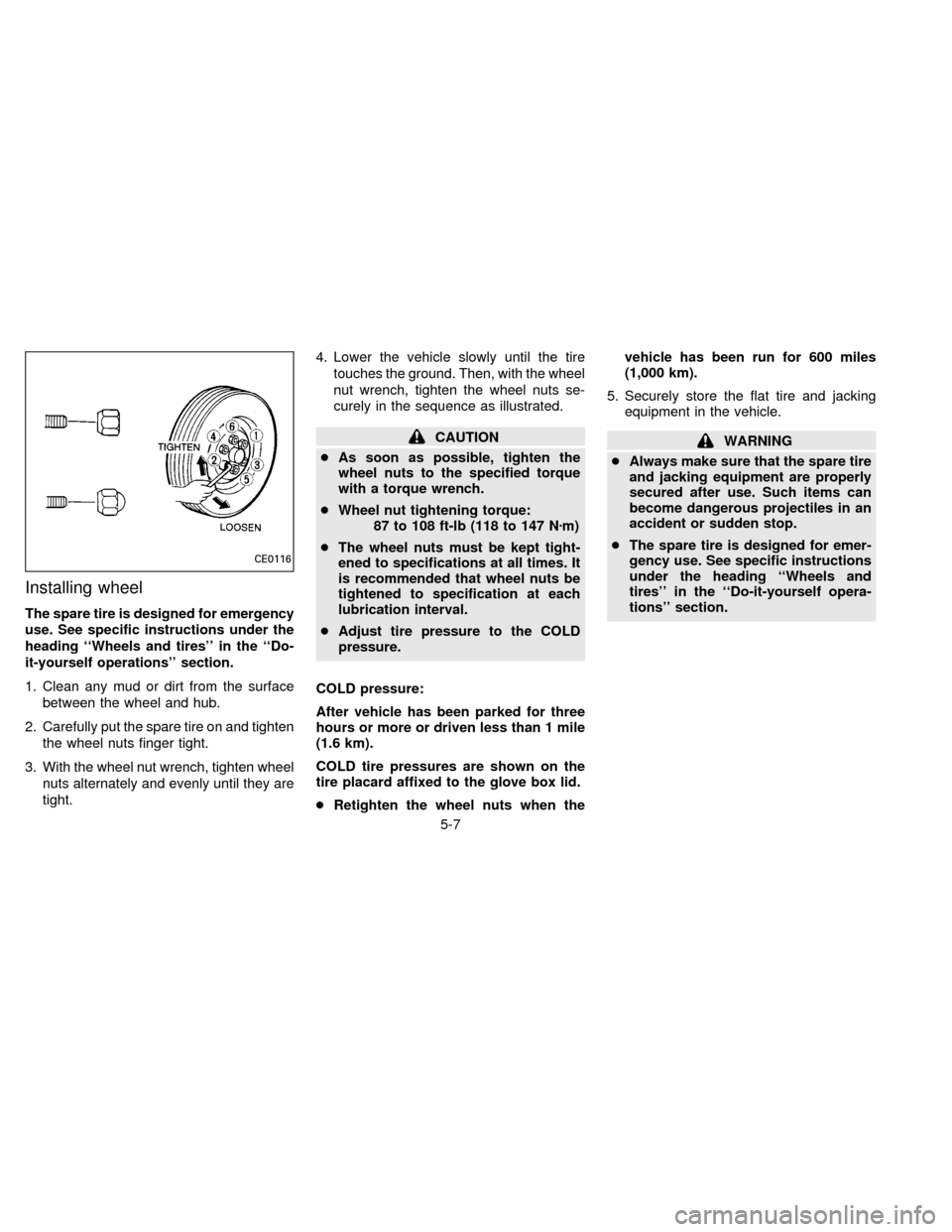
3. With the wheel nut wrench, tighten wheel
nuts alternately and evenly until they are
tight.4. Lower the vehicle slowly until the tire
touches the ground. Then, with the wheel
nut wrench, tighten the wheel nuts se-
curely in the sequence as illustrated.
CAUTION
cAs soon as possible, tighten the
wheel nuts to the specified torque
with a torque wrench.
cWheel nut tightening torque:
87 to 108 ft-lb (118 to 147 Nzm)
cThe wheel nuts must be kept tight-
ened to specifications at all times. It
is recommended that wheel nuts be
tightened to specification at each
lubrication interval.
cAdjust tire pressure to the COLD
pressure.
COLD pressure:
After vehicle has been parked for three
hours or more or driven less than 1 mile
(1.6 km).
COLD tire pressures are shown on the
tire placard affixed to the glove box lid.
cRetighten the wheel nuts when thevehicle has been run for 600 miles
(1,000 km).
5. Securely store the flat tire and jacking
equipment in the vehicle.WARNING
cAlways make sure that the spare tire
and jacking equipment are properly
secured after use. Such items can
become dangerous projectiles in an
accident or sudden stop.
cThe spare tire is designed for emer-
gency use. See specific instructions
under the heading ``Wheels and
tires'' in the ``Do-it-yourself opera-
tions'' section.
CE0116
5-7
ZX