1996 NISSAN ALTIMA trailer
[x] Cancel search: trailerPage 81 of 183
WARNING
Do not leave children, unreliable
adults, or pets alone in your vehicle.
They could accidentally injure them-
selves or others through inadvertent
operation of the vehicle. Also, on hot,
sunny days, temperatures in a closed
vehicle could quickly become high
enough to cause severe or possibly
fatal injuries to people or animals.
EXHAUST GAS
(Carbon Monoxide)
WARNING
Do not breathe exhaust gases; they
contain colorless and odorless carbon
monoxide. Carbon monoxide is dan-
gerous. It can cause unconsciousness
or death.
cIf you suspect that exhaust fumes
are entering the vehicle, drive with
all windows fully open, and have the
vehicle inspected immediately.
cDo not run the engine in closed
spaces such as a garage for any
longer than is absolutely necessary.cDo not park the vehicle with the
engine running for any extended
length of time.
cKeep the trunk lid closed while driv-
ing, otherwise exhaust gases could
be drawn into the passenger com-
partment. If you must drive in this
manner for some reason, take the
following steps:
1. Open all the windows.
2. Set the air recirculation switch to
``OFF'' and the fan control at 4
(high) to circulate the air.
cIf electrical wiring or other cable
connections must pass to a trailer
through the seal on the trunk lid or
the body, follow the manufacturer's
recommendation to prevent carbon
monoxide entry into the vehicle.
cThe exhaust system and body
should be inspected by a qualified
mechanic whenever:
a. The vehicle is raised for service.
b. You suspect that exhaust fumes
are entering into the passenger
compartment.c. You notice a change in the sound
of the exhaust system.
d. You have had an accident involv-
ing damage to the exhaust sys-
tem, underbody, or rear of the
vehicle.
THREE WAY CATALYST
The three way catalyst is an emission con-
trol device installed in the exhaust system.
Exhaust gases in the three way catalyst are
burned at high temperatures to help reduce
pollutants.
WARNING
cThe exhaust gas and the exhaust
system are very hot. While the en-
gine is running, keep people or flam-
mable materials away from the ex-
haust pipe.
cDo not stop or park the vehicle over
flammable materials such as dry
grass, waste paper or rags, as they
may burn easily.
PRECAUTIONS WHEN
STARTING AND DRIVING
4-2
ZX
Page 91 of 183
a) Lightly tap the brake pedal. When the
vehicle attains the desired speed, push
the ``COAST/SET'' switch and release it.
b) Push and hold the ``COAST/SET'' switch.
Release the switch when the vehicle
slows down to the desired speed.
c) Push, then quickly release the
``COAST/SET'' switch. Each time you do
this, the set speed will decrease by about
1 MPH (1.6 km/h).
To resume the preset speed,push and re-
lease the ``RESUME'' switch. The vehicle will
resume the last set cruising speed when the
vehicle speed is over 30 MPH (48 km/h).
Precautions
cIf the cruise control system malfunctions,
it will cancel automatically. The cruise
indicator light in the instrument panel will
then blink to warn the driver.
cWhen the cruise indicator light blinks,
turn the cruise control main switch off
and have the system checked by your
NISSAN dealer.
cThe cruise indicator light may blink when
the cruise control main switch is turned
on while pushing the ªRES/ACCELº,ªCOAST/SETº, or ªCANCELº switch (lo-
cated on the steering wheel). To properly
set the cruise control system perform the
steps above in the order indicated.
Avoid using the cruise control when
driving under the following conditions:
cwhen it is not possible to keep the vehicle
at set speed.
cin heavy traffic or in traffic that varies in
speed.
con winding roads, or hilly roads.
con slippery roads (rain, snow, ice, etc.).
cin very windy areas.
CAUTION
On manual transmission models, do
not shift into neutral without depress-
ing the clutch pedal when the cruise
control is on. Should this occur, de-
press the clutch pedal and turn the
main switch off immediately. Failure to
do so may cause engine damage.During the first 1,000 miles (1,600 km),
follow these recommendations for the future
reliability and economy of your new vehicle.
Failure to follow these recommendations
may result in vehicle damage or shortened
engine life.
cDo not drive over 55 MPH (90 km/h) and
do not run the engine over 4,000 rpm.
Avoid driving for long periods at constant
speed, either fast or slow.
cDo not accelerate at full throttle in any
gear.
cAvoid quick starts.
cAvoid hard braking as much as possible.
cDo not tow a trailer for the first 500 miles
(800 km).
BREAK-IN SCHEDULE
4-12
ZX
Page 125 of 183

TEMPERATURE CONDITIONS
FOR CHECKING ATF
cThe fluid level should be checked using
the ``HOT'' range on the dipstick after the
following conditions have been met:
Ð The engine should be warmed up to
operating temperature.
Ð The vehicle should be driven at least 5
minutes.
Ð The automatic transmission fluid should
be warmed to between 122 and 176ÉF
(50 to 80ÉC).
cThe fluid can be checked at fluid tem-
peratures of 86 to 122ÉF (30 to 50ÉC)
using the ``COLD'' range on the dipstick
after the engine is warmed up and before
driving. However, the fluid should be
re-checked using the ``HOT'' range.
1. Park the vehicle on a level surface and
set the parking brake.
2. Start the engine and then move the shift
lever through each gear range. Move the
shift lever to ``P'' after you have moved it
through all ranges.3. Check the fluid level with the engine
idling.
4. Remove the dipstick and wipe it clean
with lint-free paper.
5. Reinsert the dipstick into the charging
pipe as far as it will go.
6. Remove the dipstick and note the read-
ing. If the level is at the low side of either
range, add fluid to the charging pipe.
DO NOT OVERFILL.
USE ONLY Nissan Matic `D' (Conti-
nental U.S. and Alaska) or Genuine
Nissan Automatic Transmission Fluid(Canada). Dexronž III/Merconž or
equivalent may also be used. Outside
the continental United States and
Alaska contact a Nissan dealership
for more information regarding suit-
able fluids, including recommended
brand(s) of Dexronž III/Merconž or
Dexronž IIE/Merconž Automatic
Transmission Fluid.
NOTE:
If the vehicle has been driven for a long
time at high speeds, or in city traffic in
hot weather, or if it is being used to pull
a trailer, the accurate fluid level cannot
be read. You should wait until the fluid
has cooled down (about 30 minutes).
ADI0090
7-10
ZX
Page 147 of 183
corrosion. Such damage may cause loss
of pressure or poor seal at the tire bead.
cNISSAN recommends that the road
wheels be waxed to protect against road
salt in areas where it is used during
winter.
Spare tire (T-type spare tire)
Observe the following precautions if the
T-type spare tire must be used, otherwise
your vehicle could be damaged or involved
in an accident.
CAUTION
cThe T-type spare tire should be used
only for an emergency. It should be
replaced by the standard tire at the
first opportunity.
cDrive carefully while the T-type
spare tire is installed. Avoid sharp
turns and abrupt braking while
driving.
cPeriodically check tire inflation pres-
sure, and always keep it at 60 psi
(420 kPa, 4.2 bar).cDo not drive your vehicle at speeds
faster than 50 MPH (80 km/h).
cDo not use tire chains on a T-type
spare tire. Tire chains will not fit
properly on the T-type spare tire and
may cause damage to the vehicle.
cWhen driving on roads covered with
snow or ice, the T-type spare tire
should be used on the rear wheel
and the original tire used on the front
wheels (drive wheels). Use tire
chains only on the front two original
tires.
cTire tread of the T-type spare tire will
wear at a faster rate than the original
tire. Replace the T-type spare tire as
soon as the tread wear indicators
appear.
cBecause the T-type spare tire is
smaller than the original tire, ground
clearance is reduced. To avoid dam-
age to the vehicle do not drive over
obstacles. Also do not drive the ve-
hicle through an automatic car wash
since it may get caught.cDo not use the T-type spare tire on
other vehicles.
cDo not use more than one T-type
spare tire at the same time.
cDo not tow a trailer while the T-type
spare tire is installed.
7-32
ZX
Page 152 of 183

To ensure smooth, trouble-free, safe and
economical driving, NISSAN provides two
different maintenance schedules that may
be used, depending upon the conditions in
which you usually drive. These schedules
contain both distance and time intervals, up
to 60,000 miles (96,000 km)/48 months. For
most people, the odometer reading will in-
dicate when service is needed. However, if
you drive very little, your vehicle should be
serviced at the regular time intervals shown
in the schedule.After 60,000 miles (96,000
km) or 48 months, continue periodic
maintenance at the same mileage/time
intervals.
SCHEDULE 1
Follow Periodic Maintenance Schedule 1 if
your driving habits frequently include one or
more of the following driving conditions:
cRepeated short trips of less than 5
miles (8 km).
cRepeated short trips of less than 10
miles (16 km) with outside tempera-
tures remaining below freezing.
cOperating in hot weather in stop-
and-go ``rush hour'' traffic.cExtensive idling and/or low speed
driving for long distances, such as
police, taxi or door-to-door delivery
use.
cDriving in dusty conditions.
cDriving on rough, muddy, or salt
spread roads.
cTowing a trailer, using a camper or a
car-top carrier.
SCHEDULE 2
Follow Periodic Maintenance Schedule 2 if
none of the driving conditions shown in
Schedule 1 apply to your driving habits.
PERIODIC MAINTENANCE
SCHEDULES
8-5
ZX
Page 154 of 183
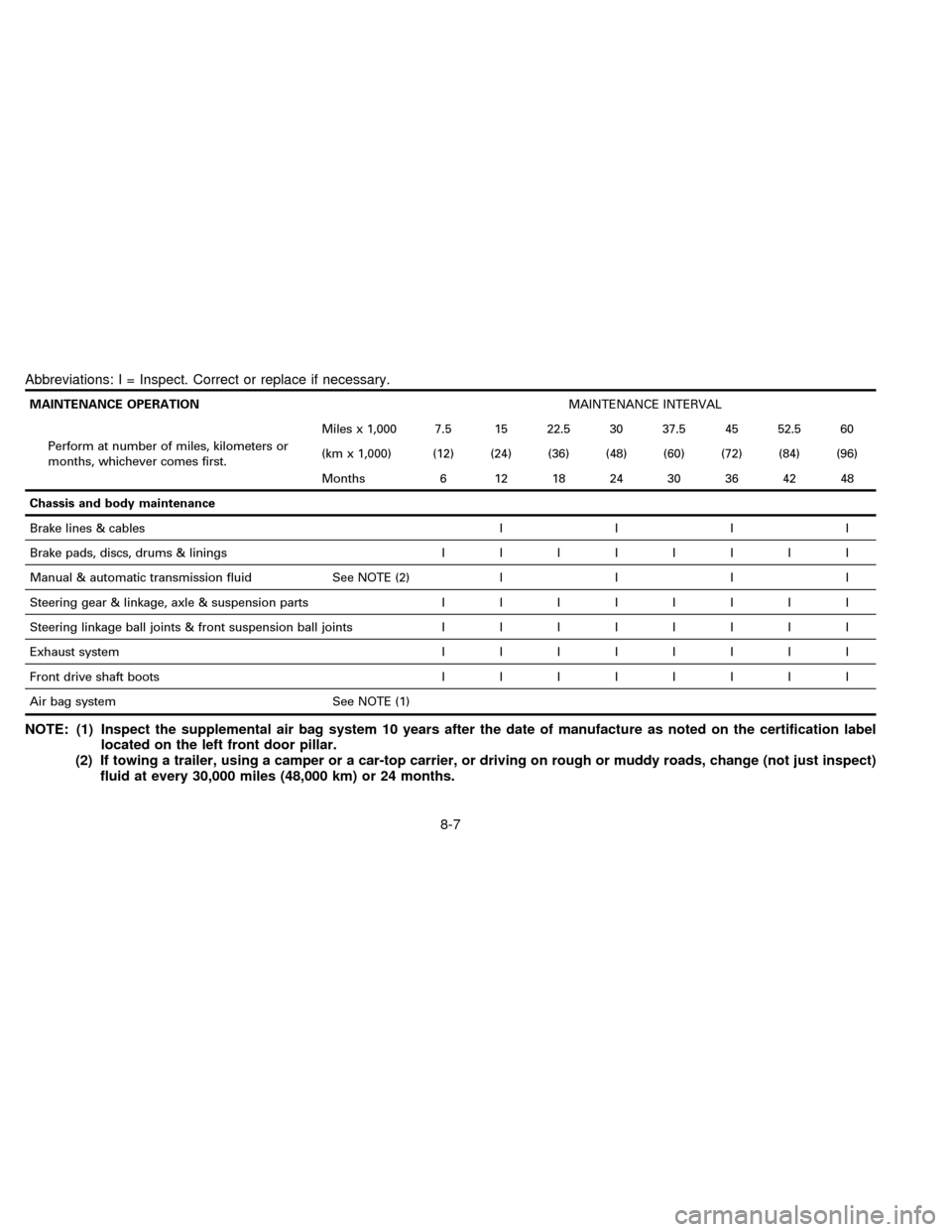
Abbreviations: I = Inspect. Correct or replace if necessary.
MAINTENANCE OPERATIONMAINTENANCE INTERVAL
Perform at number of miles, kilometers or
months, whichever comes first.Miles x 1,000 7.5 15 22.5 30 37.5 45 52.5 60
(km x 1,000) (12) (24) (36) (48) (60) (72) (84) (96)
Months 6 12 18 24 30 36 42 48
Chassis and body maintenance
Brake lines & cablesIIII
Brake pads, discs, drums & liningsIIIIIIII
Manual & automatic transmission fluid See NOTE (2)IIII
Steering gear & linkage, axle & suspension partsIIIIIIII
Steering linkage ball joints & front suspension ball jointsIIIIIIII
Exhaust systemIIIIIIII
Front drive shaft bootsIIIIIIII
Air bag system See NOTE (1)
NOTE: (1) Inspect the supplemental air bag system 10 years after the date of manufacture as noted on the certification label
located on the left front door pillar.
(2) If towing a trailer, using a camper or a car-top carrier, or driving on rough or muddy roads, change (not just inspect)
fluid at every 30,000 miles (48,000 km) or 24 months.
8-7
ZX
Page 158 of 183

9 Technical and consumer information
Capacities and recommended fuel/lubricants ...... 9-2
Engine .................................................................. 9-7
Wheel/tire size ...................................................... 9-7
Dimensions and weights ...................................... 9-8
Registering your vehicle in another country ........ 9-8
Vehicle identification............................................. 9-9
Air conditioner specification ............................... 9-11
Installing front license plate................................ 9-12
Vehicle loading information ................................ 9-13
Trailer towing ...................................................... 9-14
Uniform tire quality grading ................................ 9-17
Emission control system warranty ..................... 9-18
Reporting safety defects .................................... 9-18
Service manual/owner's manual orders ............. 9-19
ZX
Page 162 of 183

cannot be found.
Mineral based or synthetic type oils may be
used in your NISSAN vehicle. These oils
must however, meet the API quality and
SAE viscosity ratings specified for your ve-
hicle. Do not mix mineral based and syn-
thetic type oils in the engine at the same
time.
Oil additives
NISSAN does not recommend the use of oil
additives. The use of an oil additive is not
necessary when the proper oil type is used
and maintenance intervals are followed.
Oil which may contain foreign matter or has
been previously used should not be used.
Oil viscosity
The engine oil viscosity or thickness
changes with temperature. Because of this,
it is important that the engine oil viscosity be
selected based on the temperatures at
which the vehicle will be operated before
the next oil change. The chart ``Recom-
mended SAE viscosity number'' shows the
recommended oil viscosities for the ex-
pected ambient temperatures. Choosing an
oil viscosity other than that recommendedcould cause serious engine damage.
Selecting the correct oil filter
Your new vehicle is equipped with a high-
quality genuine NISSAN oil filter. When
replacing, use the genuine oil filter or its
equivalent for the reason described in
``Change intervals''.
Change intervals
The oil and oil filter change intervals for your
engine are based on the use of the specified
quality oils and filters. Oil and filter other
than the specified quality, or oil and filter
change intervals longer than recommended
could reduce engine life. Damage to en-
gines caused by improper maintenance or
use of incorrect oil and filter quality and/or
viscosity is not covered by the new NISSAN
vehicle warranties.
Your engine was filled with a high quality
engine oil when it was built. You do not have
to change the oil before the first recom-
mended change interval. Oil and filter
change intervals depend upon how you use
your vehicle. Operation under the following
conditions may require more frequent oil
and filter changes:Ð repeated short distance driving at cold
outside temperatures,
Ð driving in dusty conditions,
Ð extensive idling,
Ð towing a trailer.
9-5
ZX