1996 NISSAN ALTIMA clutch
[x] Cancel search: clutchPage 11 of 183
CAUTION
Do not continue driving if the belt is
loose, broken or missing.
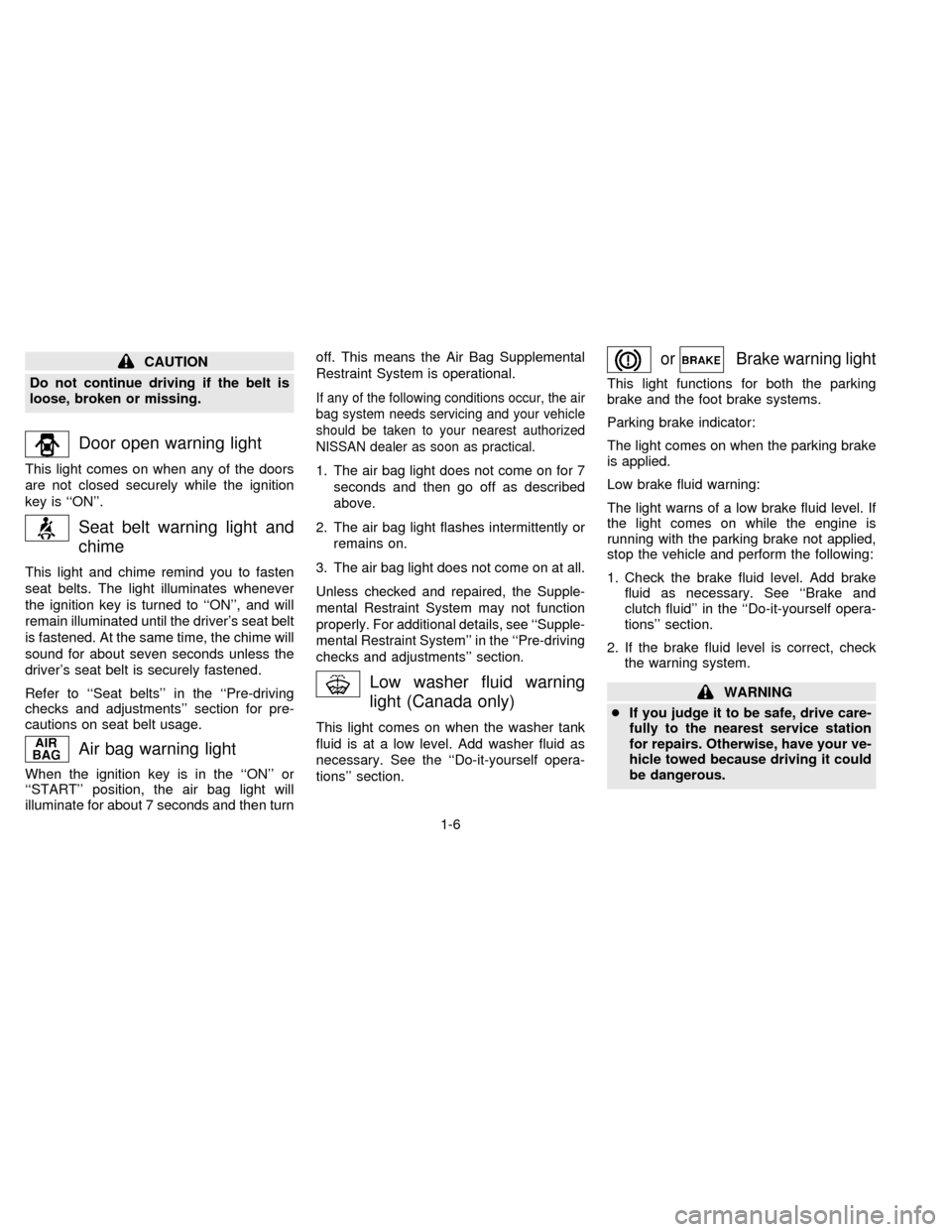
Door open warning light
This light comes on when any of the doors
are not closed securely while the ignition
key is ``ON''.
Seat belt warning light and
chime
This light and chime remind you to fasten
seat belts. The light illuminates whenever
the ignition key is turned to ``ON'', and will
remain illuminated until the driver's seat belt
is fastened. At the same time, the chime will
sound for about seven seconds unless the
driver's seat belt is securely fastened.
Refer to ``Seat belts'' in the ``Pre-driving
checks and adjustments'' section for pre-
cautions on seat belt usage.
Air bag warning light
When the ignition key is in the ``ON'' or
``START'' position, the air bag light will
illuminate for about 7 seconds and then turnoff. This means the Air Bag Supplemental
Restraint System is operational.
If any of the following conditions occur, the air
bag system needs servicing and your vehicle
should be taken to your nearest authorized
NISSAN dealer as soon as practical.
1. The air bag light does not come on for 7
seconds and then go off as described
above.
2. The air bag light flashes intermittently or
remains on.
3. The air bag light does not come on at all.
Unless checked and repaired, the Supple-
mental Restraint System may not function
properly. For additional details, see ``Supple-
mental Restraint System'' in the ``Pre-driving
checks and adjustments'' section.
Low washer fluid warning
light (Canada only)
This light comes on when the washer tank
fluid is at a low level. Add washer fluid as
necessary. See the ``Do-it-yourself opera-
tions'' section.
orBrake warning light
This light functions for both the parking
brake and the foot brake systems.
Parking brake indicator:
The light comes on when the parking brake
is applied.
Low brake fluid warning:
The light warns of a low brake fluid level. If
the light comes on while the engine is
running with the parking brake not applied,
stop the vehicle and perform the following:
1. Check the brake fluid level. Add brake
fluid as necessary. See ``Brake and
clutch fluid'' in the ``Do-it-yourself opera-
tions'' section.
2. If the brake fluid level is correct, check
the warning system.
WARNING
cIf you judge it to be safe, drive care-
fully to the nearest service station
for repairs. Otherwise, have your ve-
hicle towed because driving it could
be dangerous.
1-6
ZX
Page 87 of 183

Overdrive switch
ON: For normal driving, push the over-
drive switch ON with the shift lever in
the ``D'' position. The transmission
will shift into OVERDRIVE as the
vehicle speed increases.
The overdrive will not engage until the
engine has warmed up.OFF: For driving up and down long slopes
where engine ``braking'' would be
advantageous, push the switch OFF.
When cruising at a low speed or
climbing a gentle slope, you may feel
uncomfortable shift shocks as the
transmission shifts between 3rd and
overdrive repeatedly. In this case,
set the overdrive switch in the OFF
position. The O/D OFF indicator light
on the instrument panel will come on
at this time.
When driving conditions change, reset the
overdrive switch to the ON position.
Remember not to drive at high speeds for
extended periods of time with the overdrive
switch set in the OFF position. This reduces
the fuel economy.
To change gears, fully depress the clutch
pedal, and then move the gearshift lever.
After shifting, release the clutch pedal slowly.
On the 5-speed transmission model, you
cannot shift directly from 5th gear into Re-
verse. First shift into Neutral, then into Re-
verse.
If it is difficult to move the gear shift lever
into Reverse or First, shift into Neutral, then
release and depress the clutch pedal again
and shift into Reverse or First.
Driving precautions
cDo not rest your foot on the clutch pedal
ASD0511SD1022
DRIVING WITH MANUAL
TRANSMISSION
4-8
ZX
Page 88 of 183

while driving. This may cause clutch
damage.
cStop your vehicle completely before shift-
ing into reverse.
cWhen the vehicle is stopped for a dura-
tion, for example at a stop light, shift to
neutral and release the clutch pedal with
the foot brake applied.
Suggested upshift speeds
Shown below are suggested vehicle speeds
for shifting into a higher gear. These sug-
gestions relate to fuel economy and vehicle
performance. Actual upshift speeds will vary
according to road conditions, the weather
and individual driving habits.
For normal acceleration in low altitude ar-
eas [less than 4,000 ft (1,219 m)]:
Gear changeACCEL
shift point
MPH (km/h)CRUISE
shift point
MPH (km/h)
1st to 2nd 15 (24) 15 (24)
2nd to 3rd 25 (40) 18 (29)
3rd to 4th 36 (58) 30 (48)
4th to 5th 40 (64) 39 (63)
For quick acceleration in low altitude areas
and high altitude areas [over 4,000 ft (1,219
m)]:
Gear change MPH (km/h)
1st to 2nd 15 (24)
2nd to 3rd 25 (40)
3rd to 4th 40 (64)
4th to 5th 45 (72)
Suggested maximum speed in each
gear
Downshift to a lower gear if the engine is not
running smoothly, or if you need to accelerate.
Do not exceed the maximum suggested
speed (shown below) in any gear. For level
road driving, use the highest gear sug-
gested for that speed. Always observe
posted speed limits, and drive according to
the road conditions, which will ensure safe
operation. Do not over-rev the engine when
shifting to a lower gear as it may cause
engine damage or loss of vehicle control.
Gear MPH (km/h)
1st 30 (50)
2nd 60 (95)
3rd 90 (145)
4th þ
5th þ1. Apply the parking brake.
2.Automatic transmission:
Move the shift lever to ``P'' (Park) or ``N''
(Neutral). (``P'' preferred.)
The shift lever cannot be moved out of
``P'' and into any of the other gear
positions if the ignition key is turned to
``OFF'' or if the key is removed.
The starter is designed not to operate
if the shift lever is in any of the driving
positions.
Manual transmission:
Move the gearshift lever to ``N'' (Neutral),
and depress the clutch pedal to the floor
while cranking the engine.
The starter is designed not to operate
unless the clutch pedal is depressed.
3. Crank the enginewith your foot off the
accelerator pedalby turning the ignition
key to ``START''. Release the key when
the engine starts. If the engine starts, but
fails to run, repeat the above procedure.
Ð If the engine is very hard to start in
extremely cold or hot weather, de-
press and hold the accelerator pedal
to help start the engine.
Ð In the summer, when restarting the
engine within 30 minutes after it has
STARTING THE ENGINE
4-9
ZX
Page 90 of 183

The cruise control allows driving at a speed
between 30 to 90 MPH (48 to 144 km/h)
without keeping your foot on the accelerator
pedal.
To turn on the cruise control,push the
main switch. The indicator light on the
switch will come on.
To set cruising speed,accelerate your
vehicle to the desired speed, push the
``COAST/SET'' switch and release it. The
``CRUISE'' indicator light will come on. Take
your foot off the accelerator pedal. Your
vehicle will maintain the set speed.cTo pass another vehicle,depress the
accelerator pedal. When you release the
pedal, the vehicle will return to the previ-
ously set speed.
c
The vehicle may not maintain the set speed
when going up or down steep hills. If this
happens, drive without the cruise control.
To cancel the preset speed,use one of
the following three methods:
a) Push the CANCEL button; the ``CRUISE''
light will go out.
b) Tap the brake pedal; the ``CRUISE'' light
will go out.c) Turn the main switch off. Both the ``ON''
indicator and ``CRUISE'' lights will go out.
The cruise control is automatically can-
celled and the ``CRUISE'' light goes out if:
cYou depress the brake pedal while push-
ing the ``ACCEL'' set switch.
cThe vehicle slows down more than 8
MPH (13 km/h) below the set speed.
cYou depress the clutch pedal (manual
transmission), or move the shift lever to
``N'' (automatic transmission).
To reset at a faster cruising speed,use
one of the following three methods:
a) Depress the accelerator pedal. When the
vehicle attains the desired speed, push
and release the ``COAST/SET'' switch.
b) Push and hold the ``ACCEL'' set switch.
When the vehicle attains the speed you
desire, release the switch.
c) Push, then quickly release the ``ACCEL''
set switch. Each time you do this, the set
speed will increase by about 1 MPH (1.6
km/h).
To reset at a slower cruising speed,use
one of the following three methods:
ASD0512
CRUISE CONTROL
4-11
ZX
Page 91 of 183
a) Lightly tap the brake pedal. When the
vehicle attains the desired speed, push
the ``COAST/SET'' switch and release it.
b) Push and hold the ``COAST/SET'' switch.
Release the switch when the vehicle
slows down to the desired speed.
c) Push, then quickly release the
``COAST/SET'' switch. Each time you do
this, the set speed will decrease by about
1 MPH (1.6 km/h).
To resume the preset speed,push and re-
lease the ``RESUME'' switch. The vehicle will
resume the last set cruising speed when the
vehicle speed is over 30 MPH (48 km/h).
Precautions
cIf the cruise control system malfunctions,
it will cancel automatically. The cruise
indicator light in the instrument panel will
then blink to warn the driver.
cWhen the cruise indicator light blinks,
turn the cruise control main switch off
and have the system checked by your
NISSAN dealer.
cThe cruise indicator light may blink when
the cruise control main switch is turned
on while pushing the ªRES/ACCELº,ªCOAST/SETº, or ªCANCELº switch (lo-
cated on the steering wheel). To properly
set the cruise control system perform the
steps above in the order indicated.
Avoid using the cruise control when
driving under the following conditions:
cwhen it is not possible to keep the vehicle
at set speed.
cin heavy traffic or in traffic that varies in
speed.
con winding roads, or hilly roads.
con slippery roads (rain, snow, ice, etc.).
cin very windy areas.
CAUTION
On manual transmission models, do
not shift into neutral without depress-
ing the clutch pedal when the cruise
control is on. Should this occur, de-
press the clutch pedal and turn the
main switch off immediately. Failure to
do so may cause engine damage.During the first 1,000 miles (1,600 km),
follow these recommendations for the future
reliability and economy of your new vehicle.
Failure to follow these recommendations
may result in vehicle damage or shortened
engine life.
cDo not drive over 55 MPH (90 km/h) and
do not run the engine over 4,000 rpm.
Avoid driving for long periods at constant
speed, either fast or slow.
cDo not accelerate at full throttle in any
gear.
cAvoid quick starts.
cAvoid hard braking as much as possible.
cDo not tow a trailer for the first 500 miles
(800 km).
BREAK-IN SCHEDULE
4-12
ZX
Page 116 of 183

7 Do-it-yourself operations
Maintenance precautions ..................................... 7-2
Engine compartment check locations ................. 7-3
Engine cooling system ......................................... 7-4
Engine oil.............................................................. 7-7
Automatic transmission fluid (ATF) ...................... 7-9
Power steering fluid............................................ 7-11
Brake and clutch fluid......................................... 7-11
Window washer fluid .......................................... 7-12
Battery ................................................................ 7-13
Drive belts .......................................................... 7-14
Spark plug replacement ..................................... 7-14Air cleaner housing filter .................................... 7-15
Wiper blades ...................................................... 7-16
Parking brake check........................................... 7-17
Brake pedal ........................................................ 7-18
Brake booster ..................................................... 7-19
Clutch pedal ....................................................... 7-19
Fuses .................................................................. 7-19
Fusible links........................................................ 7-21
Light bulbs .......................................................... 7-21
Wheels and tires ................................................ 7-28
ZX
Page 126 of 183
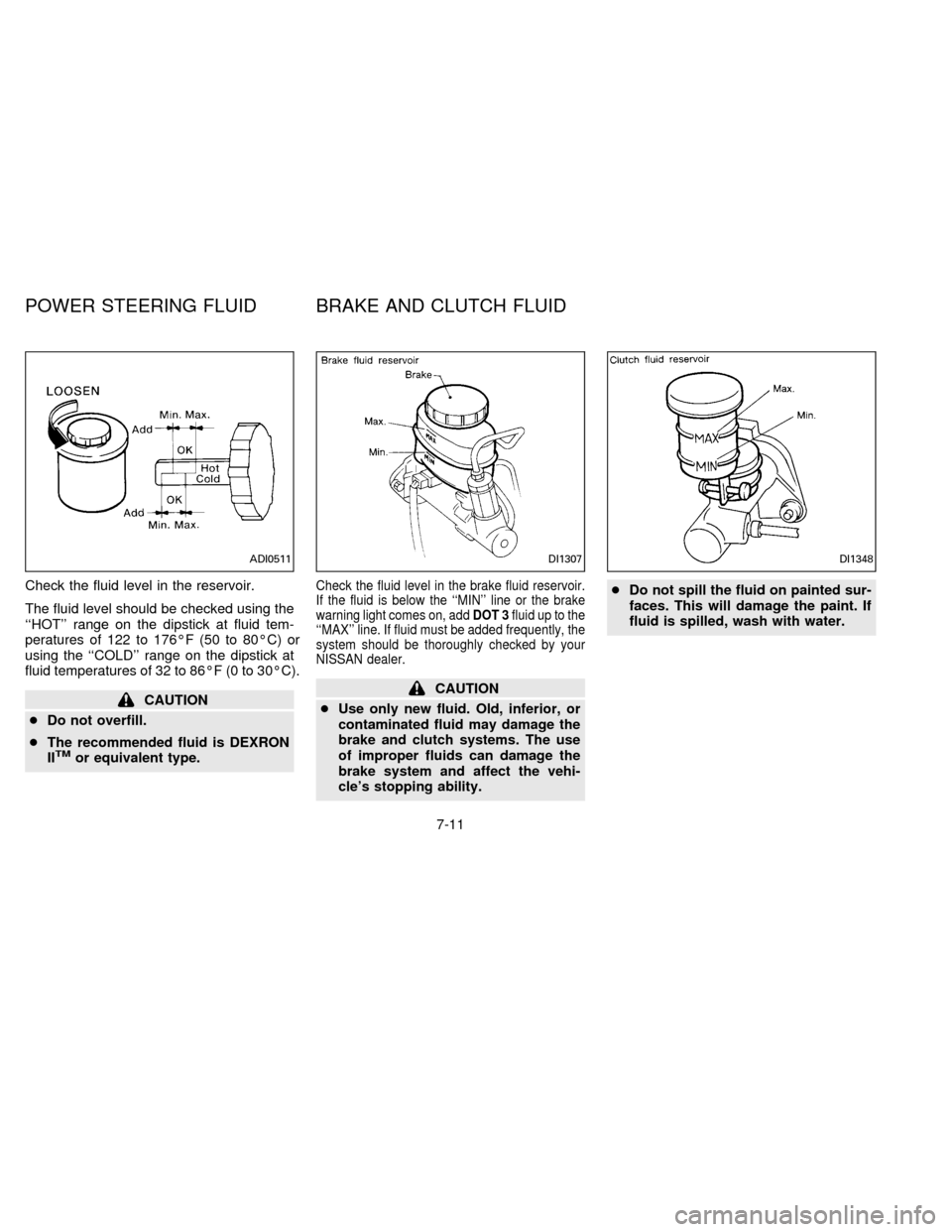
Check the fluid level in the reservoir.
The fluid level should be checked using the
``HOT'' range on the dipstick at fluid tem-
peratures of 122 to 176ÉF (50 to 80ÉC) or
using the ``COLD'' range on the dipstick at
fluid temperatures of 32 to 86ÉF (0 to 30ÉC).
CAUTION
cDo not overfill.
cThe recommended fluid is DEXRON
II
TMor equivalent type.
Check the fluid level in the brake fluid reservoir.
If the fluid is below the ``MIN'' line or the brake
warning light comes on, addDOT 3fluid up to the
``MAX'' line. If fluid must be added frequently, the
system should be thoroughly checked by your
NISSAN dealer.
CAUTION
cUse only new fluid. Old, inferior, or
contaminated fluid may damage the
brake and clutch systems. The use
of improper fluids can damage the
brake system and affect the vehi-
cle's stopping ability.cDo not spill the fluid on painted sur-
faces. This will damage the paint. If
fluid is spilled, wash with water.
ADI0511DI1307DI1348
POWER STEERING FLUID BRAKE AND CLUTCH FLUID
7-11
ZX
Page 134 of 183

Check the brake booster function as fol-
lows:
1. With the engine off, press and release
the brake pedal several times. When
brake pedal movement (distance of
travel) remains the same from one pedal
application to the next, continue on to
next step.
2. While depressing the brake pedal, start
the engine. The pedal height should drop
a little.
3. With the brake pedal depressed, stop the
engine. Keep the pedal depressed for
about 30 seconds. The pedal height
should not change.
4. Run the engine for one minute without
depressing the brake pedal, then turn it
off. Depress the brake pedal several
times. The pedal travel distance will de-
crease gradually with each depression
as the vacuum is released from the
booster.
If the brakes do not operate properly, see
your NISSAN dealer.Press the pedal by hand and be sure the
free travel is within the limits shown above.
If free travel is out of the range shown
above, see your NISSAN dealer.
Engine compartment
If the electrical equipment does not come
on, check for an open fuse.
1. Be sure the ignition key and the headlight
switch are ``OFF''.
2. Open the engine hood.
3. Remove the fusible link cover.
4. Remove the fuse with the fuse puller.
5. If the fuse is open, replace it with a new
fuse.
ADIO528DI1313
BRAKE BOOSTER CLUTCH PEDAL FUSES
7-19
ZX