1996 NISSAN ALTIMA brake
[x] Cancel search: brakePage 10 of 183
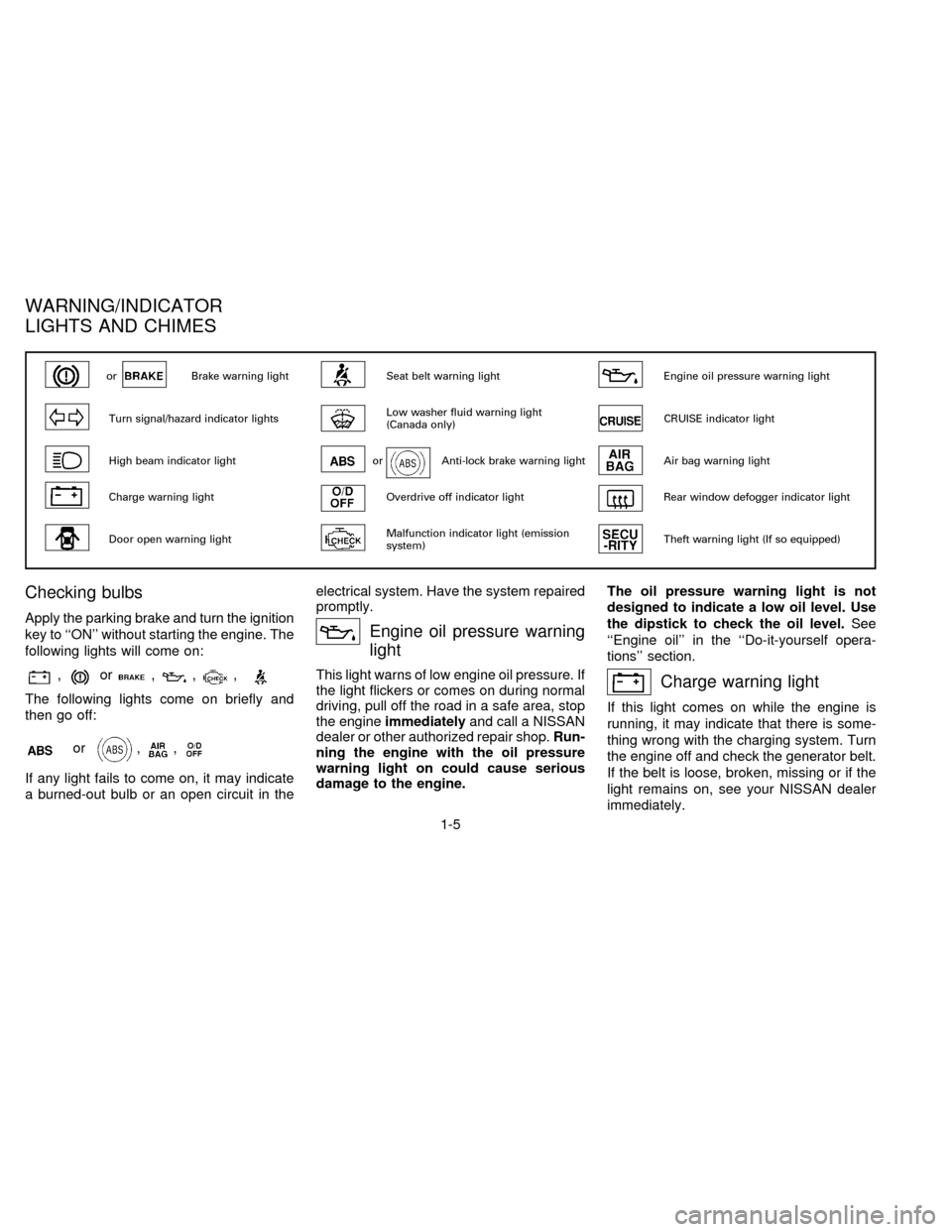
Checking bulbs
Apply the parking brake and turn the ignition
key to ``ON'' without starting the engine. The
following lights will come on:
,or,,,
The following lights come on briefly and
then go off:
or,,
If any light fails to come on, it may indicate
a burned-out bulb or an open circuit in theelectrical system. Have the system repaired
promptly.
Engine oil pressure warning
light
This light warns of low engine oil pressure. If
the light flickers or comes on during normal
driving, pull off the road in a safe area, stop
the engineimmediatelyand call a NISSAN
dealer or other authorized repair shop.Run-
ning the engine with the oil pressure
warning light on could cause serious
damage to the engine.The oil pressure warning light is not
designed to indicate a low oil level. Use
the dipstick to check the oil level.See
``Engine oil'' in the ``Do-it-yourself opera-
tions'' section.Charge warning light
If this light comes on while the engine is
running, it may indicate that there is some-
thing wrong with the charging system. Turn
the engine off and check the generator belt.
If the belt is loose, broken, missing or if the
light remains on, see your NISSAN dealer
immediately.
orBrake warning lightSeat belt warning lightEngine oil pressure warning light
Turn signal/hazard indicator lightsLow washer fluid warning light
(Canada only)CRUISE indicator light
High beam indicator lightorAnti-lock brake warning lightAir bag warning light
Charge warning lightOverdrive off indicator lightRear window defogger indicator light
Door open warning lightMalfunction indicator light (emission
system)Theft warning light (If so equipped)
WARNING/INDICATOR
LIGHTS AND CHIMES
1-5
ZX
Page 11 of 183
CAUTION
Do not continue driving if the belt is
loose, broken or missing.
Door open warning light
This light comes on when any of the doors
are not closed securely while the ignition
key is ``ON''.
Seat belt warning light and
chime
This light and chime remind you to fasten
seat belts. The light illuminates whenever
the ignition key is turned to ``ON'', and will
remain illuminated until the driver's seat belt
is fastened. At the same time, the chime will
sound for about seven seconds unless the
driver's seat belt is securely fastened.
Refer to ``Seat belts'' in the ``Pre-driving
checks and adjustments'' section for pre-
cautions on seat belt usage.
Air bag warning light
When the ignition key is in the ``ON'' or
``START'' position, the air bag light will
illuminate for about 7 seconds and then turnoff. This means the Air Bag Supplemental
Restraint System is operational.
If any of the following conditions occur, the air
bag system needs servicing and your vehicle
should be taken to your nearest authorized
NISSAN dealer as soon as practical.
1. The air bag light does not come on for 7
seconds and then go off as described
above.
2. The air bag light flashes intermittently or
remains on.
3. The air bag light does not come on at all.
Unless checked and repaired, the Supple-
mental Restraint System may not function
properly. For additional details, see ``Supple-
mental Restraint System'' in the ``Pre-driving
checks and adjustments'' section.
Low washer fluid warning
light (Canada only)
This light comes on when the washer tank
fluid is at a low level. Add washer fluid as
necessary. See the ``Do-it-yourself opera-
tions'' section.
orBrake warning light
This light functions for both the parking
brake and the foot brake systems.
Parking brake indicator:
The light comes on when the parking brake
is applied.
Low brake fluid warning:
The light warns of a low brake fluid level. If
the light comes on while the engine is
running with the parking brake not applied,
stop the vehicle and perform the following:
1. Check the brake fluid level. Add brake
fluid as necessary. See ``Brake and
clutch fluid'' in the ``Do-it-yourself opera-
tions'' section.
2. If the brake fluid level is correct, check
the warning system.
WARNING
cIf you judge it to be safe, drive care-
fully to the nearest service station
for repairs. Otherwise, have your ve-
hicle towed because driving it could
be dangerous.
1-6
ZX
Page 12 of 183
cPressing the brake pedal with the
engine stopped and/or low brake
fluid level may increase your stop-
ping distance and require greater
pedal effort as well as greater pedal
travel.
Brake pad wear warning
The disc brake pads have audible wear
warnings. When a brake pad requires re-
placement, it will make a high pitched scrap-
ing sound when the vehicle is in motion
whether or not the brake pedal is de-
pressed. Have the brakes checked as soon
as possible if the warning sound is heard.
orAnti-lock brake
warning light
If this light comes on while the engine is
running, it may indicate there is something
wrong with the anti-lock portion of the brake
system. Have the system checked by your
NISSAN dealer.
If an abnormality occurs in the system, the
anti-lock function will cease but the regular
braking system will continue to operate nor-
mally.
If the light comes on while you are driving,contact your NISSAN dealer for repair.
Overdrive off indicator light
This light comes on when the overdrive
switch is pushed to the OFF position.
Turn signal/hazard indicator
lights
This light flashes when the turn signal
switch lever or hazard switch is turned on.
High beam indicator light
(Blue)
This light comes on when the headlight high
beam is on and goes out when the low
beam is selected.
Rear window defogger indi-
cator light
This light comes on when the rear defogger
switch is activated.
Indicator light
This light comes on while the vehicle speed
is controlled by the cruise control system. If
the CRUISE indicator blinks, have the sys-
tem checked by your NISSAN dealer.
Theft warning light (If so
equipped)
This light is used to verify theft warning
system activation. For further info, see
``Theft Warning'' later in this chapter.
Key reminder chime
The chime will sound if the driver side door
is opened while the key is left in the ignition
switch. Remove the key and take it with you
when leaving the vehicle.
Light reminder chime
A chime will sound when the driver side
door is opened if the light switch is turned on
(ignition switch is turned off).
Turn the light switch off when you leave the
vehicle.
Malfunction indicator light
(MIL)
If the MIL comes on or blinks while the
engine is running, it may indicate a potential
emission control problem.
1-7
ZX
Page 16 of 183
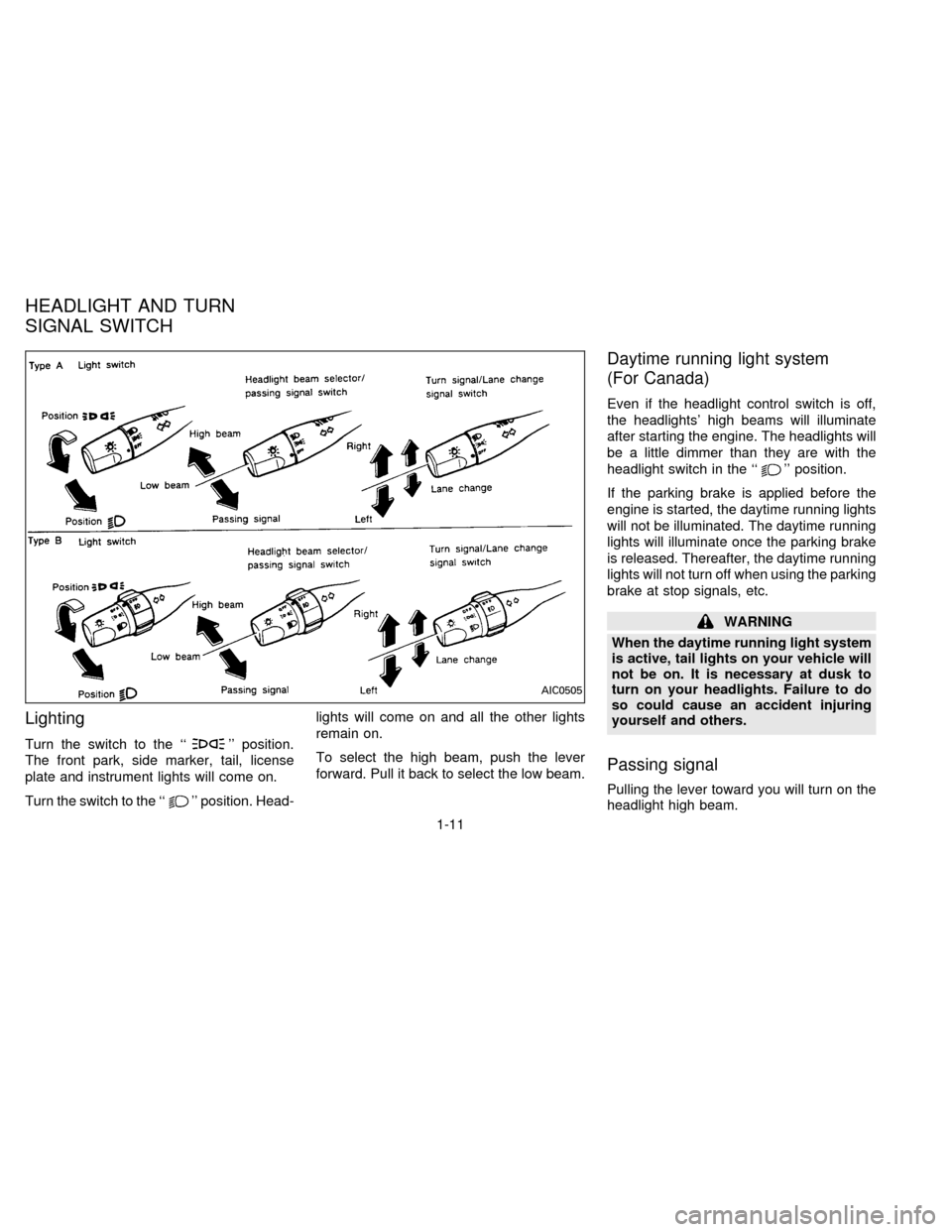
Lighting
Turn the switch to the ``'' position.
The front park, side marker, tail, license
plate and instrument lights will come on.
Turn the switch to the ``
'' position. Head-lights will come on and all the other lights
remain on.
To select the high beam, push the lever
forward. Pull it back to select the low beam.
Daytime running light system
(For Canada)
Even if the headlight control switch is off,
the headlights' high beams will illuminate
after starting the engine. The headlights will
be a little dimmer than they are with the
headlight switch in the ``
'' position.
If the parking brake is applied before the
engine is started, the daytime running lights
will not be illuminated. The daytime running
lights will illuminate once the parking brake
is released. Thereafter, the daytime running
lights will not turn off when using the parking
brake at stop signals, etc.
WARNING
When the daytime running light system
is active, tail lights on your vehicle will
not be on. It is necessary at dusk to
turn on your headlights. Failure to do
so could cause an accident injuring
yourself and others.
Passing signal
Pulling the lever toward you will turn on the
headlight high beam.
AIC0505
HEADLIGHT AND TURN
SIGNAL SWITCH
1-11
ZX
Page 80 of 183

4 Starting and driving
Precautions when starting and driving ................. 4-2
Ignition switch ....................................................... 4-4
Before starting the engine .................................... 4-5
Driving with automatic transmission..................... 4-6
Driving with manual transmission ........................ 4-8
Starting the engine ............................................... 4-9
Parking brake operation ..................................... 4-10
Cruise control ..................................................... 4-11
Break-in schedule............................................... 4-12
Increasing fuel economy .................................... 4-13
Parking/parking on hills ...................................... 4-14
Precautions when driving ................................... 4-15
Anti-lock brake system (ABS) (If so equipped).. 4-15
Cold weather driving cautions ............................ 4-17
ZX
Page 84 of 183
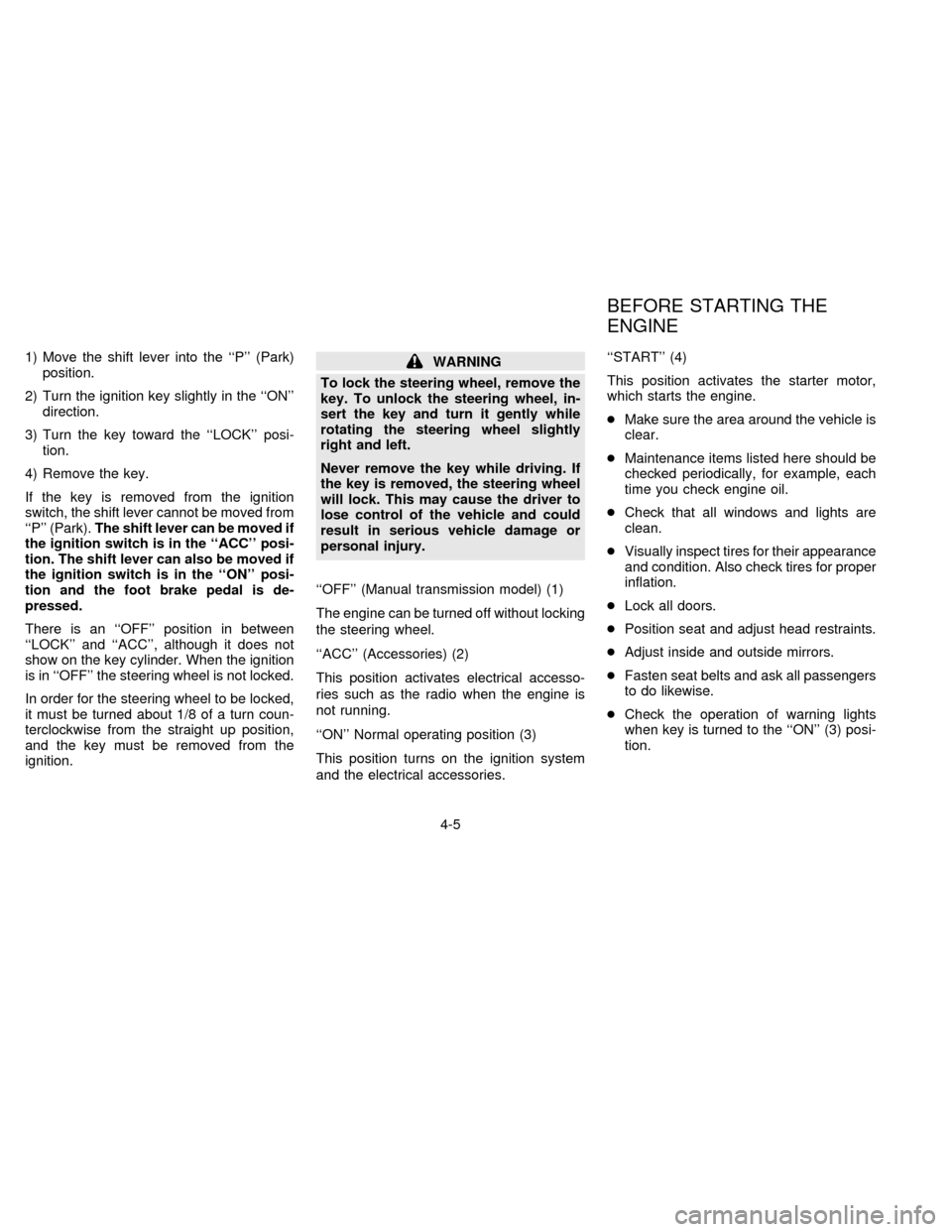
1) Move the shift lever into the ``P'' (Park)
position.
2) Turn the ignition key slightly in the ``ON''
direction.
3) Turn the key toward the ``LOCK'' posi-
tion.
4) Remove the key.
If the key is removed from the ignition
switch, the shift lever cannot be moved from
``P'' (Park).The shift lever can be moved if
the ignition switch is in the ``ACC'' posi-
tion. The shift lever can also be moved if
the ignition switch is in the ``ON'' posi-
tion and the foot brake pedal is de-
pressed.
There is an ``OFF'' position in between
``LOCK'' and ``ACC'', although it does not
show on the key cylinder. When the ignition
is in ``OFF'' the steering wheel is not locked.
In order for the steering wheel to be locked,
it must be turned about 1/8 of a turn coun-
terclockwise from the straight up position,
and the key must be removed from the
ignition.WARNING
To lock the steering wheel, remove the
key. To unlock the steering wheel, in-
sert the key and turn it gently while
rotating the steering wheel slightly
right and left.
Never remove the key while driving. If
the key is removed, the steering wheel
will lock. This may cause the driver to
lose control of the vehicle and could
result in serious vehicle damage or
personal injury.
``OFF'' (Manual transmission model) (1)
The engine can be turned off without locking
the steering wheel.
``ACC'' (Accessories) (2)
This position activates electrical accesso-
ries such as the radio when the engine is
not running.
``ON'' Normal operating position (3)
This position turns on the ignition system
and the electrical accessories.``START'' (4)
This position activates the starter motor,
which starts the engine.
cMake sure the area around the vehicle is
clear.
cMaintenance items listed here should be
checked periodically, for example, each
time you check engine oil.
cCheck that all windows and lights are
clean.
cVisually inspect tires for their appearance
and condition. Also check tires for proper
inflation.
cLock all doors.
cPosition seat and adjust head restraints.
cAdjust inside and outside mirrors.
cFasten seat belts and ask all passengers
to do likewise.
cCheck the operation of warning lights
when key is turned to the ``ON'' (3) posi-
tion.
BEFORE STARTING THE
ENGINE
4-5
ZX
Page 85 of 183
The automatic transmission in your vehicle
(if so equipped) is electronically controlled
by the A/T control unit to produce maximum
power and smooth operation.
Shown on the following pages are the rec-
ommended operating procedures for this
transmission. Follow these procedures for
maximum vehicle performance and driving
enjoyment.
Starting the vehicle
cAfter starting the engine, fully depress the
foot brake pedal before shifting the selector
lever to the ``D'', ``R'', ``2'' or ``1'' position.
Be sure the vehicle is fully stopped before
attempting to shift the selector lever.
This automatic transmission is designed
so that the foot brake pedal MUST be
depressed before shifting from ``P'' to
any drive position while the ignition
switch is ``ON''.
The shift lever cannot be moved out of
``P'' and into any of the other gear posi-
tions if the ignition key is turned to
``OFF'' or if the key is removed.
When the battery charge is low, the shift
lever can be moved if the ignition switch
is in the ``ACC'' position.1. Keep the foot brake pedal depressed and
shift into a driving gear.
2.Release the parking brake and foot brake,
then gradually start the vehicle in motion.
CAUTION
cCold engine idle speed is high, so
use caution when shifting into a for-
ward or reverse gear before the en-
gine has warmed up.
c
Avoid revving up the engine while the
vehicle is stopped. This could cause
unexpected vehicle movement.
Driving precautions
To help prevent transmission damage:
c
Do not depress the accelerator pedal
while shifting from ``P'' or ``N'' to ``R'',
``D'', ``2'' or ``1''. Always depress the
brake pedal until shifting is completed.
cNever shift to ``P'' or ``R'' while the
vehicle is moving.
cWhen stopping the vehicle on an up-
hill grade, do not hold the vehicle by
depressing the accelerator pedal. The
foot brakes should be used for this
purpose.
ASD0510
DRIVING WITH AUTOMATIC
TRANSMISSION
4-6
ZX
Page 86 of 183

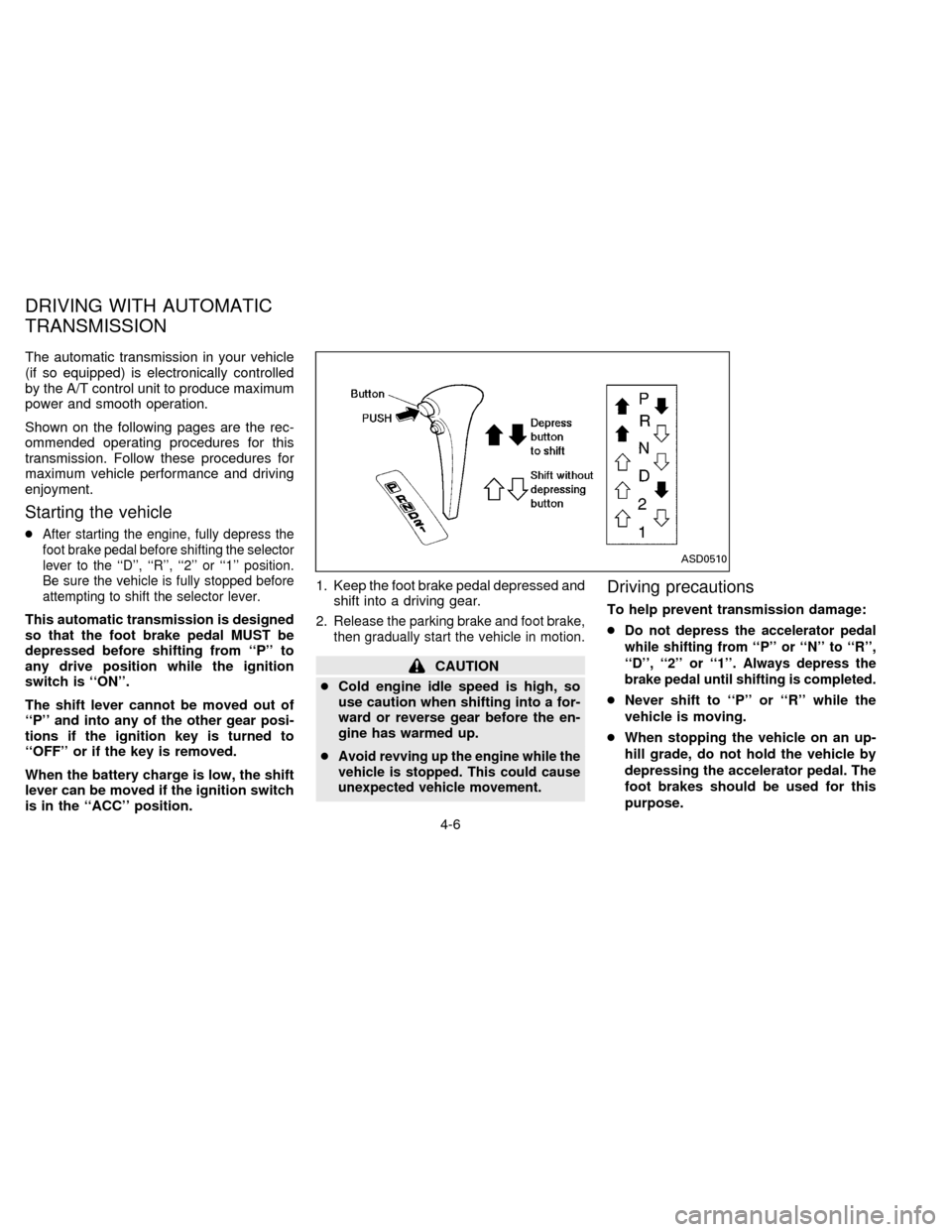
Push the button to shift into ``P'', ``R'' or from
``D'' to ``2''. All other positions can be se-
lected without pushing the button.
``P'' (Park):
Use this position when the vehicle is parked
or when starting the engine. Always be sure
the vehicle is at a complete stop. For maxi-
mum safety, depress the brake pedal, then
push in the select lever button and move the
shift lever to the ``P'' position. Apply the
parking brake. When parking on a hill, apply
the parking brake first, then move the shift
lever into the ``P'' position.
Shifting from ``P'' (Park)
If the ignition switch is in the ``ON'' position
and the foot brake pedal is depressed, but
the shift lever still cannot be moved out of
``P'' (Park), follow these instructions:
1. Shut the engine off and remove the key.
2. Apply the parking brake.
3. Reinsert the ignition key and turn it clock-
wise to the ``ACC'' position.
4. Depress the brake pedal, move the gear-
shift lever to ``N'' (Neutral) and start the
engine.These instructions for starting the vehicle in
``N'' (Neutral) position should only be used
until service can be obtained.
``R'' (Reverse):
Use this position to back up. Always be sure
the vehicle is completely stopped. With the
brake pedal depressed, push in the select
lever button and move the shift lever to the
``R'' position.
``N'' (Neutral):
In Neutral, neither forward nor reverse gear
is engaged. The engine can be started in
this position. You may shift to ``N'' and
restart a stalled engine while the vehicle is
moving.
``D'' (Drive):
Use this position for all normal forward
driving.
``2'' (Second gear):
Use for hill climbing or engine braking on
downhill grades.
Do not shift into the ``2'' position at speeds
over 74 MPH (119 Km/h). Do not exceed 74
MPH (119 Km/h) in the ``2'' position.``1'' (Low gear):
Use this position when climbing steep hills
slowly or driving slowly through deep snow,
sand or mud, or for maximum engine brak-
ing on steep downhill grades.
Do not shift into the ``1'' position at speeds
over 74 MPH (119 km/h). Do not exceed 41
MPH (66 km/h) in the ``1'' position.
Accelerator downshift
Ð In ``D'' position Ð
For rapid passing or hill climbing, fully de-
press the accelerator pedal to the floor. This
shifts the transmission down into 2 (Sec-
ond) gear or 1 (Low) gear, depending on the
vehicle speed.
4-7
ZX