1996 NISSAN ALTIMA key
[x] Cancel search: keyPage 85 of 183
The automatic transmission in your vehicle
(if so equipped) is electronically controlled
by the A/T control unit to produce maximum
power and smooth operation.
Shown on the following pages are the rec-
ommended operating procedures for this
transmission. Follow these procedures for
maximum vehicle performance and driving
enjoyment.
Starting the vehicle
cAfter starting the engine, fully depress the
foot brake pedal before shifting the selector
lever to the ``D'', ``R'', ``2'' or ``1'' position.
Be sure the vehicle is fully stopped before
attempting to shift the selector lever.
This automatic transmission is designed
so that the foot brake pedal MUST be
depressed before shifting from ``P'' to
any drive position while the ignition
switch is ``ON''.
The shift lever cannot be moved out of
``P'' and into any of the other gear posi-
tions if the ignition key is turned to
``OFF'' or if the key is removed.
When the battery charge is low, the shift
lever can be moved if the ignition switch
is in the ``ACC'' position.1. Keep the foot brake pedal depressed and
shift into a driving gear.
2.Release the parking brake and foot brake,
then gradually start the vehicle in motion.
CAUTION
cCold engine idle speed is high, so
use caution when shifting into a for-
ward or reverse gear before the en-
gine has warmed up.
c
Avoid revving up the engine while the
vehicle is stopped. This could cause
unexpected vehicle movement.
Driving precautions
To help prevent transmission damage:
c
Do not depress the accelerator pedal
while shifting from ``P'' or ``N'' to ``R'',
``D'', ``2'' or ``1''. Always depress the
brake pedal until shifting is completed.
cNever shift to ``P'' or ``R'' while the
vehicle is moving.
cWhen stopping the vehicle on an up-
hill grade, do not hold the vehicle by
depressing the accelerator pedal. The
foot brakes should be used for this
purpose.
ASD0510
DRIVING WITH AUTOMATIC
TRANSMISSION
4-6
ZX
Page 86 of 183

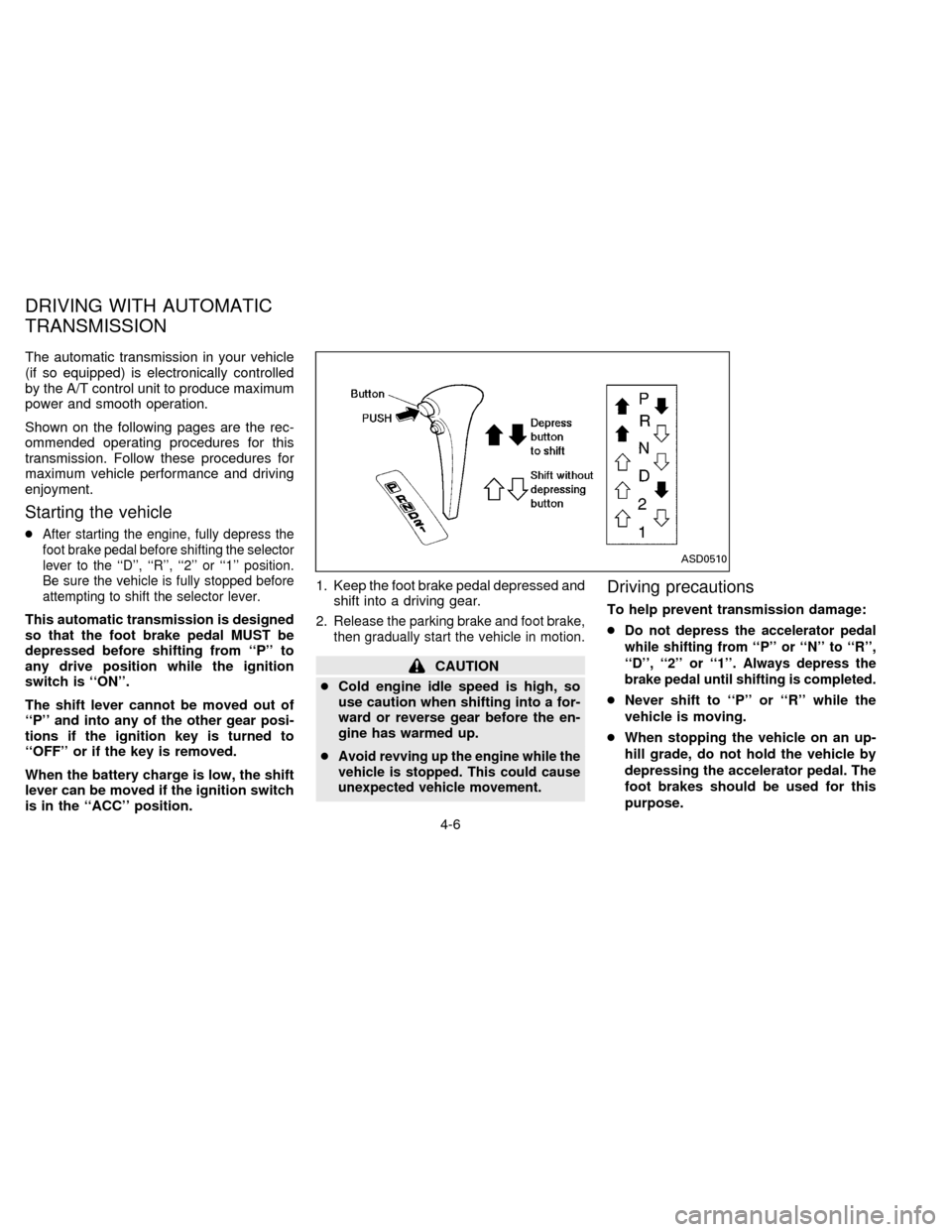
Push the button to shift into ``P'', ``R'' or from
``D'' to ``2''. All other positions can be se-
lected without pushing the button.
``P'' (Park):
Use this position when the vehicle is parked
or when starting the engine. Always be sure
the vehicle is at a complete stop. For maxi-
mum safety, depress the brake pedal, then
push in the select lever button and move the
shift lever to the ``P'' position. Apply the
parking brake. When parking on a hill, apply
the parking brake first, then move the shift
lever into the ``P'' position.
Shifting from ``P'' (Park)
If the ignition switch is in the ``ON'' position
and the foot brake pedal is depressed, but
the shift lever still cannot be moved out of
``P'' (Park), follow these instructions:
1. Shut the engine off and remove the key.
2. Apply the parking brake.
3. Reinsert the ignition key and turn it clock-
wise to the ``ACC'' position.
4. Depress the brake pedal, move the gear-
shift lever to ``N'' (Neutral) and start the
engine.These instructions for starting the vehicle in
``N'' (Neutral) position should only be used
until service can be obtained.
``R'' (Reverse):
Use this position to back up. Always be sure
the vehicle is completely stopped. With the
brake pedal depressed, push in the select
lever button and move the shift lever to the
``R'' position.
``N'' (Neutral):
In Neutral, neither forward nor reverse gear
is engaged. The engine can be started in
this position. You may shift to ``N'' and
restart a stalled engine while the vehicle is
moving.
``D'' (Drive):
Use this position for all normal forward
driving.
``2'' (Second gear):
Use for hill climbing or engine braking on
downhill grades.
Do not shift into the ``2'' position at speeds
over 74 MPH (119 Km/h). Do not exceed 74
MPH (119 Km/h) in the ``2'' position.``1'' (Low gear):
Use this position when climbing steep hills
slowly or driving slowly through deep snow,
sand or mud, or for maximum engine brak-
ing on steep downhill grades.
Do not shift into the ``1'' position at speeds
over 74 MPH (119 km/h). Do not exceed 41
MPH (66 km/h) in the ``1'' position.
Accelerator downshift
Ð In ``D'' position Ð
For rapid passing or hill climbing, fully de-
press the accelerator pedal to the floor. This
shifts the transmission down into 2 (Sec-
ond) gear or 1 (Low) gear, depending on the
vehicle speed.
4-7
ZX
Page 88 of 183

while driving. This may cause clutch
damage.
cStop your vehicle completely before shift-
ing into reverse.
cWhen the vehicle is stopped for a dura-
tion, for example at a stop light, shift to
neutral and release the clutch pedal with
the foot brake applied.
Suggested upshift speeds
Shown below are suggested vehicle speeds
for shifting into a higher gear. These sug-
gestions relate to fuel economy and vehicle
performance. Actual upshift speeds will vary
according to road conditions, the weather
and individual driving habits.
For normal acceleration in low altitude ar-
eas [less than 4,000 ft (1,219 m)]:
Gear changeACCEL
shift point
MPH (km/h)CRUISE
shift point
MPH (km/h)
1st to 2nd 15 (24) 15 (24)
2nd to 3rd 25 (40) 18 (29)
3rd to 4th 36 (58) 30 (48)
4th to 5th 40 (64) 39 (63)
For quick acceleration in low altitude areas
and high altitude areas [over 4,000 ft (1,219
m)]:
Gear change MPH (km/h)
1st to 2nd 15 (24)
2nd to 3rd 25 (40)
3rd to 4th 40 (64)
4th to 5th 45 (72)
Suggested maximum speed in each
gear
Downshift to a lower gear if the engine is not
running smoothly, or if you need to accelerate.
Do not exceed the maximum suggested
speed (shown below) in any gear. For level
road driving, use the highest gear sug-
gested for that speed. Always observe
posted speed limits, and drive according to
the road conditions, which will ensure safe
operation. Do not over-rev the engine when
shifting to a lower gear as it may cause
engine damage or loss of vehicle control.
Gear MPH (km/h)
1st 30 (50)
2nd 60 (95)
3rd 90 (145)
4th þ
5th þ1. Apply the parking brake.
2.Automatic transmission:
Move the shift lever to ``P'' (Park) or ``N''
(Neutral). (``P'' preferred.)
The shift lever cannot be moved out of
``P'' and into any of the other gear
positions if the ignition key is turned to
``OFF'' or if the key is removed.
The starter is designed not to operate
if the shift lever is in any of the driving
positions.
Manual transmission:
Move the gearshift lever to ``N'' (Neutral),
and depress the clutch pedal to the floor
while cranking the engine.
The starter is designed not to operate
unless the clutch pedal is depressed.
3. Crank the enginewith your foot off the
accelerator pedalby turning the ignition
key to ``START''. Release the key when
the engine starts. If the engine starts, but
fails to run, repeat the above procedure.
Ð If the engine is very hard to start in
extremely cold or hot weather, de-
press and hold the accelerator pedal
to help start the engine.
Ð In the summer, when restarting the
engine within 30 minutes after it has
STARTING THE ENGINE
4-9
ZX
Page 93 of 183
CAUTION
Do not park the vehicle over flammable
materials such as dry grass, waste pa-
per or rags, as they may burn easily.
1. Firmly apply the parking brake.
2.Manual transmission models:
Place the gearshift lever in Reverse.
When parking on an uphill grade, place
the gearshift lever in 1 (First) gear.Automatic transmission models:
Move the gearshift lever to the ``P'' (Park)
position.
CAUTION
Safe parking procedures require that
both the parking brake be set and the
transmission placed into ``P'' (Park) po-
sition. Make sure the shift lever has
been pushed as far forward as it can go
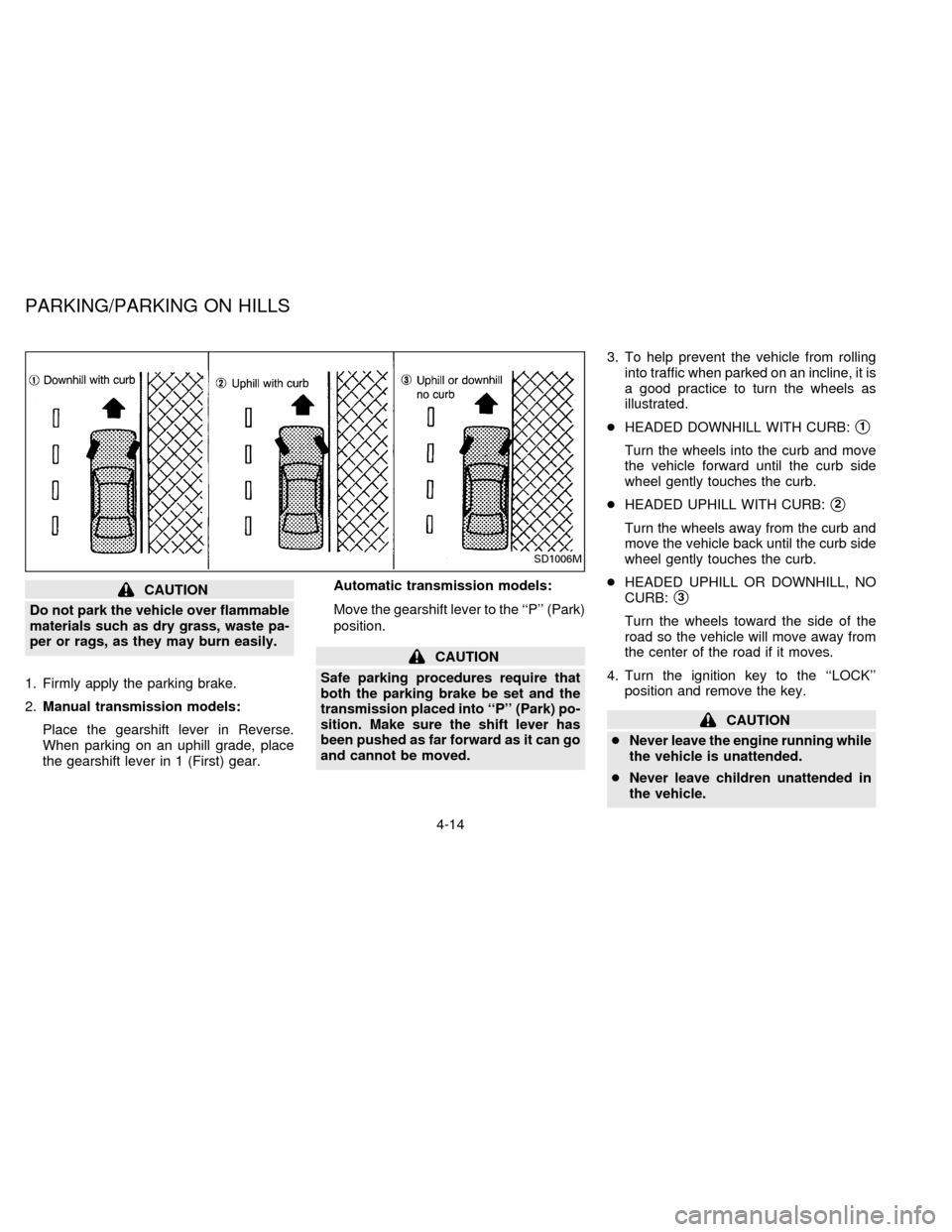
and cannot be moved.3. To help prevent the vehicle from rolling
into traffic when parked on an incline, it is
a good practice to turn the wheels as
illustrated.
cHEADED DOWNHILL WITH CURB:
s1
Turn the wheels into the curb and move
the vehicle forward until the curb side
wheel gently touches the curb.
cHEADED UPHILL WITH CURB:
s2
Turn the wheels away from the curb and
move the vehicle back until the curb side
wheel gently touches the curb.
cHEADED UPHILL OR DOWNHILL, NO
CURB:
s3
Turn the wheels toward the side of the
road so the vehicle will move away from
the center of the road if it moves.
4. Turn the ignition key to the ``LOCK''
position and remove the key.
CAUTION
cNever leave the engine running while
the vehicle is unattended.
cNever leave children unattended in
the vehicle.
SD1006M
PARKING/PARKING ON HILLS
4-14
ZX
Page 96 of 183

Freeing a frozen door lock
To prevent a door lock from freezing, apply
de-icer or glycerin to it through the key hole.
If the lock becomes frozen, heat the key
before inserting it into the key hole.
Anti-freeze
In the winter when it is anticipated that the
temperature will drop below 32ÉF (0ÉC),
check anti-freeze (ethylene glycol base) to
assure proper winter protection. For details,
see ``Engine Cooling System'' in the ``Do-it-
yourself operations'' section.
Battery
If the battery is not fully charged during
extremely cold weather conditions, the bat-
tery fluid may freeze and damage the bat-
tery. To maintain maximum efficiency, the
battery should be checked regularly. For
details, see ``Battery'' in the ``Do-it-yourself
operations'' section.
Draining of coolant water
If the vehicle is to be left outside without
anti-freeze, drain the cooling system by
opening the drain valves located under the
radiator and on the engine block. Refillbefore operating the vehicle. See ``Chang-
ing Engine Coolant'' in the ``Do-it-yourself
operations'' section.
Tire equipment
1. The SUMMER tires are of a tread design
to provide superior performance on dry
pavement. However, the performance of
these tires will be substantially reduced
in snowy and icy conditions. If you oper-
ate your vehicle on snowy or icy roads,
NISSAN recommends the use of MUD &
SNOW or ALL SEASON tires on all four
wheels. Please consult your NISSAN
dealer for the tire type, size, speed rating
and availability information.
2. For additional traction on icy roads, stud-
ded tires may be used. However, some
provinces and states prohibit their use.
Check local, state and provincial laws
before installing studded tires.
Skid and traction capabilities of studded
snow tires, on wet or dry surfaces, may
be poorer than that of non-studded snow
tires.3. Snow chains may be used if desired.
Make sure they are of proper size for the
tires on your vehicle and are installed
according to the chain manufacturer's
suggestions.
Use of tire chains may be prohibited accord-
ing to location. Check the local laws before
installing tire chains. When installing tire
chains, make sure they are of proper size
for the tires on your vehicle and are installed
according to the chain manufacturer's sug-
gestions.Use only SAE Class ``S'' chains.
Other types may damage your vehicle. Use
chain tensioners when recommended by
the tire chain manufacturer to ensure a tight
fit. Loose end links of the tire chain must be
secured or removed to prevent the possibil-
ity of whipping action damage to the fenders
or underbody. If possible, avoid fully loading
your vehicle when using tire chains. In ad-
dition, drive at a reduced speed. Otherwise,
your vehicle may be damaged and/or ve-
hicle handling and performance may be
adversely affected.
Never install tire chains on T-type and small
size spare tires. Do not use the chains on
dry roads.
COLD WEATHER DRIVING
CAUTIONS
4-17
ZX
Page 105 of 183
Switch off all unnecessary electrical
systems (lights, heater, air conditioning,
etc.).
3. Remove vent caps on the battery (if so
equipped). Cover the battery with an old
cloth to reduce explosion hazard.
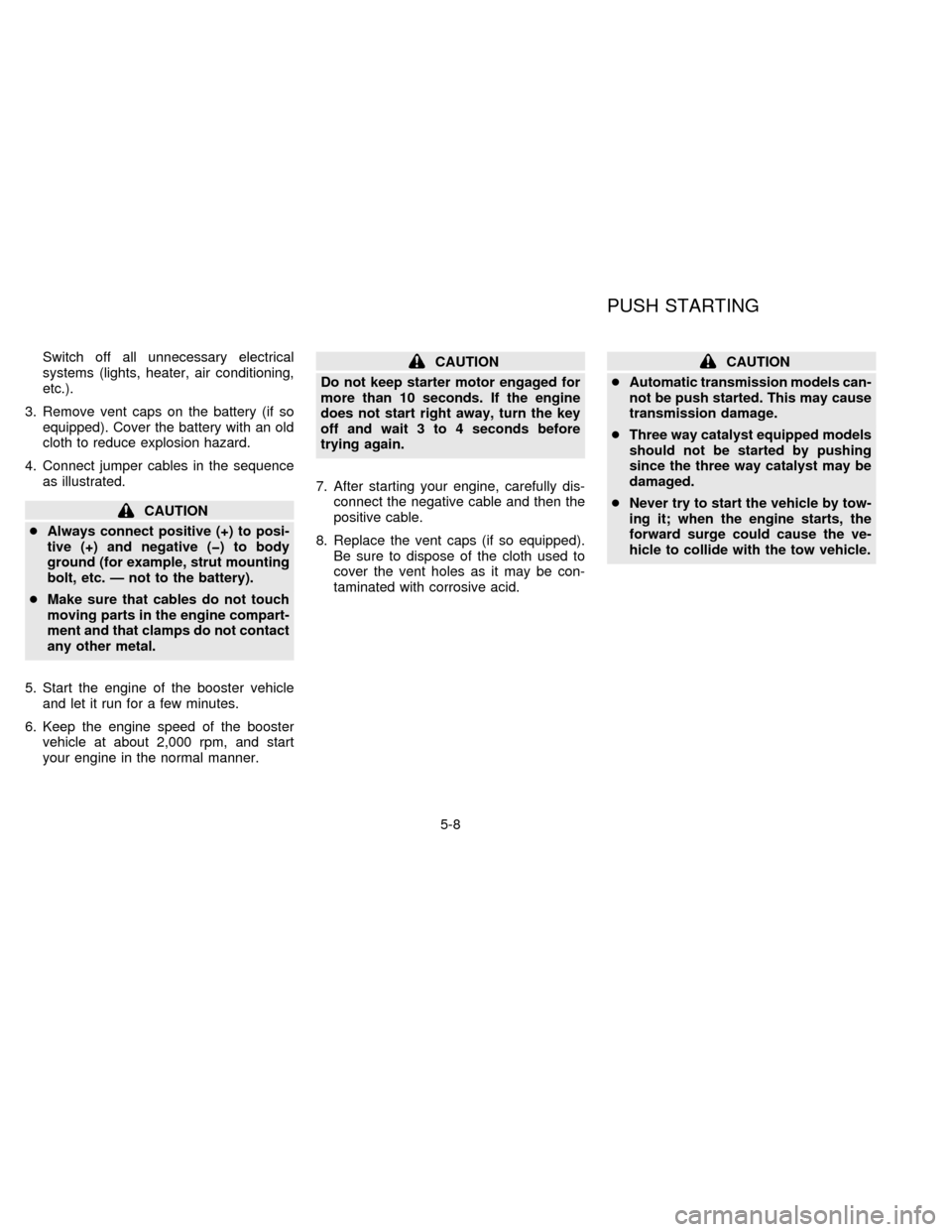
4. Connect jumper cables in the sequence
as illustrated.
CAUTION
cAlways connect positive (+) to posi-
tive (+) and negative (þ) to body
ground (for example, strut mounting
bolt, etc. Ð not to the battery).
cMake sure that cables do not touch
moving parts in the engine compart-
ment and that clamps do not contact
any other metal.
5. Start the engine of the booster vehicle
and let it run for a few minutes.
6. Keep the engine speed of the booster
vehicle at about 2,000 rpm, and start
your engine in the normal manner.
CAUTION
Do not keep starter motor engaged for
more than 10 seconds. If the engine
does not start right away, turn the key
off and wait 3 to 4 seconds before
trying again.
7. After starting your engine, carefully dis-
connect the negative cable and then the
positive cable.
8. Replace the vent caps (if so equipped).
Be sure to dispose of the cloth used to
cover the vent holes as it may be con-
taminated with corrosive acid.CAUTION
cAutomatic transmission models can-
not be push started. This may cause
transmission damage.
cThree way catalyst equipped models
should not be started by pushing
since the three way catalyst may be
damaged.
cNever try to start the vehicle by tow-
ing it; when the engine starts, the
forward surge could cause the ve-
hicle to collide with the tow vehicle.
PUSH STARTING
5-8
ZX
Page 107 of 183
When towing your vehicle, all State (Provin-
cial in Canada) and local regulations for
towing must be followed. Incorrect towing
equipment could damage your vehicle.
Towing instructions are available from your
NISSAN dealer. Local service operators will
generally be familiar with the applicable
laws and procedures for towing. To assure
proper towing and to prevent accidental
damage to your vehicle, NISSAN recom-
mends that you have a service operator tow
your vehicle. It is advisable to have the
service operator carefully read the following
precautions.
CAUTION
cWhen towing, make sure that the
transmission, axles, steering system
and powertrain are in working con-
dition. If any unit is damaged, dollies
must be used.
cWhen towing with the front wheels
on the ground:Turn the ignition key to the ``OFF''
position and secure the steering
wheel in a straight-ahead position
with a rope or similar device. Never
place the ignition key in the ``LOCK''
position. This will result in damage
to the steering lock mechanism.
Move the gearshift lever to the Neu-
tral (``N'' position).
On automatic transmission models,
to move the shift lever to the Neutral
position, turn the ignition key to the
``ACC'' position. After moving the
shift lever to the Neutral position, be
sure to turn the ignition key to the
``OFF'' position.
c
When towing with the rear wheels on
the ground, release the parking brake.
On automatic transmission models,
to move the shift lever to the Neutral
position, turn the ignition key to the
``ACC'' position. After moving the
shift lever to the Neutral position, be
sure to turn the ignition key to the
``OFF'' position.
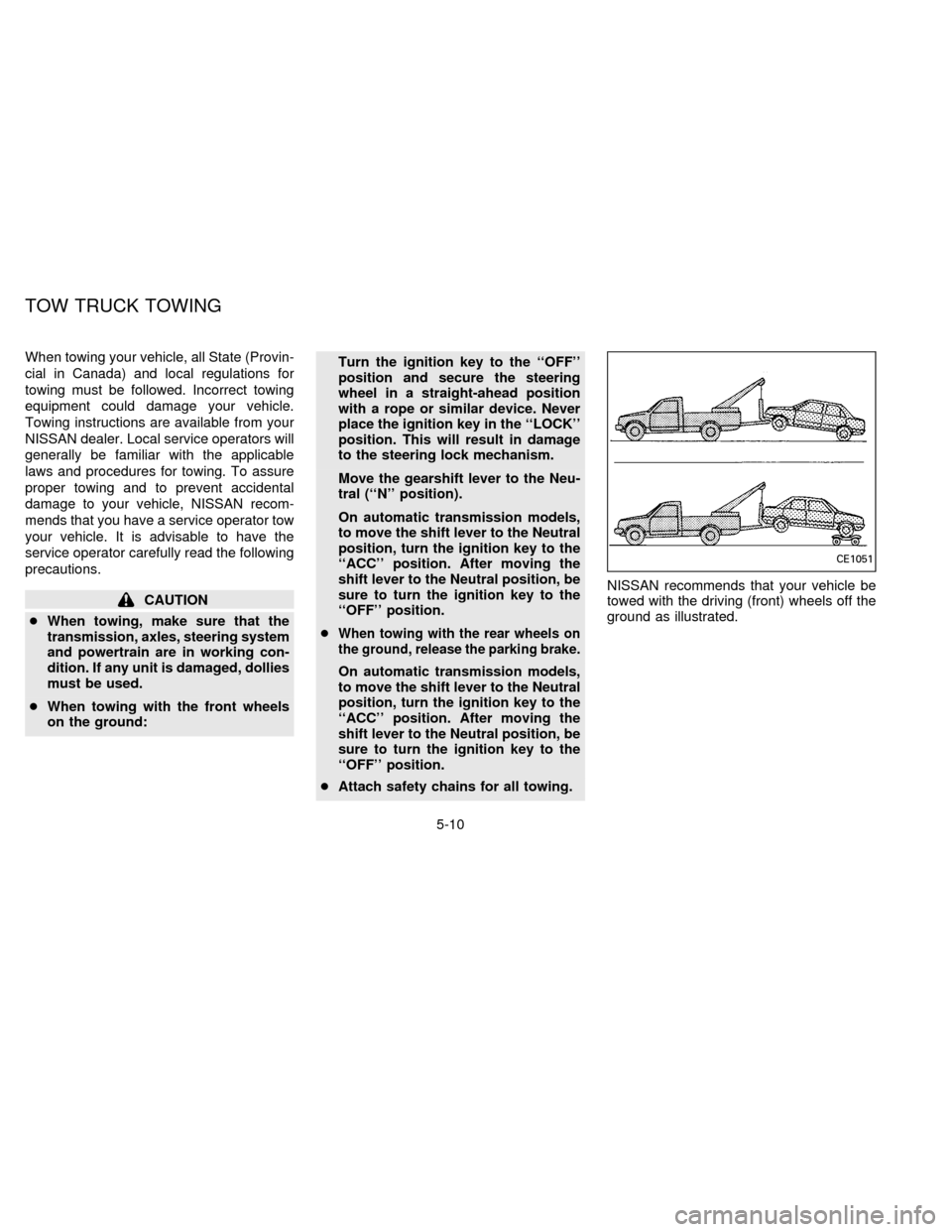
cAttach safety chains for all towing.NISSAN recommends that your vehicle be
towed with the driving (front) wheels off the
ground as illustrated.
CE1051
TOW TRUCK TOWING
5-10
ZX
Page 117 of 183

When performing any inspection or mainte-
nance work on your vehicle, always take
care to prevent serious accidental injury to
yourself or damage to the vehicle. The
following are general precautions which
should be closely observed.
cPark the vehicle on a level surface,
apply the parking brake securely and
block the wheels to prevent the ve-
hicle from moving. For a manual
transmission, move the shift lever to
Neutral. For an automatic transmis-
sion, move the shift lever to ``P''
(Park).
cBe sure the ignition key is ªOFFº
when performing any parts replace-
ment or repairs.
cDo not work under the hood while the
engine is hot. Turn off the engine and
wait until it cools down.
cYour vehicle is equipped with an au-
tomatic engine cooling fan. It may
come on at any time without warning,
even if the ignition key is in the ``OFF''
position and the engine is not run-
ning. To avoid injury, always discon-
nect the negative battery cable beforeworking near the fan.
cIf you must work with the engine run-
ning, keep your hands, clothing, hair
and tools away from moving fans,
belts and any other moving parts.
cIt is advisable to remove ties and any
jewelry, such as rings, watches, etc.
before working on your vehicle.
cIf you must run the engine in an en-
closed space such as a garage, be
sure there is proper ventilation for
exhaust gases.
cNever get under the vehicle while it is
supported only by a jack. If it is nec-
essary to work under the vehicle, sup-
port it with safety stands.
cKeep smoking materials, flame and
sparks away from fuel and the battery.
cNever connect or disconnect either
the battery or any transistorized com-
ponent connector while the ignition is
on.
cOn gasoline engine models with the
Multiport Fuel Injection (MFI) system,
the fuel filter or fuel lines should be
serviced by a NISSAN dealer becausethe fuel lines are under high pressure
even when the engine is off.
cFailure to follow these or other com-
mon sense guidelines may lead to
serious injury or vehicle damage.
cImproperly disposed motor oil and/or
other vehicle fluids can hurt the envi-
ronment. Always conform to local
regulations for disposal of vehicle
fluid. Avoid contact with used engine
oil.
This ``Do-it-yourself operations'' section
gives instructions regarding only those
items which are relatively easy for an owner
to perform.
You should be aware that incomplete or
improper servicing may result in operating
difficulties or excessive emissions, and
could affect your warranty coverage.If in
doubt about any servicing, have it done
by your NISSAN dealer.
MAINTENANCE
PRECAUTIONS
7-2
ZX